
The quickest way to improve your discovery calls is to stop treating them as a pitch. Prepare a few hypotheses, agree an agenda in the first minute, ask open questions that uncover the cost of the problem, and finish by agreeing a dated next step. Everything else in this guide is detail on those four moves.
I have sat on both sides of thousands of these conversations. The calls that win business are rarely the ones with the cleverest script. They are the ones where the buyer leaves feeling understood and clear about what happens next.
TL;DR
- A discovery call is a scheduled, consultative conversation with someone who has already shown interest. It is not a cold call and it is not a demo.
- Prepare hypotheses, not assumptions, and write down the three things you must learn before you dial.
- Ask follow-up questions until you reach the root cause and the cost of leaving it unsolved, and hold back your solution until then.
- Aim for roughly 30 to 45 minutes, and send a short recap with a dated next step within two hours.
- If a sales team is underperforming, use discovery to separate skills gaps from process, pipeline and leadership gaps before you buy any training.
Table of Contents
- What a good discovery call actually looks like
- Prepare hypotheses, not assumptions
- Open with an agenda
- Ask questions that reach the cost of the problem
- Listen more, solve later
- How long should a discovery call last?
- Close properly and follow up fast
- Using discovery to assess sales training needs
- Common discovery call mistakes
- Our perspective
- Work with us on your discovery calls
- FAQ
- Sources
What a good discovery call actually looks like
A discovery call is an early-stage sales conversation that happens after a prospect has shown interest. HubSpot describes it as more detailed and consultative than a cold call, typically running 20 to 45 minutes, whereas cold calls are unsolicited and often last only a few minutes.
That difference matters for how you behave. On a cold call you are earning the right to a conversation. On a discovery call the buyer has already given you their time, so your job is to find out whether you can genuinely help, and whether they are the right client for you.
A good call has three visible signs:
- The buyer does most of the talking, and says things they had not planned to say.
- You both leave with the same understanding of the problem, its cost and its urgency.
- The next step is in the diary before you hang up.
If you want the wider picture of where this call sits in the sale, our sales call process guide walks through each stage.
Prepare hypotheses, not assumptions
Most weak discovery calls are lost before they start. Preparation does not mean a ten-page dossier. It means ten focused minutes.
Before you dial, review the company’s website, the prospect’s role and any notes from their enquiry. Then write down a few hypotheses about what might be going on. A hypothesis is something you are ready to be wrong about: “They have grown from 20 to 60 staff and I suspect the founder is still closing every deal.” An assumption is something you stop checking.
Then do the exercise I give almost every client: write down the three things you need to learn from the call. A sticky note beside your screen will do. If you cannot name them, you are heading into a chat, not a discovery call.
A useful prep checklist:
- What prompted them to get in touch now?
- Who else is likely to be involved in the decision?
- What does their current approach probably look like?
- What would make this a clear “no” for us?
The last question matters. Deciding in advance what a poor-fit client looks like stops you chasing deals that waste both sides’ time. For a fuller routine, see our sales call preparation guide.
Open with an agenda
The first two minutes set the tone. A simple opening framework is ACE: appreciate the person’s time, check their availability, and state the end goal of the call. ZoomInfo recommends this approach for setting expectations at the start.
In practice it sounds like this:
“Thanks for making time today. Do you still have the full 30 minutes? Great. What I’d like to do is understand what prompted you to get in touch, talk through how you handle this at the moment, and then agree together whether and how we could help. Does that work for you?”
This does three things. It shows respect for their diary, it gives you permission to ask questions, and it makes the close easier, because you both said at the start that you would agree a next step.
One small tip: if you can, use video. You pick up hesitation, enthusiasm and who is nodding in a room of three. For solo consultants and coaches in particular, being seen builds trust faster than a voice alone.
Ask questions that reach the cost of the problem
Anyone can ask “What are your challenges?” The prospect gives a polite, surface-level answer, and you learn nothing you could not have guessed. Better discovery moves through four layers.
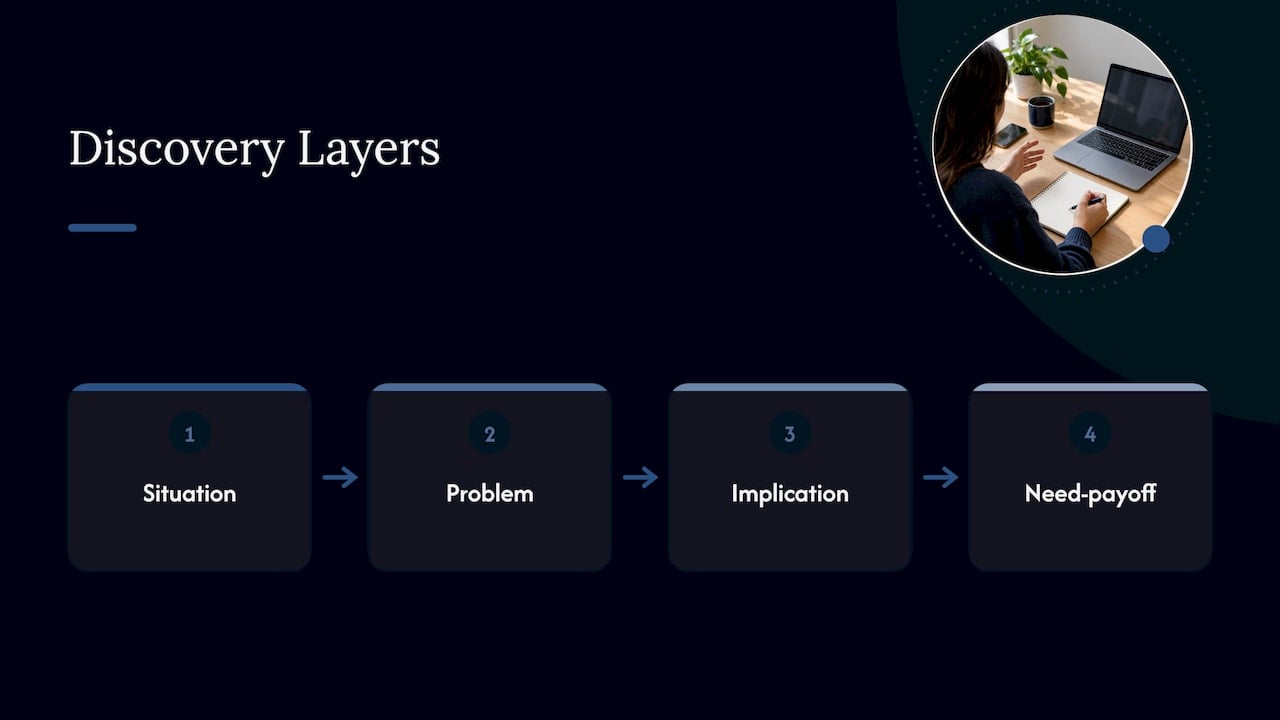
Situation: where are they now?
Keep these short and, where possible, already researched. “How does a new enquiry reach your team today?” is better than “Tell me about your business.”
Problem: what is not working?
“Where does that process slow down?” or “What happens when it goes wrong?” Then stay quiet. The pause after a question is where the real answer arrives.
Implication: what does it cost?
This is the layer most sellers skip. “If that continues for another year, what does it do to your target?” or “What has this already cost you in lost deals or management time?” Neil Rackham’s SPIN Selling framework is built around this idea of exploring implications, and then using need-payoff questions so the buyer articulates the benefits of solving the problem in their own words.
Need-payoff: what would success be worth?
“If we fixed that, what would it make possible?” When the buyer describes the benefit, they are building the business case themselves, and it is far more persuasive than anything you could say.
Discovery questions for consultants
If you sell consulting or advisory work, these tend to open the conversation well:
- What made you look for outside help now rather than six months ago?
- What have you already tried, and what happened?
- Who inside the business will be affected if this changes?
- How will you know in 90 days that this has worked?
- What would stop this from going ahead?
Discovery questions for coaches
Coaching buyers are often buying a change in themselves or their team, so the questions are more personal:
- What does a good outcome look like in a year, in concrete terms?
- What is the gap between where you are and where you want to be?
- What has got in the way before?
- How much time and energy can you realistically commit each week?
- What would you want to be different about how you work after our sessions?
If you sell advisory services and dislike the feeling of pushing, our guide on how to sell consulting services without feeling pushy builds on these questions.
Listen more, solve later
The two biggest killers of discovery are interrogation and monologue. A call that fires question after question feels like a form being filled in. A call where you launch into your offer after the first problem feels like a pitch. Research and commentary on discovery data points the same way: follow-up questions that uncover root causes, and resisting solutioning until you understand the situation, matter more than a long list of prepared questions.
Here is a habit that helps. When the prospect gives an answer, ask one more question before moving on. Use phrases such as:
- “Say more about that.”
- “What do you mean by [their word]?”
- “And what happens as a result?”
A small example. A founder tells you: “We just need more leads.” A weak call responds with a lead generation pitch. A strong call asks how many of the current leads become proposals, and how many proposals are won. Often the real problem is conversion, not volume, and you have just shown the buyer you think harder than the other people they are speaking to.
It is also worth keeping qualification and discovery distinct. One sales commentator cited by Aircall goes as far as calling the confusion of a quick qualification call with a deep-dive discovery call “malpractice”. I would not put it quite so strongly, but I agree they are different jobs. Qualify first (budget, authority, timing, fit), then spend your best time on the buyers who pass.
How long should a discovery call last?
The honest answer is that it depends on deal complexity. ZoomInfo puts discovery calls at 20 to 60 minutes, against 30 to 90 minutes for calls intended to close. Prospeo suggests targeting 30 to 60 minutes and treats calls that regularly overrun 45 minutes as a qualification problem, a sign you are asking too many questions or not filtering out poor-fit prospects.
For a UK service business selling a package in the thousands of pounds, I recommend booking 30 minutes and protecting it. Roughly:
| Stage | Time | Purpose |
|---|---|---|
| Opening and agenda | 3 minutes | Agree the purpose and the time |
| Situation and problem | 10 minutes | Understand what is happening and why now |
| Implication and need-payoff | 10 minutes | Quantify the cost and the value of fixing it |
| Fit, process and decision | 4 minutes | Who decides, by when, with what budget |
| Next steps | 3 minutes | Agree the action, date and owner |
If you cannot cover the ground in 45 minutes, do not run over by default. Offer a second, longer session with the other decision makers present.
Close properly and follow up fast
A discovery call that ends with “I’ll send something over” is an unfinished call. Before you finish, summarise what you heard in two or three sentences, check you have it right, and agree the next step with a date.
Then send the recap quickly. ZoomInfo advises a same-day follow-up, ideally within two hours, with a recap and the agreed next step. Prospeo’s guidance on follow-up adds some sensible detail: keep it to one phone screen, confirm the next step with a date and an owner, and close by asking “Anything I missed?” rather than “Let me know if you have questions.” The first question invites correction, which strengthens the shared understanding. The second invites silence.
A good recap has four parts:
- Their problem in their own words.
- The cost or consequence they described.
- What success would look like.
- The agreed next step, who owns it and when.
Using discovery to assess sales training needs
This is where sales leaders and business owners often go wrong. Results dip, and the instinct is to book a training day. But a miss against target rarely has a single cause, and training only fixes one of the possible ones.
When we run a sales training needs assessment, we treat it as a discovery call about the team itself. The questions are the same as above, aimed inward:
- Pipeline: Is there enough of the right opportunity at the top, or is the problem further down?
- Skills: Where in the conversation do deals stall, such as discovery, handling objections or asking for the decision?
- Process: Is there a shared sales process, or does every rep do their own thing?
- Leadership: Is anyone coaching on live deals, or only reviewing forecasts?
- Mindset: Do the team avoid certain conversations, such as price, or chasing a silent prospect?
The fastest diagnostic is to listen to real calls. Sit in on five or six discovery calls, or review recordings, and note where the conversation loses energy. You will usually find two or three patterns repeated across the team. That tells you whether you need skills training, a process rebuild, better management, or a mix of all three. We explain how those routes differ in sales training versus consultancy.
If you manage a team and want a repeatable structure to coach against, our 30-minute evidence-led discovery call framework gives managers something concrete to score calls against.
Common discovery call mistakes
- Pitching too early. If you describe your service in the first five minutes, the buyer will judge you on a problem you have not yet understood.
- Using a rigid script. A question list is a safety net, not a route. Follow the buyer’s answers.
- Skipping the money conversation. If budget is never discussed, you will meet it for the first time in the proposal, which is the worst moment.
- Talking to one person only. Ask who else will have a say, and invite them to the next call.
- Vague next steps. “Let’s catch up soon” loses deals. A named date wins them.
- Not taking notes. You will forget the buyer’s exact words, which are the most persuasive material in your proposal.
For the follow-on skills, our guide to consultative selling step by step covers what to do once discovery is complete.
Our perspective
We have worked with enough UK sales teams and solo service founders to see the same pattern. Discovery is where deals are won, yet it is the stage that gets the least coaching. Teams train on pitching and closing, then wonder why good conversations still end with “send me a proposal”.
That is why we combine bespoke 1:1 coaching with traditional training and consultancy. A workshop can teach a questioning framework in a morning. It takes live coaching, on your own calls and your own buyers, to make it a habit. Consultancy then fixes the process around it, so the improvement survives a quarter end.
Our aim for the businesses we work with is at least 50% annual sales growth and a team that hits target every quarter. Better discovery is one of the most direct routes there, because it improves qualification, deal size and the quality of every proposal that follows.
Jerry
Work with us on your discovery calls
If you would rather build this skill with a coach than alone, we offer several routes depending on your size. For teams of roughly 50 to 1,000 staff, our team-based bespoke coaching and consultancy engagements run from £4,500 to £8,500 one-off. For solo service businesses and consultants, our sales acceleration track is £2,995 to £5,995 one-off. If you want ongoing senior input, The Sage Collective is £990 per month. You can see how each option is put together on our sales training cost page.
Solo consultants and coaches can start with our sales coaching programme, while leadership teams that need someone to own the process can look at a fractional sales director.
FAQ
What is the 3 3 3 rule in sales?
There is no single official version, and different trainers use the phrase differently. A common use is to spend about three seconds grabbing attention, three minutes establishing relevance and three questions uncovering need. Whatever version you use, treat it as a prompt to be quick and focused, not a formula.
What are some good questions to ask in a discovery call?
Start with what prompted them to get in touch now, then ask what they have already tried and what happened. Follow with questions on cost, such as what happens if nothing changes in the next year. Finish by asking who else is involved in the decision and how they will judge success.
Is a discovery call a cold call?
No. A cold call is unsolicited outreach to someone who has not asked to hear from you, and it is usually brief. A discovery call is a scheduled conversation with someone who has shown interest, and it is about understanding their situation and checking fit.
How do I run a discovery call with a prospect who gives short answers?
Slow down and ask for examples. “Can you talk me through the last time that happened?” produces far more than “What are your challenges?” Leave a pause after they answer, and the detail often follows. Make sure you have also explained why you are asking, so the questions feel useful rather than intrusive.
Sources
- HubSpot: Discovery call questions that reveal real pain points
- ZoomInfo: Discovery Calls: A Complete Guide
- Prospeo: How Long Should a Sales Call Be? 2026 Benchmarks
- Prospeo: Discovery Call Follow-Up Email: Template + Tips
- Aircall: The Sales Discovery Process
- Science of Scaling: Interrogation and monologues kill discovery
- SPIN Selling discovery question templates