
A fractional sales director is a part-time senior sales leader who takes commercial accountability, builds the sales engine, and raises revenue without the cost of a full-time hire. The role sits on three pillars: strategy (go-to-market, forecasting, board reporting), revenue ownership (targets, pricing, key accounts), and people leadership (hiring, coaching, performance management).
Most engagements run at two to four days per week, either as a monthly retainer or a fixed-term project, and a fractional Head of Sales typically commits two to four days weekly while building repeatable process alongside hands-on selling.
Expect the outcome to show up as:
- Sharper forecasting accuracy within the first quarter
- Higher conversion rates once a documented playbook replaces improvisation
- A pipeline you can actually see, with coverage ratios that mean something
Key Takeaways
Fractional sales director responsibilities centre on embedded accountability for revenue, pipeline systems, and people, delivered part-time but with full commercial authority.
| Point | Details |
|---|---|
| Three core pillars | Strategy, revenue ownership, and people leadership define the role, not job title alone. |
| Typical time commitment | Two to four days per week, usually structured as a retainer or fixed-term project. |
| Embedded beats advisory | Fractional directors attend management meetings and own targets, unlike consultants who only recommend. |
| 90-day proof point | Expect measurable movement on forecast accuracy or pipeline coverage by day 90. |
| Aheadofsales approach | Offers fractional sales director engagements from £4,500 to £8,500 for teams, with solo acceleration packages from £2,995. |
Table of Contents
- Fractional sales director responsibilities broken down by category
- How does a fractional sales director differ from a consultant or interim?
- When should you hire a fractional sales director?
- What does the first 90 days of a fractional engagement look like?
- Ahead of Sales: proof points from fractional sales leadership in practice
- Why the first 60 days matter more than the org chart
- How Aheadofsales can put a fractional sales director to work in your business
- Sources
Fractional sales director responsibilities broken down by category
Every credible fractional brief splits into four working areas, and confusing them is where most engagements go wrong. Boardroom Advisors’ guidance on the role describes it as combining strategic planning, sales team leadership, playbook creation, and pipeline growth into one accountable position, rather than farming each out separately.
Strategic responsibilities shape everything else. That means setting the go-to-market approach, deciding which territories or product lines get sales attention first, building a forecasting model the board can trust, and presenting revenue performance in language that satisfies investors and non-sales directors alike.
Operational responsibilities are where the strategy becomes usable. A fractional director will typically:
- Audit and reconfigure the CRM so stages reflect reality, not wishful thinking
- Write or rewrite the sales playbook covering qualification, objection handling, and close
- Run weekly pipeline reviews that surface stalled deals before they die quietly
- Support pricing decisions, including discount governance and deal desk approval
People responsibilities cover the human side of the function. This includes building hiring scorecards so recruitment stops relying on gut feel, setting a coaching cadence (often weekly one-to-ones plus monthly deep dives), managing underperformance directly, and redesigning roles when the team structure no longer fits the growth stage.
Commercial responsibilities are the part business owners feel fastest. The director personally owns revenue targets, stewards key accounts through renewal and expansion conversations, and leads or oversees negotiation on the deals that matter most.
A typical week might look like this: Monday forecast review with finance, Tuesday and Wednesday split between coaching calls and live deal support, Thursday spent on hiring interviews or CRM cleanup, Friday reserved for board or investor reporting. Monthly, add a full pipeline audit and a review of win/loss patterns against the playbook.
Success metrics worth tracking from month one include forecast variance (the gap between predicted and actual revenue), pipeline coverage ratio (typically three to four times quota), average sales cycle length, and rep ramp time for new hires.
Pro Tip: Ask a candidate fractional director for one example of a playbook they’ve built and one CRM report they’d set up in week one. If they can’t show either, they’re likely offering advice, not execution.
How does a fractional sales director differ from a consultant or interim?
The distinction matters more than most job briefs suggest, and getting it wrong leads to mismatched expectations on both sides.
A consultant advises from the outside. They diagnose, recommend, and leave. A fractional sales director is embedded: attending management meetings, owning revenue targets, and building the systems, processes and people that make performance stick after they’ve gone. That embedded authority, rather than the hours worked, is what separates the two models. An interim director usually fills a full-time seat temporarily, often at full-time cost, until a permanent hire is found, whereas fractional arrangements are designed to run indefinitely at part-time cost.
Whether a fractional director carries a personal quota depends on company size. In a very small firm, they may sell directly while building process at the same time. In a larger team, they own the number but hit it through the team they manage.
Cost-to-value trade-offs favour fractional support until the sales function outgrows two to four days a week of senior attention, at which point a full-time hire usually pays for itself. A well-run engagement plans succession from day one, documenting decisions so a permanent hire (fractional or otherwise) inherits a working system, not a black box.
When should you hire a fractional sales director?
Certain patterns show up again and again in businesses that eventually call in fractional leadership, and none of them require waiting for a crisis.
- The founder is the bottleneck. Sales still routes through one person, and growth has stalled because that person can’t be everywhere.
- Forecasting is guesswork. Numbers presented to the board one month get quietly revised the next, with no clear reason why.
- Pipeline leaks silently. Deals disappear at the same stage repeatedly, but nobody has measured where or why.
- Reps churn or underperform, and there’s no repeatable onboarding or playbook to blame instead of the individual.
- A specific trigger hits: entering a new market, satisfying an investor mandate for commercial rigour, or covering a leadership gap after a departure.
Fractional support is commonly used for building sales functions from scratch, turnarounds, market entry, or bridging before a permanent hire, and the right engagement shape depends on which of those you’re facing. A turnaround needs someone comfortable making unpopular calls fast; a bridge role needs someone who documents obsessively for the successor.
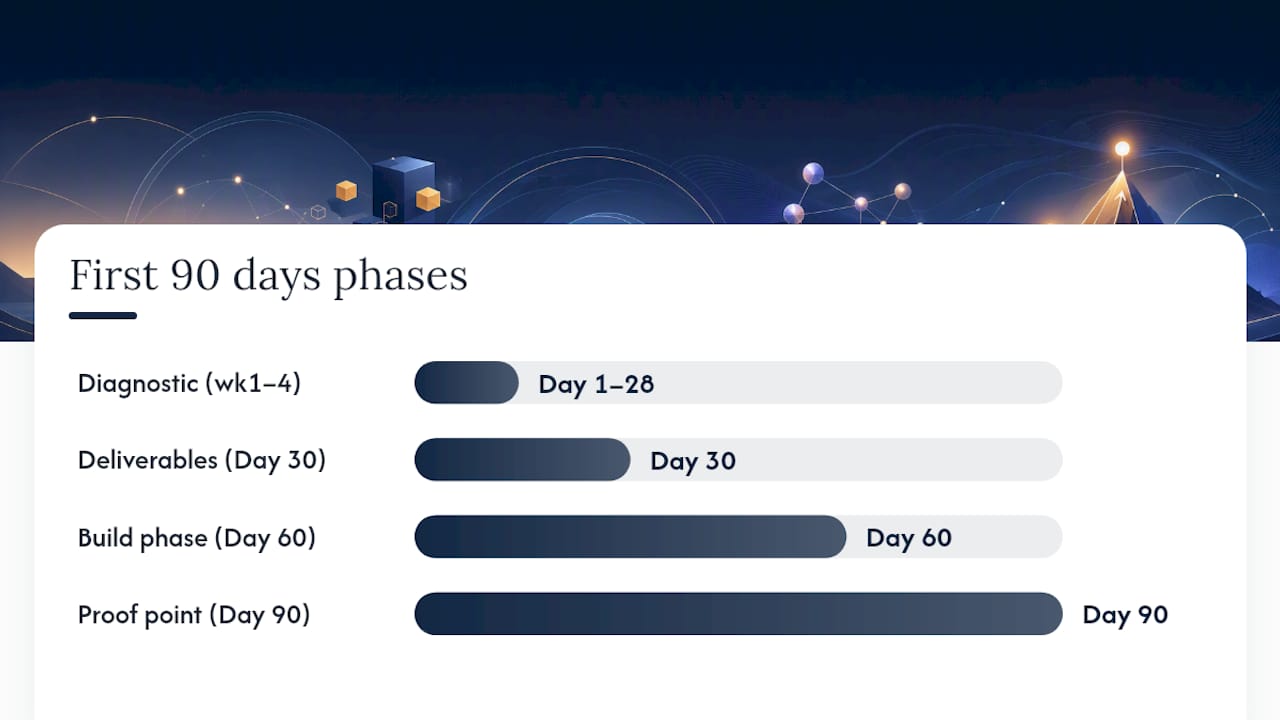
What does the first 90 days of a fractional engagement look like?
The strongest engagements follow a predictable rhythm, and you should be suspicious of anyone who can’t describe it before they’ve started.
- Weeks 1 to 4: diagnostic. Reviews of CRM data, live deal inspection, call listening, and one-to-one interviews with every person touching revenue. This phase surfaces the real problems, which are rarely the ones stated in the original brief.
- Day 30: first deliverables. Expect an initial playbook draft, a cleaned-up pipeline, and an honest forecast, even if that forecast is uncomfortable.
- Day 60: build phase. Hiring plans if headcount is needed, coaching cadence fully running, and pricing or negotiation governance in place.
- Day 90: proof point. Measurable movement on conversion rate, pipeline coverage, or forecast accuracy, backed by a reporting cadence the board can rely on without translation.
The most effective engagements pair that rapid diagnostic with a structured 60 to 90 day delivery plan that produces short-term wins alongside longer-term foundations, rather than one at the expense of the other.
Pro Tip: Insist on a written transition plan before you sign, not after month three. A good fractional director wants to make themselves replaceable; that’s the point.
Ahead of Sales: proof points from fractional sales leadership in practice
Aheadofsales runs fractional sales director engagements through our outsourced sales director services, built around the same principles this article has laid out: embedded accountability, documented playbooks, and a handover plan from day one.
Our engagement shapes include:
- A monthly retainer route for businesses that need consistent senior oversight without full-time cost
- Project-based sales acceleration packages for solo service businesses and smaller teams
- Bespoke coaching layered on top of leadership work, so the fix isn’t just structural, it’s behavioural
The businesses that get the most out of fractional leadership are the ones that treat it as capability transfer, not outsourcing. You want the playbook, the hiring scorecards, and the forecasting discipline to still be working long after the retainer ends.
Packages for team-based engagements typically start from £4,500 to £8,500, scaled to business size and complexity, while solo service businesses can access sales acceleration packages from £2,995 to £5,995. Author Jerry’s perspective on prioritisation, drawn from this framework, follows below.
Why the first 60 days matter more than the org chart
Most businesses hiring a fractional sales director obsess over reporting lines and job titles before they’ve fixed the basics. That’s backwards.
Pipeline hygiene comes first, always. A CRM full of stale, half-updated deals makes every other responsibility, forecasting, coaching, hiring, unreliable from the start. Build a minimum viable playbook alongside it, not after it. You don’t need a perfect sales bible in week one; you need three or four repeatable steps that stop the biggest source of lost deals.
Pair that structural work with immediate coaching. Fixing process without fixing conversations wastes time, because reps will keep losing the same deals for the same reasons. And plan the handover from day one. A fractional director who hasn’t mentioned succession by month two is building dependency, not capability.
— Jerry
How Aheadofsales can put a fractional sales director to work in your business
Aheadofsales is the practical alternative to hiring full-time before you’re ready, or paying consultancy fees for advice nobody executes. Our fractional sales director services combine bespoke coaching with hands-on leadership, so you get someone who builds the playbook and coaches the team through using it, rather than handing over a document and disappearing.

If your business has outgrown founder-led selling but a six-figure full-time hire isn’t justified yet, our sales director retainer starts from £990 a month, with team packages from £4,500 to £8,500 depending on scope, and solo service business acceleration packages from £2,995 to £5,995. This suits companies with roughly 50 to 1,000 staff carrying a genuine growth mindset, as well as solo consultants ready to scale.
Book a conversation about your sales function through our sales director services page and we’ll map out which engagement shape fits your stage of growth.
Sources
- Fractional Head of Sales Guide: What They Do, Cost & How to Hire (2026) | RevenueCxO
- Fractional Sales Director Recruitment UK | Exec Capital
- What Is A Fractional Sales Director? Job Description Guide – Boardroom Advisors