
The best sales teams are not collections of superstar individuals grinding harder than everyone else. They are engineered systems where role specialisation, weekly coaching, aligned compensation, and AI-enabled workflows compound into consistent, repeatable results. UserGems’ team quota attainment sits notably above average, with sustained strong performance across multiple quarters. That is not luck. That is architecture.
Here are the defining traits and real-world examples of high-performing sales teams, and what you can take from them right now:
- Quota attainment at 73% across the full team, not just top performers
- Deliberate, slow hiring that prioritises behaviour and resilience over charisma
- Role specialisation split by deal stage: Openers, Closers, and Account Executives
- Weekly competency-based coaching rather than quarterly pipeline reviews
- Compensation plans simple enough to explain in 30 seconds, aligned directly to sales strategy
- AI integrated natively into daily workflows, not bolted on as a seventh tool
- A culture of customer experience accountability, where peer transparency is the norm
- Tenure optimised over headcount, so institutional knowledge compounds over time
Each of these traits reinforces the others. Pull one out and the system weakens. Get them all working together and you have something genuinely difficult to replicate.
Table of Contents
- What traits set successful sales teams apart?
- How do you build and scale a high-performing sales team?
- Why ongoing coaching is the single biggest lever you have
- Motivational and communication strategies that actually work
- How Aheadofsales helps you build a team that hits target every quarter
- Key takeaways
What traits set successful sales teams apart?
The gap between a good sales team and a great one rarely comes down to talent. It comes down to system density. Only 28% of reps at high-performing organisations are classified as top performers. The other 72% determine whether the team is good or great, and great teams develop that 72% deliberately.
Clear goals and shared vision
High-performing teams know exactly what they are collectively trying to deliver: ARR target, quota attainment percentage across the full team, and forecast accuracy. A great team hits 80% or higher forecast accuracy. Vague targets produce vague effort.

Role specialisation that matches deal complexity
Generalists who handle prospecting, discovery, and closing simultaneously tend to be mediocre at least one stage. The most effective teams split these responsibilities. Openers (SDRs and BDRs) focus purely on booking qualified meetings. Closers run discovery and demos. Senior Account Executives handle negotiation and post-close expansion. Each role demands a different skill set, and hiring for all three in one person almost always produces a compromise.
Curiosity and active listening over assertiveness
Top-performer analysis consistently shows that curiosity and active listening outrank assertiveness as predictors of quota attainment. The best sellers are not the loudest talkers. They ask better questions and genuinely hear the answers. Ambiverts tend to outperform extroverts, indicating important considerations about who you should be hiring.
A culture of customer experience accountability
Top teams have CX accountability cultures at 48% versus 25% for average organisations. Shared goals, transparent pipeline reviews, and peer accountability separate cultures that retain talent from those that lose it. Sellers who reach trusted partner status with buyers achieve 48% higher quota attainment and 25% higher win rates compared with those stuck at approved vendor status.
Messaging clarity and cross-functional collaboration are more prevalent among top teams compared to their peers. These are not soft metrics. They directly affect how well reps can articulate value in front of a buyer.
Key traits to look for when assessing your own team:
- Consistent use of a documented sales playbook
- Weekly coaching cadence anchored to specific competencies
- Reps who share what is working rather than hoarding it
- Pipeline that does not collapse when a top performer leaves
- Metrics tracked at both activity and outcome level
Pro Tip: Embed a short “what worked this week” segment into your weekly team meeting. It takes five minutes and gradually builds the habit of knowledge sharing that separates high-performing cultures from star-dependent ones.
How do you build and scale a high-performing sales team?
Building a team that performs consistently requires deliberate decisions at every stage, from who you hire first to how you structure the org as it grows. The sequence matters more than most leaders realise.
Hire slowly and for behaviour, not charisma
Behavioural assessments that focus on traits like resilience and curiosity improve rep ramp rates and reduce costly turnover. One case study illustrates this clearly: two reps with identical backgrounds and quota attainment histories were hired simultaneously. One scored 78 out of 100 on a behavioural assessment; the other scored 52. Six months later, the 78-score rep had closed four deals worth £340,000. The 52-score rep had closed zero and left after nine months, costing £95,000 to replace.
Follow the hiring sequence
Most founders hire in the wrong order. The correct sequence is: hire an Opener once the founder has closed five or more deals consistently, then add a Closer once the Opener is booking ten or more qualified meetings per month, and finally bring in a senior Account Executive once the Closer has a repeatable close rate across five or more deals. Skipping steps wastes budget and burns pipeline.
Match your org structure to deal complexity
| Model | Best for | Pros | Cons |
|---|---|---|---|
| Island | Early stage, fewer than 10 reps | Full ownership, deep relationships | Inconsistent, hard to scale |
| Assembly line | SMB and mid-market, 10–50 reps | Specialisation, efficiency | Handoff friction, fragmentation |
| Pod | Enterprise, large deals | Cross-functional, buyer-aligned | Complex to manage, needs senior talent |
For enterprise deals where buying committees average around seven people, pods give you the cross-functional coverage you need. An Account Executive, a solutions engineer, and a customer success manager working the same account simultaneously is not a luxury at that deal size. It is the minimum viable structure.
Document your playbook before you hire rep two
A SaaS founder built a 40-page sales playbook after their first Closer hit quota three quarters in a row. When they hired their second Closer, ramp time dropped from six months to four. When they hired their third, it dropped to three months. The playbook made the process repeatable, not the individual.
Integrate AI into daily workflows, not as an afterthought
UserGems’ ADRs and AEs significantly increased outbound meetings booked per rep over one year by using their own AI product internally. Reps arrive in their sequencing platform each day with their top five accounts and top 30 prospects already selected and prioritised. Manual account selection, list building, and prospect research were eliminated entirely. Anthropic took a similar approach, markedly scaling sales output without a hiring spree by encoding top-performer behaviours into five standardised AI skills used daily by every rep.
Key steps for building a scalable team:
- Define your performance standard before you hire anyone
- Use behavioural assessments for every role, not just senior hires
- Set clear ramp time expectations by segment and track them
- Build a sales playbook before you need it, not after
- Add a sales manager when you have four to five reps, not before
Why ongoing coaching is the single biggest lever you have
One-off training events do not work. Reps forget up to 70% of unstructured training within 24 hours. That is not a motivation problem. It is a delivery problem. The solution is not more training. It is better-structured, more frequent coaching anchored to specific competencies.

The distinction between coaching and training matters here. Training delivers information. Coaching changes behaviour. Weekly competency-based coaching sessions, built around real call recordings and live deal reviews, embed skills in a way that a quarterly workshop simply cannot. The ongoing sales training model, where coaching is woven into the weekly rhythm rather than scheduled as a separate event, is what separates teams that sustain performance from those that peak and plateau.
Top teams invest substantially more per rep annually on training compared to average organisations. They are also twice as likely to provide dynamic, manager-led coaching rather than relying on static monthly sessions. The investment compounds: better coaching produces better reps, who produce better results, which funds more coaching.
Anthropic’s approach illustrates what this looks like at scale. Rather than static coaching methodologies, their managers use AI to surface six coaching moments per week based on evolving business priorities. If the focus shifts from volume to multi-threading, the coaching moments reflect that shift in real time. Forecast meetings stop being about catching reps with messy data and start being about identifying where a customer is stuck and how the manager can help move things forward.
Coaching strategies that consistently produce results:
- Weekly sessions anchored to one or two specific competencies, not general performance
- Real call recordings reviewed together, not just discussed in the abstract
- Peer coaching structures that reduce dependency on management bandwidth
- Call recording libraries organised by scenario (objection handling, discovery, negotiation)
- Clear ramp time targets by segment, reviewed weekly not quarterly
- Moving reps from 80% to 100% of quota before focusing on top performers
Pro Tip: Before your next coaching session, pull three call recordings from the past week and identify the single moment in each where the conversation could have gone differently. That specificity is what makes coaching stick rather than slide off.
Motivational and communication strategies that actually work
Motivation in sales is not about pizza Fridays or leaderboard dashboards. The teams that sustain high performance treat their reps as whole people, not quota-carrying resources. That shift in framing changes everything from how you structure incentives to how you run a one-to-one.
Align compensation to strategy, and keep it simple
62% of top teams have compensation plans aligned to sales strategy, compared with 32% of average organisations. If your reps cannot explain their commission plan in 30 seconds, it is broken. Complexity does not motivate. It confuses and erodes trust. The operational reality is that 66% of companies over or underpaid commissions in the past year, creating expensive errors and damaging rep confidence in the plan itself. When 49% of top-team reps perceive their compensation as fair versus only 30% at average organisations, you can see directly how trust in the plan feeds performance.
Build intrinsic motivation alongside financial incentives
Financial incentives matter, but they are not the whole picture. Reps who understand why their work matters, who feel genuine ownership over their accounts, and who see a clear path for development tend to stay longer and perform more consistently. Addressing burnout and generational mindset shifts is now a core leadership competence, not a nice-to-have. Younger reps, particularly those from Gen Z, often respond better to purpose-driven framing and flexible recognition than to traditional leaderboard competition.
Understanding how to adapt communication for different generations is part of building a modern sales culture. The same principles that apply to overcoming digital marketing challenges for diverse audiences apply here: you need to know who you are talking to before you decide how to talk to them.
Use transparent pipelines and shared goals
Shared visibility into pipeline health removes the information asymmetry that breeds mistrust. When reps can see how their contribution connects to the team’s overall number, peer accountability emerges naturally. You do not need to manufacture it with a leaderboard. Teams that share goals and review pipeline together tend to retain talent at higher rates, partly because the culture feels fair and partly because people learn from each other in real time.
Adapt your communication cadence
Not every rep needs the same frequency or format of communication. Some want daily check-ins; others perform better with weekly structured reviews and autonomy in between. The key is asking, not assuming. Taking the time to understand how each person prefers to be recognised and motivated is not a soft management skill. It is a retention strategy. A highly engaged workforce produces measurably better results, and engagement starts with feeling seen as an individual rather than a headcount.
Practical motivational strategies worth implementing now:
- Simplify your commission plan so every rep can explain it in under 30 seconds
- Create peer coaching structures where top performers share what is working in their territories
- Build a call recording library organised by scenario for self-directed learning
- Schedule regular one-to-ones that address wellbeing alongside performance
- Celebrate process wins, not just revenue wins, to reinforce the right behaviours
- Adjust communication style and recognition format to the individual, not the team average
Building a culture where reps feel psychologically safe to share what is not working is just as important as celebrating what is. Teams that improve customer retention over time tend to do so because their internal culture mirrors the trust they build externally with buyers.
How Aheadofsales helps you build a team that hits target every quarter
If you have read this far, you already know what separates a high-performing sales team from an average one. The harder question is how to close the gap between where your team is now and where it needs to be, without disrupting the revenue you are already generating.
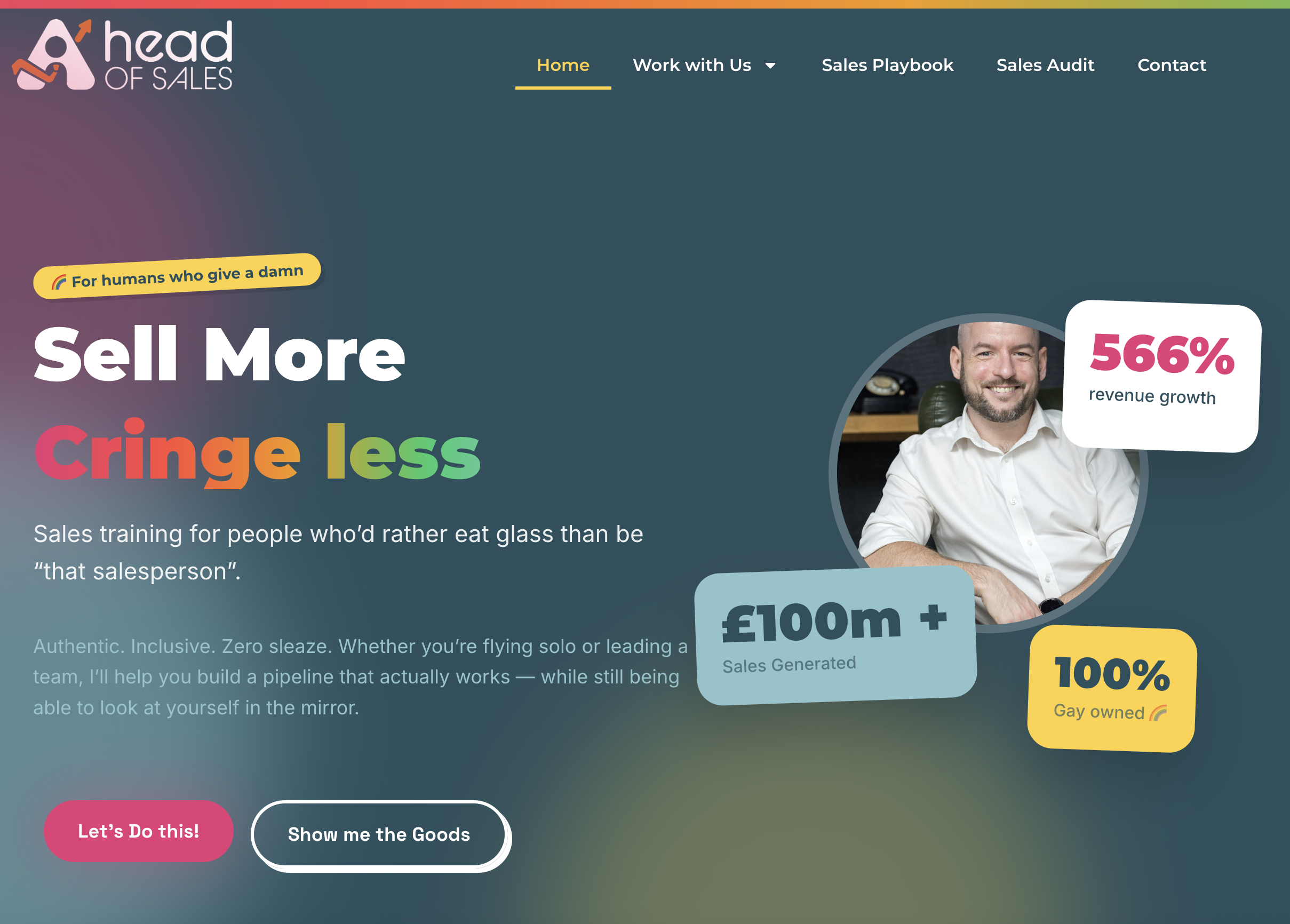
Aheadofsales works with B2B businesses of 50 to 1,000 staff to do exactly that. The approach combines bespoke 1:1 coaching with structured team training and hands-on consultancy, designed to deliver at least 50% sales growth year on year and ensure your team hits target every quarter. This is not a generic workshop that your reps forget by Friday. It is a tailored programme built around your specific sales process, your team’s current competency gaps, and the deals you are actually trying to close.
For businesses that need more than training, the fractional sales director service gives you senior sales leadership without the full-time cost. For solo service businesses, the sales acceleration packages start from £2,995 and are built to generate momentum fast. Team packages start from £4,500, with bespoke engagements up to £8,500 depending on scope and team size.
The sales training programmes cover everything from objection handling and consultative selling to mindset and pipeline management, all delivered in a format that fits around your team’s existing commitments. If you want to see what a structured, coaching-led approach looks like in practice, book a consultation and we will map out exactly where your team’s biggest growth opportunities are.
Key takeaways
High-performing sales teams are built on structure, consistent coaching, and aligned compensation, not on individual talent alone.
| Point | Details |
|---|---|
| Coaching drives quota attainment | Reps with a coach are 75% more likely to hit targets, and UserGems’ team quota attainment reached 73%. Weekly competency-based sessions outperform quarterly reviews. |
| Training investment separates top teams | Top teams invest substantially more per rep annually on training compared to average organisations. |
| Role specialisation reduces costly mistakes | Splitting roles into Openers, Closers, and Account Executives improves close rates and reduces turnover. |
| Compensation alignment builds trust | 62% of top teams align comp to strategy versus 32% of peers, directly improving rep performance and retention. |
| Aheadofsales delivers structured growth | Bespoke 1:1 coaching and team training programmes designed to generate at least 50% sales growth year on year. |