
The Challenger Sale is a sales methodology built on one core idea: the best sellers don’t build relationships, they teach customers something they didn’t know about their own business, tailor that insight to each stakeholder, and take control of the sales conversation. It works best where deals are complex, involve multiple decision-makers, and carry real switching costs, think enterprise software, professional services, or high-value B2B contracts with 12+ month cycles.
If you’re selling something transactional or low-risk, this isn’t your framework. But in complicated, multi-stakeholder sales, the evidence is compelling:
- Sellers who teach, tailor, and take control consistently outperform relationship-focused reps in complex deals
- Buying groups now commonly include multiple stakeholders, so a single relationship rarely closes a deal alone
- Teams that implement Challenger properly tend to report higher win rates on their largest, most contested opportunities
The rest of this piece breaks down exactly how to apply it, including the scripts, the seller profiles, and the sequence that turns an insight into a signed contract.
Key Takeaways
Challenger selling outperforms relationship-based approaches specifically in complex, multi-stakeholder B2B deals, and requires structured coaching and centralised insight production to scale beyond a single talented rep.
| Point | Details |
|---|---|
| Core method | Teach, tailor, and take control are deployed throughout the sales cycle, not as a fixed sequence. |
| Best fit | Multi-stakeholder deals with long cycles and real switching costs see the strongest results. |
| Poor fit | Transactional, price-led purchases usually see the method backfire rather than help. |
| Implementation backbone | Centralised insight production and a specific coaching cadence matter more than a one-off training day. |
| Turning theory into habit | Aheadofsales pairs team training with bespoke 1:1 coaching so reframes hold up under real objections, not just role-play. |
Table of Contents
- Understanding the Challenger Sale: origin, research and how it differs from relationship selling
- The three T’s: teach, tailor and take control in practice
- The five seller profiles: who to hire, who to coach
- The six-step commercial teaching sequence, step by step
- When Challenger selling works, and when it backfires
- How to implement Challenger selling in your organisation
- The Aheadofsales approach: turning teams into Challengers
- Where Challenger selling goes next
- Ready to build Challenger behaviours into your sales team?
- Sources
Understanding the Challenger Sale: origin, research and how it differs from relationship selling
Matthew Dixon and Brent Adamson didn’t set out to write a sales book. They were researchers at CEB (Corporate Executive Board) trying to work out why some sales reps consistently beat their quota while others, doing seemingly similar work, fell short. What they found surprised the sales world enough to become a bestselling framework: reps who challenged customers’ thinking outperformed those who simply built rapport.
The research behind the claim
The finding came from a study of roughly 6,000 sales representatives across multiple industries, later published as The Challenger Sale by Dixon and Adamson. Every rep in the study was sorted into one of five behavioural profiles based on how they sold. When the researchers cross-referenced profile against performance, particularly in complex, high-value deals, one profile pulled clear of the pack: the Challenger.
That single result reframed a decade of sales training orthodoxy. Up to that point, the dominant model had been relationship selling: be likeable, be responsive, be present, and the business follows. Dixon and Adamson’s data suggested the opposite was often true in complex sales. Relationship Builders, the profile most associated with the “nice, helpful rep” archetype, actually underperformed in the toughest deals. Buyers with genuinely difficult problems didn’t want a friend. They wanted someone who understood their business better than they did and could show them a blind spot.
How Challenger reframes the seller’s role
Traditional relationship selling treats the sales conversation as a service: uncover the customer’s stated need, match a product to it, remove friction. Challenger selling treats the conversation as an intervention. You’re not there to confirm what the customer already believes. You’re there to disrupt it, gently but firmly, with evidence they hadn’t considered.
That’s a genuinely different job. It requires:
- Deep enough market and customer knowledge to spot a problem the buyer hasn’t named
- The confidence to introduce that problem even when it complicates the sale
- The commercial discipline to connect the new problem directly to what you’re selling, without it feeling like a bait and switch
This is where a lot of teams stumble when they first try to adopt the method. “Being a Challenger” gets misread as being combative or contrarian for its own sake. It isn’t. It’s a research-and-insight discipline first, and a conversational skill second. Get the insight wrong, and confident delivery just makes you sound arrogant. Get it right, and the confidence is what makes the insight land.
The practical upshot for sales leaders: if your team has been trained mainly on discovery questions and objection handling, Challenger selling asks for a different muscle entirely, one built around proactive teaching rather than reactive responding. That shift alone is often the biggest barrier to adoption, more than any script or slide deck.
The three T’s: teach, tailor and take control in practice
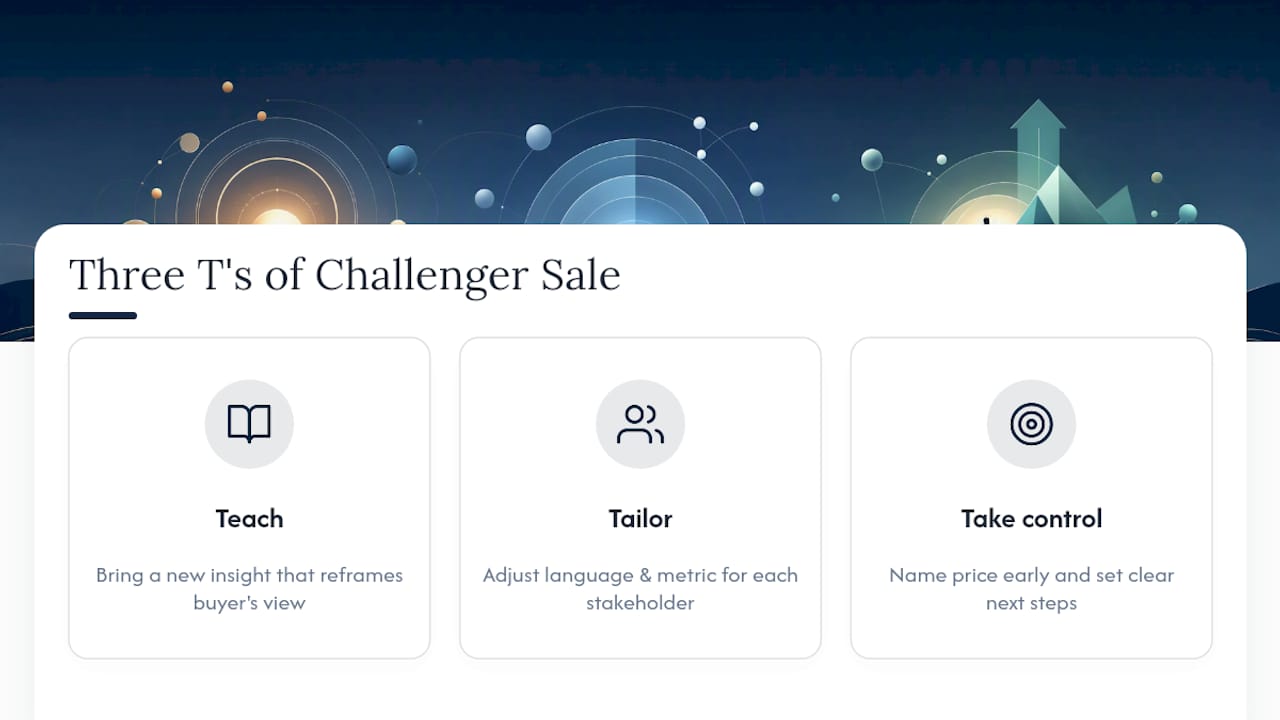
The three T’s, commonly summarised as teach, tailor, and take control, aren’t a sequence you tick off once and move past. They’re capabilities a Challenger seller deploys throughout the entire sales cycle, from the first call to contract signature.
1. Teach for differentiation
Teaching means bringing the customer a piece of insight about their own business or market that they didn’t already have, structured so it leads naturally towards your solution. This isn’t a generic industry trend deck. It’s a commercial teaching pitch: a specific, provable claim that reframes how the buyer sees their current approach.
2. Tailor to the stakeholder in front of you
The same underlying insight needs a different frame depending on who’s in the room. A CFO cares about cost of inaction and payback period. An operations lead cares about workflow disruption and implementation risk. An end user cares about how their day-to-day actually changes. A Challenger seller keeps the core reframe constant but adjusts the language, the metric, and the emotional hook for each audience, because buying groups now routinely include five or more stakeholders, each with a different lens on the same decision.
3. Take control, without the aggression myth
This is the most misunderstood pillar. “Take control” doesn’t mean pushy or dominant. It means being comfortable naming the price early, pushing back on unrealistic timelines, and setting clear next steps rather than waiting passively for the buyer to lead. In practice, it’s confident guidance, not confrontation: a seller who says “here’s what needs to happen next, and here’s why” rather than one who asks “what would you like to do next?”
Pro Tip: If a reframe gets immediate, enthusiastic agreement, treat that as a warning sign rather than a win. It usually means you’ve told the buyer something they already knew. A reframe that’s doing its job tends to produce a beat of silence, followed by a genuinely curious question.
Put together, the three T’s turn a sales call from an exchange of information into a structured argument for change, one where the seller, not the buyer, is setting the pace.
The five seller profiles: who to hire, who to coach
The original CEB research sorted sellers into five distinct profiles, and understanding where your team currently sits is more useful than trying to hire a room full of Challengers overnight.
- The Challenger teaches, debates, and pushes the customer’s thinking. Strongest in complex, high-stakes deals where the buyer needs a new perspective, not reassurance.
- The Relationship Builder focuses on rapport, availability, and service. Reliable in simple or relationship-dependent accounts, but the profile Dixon and Adamson’s research found most likely to underperform in complex, high-value deals.
- The Hard Worker shows up, follows up, and puts in the volume. Solid in high-activity, transactional environments where persistence beats insight.
- The Lone Wolf trusts instinct over process, often a strong individual closer but a difficult profile to scale or coach consistently.
- The Problem Solver is detail-oriented and reactive, excellent at post-sale service and technical troubleshooting, weaker at proactively driving new opportunities.
None of these profiles is inherently bad. A Hard Worker running a high-volume outbound desk for a low-ticket product may be exactly right for that role. The mistake is assuming every seller needs to become a Challenger, or assuming you need to fire your Relationship Builders and hire a new team.
The more realistic path is coaching, not wholesale replacement. Relationship Builders often have the product knowledge and customer trust already, what they lack is the confidence and the material to introduce a challenging reframe. Give them a scripted teaching pitch, rehearse it until it feels natural rather than scripted, and pair it with real-time coaching on the calls where they default back to rapport building instead of pushing the conversation forward.

This is precisely where structured coaching earns its budget. A seller can read about the three T’s in an afternoon. Turning that theory into a habit that survives a tense negotiation call takes repetition, feedback, and someone in the room (or on the recording) telling them exactly where they backed off too early.
The six-step commercial teaching sequence, step by step
Commercial teaching isn’t improvised. It follows a six-step choreography: warmer, reframe, rational drowning, emotional impact, a new way forward, and your solution. Each step has a distinct objective, and skipping one usually breaks the pitch’s momentum.
-
Warmer. Objective: earn the right to be heard. Open with a statement that signals you understand the buyer’s world, not a generic “how’s business” line. A concrete example: “Most operations leaders we talk to in your sector are quietly absorbing a cost they’ve stopped noticing.” It’s specific enough to earn attention without giving away the reframe yet.
-
Reframe. Objective: introduce the insight that challenges current thinking. State a claim the buyer hasn’t fully considered, backed by something concrete rather than a vague industry cliché. This is the moment you’re teaching, not selling.
-
Rational drowning. Objective: quantify the cost of inaction until the scale of the problem is undeniable. This is where data does the heavy lifting. Combining a hard number with a clear narrative around it, rather than presenting either alone, is what tends to move buyers off the status quo. A one-pager showing the cost per month of the current approach, laid out against a comparable benchmark, works well here.
-
Emotional impact. Objective: make the cost personal, not just financial. Numbers alone rarely move a room. A short story, a customer example, or a specific consequence tied to the buyer’s own role turns “this costs money” into “this is a problem I’m personally responsible for.”
-
A new way forward. Objective: present an alternative approach in principle, before naming your product. This step matters because it separates the insight from the pitch. The buyer needs to agree the new way makes sense on its own merits first.
-
Your solution. Objective: connect the new way forward directly to what you sell, as the natural, almost inevitable next step rather than a hard pivot into a sales pitch.
The sequence works because each step removes an objection before it’s raised. By the time you reach step six, the buyer has already agreed there’s a problem, agreed it’s costly, felt why it matters, and agreed in principle with the direction of the fix. You’re not selling into resistance, you’re confirming a decision they’ve half made already.
Adapting the sequence for modern buying habits
Buyers now do far more research before they ever speak to a rep, so the full six-step pitch doesn’t always need to happen live on a call. Short asynchronous assets, a two-minute video covering the warmer and reframe, or a one-page business case laying out the rational drowning with hard figures, let a champion inside the buying committee carry your teaching pitch to stakeholders you’ll never speak to directly. Building these as reusable, editable assets rather than one-off slides is one of the highest-leverage moves a sales leader can make.
When Challenger selling works, and when it backfires
Challenger selling isn’t a universal fix, and applying it in the wrong context does more damage than using no methodology at all.
Where it works well:
- Multi-stakeholder purchases with five or more people influencing the decision
- Long sales cycles, typically several months or more, where a single call can’t close the deal
- High average selling prices and meaningful switching costs, where the buyer has real reason to defend the status quo
- Markets where the buyer’s problem is genuinely underestimated or poorly understood internally
Where it tends to backfire:
- Transactional, low-risk, price-led purchases, where the buyer just wants speed and simplicity, and a reframe feels like friction
- Situations where the seller hasn’t done the research to back up the challenge, leading to a reframe that’s wrong, generic, or already obvious to the buyer
- Early-stage conversations where control is asserted before trust or credibility has been established, which reads as arrogance rather than insight
Applicability guidance is consistent across analyst and practitioner sources: Challenger performs best on complex deals and loses its edge fast once the purchase becomes routine or purely transactional. Trying to “challenge” a buyer who just wants a straightforward renewal usually creates friction with no upside.
Reading the buying window
Certain buyer-side signals suggest a genuine opening for a Challenger approach: a new executive hire in the relevant function (new leaders are actively looking to make an early mark), a recent funding round (fresh budget and mandate to change), or a technology migration already underway elsewhere in the business (appetite for change is already proven). These moments make buyers receptive to a reframe precisely because their own status quo is already shifting. Timing a commercial teaching pitch to land during one of these windows dramatically increases the odds it’s heard rather than resisted.
How to implement Challenger selling in your organisation
Training alone won’t get you there. Organisations that make Challenger stick treat it as an operating model change, covering insight production, coaching cadence, and pipeline structure, not just a workshop.
-
Centralise insight production. Don’t leave commercial teaching pitches to individual reps’ improvisation. Pull data and examples from marketing, product telemetry, and customer success into a shared library of reframes, each with the supporting numbers and a one-pager or short video already built. This is what stops the method collapsing into “some reps are naturally good at this and some aren’t.”
-
Build a coaching rhythm around specific behaviours. Generic sales coaching won’t move the needle here. Coach reframes specifically: does the rep have one, is it backed by real evidence, does it land as intended in role-play? Coach pricing defence separately: can the rep hold their ground on price without softening the moment there’s pushback? Weekly call reviews focused on these two behaviours alone will move a team further than a broad “improve your discovery skills” programme.
-
Change the pipeline stages to reflect the method. If your CRM still tracks “discovery, demo, proposal, close,” it isn’t measuring anything the Challenger method actually cares about. Add a stage or field for “reframe delivered” and track whether it correlates with progression. Over a couple of quarters, this becomes a genuinely useful leading indicator of deal health.
-
Run a 90-day rollout, not a one-off session. Days 1 to 30: build and validate two or three core reframes with real customer data, train the team on the three T’s and the six-step sequence, and run role-play until it stops sounding scripted. Days 31 to 60: apply the reframes live on real calls, with coaches reviewing recordings weekly and refining the material based on what actually lands. Days 61 to 90: measure early results, win rate on deals where a reframe was delivered versus those where it wasn’t, and adjust the insight library accordingly.
Pro Tip: Track “reframe delivered” as a binary field on every opportunity for one full quarter before you try to correlate it with win rate. Most teams give up on measurement too early, after two or three weeks, long before the sample size means anything.
The pattern across implementation guidance is consistent: teams that skip the coaching and insight-production infrastructure and rely purely on a training day tend to see behaviour revert within a few weeks. The method isn’t the hard part. Sustaining it is.
The Aheadofsales approach: turning teams into Challengers
Reading about the three T’s is one thing. Getting a team of ten or fifty reps to actually deliver a reframe with the right timing, tone, and confidence on a real call, under real pressure, is another. That gap is where most Challenger training investments quietly fail, and it’s the specific problem bespoke 1:1 coaching is built to close.
Aheadofsales works with two distinct client shapes. For teams of roughly 50 to 1,000 staff with a genuine growth mindset, packages combine structured team training with individual coaching, so reframes get built collaboratively, then rehearsed and refined one seller at a time until they hold up under real objections. For solo service business founders and consultants, a leaner sales acceleration package applies the same teach, tailor, and take control discipline at a scale suited to a one-person sales operation.
The metrics that matter most when judging whether Challenger adoption is actually working: win rate on your most complex, multi-stakeholder deals, average selling price trends, and forecast accuracy on deals where a reframe was delivered versus those where it wasn’t.
Useful markers to track over a coaching engagement:
- Win rate specifically on deals involving three or more stakeholders
- Movement in average deal size once tailored reframes are in regular use
- Forecast accuracy, since confident, controlled sellers tend to qualify more honestly
Where Challenger selling goes next
The biggest shift coming for Challenger selling isn’t the framework itself, it’s when teaching happens. Buyers now research extensively before a rep ever gets a call booked, which means the warmer and reframe increasingly need to exist as short async video or a shared business case document a champion can forward internally, rather than only living inside a live pitch.
That raises the stakes on coaching and insight production. A brilliant reframe improvised by one talented rep doesn’t scale. A reframe built once, tested, and coached into every seller’s delivery does. Centralised insight creation stops being a nice-to-have and becomes the actual bottleneck on growth.
One caution worth holding onto: challenge without genuine insight is just arrogance with better branding. The moment a rep starts pushing back on a buyer to seem confident rather than because they’ve earned the right to, the method stops working and starts costing you deals.
— Jerry
Ready to build Challenger behaviours into your sales team?
Reading the framework gets you halfway. What actually changes win rates is a team that’s rehearsed a reframe until it’s second nature, coached through the calls where they lose their nerve, and held to a pipeline that measures whether the teaching landed. That’s the gap between a training day and a habit, and it’s the gap Aheadofsales exists to close.

For teams of 50 to 1,000 staff, bespoke sales training pairs group workshops on the three T’s with 1:1 coaching on real, recorded calls, so reframes get tested against actual objections, not just role-play. SaaS teams selling into product-led buying committees have a dedicated route through SaaS-specific sales training, built around the multi-stakeholder tailoring Challenger demands. Solo consultants and service business founders can access the same discipline through a leaner sales acceleration package, sized for a one-person sales operation.
If you want a clear view of where your team currently sits against the five seller profiles, and what a 90-day coaching rollout would look like for your pipeline, book a consultation on the training services page and get a straight answer on fit before committing to anything.
Sources
- The Challenger Sale by Matthew Dixon & Brent Adamson — Cliff…
- The Challenger Sale: What It Is, How It Works, and When to Use It — Gangly Blog
- The Challenger Sale Book Summary + Methodology
- What the Challenger sales method involves — Coursera article
- What sales should know about B2B buyers — Gartner
One Response