
Buyer enablement content is any asset that helps a buying group complete the work of buying: understanding the problem, comparing options, building a business case and getting colleagues to agree. The content only works when it answers the questions your buyers actually ask, and those questions live in your sales conversations. That is why the best buyer enablement starts with a sales team that asks sharp questions and listens, not with a content calendar.
TL;DR
- Buyer enablement content is external: it helps buyers decide and sell the decision internally. Sales enablement is internal: it helps your reps sell.
- UK buyers complete 55.6% of their journey before speaking to a seller, so what they can read alone matters as much as your pitch.
- Map content to the six buying jobs, from problem identification to consensus creation, and write for the people you never meet.
- Source topics from real objections and deal outcomes, then measure by deal progress, not downloads.
Table of Contents
- What buyer enablement content actually is
- Why UK buyers need it now
- Buyer enablement vs sales enablement
- The six buying jobs and the content for each
- Write for the people you never meet
- How to create it: start with your sales conversations
- Where it is most useful for your business
- Measuring whether it works
- Where we come in
- Our perspective
- FAQ
- Sources
What buyer enablement content actually is
Gartner’s research defines buyer enablement as content that supports the critical buying jobs: prescriptive advice (do this, avoid that) plus practical support such as calculators and diagnostic tools. Its finding is that customers who meet this kind of information are three times more likely to make a high-quality purchase.
The point is a change of purpose. Persuasion content tells buyers why you are good. Buyer enablement content helps them do the work of buying, including the parts you will never see, such as the finance director reading a summary your champion forwarded.
If you run a £2m+ company, lead sales as an SVP, or sell services as a founder or solo consultant, this matters because your buyers are under more pressure than they used to be. Gartner found that 77% of buyers agree purchasing has become very complex and difficult.
Why UK buyers need it now
The 2026 6sense UK and Ireland Buyer Experience Study surveyed 993 buyers, 911 of them in the UK. Its headline numbers describe a buyer who is slow, thorough and self-directed:
- The average buying cycle was 9.74 months.
- 55.6% of the journey was complete before the buyer spoke to a seller.
- 84.7% of first conversations were started by the buyer.
- The average buying group had 10.9 people.
Read those together and the job is clear. By the time someone books a call, they have already formed a view from what they found. Ten or so people have opinions, and most will never speak to you.
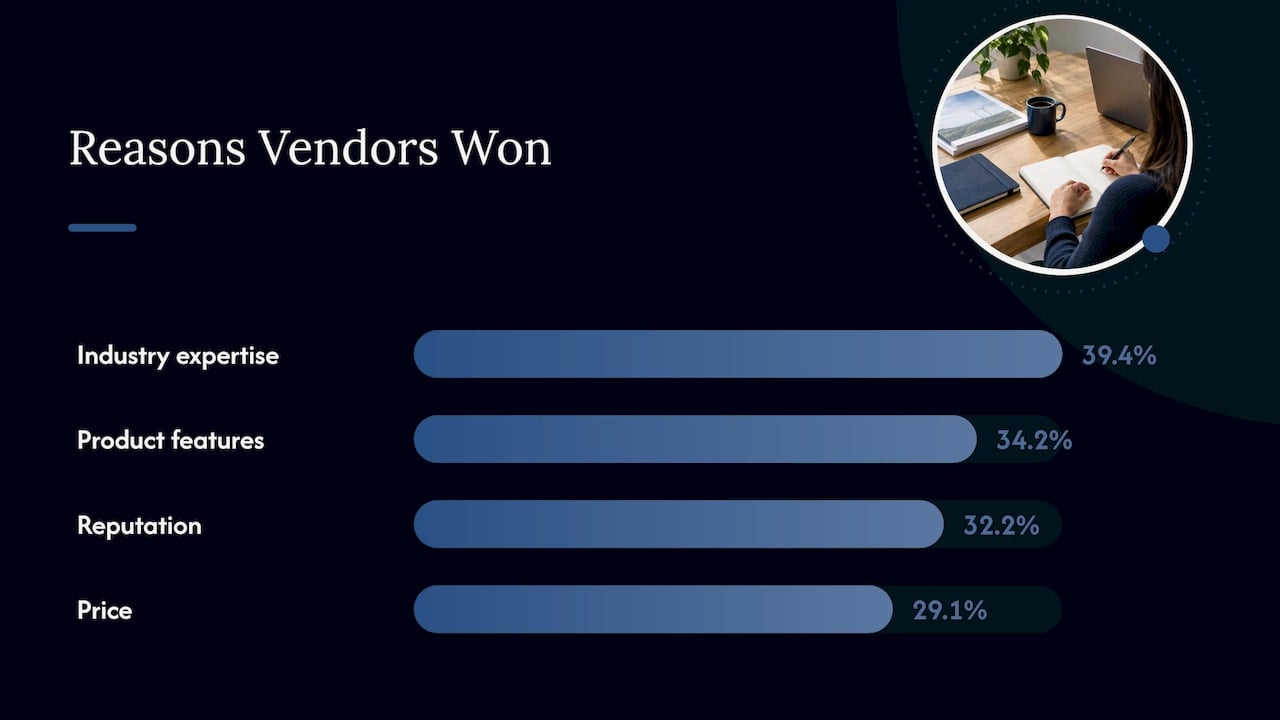
The same study found that 27.1% of buying groups that failed to agree on a vendor said they lacked content to make the case internally. Another 37.1% said no vendor stood out. Industry expertise was the most common reason the winner won (39.4%), ahead of product features (34.2%), reputation (32.2%) and price (29.1%). For a service business or a SaaS company, that favours specific, sector-aware material over generic thought leadership.
Buyer enablement vs sales enablement
The simplest distinction is direction. Buyer enablement is external: ROI studies, cost calculators, diagnostic tools and mutual action plans that make it easy for a buyer to buy. Sales enablement is internal: buyer personas, call scripts and deck templates that make it easy for a rep to sell.
A quick test: if an asset only makes sense with a rep in the room, it is sales enablement. If a buyer can pick it up alone and get further, it is buyer enablement.
They overlap more than they compete. A strong case study helps a rep make a point on a call and helps a buyer justify the decision afterwards. Build it once, design it for both audiences.
The two also depend on each other. Content a rep cannot explain or place in a conversation gets ignored, however good it looks. If you want the internal side in depth, we cover it in sales enablement vs sales training and in our definition of sales enablement.
The six buying jobs and the content for each
Gartner’s research found that virtually every complex B2B purchase spans six buying jobs: problem identification, solution exploration, requirements building, supplier selection, validation and consensus creation. Buyers loop back between them, so you cannot treat them as a tidy funnel. You can, however, check that each one has something useful behind it.
| Buying job | What the buyer is trying to do | Content that helps |
|---|---|---|
| Problem identification | Decide whether the problem is worth solving | Diagnostic checklists, benchmark data, problem-framing guides |
| Solution exploration | Understand the types of solution | Buyer’s guides, category overviews, short walkthroughs |
| Requirements building | Agree what “good” looks like | Requirements templates, scorecards |
| Supplier selection | Shortlist and compare | Honest comparison guides, case studies in the buyer’s sector |
| Validation | Check the claims and the risk | ROI calculators, security and compliance packs, references |
| Consensus creation | Get the group to agree | Executive summaries, business case templates, a short deck a champion can forward unedited |
This mapping draws on the practical guides from Aligned and Warmdoc, which agree on the pattern. Gartner also notes that engagement-stage assets, such as implementation guides and value assessment tools, are frequently missing from content plans, which makes them a good place to start.
A worked example
Gartner’s ebook describes a food supplier that gave restaurant buyers a profit calculator. The buyer entered five inputs (locations, guests per day, the share of orders with fries or sides, the share with premium add-ons, and price) and saw the extra annual profit in real time. It worked because it was anchored on something the buyer already wanted: a bigger average check.
A UK service business can copy the logic. A consultant selling to agencies might build a one-page calculator: current win rate, average deal value, number of proposals a month, and the revenue effect of a few points of improvement. The buyer gets a number to take to their partner or finance lead.
Write for the people you never meet
With 10.9 people in the average group, most of your audience is not on your calls. Gal Aga of Aligned argues that consensus creation is where many deals stall, because the hardest conversations happen in meetings the vendor is not invited to, where the CFO or security reviewer shapes the outcome.
So write for each stakeholder by role, and ask one question of every asset: could your champion forward this without adding a word of explanation? If not, it is a brochure, not an enabler. Our guide to stakeholder mapping shows how to identify who those silent voices are before a surprise veto arrives, and the piece on types of B2B buyers helps you pitch each one correctly.
The 2026 study adds a modern wrinkle. 83.2% of UK and Irish buyers used AI tools during evaluation, peaking at 54.6% of the journey mid-cycle. Buyers increasingly use AI to interrogate material they already hold, so proposals, case studies and comparison pages must still make sense when summarised by a machine for someone who never reads your wording. Plain claims, named numbers and clear scope survive summarising. Vague superlatives do not.
How to create it: start with your sales conversations
The most useful advice across the practical guides is consistent. Do not start from a content list. Start from buyers.
- Collect the recurring questions. Ask your sales team which questions come up in almost every deal, and which concerns stop deals. Mine emails and meeting notes for the buyer’s own words. D2 Design recommends talking to current customers about what nearly stopped them buying.
- Include the lost deals. Interview a handful of recent buyers, won and lost, to map how the decision really happened. A lost deal often shows exactly which asset was missing.
- Audit what you have. Check for gaps by stage, by stakeholder and by format. Most businesses find plenty for supplier selection and almost nothing for requirements building or consensus.
- Answer each concern directly. A pricing overview that explains what a quote includes. An implementation guide showing who handles which tasks. Case studies with verified results.
- Make it shareable and short. Write for the moment, not the record. A prospect gives a one-pager seconds, not minutes, to prove its worth.
- Be honest about fit. A comparison guide that says who you are not right for earns more trust than one that claims to suit everyone.
Step one is where many small teams fall down. Content built from guesswork answers questions nobody asked. Content built from real discovery calls answers the ones that decide deals, and that depends on how well your people run those calls. Our article on B2B sales strategy and the overview of the buyer journey give useful context here.
Where it is most useful for your business
£2m+ companies and SaaS businesses at Series B or beyond: your buying groups are large, so invest in role-specific material, security and ROI documentation, and a shared plan with dates and owners.
SVPs of Sales: you own the conversation that produces the content brief. Ask your reps to log objections and stakeholder names in your CRM, and review them monthly.
Service businesses, solo consultants, coaches and HR consultants: you do not need a library. A clear pricing explainer, two sector-specific case studies, a short “what working with me looks like” document and a one-page summary your buyer can forward to a partner or finance lead will cover most of the six jobs.
Measuring whether it works
Download counts tell you very little about a deal. Better signals, as Aligned suggests, are engagement depth (who opened what, and for how long), stakeholder spread (new people entering the content), deal progression compared with deals that did not engage, and champion activity such as forwards and shares.
Be realistic about attribution. BCM Public Relations points out that an asset appearing before a sale does not prove it caused the sale, and recommends pairing the numbers with sales feedback and agreeing the definitions with the sales team first.
A simple starting method:
- Keep a spreadsheet of deals, noting which assets were shared and with how many stakeholders.
- Compare win rate, time to close and no-decision outcomes for deals with and without the content.
- Ask new customers how easy it was to buy from you, and track the answer over time.
- Review monthly with sales, and retire or rewrite anything that never appears in a won deal.
With a small deal count, treat the pattern as directional rather than proof.
Where we come in
Buyer enablement content gets written in marketing but proven in sales calls. It only helps when your team can uncover the real concern, map the buying group and guide a champion through the internal sell. That is the sales side of the work we do.
We combine bespoke 1:1 coaching with team training and consultancy. Our sales consultancy covers your process end to end, and a fractional sales director can lead the team part time if you have no one in the seat. Team-based bespoke coaching and consultancy engagements are £4,500-£8,500 one-off. The sales acceleration track for solo service businesses and consultants is £2,995-£5,995 one-off. The Sage Collective is £990 per month. You can see how the packages fit together on our pricing and packages page.
If you are a solo consultant or coach, the sales coaching programme is built for your situation. If you lead a team, the sales training cohorts are a good place to begin.
Our perspective
We see buyer enablement as the written half of a conversation that sales has to hold well first. Content can only be as good as the questions behind it, and those come from discovery calls, objections and lost deals.
That is why we put 1:1 coaching alongside training and consultancy. A team that asks better questions, maps every stakeholder and helps its champion make the case internally produces the raw material for content that works. It also uses that content well once it exists.
Our advice to owners and sales leaders is simple. Pick the three questions that stall your deals, answer them in plain language for each person in the buying group, and train your people to place those answers at the right moment. Do that before you build a library.
Jerry
FAQ
What is buyer enablement content?
It is content and tools designed to help buyers complete the work of buying: understanding the problem, comparing options, building a business case and gaining internal agreement. Examples include ROI calculators, comparison guides, implementation guides and shareable summaries. Gartner’s research links it to buyers being three times more likely to make a high-quality purchase.
What is the difference between buyer enablement and sales enablement?
Buyer enablement is external and helps prospects buy. Sales enablement is internal and helps your reps sell, through training, scripts and playbooks. Many assets serve both, such as a good case study.
Do small service businesses need buyer enablement content?
Yes, but in a lean form. A pricing explainer, a couple of relevant case studies and a short summary a buyer can forward to a partner or finance lead cover most of the buying jobs. Buying groups in smaller deals are smaller, but the buyer still has to justify the decision to someone.
How do I know which content to create first?
Start with the questions that recur in sales conversations and the objections that stall deals. Then check which of the six buying jobs has the thinnest coverage. Gaps at the validation and consensus stages are common and tend to affect close rates directly.
How long does it take to see results?
It depends on your sales cycle. The 6sense UK study found an average cycle of 9.74 months, so expect patterns to appear gradually. Track deal progress and time to close across several months before judging an asset.
Sources
- Gartner: Marketing-Fueled Buyer Enablement
- 6sense UK and Ireland Buyer Experience Study 2026
- Gartner: Develop Marketing Content to Drive Conversion
- Buyer Enablement Guide
- What Is Buyer Enablement? A Practical B2B Guide
- Buyer Enablement Content: Examples, Strategies, and Best Practices
- Buyer Enablement Content: Six Jobs, Page Signals, Better Pages
- B2B Content Marketing That Answers Buyer Questions
- Content marketing for long sales cycles: a guide