
Conversation intelligence is software that records your sales calls and meetings, transcribes them and uses AI to flag what matters: objections, buyer intent, talk time, next steps. Its best use cases are coaching, objection analysis, deal inspection, forecasting and onboarding. It shows you what was said on every call, but it cannot change how you or your team sell. That takes coaching, and that is the part we do.
This guide is for owners, sales leaders and solo consultants who sell high-value services or B2B products and want to know where this technology earns its keep. It covers what it does, the use cases with the best evidence, the UK rules on recording, and how to turn the output into more closed deals.
TL;DR
- Conversation intelligence turns recorded calls, meetings and emails into searchable data: transcripts, objections, sentiment, next steps and deal signals.
- The strongest use cases are coaching, objection analysis, deal inspection, forecasting and onboarding new sellers. Most teams get the value from one or two of them.
- Published UK results are encouraging, but they come from teams that acted on what the calls showed, usually through coaching and a clear sales process.
- In the UK, tell staff and callers that calls are recorded, and keep monitoring to what is necessary for business purposes.
- Insight on its own does not lift conversion. Pairing it with 1:1 coaching is what changes behaviour on the next call.
Table of Contents
- What conversation intelligence actually does
- The use cases that matter most
- What UK businesses have reported
- Choose your use case before you choose a tool
- Recording calls in the UK: the basics
- From insight to behaviour: where results are made
- How we approach it at Ahead of Sales
- Our perspective
- FAQ
- Sources
What conversation intelligence actually does
IBM describes it as using AI tools to analyse phone calls, video meetings and chat, transcribing them and applying natural language processing (software that reads human language) to pick out key moments, customer sentiment and pain points. In plain terms, every conversation becomes a document you can search, sort and compare.
For a sales team, that means you can answer questions that used to rely on memory or on what a rep chose to tell you. How often did pricing come up before the second call? Did the decision-maker ever join? What did we say the last six times a prospect said “send me something to look at”?
If you run a small team or sell alone, the same logic applies at a smaller scale. Your calls are your richest source of market research, and most of it is currently forgotten by the following Tuesday.
The use cases that matter most
Vendors list a dozen use cases. Most teams use two or three. These are the ones with the clearest case for an owner or sales leader.
1. Coaching on real calls
The classic use case. Instead of a manager sitting in on one call a month, or a founder replaying a half-remembered pitch, you review the actual moments that decided the outcome. HubSpot’s guide describes timestamped feedback and rubric-based comparisons of calls, so a manager can point at the exact minute where a discovery call went flat.
The common signals are the ratio of talking to listening, how well questions are asked, how a rep handles a challenge on price, and whether the call ends with an agreed next step. Triage matters here: nobody has time to listen to everything, so the value is in finding the five minutes worth hearing.
The software finds the moment. Someone still has to turn it into a better habit, which is why we treat call review as an input to coaching, not a replacement for it. If you want to see what a structured approach looks like, our 1:1 sales coaching plan sets it out.
2. Objection analysis
Objections are patterns, and patterns are hard to see from inside one conversation. Searching across calls lets you see which objections come up most (price, timing, “we already have a supplier”), at which stage, and which responses preceded a yes.
One published case study from a B2B research firm reports a 34% increase in win rates after adopting conversation intelligence. The company credits a coaching culture and a new multi-threading policy (involving several contacts in each deal), with analysis showing four contacts was the right number for them. Note the order: the data identified the pattern, then a policy and coaching changed behaviour.
For the objections themselves, our guides on objection handling in B2B sales and cold call objection handling give you the responses to rehearse once the data tells you which ones you need.
3. Lead qualification and buyer intent
Calls contain signals that CRM fields never capture. Explicit ones are a stated budget, a timeline, procurement questions or the arrival of a new stakeholder. Implicit ones are subtler: a buyer repeating your value proposition back to you, a change in tone, or silence after you mention price.
For a solo consultant doing ten discovery calls a month, this is less about automation and more about discipline. Reviewing your own transcripts for these signals shows you which prospects you chased too long and which you under-qualified. Our sales call process guide and call preparation guide help you decide what you should be listening for before you press record.
4. Deal inspection and forecasting
This is the use case that needs the least change in behaviour, because sales managers already run pipeline reviews. The difference is that the review can rest on what the buyer actually said: was the decision-maker present, was a timeline mentioned, has the internal champion gone quiet?
For a SVP of Sales or a founder who signs off the forecast, that is a more defensible number than a rep’s optimism. The data is evidence for the forecast conversation, not the forecast itself. A deal marked “commit” with no confirmed next step and no economic buyer on any call deserves a question.
5. Onboarding new sellers
A library of good calls is a faster training aid than a slide deck. New hires hear how discovery sounds when it is done well, how a pricing challenge is handled, and how your best seller closes. For teams of 50 to 1,000 people, where ramp time is a real cost, this is often where the return shows first.
We cover how teams combine technology with human development in AI for sales training with 1:1 coaching.
6. Voice of the customer
Searching calls for competitor mentions, feature requests and the exact words buyers use gives marketing and product teams first-hand material. It is useful, but a search only returns calls where a term came up and says nothing about the deals where it did not, so treat it as a source of leads for further questions, not as proof.
7. Compliance and quality assurance
In regulated sectors, scoring every call rather than a small sample is the headline use. A major UK retail and commercial bank, handling around 5,000 mortgage conversations a month, raised sales oversight from under 5% to 100% and cut review time by more than half. This is a specialist use case, mostly for larger regulated firms, rather than something a growing services business needs on day one.
What UK businesses have reported
Be sceptical of any single number, but the pattern across published UK cases is consistent: time saved, more conversations, better oversight.
| Organisation | Reported result | Main use case |
|---|---|---|
| Lincoln City FC | 216% rise in partnership revenue over 12 months; at least five hours saved per salesperson each week | Sales activity and coaching |
| A leading private bank (PwC UK) | Note-writing time down 75%; QA time down 40%; £4 million a year in operational savings | Admin and QA |
| Contact centre examples (Comms Business) | Sales conversions up 41% after training on the skills of top agents | Skills-focused training |
The Lincoln City example is the closest to a typical growing B2B sales team. The club’s commercial head describes using the data to give reps supportive, specific feedback, for instance showing how tone across their last 50 calls affected conversion. The data supplied the evidence, and a person had a conversation with the rep.
The contact centre figure says the same thing. The conversion gain came after training focused on what separated top agents, not from the analytics alone.
Choose your use case before you choose a tool
Most teams pay for far more than they use. Before you look at software, decide which one or two jobs you need done.
- A solo consultant or coach: your own call review, qualification signals and objection patterns. Your priority is a repeatable discovery call.
- A service business at £10k a month or more: objection analysis and a clear sales process, so that whoever sells next can repeat what worked.
- A £2m+ company or Series B SaaS team: coaching at scale, deal inspection and onboarding, so that quota attainment does not depend on two star sellers.
- An SVP of Sales: forecast evidence and consistency across regions or pods.
A useful test: write down the single decision you would make differently if you had perfect call data. If you cannot name one, no tool will fix that. If you can, the use case is your starting point.
Recording calls in the UK: the basics
Recording sales calls is routine, but it comes with data protection duties. The ICO’s draft monitoring at work guidance (the ICO is the UK data protection regulator, and this version was published in draft in 2022) sets out the principles employers should follow:
- Tell workers about monitoring through your privacy information.
- Business calls may be monitored where necessary, for example for evidence of transactions, training or quality control, but it will not usually be proportionate to record every call’s content in all cases.
- Personal calls should not be monitored.
- Tell callers that recording is taking place. A recorded message at the start of the call is the best practice.
- Take reasonable steps to make sure monitoring data is accurate.
Consent can also matter in sensitive sectors. A UK pharmaceutical company piloting an AI call-recording tool with 13 representatives obtained verbal consent from each healthcare professional before recording. Five declined and the pilot ended, with the industry panel finding no breach of its code. If you sell into healthcare, education or financial services, check your sector’s own rules and take advice from your data protection adviser or solicitor before rolling out recording.
Whatever your sector, say plainly at the start of a call that it is recorded and why. Buyers rarely mind, and your team will trust the process more when they know what it is for.
From insight to behaviour: where results are made
Here is what we see as the gap. Conversation intelligence is excellent at showing you that a rep talks for 70% of discovery calls, or that price objections go unanswered in the first meeting. It does not sit alongside the rep on Thursday and rehearse a better way to ask about budget.
That step has three parts:
- Pick one behaviour. Not ten. For example, ending every call with a dated next step.
- Practise it away from live deals. Role-play the objection, then replay a real call and compare.
- Review again in two weeks. Check whether the behaviour showed up on calls, and adjust.
If you try to fix everything the transcripts reveal, you will fix nothing. A coach keeps the focus narrow and the practice regular. Our guide to sales team coaching techniques and the piece on call reluctance coaching show how that works in practice, including for reps who avoid the phone in the first place.
How we approach it at Ahead of Sales
We combine bespoke 1:1 coaching with traditional training and consultancy. If your calls show a pattern, whether that is weak discovery, discounting too early or deals stalling after proposal, that pattern becomes the brief for the coaching and the process work.
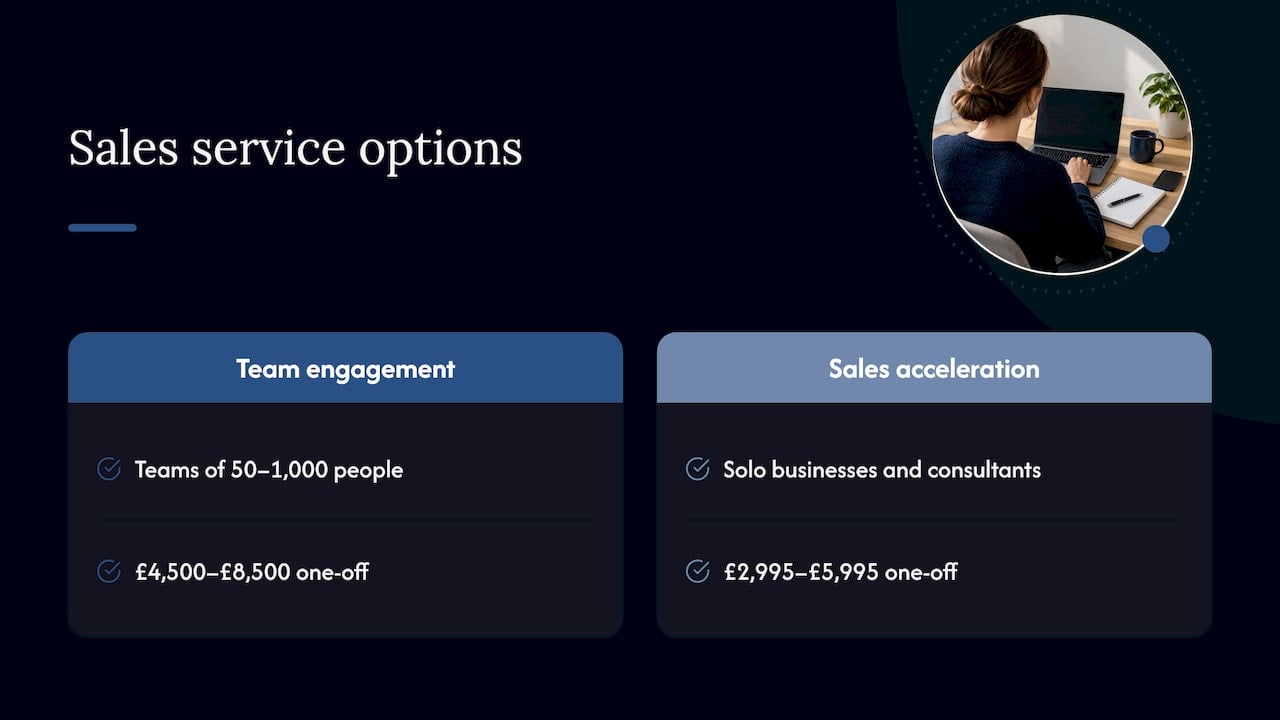
For teams of roughly 50 to 1,000 people, our team-based coaching and consultancy engagements are priced at £4,500 to £8,500 one-off. For solo service businesses and consultants, our sales acceleration track is £2,995 to £5,995 one-off. Details are on our sales training cost page.
If you would rather have a senior sales leader embedded in the business, our fractional sales director service covers that for B2B companies and solo service businesses. For solo owners who want to build the skill themselves, the sales coaching programme is the place to start. You can also see everything we offer, including The Sage Collective at £990 per month, on our home page.
Our perspective
Every month we talk to owners who have bought a recording tool and then wondered why conversion has not moved. The tool worked. It captured every call. What was missing was somebody turning “your discovery calls are too short” into a rehearsed, repeatable habit.
We think the order matters. First decide the one or two things you need from your calls. Then use what they show to coach the people who sell, whether that is a team of 80 or just you. Our approach pairs 1:1 coaching with training and consultancy because a behaviour only sticks when it is practised, reviewed and built into the sales process.
If you are a solo consultant, you do not need an enterprise platform to start. You need a clear call structure, an honest review of how your last ten conversations went, and someone to hold you to the changes. If you lead a larger team, you need all of that plus consistency, so that results do not depend on two people.
Call data tells you where the opportunity is. Coaching is how you capture it.
Jerry
FAQ
What is a typical use case for conversation intelligence in sales?
Coaching is the most common one. Managers review real calls, find moments such as a mishandled objection, and give specific feedback. Objection analysis, deal inspection and onboarding come next. Most teams get the greatest return by focusing on one or two of these.
Is conversation intelligence only for large teams?
No. Large teams benefit from scale, but a solo consultant can use transcripts to review discovery calls, spot repeated objections and tighten their pitch. The principle is the same: learn from what was actually said rather than what you remember.
Do I have to tell people I am recording a sales call in the UK?
Yes, as good practice and under data protection principles. The ICO’s draft monitoring guidance says callers should be told that monitoring is taking place, with a recorded message as best practice, and that workers should be informed through privacy information. Sector rules may add further requirements, so check with your data protection adviser.
Will conversation intelligence improve my win rate on its own?
Published results, such as the 34% win rate increase at one B2B firm, come from teams that used the insight to change coaching and process. The data points to the opportunity, and coaching and a clear sales process are what act on it.
Sources
- What Is Conversation Intelligence? (IBM)
- Call intelligence software: how it works with your CRM (HubSpot)
- Mintel’s 34% win rate increase case study
- Recordsure: advice conversations QA oversight at a major UK bank
- Diginomica: how Lincoln City FC is using AI in sales
- PwC UK: leading private bank case
- Comms Business: turning dialogue into data
- ICO draft monitoring at work guidance (2022)
- PMCPA Case Report 3820