
Outsourced sales leadership means bringing in an experienced sales leader, usually for one to three days a week, to set the strategy, run the pipeline and coach your managers and reps, without hiring a full-time sales director. It suits UK businesses that have proven someone will buy, but where the founder is still the best salesperson and the sales function has outgrown them. This guide covers what the role involves, how it differs from outsourced selling, what it costs, and how to tell whether it is working.
TL;DR
- An outsourced (or fractional) head of sales manages and builds your sales function part-time. An outsourced sales team does the selling for you. They are different purchases.
- It works best when you already have a stable, if messy, sales process and a founder who has run out of hours to manage it.
- Judge any engagement on leading indicators in the first 90 days and on revenue, conversion and forecast accuracy over the following two quarters.
- Price the real alternative: a full-time sales director’s salary plus employer National Insurance, recruitment time and the cost of a wrong hire.
- Be wary of any provider who will not read your numbers before touching your team.
Table of Contents
- What outsourced sales leadership actually is
- Signs you need sales leadership, not just more salespeople
- How it works alongside your existing team
- What outsourced sales leadership costs in the UK
- Engagement models you will be offered
- Benefits, drawbacks and risks
- How to tell whether it is working
- Our perspective
- Working with us
- FAQ
- Sources
What outsourced sales leadership actually is
The phrase covers a few overlapping labels: outsourced head of sales, outsourced sales director, part-time or fractional sales leader. In practice they describe the same thing. A senior person who has led sales teams before works inside your business on a contract basis, owns the sales number alongside you, and is accountable for the system that produces it.
In a typical week that person will:
- review the pipeline deal by deal and challenge the forecast
- write or tighten the sales process, qualification criteria and handover points
- hold one-to-ones and run coaching with your sales manager or reps
- set targets, commission logic and the weekly rhythm of meetings
- help recruit, onboard or move on people
- report to you (or your board) on a short list of numbers
We go through the day-to-day detail in our guide to a fractional sales director’s responsibilities, and the service itself is described on our outsourced sales director page.
Leadership versus outsourced selling
This is where most buyers get confused, and the search results mix the two. An outsourced sales team, sometimes called sales outsourcing, takes on the contact-to-close work: prospecting, calling, booking meetings, sometimes closing. Outsourced sales leadership does not sell on your behalf. It manages and improves the people and process that do.
| Outsourced sales leadership | Outsourced sales team | Full-time sales director | |
|---|---|---|---|
| Main job | Strategy, management, coaching, forecasting | Doing the prospecting and selling | Same as leadership, full-time |
| Who sells | Your own team and you | The provider’s reps | Your own team |
| Time in your business | Typically 1 to 3 days a week | Whatever the contract buys | Five days |
| Best when | The function needs structure and a manager | You need volume and have a clear offer | You have enough team and revenue to keep one busy |
| Main risk | Founder will not hand over authority | Provider’s reps do not know your market | Expensive wrong hire |
The two can be combined, but if you only buy the team without the leadership, nobody is responsible for the system the team plugs into.
Signs you need sales leadership, not just more salespeople
The question “do I need a sales director?” rarely arrives with a clean answer. It tends to show up as a pattern:
- The founder is the pipeline. Every big deal still needs you on the call, and you cannot take a holiday without revenue dipping.
- Results are lumpy. Some months are strong, then nothing, and nobody can say why.
- Reps are hired and then drift. There is no onboarding, no coaching and no consistent definition of a good opportunity.
- Your forecast is a hope, not a number. Deals sit at the same stage for months.
- You are managing sales in the gaps. You are the best seller and the worst manager of sellers, and you know it.
Mark Glazer of ReplyLead describes the “renting the management” model as a fit for founder-led businesses that have had early success but have outgrown the founder’s capacity to structure and manage the function. That matches what we see. A founder at £10,000 a month in revenue and a founder at £3 million a year are both asking the same question: who runs this properly?
If the problem is one weak rep, you need coaching. If it is that nobody owns the number, you need leadership. Our piece on when UK founders hire a fractional sales director goes through the thresholds in more depth.
How it works alongside your existing team
The best engagements feel like a new senior colleague arriving, not a consultancy report landing on your desk. Salesdorado’s guidance on outsourced sales forces says that a clear division of labour and agreed KPIs stop internal and external people from competing with each other. The same principle applies to leadership.
A sensible first month looks like this:
Week one: read the numbers. Pipeline, win rates, average deal size, sales cycle length, source of leads and activity per rep. A good provider reads these before holding opinions about your people. Anyone who diagnoses the team in a first meeting, without data, is selling a pitch.
Weeks two and three: listen and observe. Sit in on calls, review recordings and proposals, and talk to the reps and the customers who said yes (and no).
Week four: agree the plan. A short list of changes, who owns each, and the numbers that will move. We structure ours as a 30, 90 and 180 day plan, which you can see in our write-up on fractional sales leadership for founders.
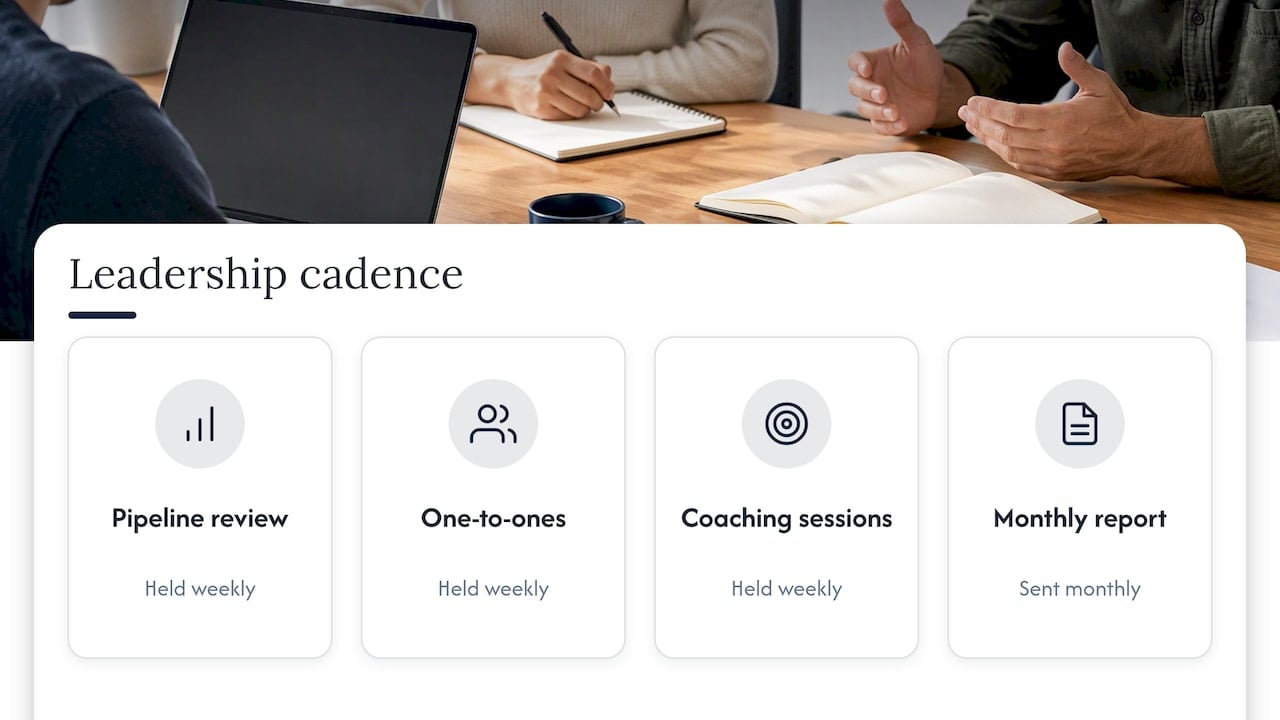
After that comes the weekly rhythm: pipeline review, one-to-ones, coaching sessions, and a monthly report to you. Our sales team management workflow shows what that cadence looks like and why consistency matters more than clever tactics.
What you must have in place first
Axel Lavergne of Salesdorado makes a point that deserves repeating: sales outsourcing of any kind fails when there is no established, stable sales process before the provider arrives, even if that process is far from optimised. In leadership terms, you do not need a polished machine. You do need:
- some customers who bought for reasons you can explain
- a repeatable way of getting leads, even if it is only referrals and your own network
- a CRM or at least a spreadsheet that records deals honestly
If your leads depend heavily on search, it also helps to have SEO and content marketing running steadily, because a sales leader needs a consistent flow of enquiries to measure and improve conversion against.
What outsourced sales leadership costs in the UK
Prices are rarely published, and they vary with seniority, days per week and how much hands-on work is included. Be sceptical of any single “average” figure. A more useful approach is to compare against what you would otherwise pay.
A full-time sales director is not just a salary. Since April 2025, employers pay 15% secondary Class 1 National Insurance on earnings above £5,000 a year, before you add pension contributions, commission or bonus, recruitment fees, equipment, and the months it takes to find and onboard someone. A wrong hire at this level can cost a year of revenue growth as well as the money.
A part-time engagement trades that fixed cost for a flexible one. You buy senior time in the amount you need, usually one to three days a week, and can scale it up or down. Compare in four ways:
- Monthly cash cost against a full-time package including employer National Insurance and pension.
- Time to impact. A fractional leader who has done this before can often start within weeks, where a permanent search can take months.
- Exit cost. A rolling or time-boxed engagement is easier to end than an employment contract.
- What is included. Check whether coaching, recruitment support and reporting sit inside the fee or are charged on top.
Our own approach to pricing is straightforward. Team-based bespoke coaching and consultancy engagements run from £4,500 to £8,500 as a one-off, and our sales acceleration track for solo service businesses and consultants runs from £2,995 to £5,995 as a one-off. Our Fractional Sales Director service is scoped to your business, so we do not publish a price for it. The detail is on our sales training cost page, and we explain how to compare packages by outcome in our guide to buying coaching by cost per outcome.
Engagement models you will be offered
Providers package this in a few ways. Knowing the shapes helps you compare like with like.
Advisory
A few hours a month with a senior person who reviews your numbers and challenges your plan. Cheap, useful for a founder who has capacity to execute, but nobody is accountable for the result.
Embedded part-time leadership
One to three days a week, with the leader managing the team, running meetings, coaching and reporting. This is the model most people mean by outsourced head of sales.
Interim cover
A fuller-time commitment for a limited period, often while you recruit a permanent director or after a departure. Here the provider’s job is partly to hand over cleanly.
Leadership plus training
Part-time leadership combined with structured skills training for the team. This is the model we run most often, because a manager can set direction all day long, but reps still need to practise objection handling and discovery. Our sales training for teams and sales management coaching fit around the leadership work.
Benefits, drawbacks and risks
The benefits are real:
- senior experience without a senior salary or a long hiring process
- an outside view of your team, free of office politics
- flexibility to increase or reduce time as the business changes
- a manager who is accountable for the number, so you can step back
So are the drawbacks:
- Part-time means part-time. Your leader is not there on the days they are not there. A team that needs daily direction may need a full-time manager under them.
- Culture is built by presence. An external leader can set a strong rhythm, but you will still carry the culture.
- Authority has to be real. If reps hear that the founder will overrule every decision, the leader cannot lead.
- Dependence. A good engagement builds your own managers, so the arrangement can shrink. Be cautious of a provider whose business model needs you to stay indefinitely.
How to tell whether it is working
Most people look at revenue and nothing else. That is the right final measure but a poor early one, because new pipeline takes a sales cycle to turn into cash. Use two layers.
Leading indicators in the first 90 days:
- the weekly pipeline review actually happens, and deal stages are honest
- each rep has a coaching plan and a target they understand
- qualified opportunities created per week rise or stabilise
- the forecast is closer to the outcome month by month
Lagging indicators over two to three quarters:
- win rate and average deal size
- sales cycle length
- revenue per rep and quarterly target attainment
- the founder’s time spent in deals
Set these numbers before the engagement begins, and agree what happens if they do not move. We would also expect a hand-back plan: by the end, you should have a manager, a documented process and a rhythm that does not need us in the room.
Our perspective
We have learned that most businesses do not have a talent problem, they have a system problem. A good rep in a bad system looks average, and an average rep in a clear system with regular coaching often surprises everyone. That is why we combine one-to-one coaching with consultancy and training rather than selling any one in isolation.
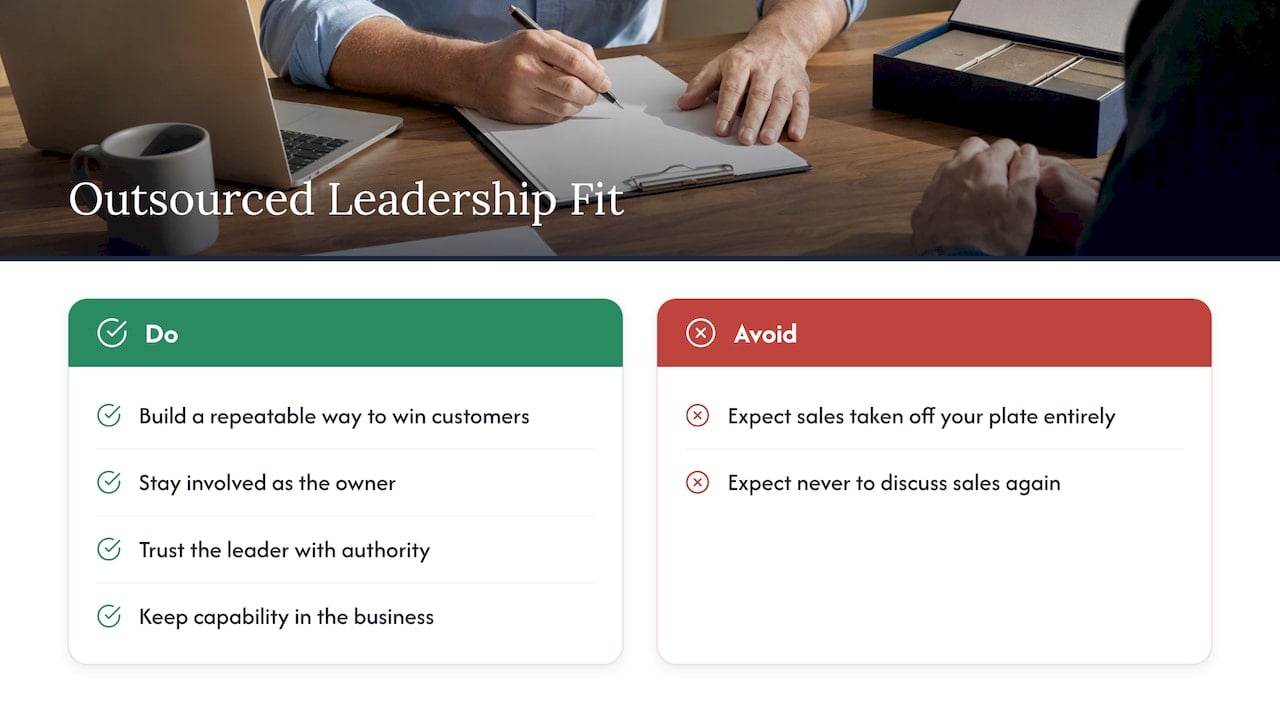
We would also say, honestly, that outsourced leadership is not for everyone. If you have no repeatable way of winning customers yet, you need to get that first, and a fractional leader can help you find it. If you want somebody to take sales off your plate entirely and never discuss it again, this is not that. It works when the owner stays involved, trusts the leader with authority and wants the capability to stay in the business afterwards.
Our aim is a sales function that hits its target every quarter and keeps doing so after we have gone. The founders who get the most from us are the ones who ask hard questions in week one.
— Jerry
Working with us
If you want to talk through whether a part-time sales leader is right for your business, our Fractional Sales Director service is the place to start. For founders who want a lighter route, the Sage Collective is £990 per month. Solo consultants and service business owners can look at our sales coaching programme.
FAQ
Do I need a sales director?
You probably need sales leadership if the founder is still the main closer, results swing wildly from month to month, and nobody owns the forecast. You do not necessarily need a full-time director: at that stage, a part-time leader costs less and carries less risk. If you have one under-performing rep and an otherwise sound process, coaching is likely a better first step.
What does an outsourced head of sales do?
They run your sales function on a part-time basis: they set the process and targets, review the pipeline, coach managers and reps, help with recruitment and report on the numbers. They do not usually sell on your behalf. Our guide to the sales consultancy process shows how that diagnostic work is done.
How is part-time sales leadership different from outsourced sales?
Leadership improves the team and system you already own. Outsourced sales hands the selling itself to an external team. Leadership is the better choice if you have a product that sells but inconsistent execution, and outsourced selling suits you if you need extra volume from a well-defined offer.
How long should I commit to?
Plan for at least two quarters. The first 90 days establish rhythm and process, and the following quarter shows whether win rates and forecast accuracy are improving. After that, many businesses reduce days as their own managers take over.
Sources
- Outsourced sales force: principles, operation and cost (Salesdorado)
- Outsourced Sales Management: Rent the Leader, Not the Team (ReplyLead)
- Employer National Insurance increase (Alto Accounting)
- Blindspot digital marketing