
A good sales kickoff agenda does one job: it turns next year’s strategy into things your reps will do differently on Monday morning. The running order below is built around that. It opens with a clear “why”, moves quickly into practice, and ends with commitments and a follow-up plan, not a round of applause.
I have sat through plenty of kickoffs that were really company results presentations with a buffet attached. Reps enjoyed the dinner and forgot the content by February. Here is how I would build one that sticks.
TL;DR
- Build the agenda backwards from three or four behaviours you want to see in the first quarter, then choose sessions that practise those behaviours.
- Keep presentations short, put practice (role-play, live deal reviews, objection handling) in the biggest blocks, and leave real time for questions.
- Choose one theme that acts as the spine of the day, not a logo and a T-shirt.
- Check accessibility early: venue, materials, microphones and a named contact for adjustments.
- Treat the kickoff as the launch of a 90-day reinforcement plan. Without that, most of the learning fades.
Table of Contents
- What a sales kickoff is (and what the agenda is for)
- A full-day sales kickoff agenda you can adapt
- Sales kickoff themes that give the agenda a spine
- Sales kickoff training content: what to teach and how long to teach it
- Plan for accessibility from the start
- Make the kickoff the start of a 90-day plan
- Our perspective on kickoffs
- When to bring in outside help
- Sales kickoff checklist
- FAQ
- Sources
What a sales kickoff is (and what the agenda is for)
A sales kickoff (SKO) is an annual meeting, usually held at the start of a financial year, where revenue teams align on strategy, priorities and execution plans. Depending on the company, sales, marketing, customer success and leadership may all be in the room.
The agenda is where the strategy becomes concrete. If the agenda is a list of speakers, you get a list of speeches. If it is a list of outcomes, you get a day with a point.
Before you open a spreadsheet, answer three questions:
- What will reps do differently by the end of Q1? Name three or four behaviours, such as qualifying harder, multi-threading deals, or asking for the next step on every call.
- What is the commercial target behind them? Pipeline coverage, win rate, average deal size, whatever your numbers say is the real gap.
- What do reps already believe that gets in the way? This is the mindset question, and it is the one most kickoffs skip.
Once you have those, every slot on the agenda either serves one of them or comes out.
A full-day sales kickoff agenda you can adapt
This is a one-day, in-person running order for a team of roughly 15 to 60 people. A typical SKO guide suggests combining presentations, training and team-building, and I agree with the mix. I would just weight it very differently: roughly 25% listening, 60% practising and 15% connecting.
| Time | Session | Purpose |
|---|---|---|
| 08:30 | Arrivals, coffee, buddy introductions | Settle people in, especially newcomers |
| 09:00 | Welcome and “why this year is different” (20 min) | Set expectations and the theme |
| 09:20 | Year in review: honest numbers (30 min) | Wins, misses, what the data says about why |
| 09:50 | Strategy and targets for the year (30 min) | Where the growth comes from, by segment |
| 10:20 | Break | |
| 10:40 | Live scenario: where our current approach breaks (60 min) | Show the gap before offering the fix |
| 11:40 | The new method or tool, explained (40 min) | Introduce it as the answer to that gap |
| 12:20 | Lunch | |
| 13:15 | Skills practice rotation (90 min) | Discovery, objection handling, closing and next steps |
| 14:45 | Break | |
| 15:00 | Customer or top-performer panel (40 min) | Real examples, not slogans |
| 15:40 | Deal clinics (50 min) | Teams work live opportunities using the new method |
| 16:30 | Commitments and 90-day plan (30 min) | Each rep leaves with three written actions |
| 17:00 | Close, then informal drinks | Connection, with no content pressure |
Open with the why, not the logo
The first 20 minutes decide how the rest of the day lands. Say plainly what you want from people and why this year’s plan is different. Put the theme on one slide and move on.
Avoid opening with a long CEO speech. Twenty minutes is enough; if leadership wants more airtime, give them a slot in the afternoon where they answer questions rather than present.
Review the year with honesty
Reps can smell a polished version of the truth. Show the real conversion numbers, including the awkward ones, and explain what you think caused them. This is also where you celebrate genuine wins by name, with specifics: which deal, which approach, what was learnt.
Show the gap before you teach the fix
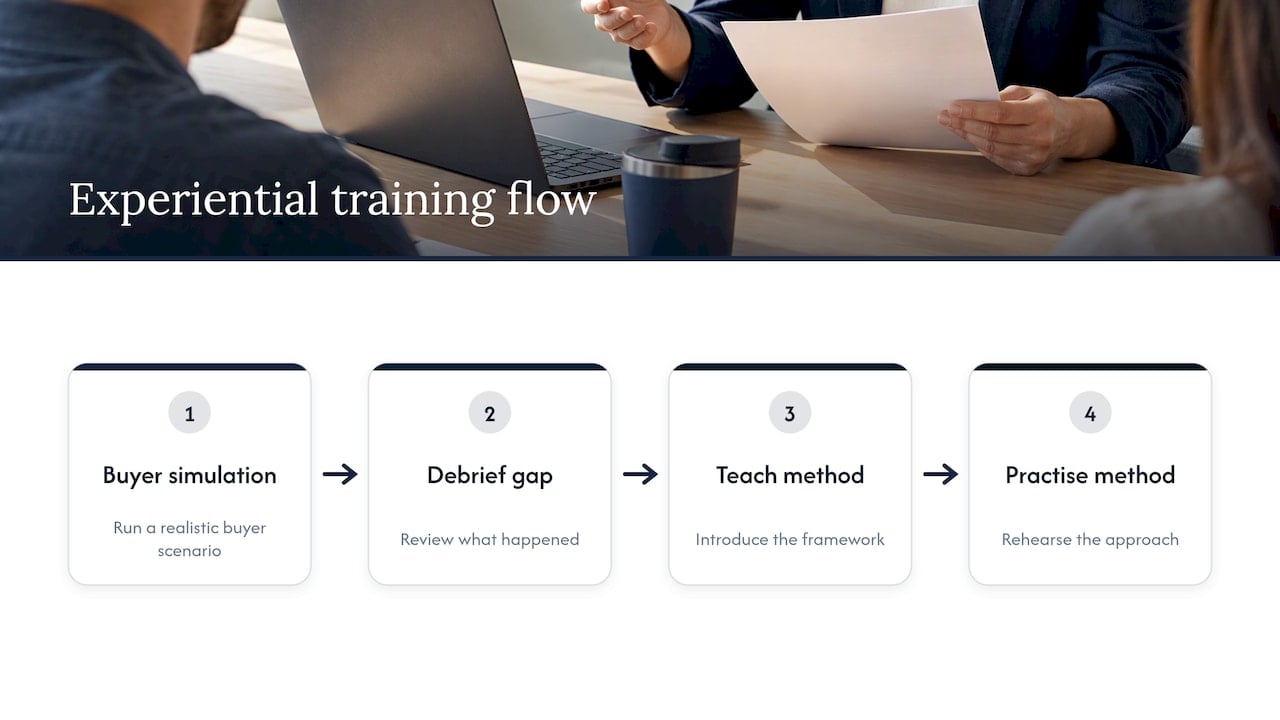
This is the most useful structural idea I know for kickoff design. One practitioner write-up describes an experiential flow: start with a live simulation that exposes a gap in current performance, introduce the method that closes it, then spend the remaining time practising. I would keep it simple. Run a short, realistic buyer scenario at 10:40 (a sceptical finance director, a stalled renewal), let reps handle it as they normally would, and debrief what happened. When people see their own instincts fall short, the framework you teach next is something they want, not something they sit through.
Put practice in the biggest blocks
The afternoon rotation is the heart of the day. Split the room into groups of four to six and run three or four stations, 20 to 25 minutes each:
- Discovery: asking better questions and listening for what is not said.
- Objection handling: the five objections that cost you the most deals this year, played with real wording from lost opportunities.
- Value conversations: talking about outcomes and cost of inaction, not features.
- Next steps: closing each call with a specific, dated commitment.
Each station needs a facilitator who gives feedback straight away. If you have no one internally who can coach well, an outside sales trainer for this block is money well spent.
End with commitments, not applause
The last working session should be quiet and personal. Each rep writes three actions for the first 30 days, shares them with their manager, and agrees a check-in date. Managers keep a copy. This is the bridge into everything that happens after the event.
Sales kickoff themes that give the agenda a spine
A theme is a single organising idea. One swag specialist describes it as the thing that gives the agenda a spine and gives attendees a shorthand to repeat afterwards. I agree with that, with one condition: the theme must come from your strategy, not from a film you like.
Start with the strategic priority, then find the phrase. A few examples of how that works:
| If your priority is… | A theme might be… | The agenda shows it by… |
|---|---|---|
| Moving up-market to larger deals | “Bigger conversations” | Senior-buyer role-plays, multi-threading clinic |
| Fixing late-stage deals that stall | “Finish strong” | Deal clinics, mutual action plans, next-step practice |
| Selling a new product line | “Day one of the new range” | Product positioning drills, customer panel |
| Rebuilding confidence after a tough year | “Back to fundamentals” | Core skills practice, wins from within the team |
| Pipeline discipline | “Full pipe, clean pipe” | Qualification workshops, CRM habits session |
Test your theme with one question: could a rep explain it to a colleague in ten seconds, and would it change what they do on a call? If not, keep looking.
Sales kickoff training content: what to teach and how long to teach it
The common mistake is trying to cover everything. People retain a little, practised well, far more than a lot, presented fast. I would pick no more than three skills for a one-day event.
Choose skills by evidence. Look at your lost deals and stalled opportunities over the last two quarters. Where do they die: discovery, pricing, decision-maker access, the final ask? Teach there.
Mix hard and soft. Process (qualification criteria, stage definitions) matters, but so does mindset. Reps who dread price conversations or avoid calling senior people need a different kind of session from a CRM walkthrough. If you want a primer on one proven approach to build on, our article on consultative selling techniques covers it, and training consultative selling shows how to make the skills last.
Keep product training short. Reps can read product updates. The kickoff is for the things that need a person across the table from them: conversation skills, feedback, peer learning.
Involve your best people. Ask two or three top performers to run a session on how they actually work a deal. Peers are credible in a way slides are not.
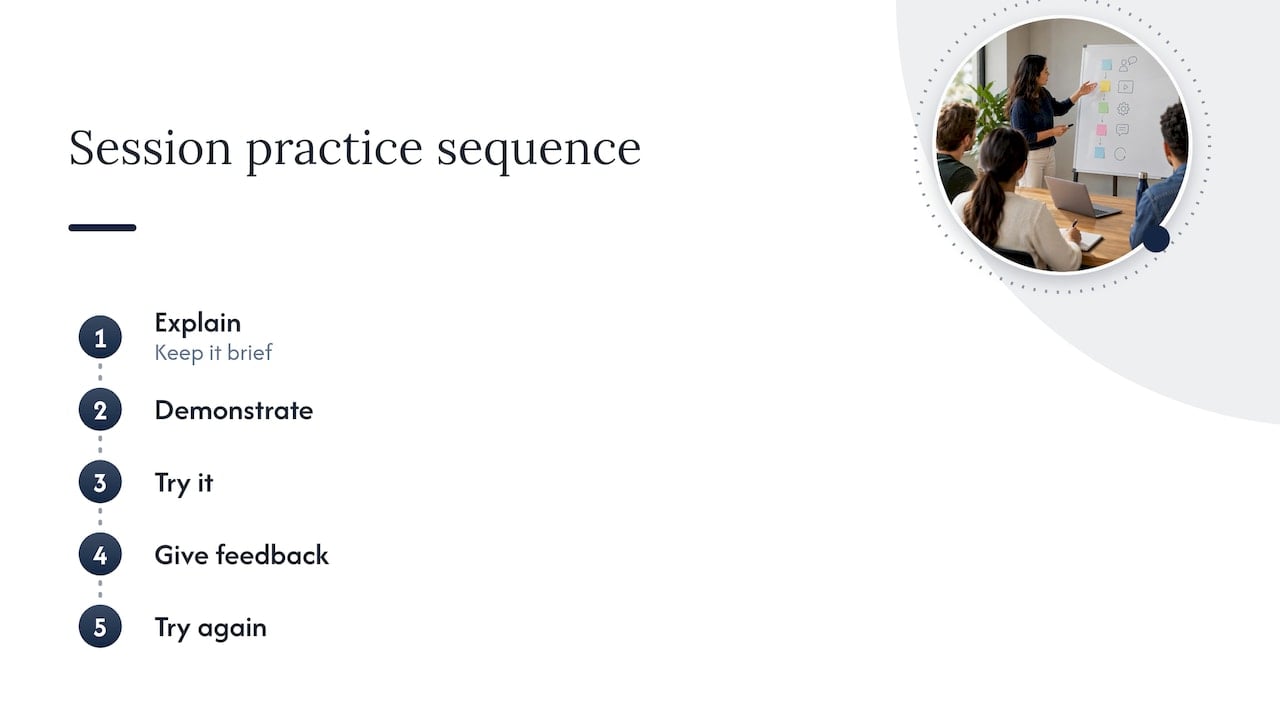
Use a consistent structure for each session: explain it briefly, demonstrate it, let people try it, give feedback, try it again. If a session has no “try it” step, it is a presentation, so shorten it.
Plan for accessibility from the start
In the UK, accessibility is a legal matter as well as good manners, because the Equality Act requires reasonable adjustments. Planning for it makes the day better for everyone.
Government guidance on making meetings accessible is a practical checklist. It covers induction loops, microphones and how to run discussions so everyone can follow. A few points I always apply:
- Ask early. Send a short pre-event form asking about access needs, dietary requirements and anything else people want you to know. The government’s advice on hosting inclusive online events also recommends surveying your audience in advance and sharing accessible agendas, which applies equally to in-person days.
- Use roving microphones. The same guidance notes that a single loop-connected microphone causes problems when several people contribute, so have more than one to pass around.
- Make materials readable. Use clear typefaces, large print and plain language. Local-authority guidance on age-friendly communication suggests sentences averaging 15 to 20 words and explaining any acronyms, which is a good test for kickoff slides too.
- Assign buddies. Pair each new starter with an established colleague for the day. It lowers the social risk of a big room and gives them someone to ask practical questions.
- Schedule real breaks and a quiet room. Back-to-back sessions exclude people and tire everyone.
If you are running a hybrid kickoff, give remote attendees their own moderator and their own practice groups. Do not leave them watching a livestream of the room.
Make the kickoff the start of a 90-day plan
The event is one day. The behaviour change takes months. Commentary from this year’s CIPD Festival of Work noted the long-term decline in training investment and the need for workforces that can keep learning. For sales leaders, the practical reading is that a kickoff on its own is not enough. It needs a plan around it.
Here is a simple one:
- Week 1: managers hold one-to-ones using the written commitments from the final session.
- Weeks 2 to 4: short weekly practice sessions (20 to 30 minutes) on one of the skills taught. Rotate who leads.
- Day 30: review early indicators: call quality, meetings booked, stage progression. Share the wins.
- Day 60: a half-day refresher or deal clinic on the skill where progress is slowest.
- Day 90: measure against the Q1 targets you set before the event, and decide what to keep, change or stop.
If your team has fallen behind and you need movement quickly, our 90-day sales turnaround plan sets out how I would structure that period. For ongoing manager-led practice, sales team coaching techniques is a good companion read.
Our perspective on kickoffs
We work with business owners and sales leaders who want their teams to hit target every quarter, and we see the same pattern again and again: the kickoff is energetic, the follow-through is thin.
Our view is that a kickoff earns its cost only if it is tied to coaching afterwards. That is why we combine 1:1 coaching with team training and consultancy, rather than treating a day of training as the whole answer. Training gives people the method. Coaching helps each person apply it to their own deals, their own habits and their own hesitations. Consultancy makes sure the process around them, from targets to pipeline stages, supports the behaviour you are asking for.
We would also say this to any owner planning a first kickoff: do not copy a corporate template built for 500 people. A team of 20 can run a tighter, more honest day with more practice in it. Smaller can be better.
And before you spend anything on a venue or speakers, decide what you will measure at 90 days. If you cannot say what success looks like, the agenda is not ready.
— Jerry
When to bring in outside help
You can run a perfectly good kickoff in-house. Outside support helps most in three situations: your managers have little coaching experience, the team needs a mindset shift (for example, around objections or price), or you want someone neutral to facilitate the practice blocks.
Our team-based coaching and consultancy engagements run from £4,500 to £8,500 as a one-off, and are built around your team’s numbers and gaps rather than an off-the-shelf course. You can see how packages are structured on our sales training cost page, or look at sales training for teams and solo operators if you want to compare formats. If you need ongoing leadership of the follow-through, our fractional sales director service is the option to look at.
Sales kickoff checklist
Use this as a final check before you send the invite.
- Three or four target behaviours written down, with Q1 measures.
- A theme that comes from strategy and can be explained in ten seconds.
- No presentation longer than 40 minutes, and no block longer than 90 minutes without a break.
- At least half the day spent on practice with feedback.
- Real deals and real objections used as practice material.
- Access needs surveyed, loop and roving microphones arranged, materials in clear, large type.
- Buddies assigned for new starters.
- Written commitments from every rep, shared with their manager.
- A 90-day follow-up calendar sent before the day itself.
FAQ
How long should a sales kickoff be?
For most UK teams under 60 people, one full day works well, or a day and a half if you want a social evening and a short second morning for deal clinics. Longer events tend to dilute the content. If travel is involved, check that the time on the ground justifies it.
What should be on a sales kickoff agenda?
A welcome and theme, an honest review of last year, the strategy and targets for the coming year, a skills block with live practice, a customer or top-performer session, and a commitments session. Add breaks, lunch and a social element. The running order above shows how to time each part.
What are some fun activities for a sales meeting?
The best ones are competitive and relevant: a timed objection-handling challenge, a pitch-in-60-seconds round judged by a customer, or a deal-clinic contest where teams get the same stalled opportunity and compare plans. Games that mirror the real job build skill and energy at the same time. Pure icebreakers have their place, but keep them short.
How do I choose a sales kickoff theme?
Start with your single biggest commercial priority for the year, then write a short phrase that expresses it. Check that it explains the agenda and would shape behaviour on calls. If it is only a slogan for the merchandise, it will not last past the afternoon.
Sources
- Sales Kickoff Agenda: How to Plan an SKO That Drives Revenue (ZoomInfo)
- How to Plan a High-Impact Sales Kickoff (HubSpot)
- Selling changed. Did your kickoff? (BTS)
- Sales kickoff themes: 25 ideas (Team Sunday)
- A handy guide to: Making meetings accessible (GOV.UK)
- Top tips for hosting accessible and inclusive online events (Accessibility in government)
- Age-Friendly Communication Guidelines (Live Well Cheshire West)
- CIPD Festival of Work 2026: people, performance and practical action