
Most coaches don’t have a coaching problem. They have a selling problem. You can change a client’s working life in six sessions and still struggle to get the first conversation to turn into a signed agreement. Good sales training for coaches fixes that gap: it teaches you to run a proper discovery conversation, price with confidence, handle “I need to think about it” and build a pipeline that doesn’t depend on referrals alone.
I’ve spent my career training and coaching sellers, and the coaches I work with are nearly always the same. They are brilliant with people and uncomfortable asking for money. This guide covers what to learn, what to avoid, and how to choose training that fits a UK solo practice rather than a 200-person sales floor.
TL;DR
- Coaches rarely lose clients on quality. They lose them in the conversation before the contract: weak discovery, vague pricing and no follow-up.
- Generic sales courses are built for employed reps. A solo coach needs training in consultative selling, pricing, objection handling and pipeline habits.
- Training on its own fades fast: without reinforcement, most of it is forgotten within a week. Pick something with live practice and 1:1 feedback.
- Judge any programme on whether it works on your real deals this quarter, not on a certificate.
- If you’re a UK coach or consultant at roughly £10k a month or above, a structured one-off programme usually pays back faster than piecemeal courses.
Table of Contents
- Why coaches struggle to sell (and why it isn’t your fault)
- What sales coaching is, and how it differs from sales training
- The five skills worth paying to learn
- A worked example: the same call, before and after
- Why one-off courses often don’t stick
- The wider picture: selling is harder for everyone
- How to choose sales training as a coach
- Should you hire a trainer, a coach or a consultant?
- Our view: what coaches get wrong about selling
- What it costs in the UK
- Where our programme fits
- Making any training pay: a 90-day plan
- FAQ
- Sources
Why coaches struggle to sell (and why it isn’t your fault)
Coaching training teaches you to listen, ask open questions and hold back from giving answers. Selling asks you to do some of the same things, then add things your training never covered: qualifying whether someone can actually buy, naming a price without apologising, and asking for a decision.
There are three patterns I see again and again.
The free-session trap. A prospect books a “chat”. You are generous, you ask great questions, and forty minutes later they have had a coaching session for nothing and feel no urgency to pay. The call was warm, and nothing came of it.
The price whisper. You get to the fee and your voice drops. You add a discount nobody asked for. The buyer reads the hesitation as doubt about the value.
The polite follow-up. “Just checking in” emails go out for a fortnight, then silence. You tell yourself they weren’t ready. Often the issue was that no next step was agreed on the call.
None of these are character flaws. They are skills gaps, and skills can be trained.
What sales coaching is, and how it differs from sales training
The two get mixed up constantly, and the difference matters when you’re spending your own money.
Sales training is structured teaching: a framework, a process, a set of techniques. It’s useful for building a foundation, and it’s usually delivered to groups.
Sales coaching is personalised and ongoing. It focuses on individual barriers, behaviours and real-time situations, which means you bring a live deal and work on it with someone who has sold in your market.
For a solo coach, the best results come from a blend. You need the framework (so you aren’t improvising every call) and the 1:1 feedback (so the framework fits your voice and your clients). That blend is what I build into every programme at Ahead of Sales, and it’s why I’m sceptical of anything that is only a video library.
The five skills worth paying to learn
If a programme doesn’t cover these, I’d keep looking.
1. Discovery that leads to a decision
Discovery is the part coaches are naturally good at, so the aim isn’t to ask more questions. It’s to ask the right ones: what is the problem costing them (in money, time or stress), what have they already tried, who else has a say, and what happens if nothing changes?
That last question is the one most coaches skip. A buyer who can describe the cost of inaction in their own words has already started justifying the fee.
2. Qualifying out, not just in
Every coach has taken on a client who wasn’t ready, wasn’t funded or wasn’t the decision maker. Qualification is the habit of finding that out in the first call. It protects your time and your results, because clients who are ready get better outcomes and give better testimonials.
3. Pricing and the money conversation
Practise saying your fee out loud until it sounds like a fact. Then stop talking. Silence after the price feels long to you and perfectly normal to the buyer.
Good training also covers packaging: moving from hourly sessions to outcome-based programmes, so the buyer is comparing your fee to the result and not to a number of hours.
4. Objection handling
“It’s too expensive”, “I need to talk to my partner”, “Can we start next quarter?” These are rarely the real objection. Training should teach you to explore what sits behind them without becoming pushy. In my experience, most coaches over-explain at this point. Fewer words and a better question work far better.
5. Pipeline and follow-up habits
The unglamorous bit. A coach with a steady pipeline can afford to be relaxed on calls, because no single prospect decides their month. Training should give you a weekly routine: how many conversations you need, where they come from and how you follow up in a way that doesn’t feel desperate.
A worked example: the same call, before and after
Here is a composite scenario, not a named client, to show how small changes alter the outcome.
A leadership coach in Manchester charges £400 a session and is converting roughly one discovery call in five. On a typical call she spends 35 minutes diagnosing and giving advice, then says, “So I do packages, they start at around £400 a session, but we can look at what works for you.” The prospect says they’ll think about it.
After training, the structure changes:
- She opens by agreeing the purpose of the call and how it will end (“by the end we’ll both know whether working together makes sense”).
- She spends 20 minutes on the problem, its cost and the decision process.
- She summarises back what she heard and asks whether she has it right.
- She presents one programme, with a fixed fee and a defined outcome, and stays quiet.
- She agrees a next step, with a date, before the call ends.
None of that involves tricks. It is structure, and the structure gives the buyer something clear to say yes or no to.
Why one-off courses often don’t stick
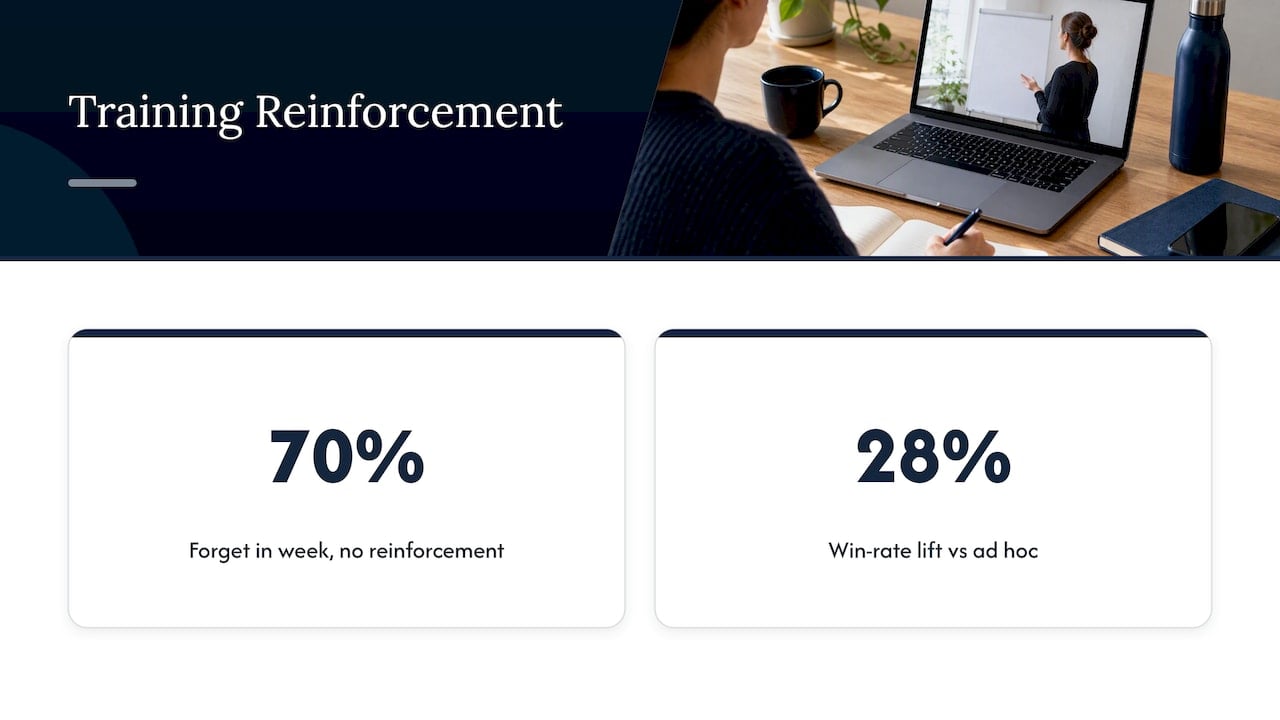
There’s a well-known retention problem in sales training. Gartner research reported by Sendspark says 70% of sales reps forget training content within a week without reinforcement. That finding is about sales teams, but I see the same pattern with solo practitioners. You come away from a two-day course buzzing, go back to a full diary, and by the following Friday you’re back to your old habits.
The fix is practice on real deals. Industry research suggests that is where the return sits too: a 2026 strategic report from Coachlab reports that teams with structured coaching programmes see up to a 28% higher win rate than those relying on ad-hoc feedback. Those figures come from team environments and vendor-published research, so treat them as direction rather than a promise. The logic holds for one person, though: feedback tied to your actual pipeline beats general advice.
The same point appears in the State of Sales Enablement report from Seismic, where an expert notes that coaching must match what the seller is dealing with right now. If you’re stuck on discovery, a session on negotiation is wasted. Good training diagnoses first.
The wider picture: selling is harder for everyone
If you feel selling has become tougher, you’re not imagining it. One analysis puts quota attainment at just 16% in 2024, which the author links to a shift from static training towards behaviour-based coaching. That figure describes employed sales reps, mostly in the US, so it isn’t a UK coaching benchmark. It does show that buyers are more careful and that polished pitches matter less than good conversations.
For coaches, that favours the consultative approach you already lean towards. If you’d like to see how that looks in practice, our piece on consultative selling techniques for real revenue growth walks through it.
How to choose sales training as a coach
When coaches ask me what to look for, I give them these criteria.
| Question | What a good answer looks like |
|---|---|
| Is it built for solo, service-based sellers? | Examples come from coaching, consulting or similar high-trust services, not from SaaS reps or retail. |
| Is there live practice? | Role-play and review of your real calls or deals, not only videos. |
| Is there 1:1 feedback? | You get individual input on your wording, pricing and pipeline. |
| Does the trainer sell for a living? | They have personally closed the kind of deals you want to close. |
| What happens after the course? | There is a way to reinforce it: check-ins, a community or a retainer. |
| Is the cost clear? | You know the fee and what it covers before you speak to anyone. |
I’d also be wary of two things. The first is any course that promises a fixed income number. Nobody can honestly guarantee that for a coach they haven’t met. The second is a heavy qualification focus. Some programmes lead to accredited credentials, such as the Level 5 qualification specifications from the Institute of Sales Professionals, which suit people building a sales career. If you’re a business owner who needs more clients next quarter, a credential is usually less useful than practice.
Should you hire a trainer, a coach or a consultant?
These are three different jobs.
- A trainer teaches a method to a group. Good when you want a common foundation.
- A sales coach works 1:1 on your calls and deals. Good when you have the basics but results are patchy.
- A consultant looks at the system: your offer, your pricing, your funnel. Good when the problem is bigger than your technique.
Most solo coaches need a mixture, which is why we combine them. If you suspect the issue is your offer or lead flow rather than your closing, our sales consultancy work looks at that first. And if you’ve been burned by coaching packages that stop at “12 sessions”, our note on why a set number of sessions isn’t the whole offer explains what to ask for instead.
Our view: what coaches get wrong about selling
We train coaches, consultants and HR consultants, and the same belief holds them back: that selling is the opposite of serving. It isn’t. A prospect who leaves a conversation without a decision hasn’t been helped. They are as stuck as when they arrived, and some of them will stay stuck for another year.
Our approach is to treat the sales conversation as the first stage of the work. You diagnose, you are straight about whether you can help and you ask for a decision. Where it isn’t a fit, you say so, and that honesty is what makes people refer you.
We also don’t believe in training anyone in the abstract. Every engagement starts with your current pipeline: the deals you’ve lost, the calls that stalled and the price you quietly discount. We fix those first, because that’s where the money is. Teaching it as theory comes second, and often isn’t needed at all.
And we’re patient about it. Changing how you sell takes repetition. Most people feel awkward for the first few calls with a new structure, then it becomes natural. Stick with it through the awkward stage.
— Jerry
What it costs in the UK
Prices vary widely, so here is what we publish. Our solo service business and consultant sales acceleration track is a one-off fee between £2,995 and £5,995. Team-based bespoke coaching and consultancy engagements run from £4,500 to £8,500 one-off. For ongoing support, The Sage Collective is £990 per month.
The full breakdown, and what influences where you land in each range, is on our sales training cost page. If you’re weighing up public funding, we’ve also written about sales training grants in the UK.
A simple way to judge any fee: work out what one extra client is worth to you over a year. If your programme is £3,000 and a typical client is worth that, the training pays for itself on one signature. That is a calculation to run on your own numbers, not a guarantee.
Where our programme fits
If you’re a UK coach, consultant or HR consultant running a service business and already bringing in around £10k a month, our sales coaching programme for solo operators is designed for you. It combines 1:1 coaching on your live deals with the structure and consultancy to fix your offer and pipeline. For consultants specifically, see how we approach closing higher-value deals in 6 to 8 weeks.
If you’re still working out the basics, Fundamental Sales Skills is the place to start. And if you want to talk through which route suits you, begin on the Ahead of Sales homepage.
Making any training pay: a 90-day plan
Whichever route you choose, these habits decide whether the money is well spent.
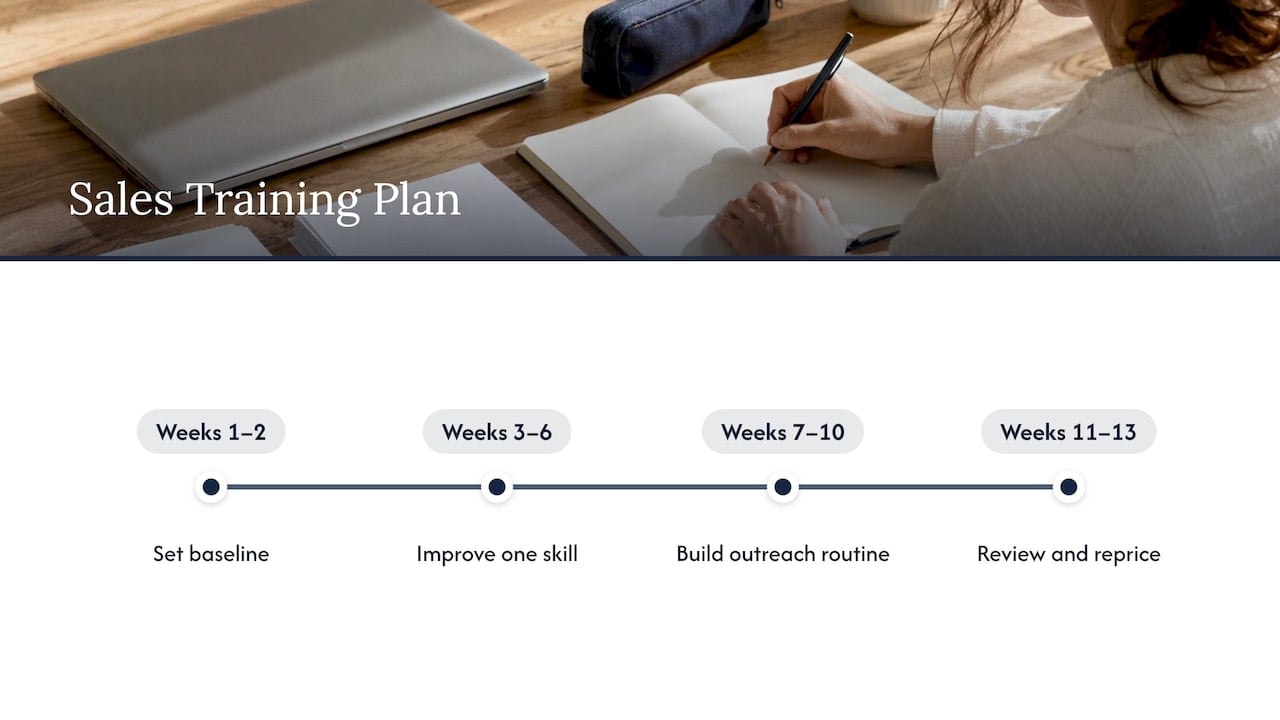
Weeks 1 to 2: baseline. Record or note your last ten discovery calls. How many ended with a next step? How many reached a clear price? How many got a decision? You can’t improve what you haven’t counted.
Weeks 3 to 6: one change at a time. Pick the biggest leak (usually qualification or the price conversation) and work on that alone. Changing everything at once makes it impossible to see what worked.
Weeks 7 to 10: build the pipeline routine. Block time weekly for outreach and follow-up. Retention and repeat business are part of this too: a client who renews or refers costs far less to win than a cold lead.
Weeks 11 to 13: review and reprice. If your conversion has improved, your fee probably should too. Most coaches wait far too long to raise prices.
Block the time in your diary now. Research on sales managers suggests that coaching doesn’t happen unless time is explicitly scheduled away from admin, and the same applies to your own development. If it isn’t in the calendar, it won’t happen.
FAQ
Do coaches really need sales training?
If you depend on referrals and they keep your diary full, you may not. Most coaches hit a ceiling, though, because referrals are unpredictable and don’t scale. Sales training gives you a repeatable way to turn conversations into clients.
How is sales training for coaches different from a standard sales course?
Standard courses are written for employed reps with leads handed to them, quotas and a script. Coaches sell a high-trust, high-ticket service, usually to a small number of buyers, often themselves. The training has to cover consultative discovery, pricing your own time and building your own pipeline.
How long does it take to see results?
It depends on your starting point and how many conversations you have. Most coaches notice a difference in how calls feel within a few weeks. Measurable changes in conversion usually need a couple of months of consistent practice, so be wary of anyone promising overnight results.
Is 1:1 sales coaching better than group training?
Neither is better in every case. Group training gives you a shared foundation at a lower cost, while 1:1 coaching works on your own deals and your own wording. Many coaches start with the foundation and then move to 1:1 once they know where their specific gaps are.
Can I do this without paying for training?
Yes, to a point. You can record your calls, study your own conversion numbers and read widely. What’s hard to replicate is an experienced seller watching you and telling you what you can’t hear yourself doing. That outside view is what you’re paying for.
Sources
- Sales coaching impact on profit 2026 strategic report, Coachlab
- Executive sales coaching: worth it in 2026?, Sendspark
- State of Sales Enablement 2023/24, Seismic
- 16% of reps hit quota last year, and why
- Level 5 qualification specifications, Institute of Sales Professionals
- How to increase customer retention: 5 proven strategies