
Tailored, inclusive sales training can be a useful route to sales improvement for LGBTQ entrepreneurs. It combines consultative selling, identity-aware language and weekly practice against clear targets. LGBTQ+ businesses already contribute over £106 billion to the UK economy, and the Equality Act 2010 shapes how you sell. The steps below show you how.
TL;DR:
- Record one sales call each week, score questions, talk time, and next steps, then rehearse pronouns, boundary lines, and biased objection responses with a peer.
- Track conversations booked, conversion rate, and revenue per client, while setting a process target such as ten conversations weekly because revenue lags activity.
- Pair LGBTQ community networks with sector groups and reciprocal referral partners, then track each introduction source to identify which relationships produce paying clients.
- Treat awareness courses as language training, not sales coaching; ask providers for comparable client results, references, tailored content, and agreed KPIs before enrolling.
- Published prices range from £2,995 to £5,995 for solo acceleration and £4,500 to £8,500 for team coaching; compare inclusions and calculate your break even point.
Table of Contents
- Why does tailored sales training matter for LGBTQ entrepreneurs?
- Which core sales skills should LGBTQ entrepreneurs adapt?
- Where can you build networks and find customers and referral partners?
- What does a practice plan look like?
- How do you choose a sales training provider that genuinely helps?
- What sales challenges are unique to LGBTQ entrepreneurs?
- What do success stories look like when sales training is tailored?
- How do you build a sales mindset and confidence as an LGBTQ business owner?
- What should you budget for bespoke sales training?
- What is the timeline from enrolment to measurable sales growth?
- Why do we run inclusive sales programmes?
- How can our inclusive sales programmes help you?
- FAQ
- Sources
Why does tailored sales training matter for LGBTQ entrepreneurs?
Generic sales advice assumes a seller who never has to think about disclosure, bias or belonging. That is not your reality. The report on LGBTQ+ businesses found that, alongside real economic strength, owners face discrimination, disclosure dilemmas and disconnection from mainstream business networks. Those pressures show up in daily selling: whether to mention a partner when building rapport, how to respond to an intrusive question, how to walk into a room where you are the only visible outsider.
Doubt, invasive questioning and a lack of role models can make one-size-fits-all programmes feel alienating. Tailored training starts from your starting point instead of treating it as a footnote.
There is also a legal backdrop worth knowing. The Equality Act 2010 requires organisations to prevent discrimination and promote equality, and that applies to customer-facing sales roles as well as workplace practice. It protects you as a seller, and it shapes how any team you hire should treat customers.
Which core sales skills should LGBTQ entrepreneurs adapt?
The fundamentals stay the same: ask good questions, listen, propose, close. What changes is how you apply them when identity is part of the conversation. Focus on these five:
- Consultative questioning. Map the buyer’s needs with open questions, and decide in advance how much of your own story a given conversation needs. Curiosity about them beats disclosure about you.
- Rapport with boundaries. Prepare a warm, short deflection for personal questions you would rather not answer, such as “That’s a longer story, but I’d love to hear how you got started.”
- Inclusive language and pronouns. Offer your own pronouns in email signatures and introductions, and ask rather than assume with new contacts: “How would you like me to address you in the proposal?”
- Storytelling. Use your identity as an asset (your lived understanding of an underserved community, say) without centring hardship. Lead with the result you create for customers.
- Objection handling for bias. Separate a price or fit objection from a prejudiced one. Answer the first with evidence, and meet the second with a calm, professional line, then decide whether the client is worth pursuing.
Pro Tip: Record one real sales call a week and listen only for moments where you over-explained yourself. Trim those first.
If you want structured help with the basics, our Fundamental Sales Skills programme covers the core techniques that these adaptations sit on top of.
Where can you build networks and find customers and referral partners?
Mainstream networking groups can feel closed, so build deliberately around communities where you are already welcome, then widen the circle on your terms.
- LGBTQ chambers and community networks. Join them for introductions to buyers who actively want to spend with queer-owned firms.
- Sector groups. Pair community membership with an industry body so you are known for your expertise, not only your identity.
- Allied referral partners. Offer reciprocal introductions to accountants, designers, recruiters and consultants who serve the same customers, and to niche community voices with an engaged following.
- Multi-channel outreach. Combine useful content, direct messages and in-person events rather than relying on one channel. This practical guide to multi-channel selling explains how to coordinate channels, and this lead generation playbook covers tactics for finding and nurturing prospects.
Track where each introduction came from. Over time, you will see which rooms actually produce revenue.
What does a practice plan look like?
Skills only stick when they are rehearsed. This routine can be practised without a budget.
- Baseline. Record real calls, score them against a simple sheet (questions asked, talk-to-listen ratio, clear next step), and write your current numbers down.
- Questions and language. Roleplay discovery calls with a peer. Practise your pronoun introduction and your boundary lines until they sound natural.
- Objections. Rehearse common objections, including a biased comment, with a friendly peer playing the buyer. Set aside time for outbound calls and apply what you rehearsed.
- Close and review. Practise asking for the sale and proposing next steps. Re-record a call, compare it with your baseline, and set future targets.
Track three KPIs throughout: conversations booked, conversion rate from conversation to paid work, and revenue per client. Peer roleplays, recorded calls and a one-page scorecard cost nothing and give you honest feedback quickly.
How do you choose a sales training provider that genuinely helps?
Treat the discovery call as an interview. Judge providers on evidence, not on the warmth of the website.
- Demonstrated outcomes. Ask for specific results from clients in situations like yours, and for references you can speak to.
- Bespoke content. The programme should change based on your market, offer and identity, not simply be a generic deck with a rainbow on the cover.
- Lived-experience competence. The trainer should handle inclusive language and sensitive topics fluently, and not need you to educate them.
- Practical KPIs. Agree in advance what success looks like: meetings booked, conversion rate, revenue.
Useful questions to ask: How would you adapt your approach to my situation? Which outcomes have comparable clients achieved? Who will actually coach me? What happens if progress stalls?
On engagement models, expect a mix of group cohorts, 1:1 coaching and consultancy. Awareness-style courses exist too, such as LGBTQ+ awareness training developed with LGBT Foundation, which covers terminology and inclusive language, but these build understanding rather than sales performance. Our own bespoke training article explains why tailored content tends to beat broad programmes.
What sales challenges are unique to LGBTQ entrepreneurs?
Some challenges are familiar to every founder: pricing nerves, inconsistent pipelines, discomfort with follow-up. Others are layered on top.
Disclosure decisions. Every new relationship raises a quiet question about how open to be. Sellers who decide case by case, without a plan, spend energy on it in every meeting. A simple personal policy removes that drain.
Isolation from mainstream networks. The business report found that many LGBTQ+ owners feel disconnected from mainstream business networks, which means fewer warm introductions and a pipeline that depends more on cold outreach.
Access to finance. Research on LGBTQ+ social enterprises shows higher structural barriers to external finance, with a lower success rate than peers. Where capital is tight, early sales matter even more, because revenue becomes the main way to fund growth.
Role models and doubt. Founders often report few visible examples of people like them selling confidently at scale. That absence feeds self-doubt, which in turn shows up as discounting too early or avoiding follow-ups.
Biased pushback. Occasionally a prospect’s comments cross a line. Without a rehearsed response, a seller can freeze or over-apologise.
The upside is real. Community loyalty is strong, and buyers who value inclusive suppliers often become long-term advocates. Training should turn that loyalty into a repeatable pipeline.
What do success stories look like when sales training is tailored?
We will not dress up anecdotes as evidence. What we can describe honestly is the pattern we see when training is tailored, so you know what to look for in any provider’s case studies.
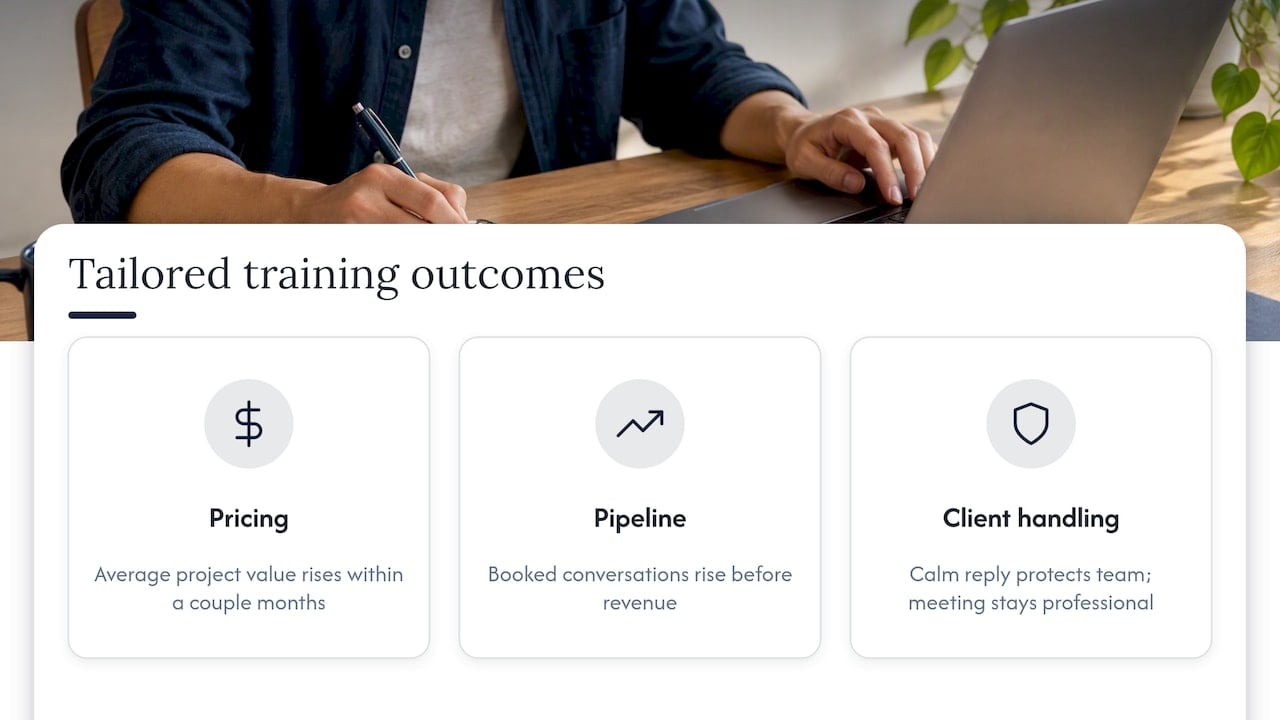
The consultant who stopped discounting. A solo service provider who had been quoting low to avoid awkward conversations learns to anchor on outcomes, rehearses her price conversation and holds her rate. The change is rarely dramatic overnight. It shows in a higher average project value within a couple of months.
The founder who rebuilt his pipeline. A founder relying on word of mouth from a single community adds a weekly outreach block, two referral partnerships and a simple follow-up routine. Conversations booked rise first, revenue follows.
The team lead who handled a difficult client. After rehearsing objection scripts, a founder responds calmly to a prejudiced comment, keeps the meeting professional and protects her team. The practice mattered more than the script.
When you read any provider’s case studies, check four things: is the client’s situation similar to yours, is the metric specific, is the timeframe stated, and can you speak to the client? If the answer to all four is no, treat the story as marketing, not proof.
How do you build a sales mindset and confidence as an LGBTQ business owner?
Confidence in sales is built, not inherited. Start by reframing what selling is: a service conversation in which you help someone solve a problem, and being paid for it is the fair exchange.
Next, separate two sources of discomfort that often get tangled together. One is ordinary sales anxiety, which every founder shares. The other is the extra vigilance that comes from reading a room for safety. Naming them apart helps, because the first responds to practice and the second responds to preparation: knowing your boundaries, your scripts and your exit lines.
Practical habits that build momentum:
- Keep a wins file. Write down every positive reply, referral and closed deal. Review it before a big call.
- Find a peer or mentor. Even one fellow founder who sells for a living gives you a role model and a roleplay partner.
- Set process goals. Aim for ten conversations a week, not a revenue figure you do not fully control.
- Lead with value. Open with the problem you solve, and let your identity be part of the story, not the apology.
Over time, repetition does the quiet work. Each pricing conversation can feel easier with practice. Our guide to how tailored coaching drives growth explains how coaching speeds up that repetition.
What should you budget for bespoke sales training?
Think of training as an investment measured against the revenue it should create, not a cost to be minimised. Fees vary with format, from group cohorts to fully bespoke coaching.
For reference, we publish our own ranges. Team-based bespoke coaching and consultancy engagements run from £4,500 to £8,500, and our sales acceleration track for solo service businesses and consultants runs from £2,995 to £5,995, as set out on our sales training cost page. The Sage Collective is £990 per month. Current cohort prices are on our Sales Training Cohorts page.
When you weigh any quote, ask what is included: number of 1:1 sessions, materials, access between sessions, and whether KPIs are tracked. Work out your break-even: how many extra clients at your average project value would repay the fee? If only a small number of additional clients would repay the fee, the maths may be sensible. If it would take many more, keep looking.
Funding is worth exploring too. Our guide to sales training grants outlines options for teams, and being aware that LGBTQ+ organisations can face barriers to external finance is a good reason to plan your budget early and phase the spend.
What is the timeline from enrolment to measurable sales growth?
A well-run programme follows a predictable arc, so you can judge progress without guessing.
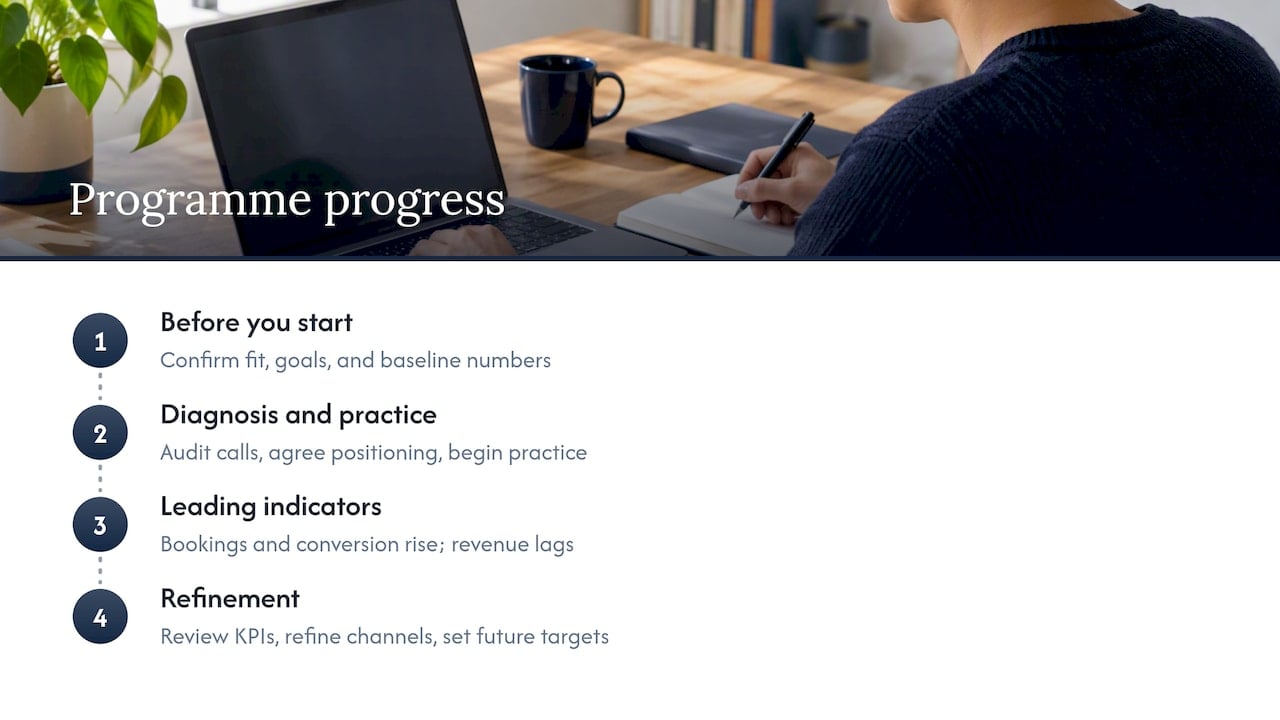
Before you start. A discovery call confirms fit, your goals and your baseline numbers: current conversations per week, conversion rate and average deal value.
At the start. Diagnosis and foundations. You audit real calls, agree your positioning and begin the regular practice routine described above. Early wins are usually behavioural: better questions, clearer next steps, fewer unnecessary discounts.
As the programme progresses. Skills show up in numbers. You may see more conversations booked and a rising conversion rate as objection handling improves. Revenue tends to lag activity, because deals take time to close, so judge early progress on leading indicators.
As you continue. Refinement. You review KPIs, drop what is not working, double down on the channels that convert and set future targets.
Be sceptical of any provider that promises overnight transformation. Sales cycles in your market set the pace, and a provider should tell you honestly how long yours is likely to be. Agree review points in writing so progress is visible at every stage.
Why do we run inclusive sales programmes?
We built our programmes around outcomes, delivered through cohorts, 1:1 coaching and consultancy, because we have seen how often capable founders are held back by advice that was never written for them. We measure success by what happens to your pipeline and your revenue, not by attendance. Our cohorts are designed to give you a place to practise. If that appeals, explore our cohort or bespoke options below.
— Jerry
How can our inclusive sales programmes help you?
If you want a supported route from training to sales growth, these are the options we offer:
- Sales Training Cohorts. Group programmes for founders and teams who learn well alongside others, including our inclusive sales accelerator for LGBTQ+ and women founders.
- The Sage Collective. Our membership for scaling leaders and teams, at £990 per month.
- Solo sales accelerator. 1:1 sales coaching for solo service businesses and consultants who want faster progress.
- Fractional Sales Director. Senior sales leadership on a part-time basis for growing businesses.
Solo founders usually start with the accelerator, small teams with a cohort, and scaling organisations with The Sage Collective or a bespoke engagement.
Book a discovery call through our Sales Training Cohorts page and we will talk through your goals, your baseline and the programme that fits.
FAQ
What is sales training for LGBTQ entrepreneurs?
It is sales coaching that teaches core selling skills while accounting for identity-related realities such as disclosure, bias and network gaps. It combines consultative selling, inclusive language, roleplay and measurable targets. The aim is simple: more conversations, better conversion and higher revenue.
Does the Equality Act 2010 apply to my sales team?
Yes. The Equality Act 2010 requires organisations to prevent discrimination and promote equality, which covers customer-facing sales roles. It is worth checking the official guidance for your specific circumstances or taking professional advice.
How long does it take to see results from sales training?
Behaviour usually improves within the first month, and leading indicators such as conversations booked tend to follow within a few months. Revenue lags activity because it depends on your sales cycle, so agree review points and KPIs at the start.
What should I ask a sales training provider before signing up?
Ask how they would adapt the programme to your situation, which outcomes comparable clients achieved, who will coach you and how progress is measured. A good provider answers specifically and offers references.
Can I practise these skills without paying for training?
Yes. Recording calls, running peer roleplays and using a simple scorecard cost nothing and build real skill. Paid training adds expert feedback, structure and accountability, which speed up the same process.
Sources
- LGBTQ+ businesses contribute over £106 billion to the UK economy despite huge challenges, report finds – BeBeez International
- ADDRESSING THE FUNDING GAP OF LGBTQ+ SUPPORT ORGANISATIONS Can social investment be part of the solution?
- Gov