
Yes, you can shorten sales ramp time significantly by combining short, role-specific learning with in-flow guidance and targeted 1:1 coaching. We’ve seen this mix outperform longer, theory-heavy onboarding programmes because it trains the behaviours reps actually need at the moment they need them. Below, we walk through benchmarks, the metrics worth tracking, six proven tactics, a 30/60/90 template and how to tie the improvements back to revenue.
TL;DR:
- Define ramp time by role: SDR progress can mean sustained qualified meetings, while an AE may need months to close deals and reach quota.
- Track first qualified outcomes and weekly quota trends, then intervene when day 30, 60, or 90 milestones slip with coaching or territory changes.
- Pair five to ten minute lessons with spaced repetition and a scored roleplay within 48 hours; guidance reports up to 60% fewer training hours.
- Require a qualified meeting by day 30, weekly call reviews by day 60, and leader signoff by day 90, with pass criteria at every stage.
- Test onboarding with six to twelve reps against a control group with similar starting conditions, and track quota through months six to nine.
Table of Contents
- What is ramp time and how do you calculate it?
- Which metrics and checkpoints matter most during ramp?
- Proven strategies to reduce ramp time
- A practical 30/60/90 day ramp plan template
- Measuring, iterating and tying ramp gains to revenue
- Applied practice: how we approach cutting ramp time
- What actually moves the needle on ramp
- Get help shortening your team’s ramp time
- FAQ
- Sources
What is ramp time and how do you calculate it?
Ramp time is the period between a new sales rep’s start date and the point at which they reach full productivity, usually defined as consistently hitting quota or closing deals at the same rate as a tenured rep. Some teams measure it differently depending on role: for an SDR, it might be time to a sustained run of qualified meetings; for an account executive, it’s often time to the first closed deal, then time to full quota attainment.
The simplest formula is:
Ramp time = Date of first sustained quota attainment minus start date
A more granular version breaks this into stages:
Ramp time = Time to first activity + Time to first qualified outcome + Time to quota consistency
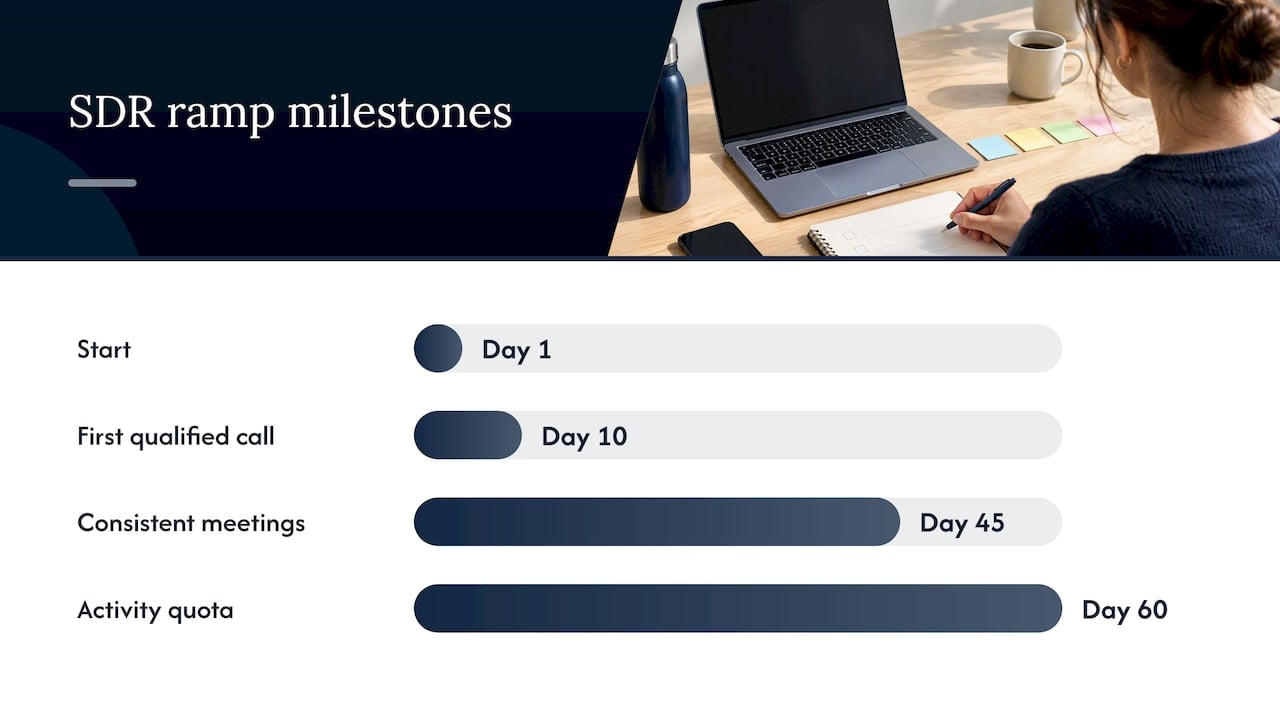
Say an SDR starts on day 1, makes their first qualified call by day 10, books a consistent run of qualified meetings by day 45, and hits their activity quota by day 60. Their ramp time is 60 days. An AE with a longer sales cycle might not close a first deal until day 90 and may not reach full quota attainment until month five or six.
Recent benchmarking from HubSpot’s onboarding research indicates that AEs often take several months to reach full productivity, with SDRs generally ramping faster due to shorter activity cycles. These are ranges, not fixed targets. The following factors stretch or compress them:
- Deal size and sales cycle length: longer, more complex cycles extend the time needed to observe a full sales motion.
- Onboarding quality: structured, milestone-based onboarding consistently shortens ramp compared with ad hoc shadowing.
- Coaching cadence: frequent, short coaching sessions accelerate skill transfer more than infrequent, lengthy ones.
- Product and market complexity: technical or multi-stakeholder sales naturally take longer to master.
Which metrics and checkpoints matter most during ramp?
Tracking the right signals early lets you intervene before a slow ramp becomes a missed quarter. The goal isn’t to monitor everything, it’s to watch the handful of numbers that predict whether a rep is on track.
- Time to first activity (first call, first demo booked): flags whether onboarding and tooling access are working from day one.
- Time to first qualified meeting or opportunity: the earliest real signal that the rep can apply training in a live setting.
- Activity-to-outcome conversion rate: compares a new rep’s conversion against the team average to spot skill gaps early.
- Quota attainment curve: tracked weekly rather than only at quarter-end, this shows whether the trajectory is improving or flatlining.
- Day 7 checkpoint: system access, product knowledge quiz passed, first shadowed call completed.
- Day 30 checkpoint: first independent qualified meeting booked, objection-handling role-play scored.
- Day 60 checkpoint: supervised deals in pipeline, coaching scores trending upward.
- Day 90 checkpoint: quota attainment at or near team average, sign-off for full autonomy.
When a rep misses a checkpoint, that’s the trigger for a structured intervention: extra coaching sessions, a revised territory, or in some cases a role reassignment before the gap becomes unrecoverable.
Proven strategies to reduce ramp time
Six tactics consistently shorten ramp when applied together rather than in isolation.
- Microlearning and spaced repetition: break training into 5 to 10 minute lessons focused on one skill, then schedule repetition over several weeks. Industry L&D guidance from eLearning Industry shows this approach can cut formal training hours by up to 60% while maintaining or improving retention.
- Blended learning: move theory and product knowledge into short digital modules, then reserve live sessions for practice, objection handling and coached role-play. This keeps classroom time focused on application rather than lecture.
- In-flow guidance and playbooks: embed call scripts, objection responses and next-best-action prompts directly inside the CRM and calling tools reps already use. This reduces the cognitive load of recalling training content mid-conversation.
- 1:1 coaching and field visits: short, frequent coaching cycles with scored rehearsals apply new skills faster than a single long training event followed by silence. Our field sales training approach builds this cadence into the first sixty days deliberately.
- Role-based progression over time-in-role: certify reps on demonstrated milestones (first qualified meeting, first scored role-play pass) rather than simply “they’ve been here six weeks”.
- AI-enabled enablement: Gartner projects that organisations embedding AI-driven, in-workflow enablement will achieve up to 40% faster sales-stage velocity by 2029 compared with traditional methods. Used well, this means personalised practice prompts and in-moment coaching nudges, not a replacement for a coach’s judgement.
Pro Tip: Pair every microlearning module with a scored role-play within 48 hours, retention drops fast without immediate practice.
A practical 30/60/90 day ramp plan template
A good ramp plan has objective pass criteria at each stage, not vague goals like “get up to speed”.
- Day 0 to 30: complete product and process knowledge checks, shadow at least five live calls, deliver two scored role-plays, and book a first independent qualified meeting. Pass criteria: knowledge check score above the team baseline and at least one qualified meeting logged.
- Day 31 to 60: run supervised selling with a coach reviewing calls weekly, complete a milestone assessment covering objection handling and discovery, and begin building an independent pipeline. Pass criteria: activity-to-outcome conversion within range of team average and coaching scores trending upward.
- Day 61 to 90: operate with growing autonomy, work towards a quota target proportional to a tenured rep’s output, and complete a transition sign-off documenting readiness against the KPIs tracked since day one. Pass criteria: quota attainment at or near team benchmark and sign-off approved by the sales leader.
Documenting each phase this way means a slow ramp is visible by day 30, not discovered at the end of a disappointing quarter.
Measuring, iterating and tying ramp gains to revenue
Treat ramp-reduction tactics as experiments, not permanent fixtures adopted on faith.
- Run a small pilot cohort of six to twelve new reps against a control group using the previous onboarding process, as recommended in onboarding research from HubSpot.
- Form a clear hypothesis before starting: for example, “microlearning plus weekly coaching will cut time to first qualified meeting by two weeks”.
- Track both short-term signals (30 to 60 day KPIs) and medium-term outcomes (quota attainment at month six to nine) before declaring success.
- Watch for attribution pitfalls: a stronger hiring bar or an easier territory can mimic a training effect, so compare cohorts with similar starting conditions.
- Once a tactic proves out, update your capacity and hiring plan: a shorter ramp means new hires contribute to pipeline sooner, which changes how many reps you need to hit a given revenue target.
Applied practice: how we approach cutting ramp time
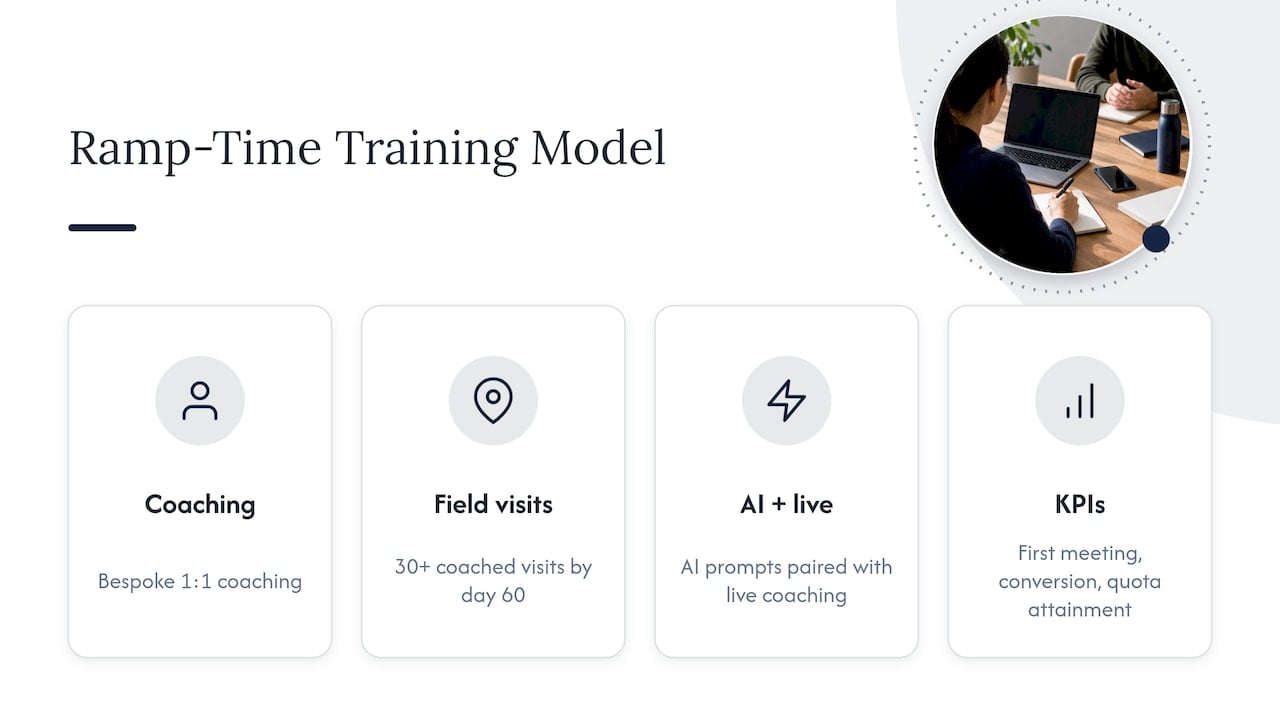
In our engagements, we combine bespoke 1:1 coaching with field visits and modular training built around the same milestones outlined above. Our field sales training model includes more than thirty coached visits by day sixty, mapped directly to a 30/60/90 structure. We also blend AI-supported prompts with live coaching where it genuinely speeds skill application, rather than as a substitute for a coach watching a real call. Teams working with us track the same KPIs covered here, time to first meeting, conversion rate, quota attainment, from day one.
What actually moves the needle on ramp
If we had to pick one priority, it’s this: spend less time building more content and more time running scored practice with fast feedback. The common trap is bulk training rolled out without any measurement attached, which feels productive but tells you nothing about whether reps can actually sell. For a quick win this week, pick a single metric, time to first qualified meeting, and start tracking it against every new hire’s cohort. For a grounded view of field-level technique that complements structured coaching, Jarrod Harman’s sales tactics are worth a look.
— Jerry
Get help shortening your team’s ramp time
We build ramp-reduction programmes around the exact mix covered above: bespoke 1:1 coaching, field visits and modular training mapped to measurable milestones, not generic course libraries. Our packages typically run from £4,500 to £8,500 for team-based coaching and consultancy engagements, and from £2,995 to £5,995 for solo service businesses and consultants, with pricing matched to the scope of the engagement.

If you’re weighing up where to start, our Sales Training Cohorts page outlines how a cohort pilot works, and the Ahead of Sales homepage covers the full range of programmes, including The Sage Collective. Get in touch to talk through what a shorter ramp would look like for your team.
FAQ
What does “ramp time” mean in the context of sales?
Ramp time is the period a new sales hire needs to go from starting the role to performing at a consistent, fully productive level, typically measured against quota attainment or deal-closing rate. It covers everything from initial product training through to independent selling.
What is the meaning of ramp time?
In a sales context specifically, ramp time measures the period a new rep requires to reach the output level of an established team member. Outside sales, the term can apply more broadly to any new employee reaching full productivity, but the sales usage centres on quota and pipeline metrics without specifying a precise duration.
How long is the ramp up period?
Ramp length varies by role and sales cycle complexity. Recent HubSpot research indicates that AEs typically require multiple months to reach full productivity, while SDRs tend to ramp faster given shorter activity cycles.
What does “ramp in work” mean?
“Ramping in” generally refers to the gradual increase in a new employee’s workload and responsibility as they build competence, rather than being handed a full caseload or quota from day one. In sales, this often means starting with supervised activity before moving to independent pipeline ownership.
Sources
- Gartner predicts AI-driven sales enablement will deliver 40% faster sales stage velocity than traditional enablement methods by 2029
- Onboarding new sales reps + manuals and templates that help you get it right
- Cut training time, boost learning outcomes – eLearning Industry