
Bespoke sales training delivers targeted, measurable commercial gains when it is diagnostic-led, intensive and reinforced. UK firm-level evidence finds that training intensity and targeting can lift productivity by 5.5-10.8% for professional staff, and we’ve built our own approach around that same principle: coaching that is tailored to the individual seller rather than poured from a generic mould. The gains only hold, though, when leaders measure them and when managers get involved too.
TL;DR:
- A study of more than 50,000 retail associates found sales rates rose 1.8% per online module completed, but gains varied by seller and could fade.
- UK evidence found that adding manager training amplified productivity effects by roughly 20–25% compared with training sales staff alone, while continued coaching helps skills persist.
- Run a 6–8 week pilot with baseline metrics before training, then expand only after reviewing results and refining the curriculum.
- Track leading indicators weekly during the pilot, review commercial outcomes monthly after launch, and compare quarterly people metrics with the original baseline.
- Map exercises to live CRM stages and deals, and involve the CRM owner early, so managers can coach techniques when opportunities stall.
Table of Contents
- 1. Core benefits explained: revenue, productivity and people metrics
- 2. What makes a programme truly bespoke versus off-the-shelf
- 3. Evidence and practical ROI: how to interpret research for decision-making
- 4. Implementing bespoke training: procurement steps, timeline and budget expectations
- 5. How to measure success: metrics, baseline and reporting cadence
- 6. Ahead of Sales: our approach and proof points
- 7. Integration of bespoke training with existing sales processes and CRM systems
- 8. Scalability of bespoke training programs across different team sizes and geographies
- 9. A leadership view on prioritising bespoke training
- Where Ahead of Sales can help and how to proceed
- FAQ
- Sources
1. Core benefits explained: revenue, productivity and people metrics
We’ve sat across the table from enough sales leaders to know what finance directors actually want to hear: will this move the numbers, and by how much. Bespoke training, done properly, moves three sets of numbers that matter to a board.
The first is win rate and deal value. A programme built around your actual buyer objections, your actual sales cycle and your actual product complexity teaches sellers to handle the conversations they’ll genuinely have, not a generic script. That specificity tends to show up in stage conversion: more qualified opportunities progress rather than stalling at the same points they always stalled at before.
The second is ramp time. New hires who go through a curriculum built on your own sales motion get to competence faster than those sitting through a one-size-fits-all onboarding deck. Every month shaved off ramp time changes the cost-per-hire maths, because a rep who hits quota in month four rather than month seven has simply cost less to bring online.
The third is retention and engagement. Sellers who feel invested in, rather than processed through a compliance module, tend to stay longer. Replacing a mid-level salesperson is expensive once you count recruitment, lost pipeline continuity and the ramp time of the replacement, so even a modest improvement in retention compounds quickly.
A few illustrative patterns worth holding in mind when you build a business case:
- Faster ramp time reduces the effective cost of each new hire because productive output starts sooner.
- Higher stage conversion from targeted objection handling increases pipeline yield without adding headcount.
- Improved retention protects institutional knowledge of accounts and reduces repeated onboarding costs.
Pro Tip: Ask any training provider to show you how their curriculum maps to your specific sales stages before you commit budget.
Training intensity and targeting matter more than breadth. UK firm-level research on training productivity found that poorly designed broad coverage with low intensity can actually reduce output by disrupting workflows, while concentrated, targeted investment above a certain intensity threshold produces sharply rising returns. That’s the core argument for bespoke over generic: breadth without depth can do more harm than good.
2. What makes a programme truly bespoke versus off-the-shelf
Plenty of providers describe their offering as “tailored” when what they actually mean is a generic deck with your logo added to the title slide. Genuine customisation looks different, and it’s worth knowing what to check for before you sign anything.
A real diagnostic comes first. We start by understanding where deals actually stall, which objections reps consistently fumble, and which commercial bottleneck is costing the most revenue, before a single training hour is designed. That diagnostic should shape the curriculum, not just decorate it.
Role-based content follows. A new business hunter needs different skills from an account manager protecting renewal revenue, and a bespoke programme reflects that split rather than teaching everyone the same generic pitch structure.
- Confirm the provider runs a diagnostic needs analysis before proposing any curriculum.
- Ask how much of the delivery is 1:1 coaching versus group workshop content.
- Check whether live-deal practice (working actual pipeline opportunities, not hypothetical case studies) is built into sessions.
- Ask what happens after the main delivery: is there spaced follow-up coaching, or does it end when the workshop does.
- Request evidence of how managers are involved in reinforcing the training once it’s delivered.
The delivery mix matters as much as the content. Field research on training transfer shows that spaced practice and follow-up coaching improve how well skills stick, whereas single-session workshops tend to show weaker sustained effects. A two-day intensive that ends with no reinforcement plan is unlikely to change behaviour six months later, however well it was delivered on the day.
Manager coaching is the piece most programmes skip, and it’s the piece that determines whether training sticks or fades. A seller who learns a new technique in a workshop needs a manager who recognises that technique in a live deal review and reinforces it, otherwise the new habit competes with old habits and usually loses.
3. Evidence and practical ROI: how to interpret research for decision-making
Sales training research tends to get oversold in two directions: either a case study implies every programme produces miracle results, or sceptics dismiss training entirely because some programmes fail. The honest picture sits between those extremes.
A large field study covering more than 50,000 retail sales associates found a 1.8% increase in sales rate for each online training module completed, but the same research makes clear that effects are heterogeneous: some sellers respond strongly, others barely move, and the gains can fade over time. That heterogeneity is the single most important thing to build into your expectations. A bespoke programme targeted at your highest-potential sellers, or at your most costly bottleneck, is more likely to produce a strong return than the same budget spread thinly across everyone.
The companion research on this topic adds a second, related finding: programmes that build in repetition, live-deal practice and follow-up coaching produce stronger transfer than one-off workshops, and peer spillover effects within a cohort can run positive or negative depending on how enthusiastically colleagues engage. A single disengaged voice in a cohort can quietly drag down the group’s uptake.
UK-specific evidence reinforces the same lesson from a productivity angle. Firms that combine staff training with manager training see effects amplified by roughly 20-25% compared with training the sales team alone, because managers who understand the new approach can coach it into daily habit rather than letting it decay.
What this means practically for a business case:
- Set expectations as ranges, not guarantees: expect variation across your team, not a uniform uplift for every seller.
- Budget for a measurement-and-reinforcement cycle, not a single training event, since effects can fade without follow-up.
- Pair any seller-facing programme with manager coaching wherever possible, since the evidence consistently shows this amplifies results.
- Treat your highest-opportunity cohort (new hires, or a specific underperforming segment) as the first place to concentrate budget rather than spreading it evenly.
One realistic way to frame a business case: if targeted, intensive training combined with manager coaching can amplify productivity effects by around 20-25% over training alone, the manager component is not an optional extra. It’s close to half the value.
4. Implementing bespoke training: procurement steps, timeline and budget expectations
Commissioning bespoke training works best as a staged project rather than a single large purchase decision, and the sequence matters.
- Diagnostic phase. Before any curriculum is written, map your sales stages, pull recent lost-deal reasons and interview a handful of reps and managers to find where the commercial bottleneck actually sits.
- Pilot (typically 6-8 weeks). Run the proposed curriculum with one team or cohort, with clear baseline metrics captured before the pilot starts so you can measure change against something real.
- Phased roll-out. Extend the programme to further teams or regions once the pilot has validated the approach and the content has been refined based on what the pilot revealed.
- Reinforcement and coaching. Build in spaced follow-up sessions and manager coaching cycles rather than treating delivery as a one-off event.
Budget bands vary by scope and delivery format. As a reference point, fully bespoke packages combining coaching and consultancy for teams typically run from £4,500 to £8,500 as a one-off engagement, while solo consultants and service business owners looking for a sales acceleration track typically see packages from £2,995 to £5,995. These figures are illustrative of the market we operate in rather than a universal rule, and the right band for your business depends on team size and scope.
Governance matters more than most procurement teams expect at the outset. Someone needs to own the baseline metrics, someone needs to sign off the pilot design before it launches, and someone (usually a sales operations lead or the commissioning sales leader) needs to own the post-pilot decision on whether to scale.
The most common pitfall is treating training as an event rather than a programme: a single intensive week with no manager involvement and no follow-up coaching. The second most common pitfall is spreading budget too thinly across the whole team instead of concentrating it where the diagnostic shows the greatest bottleneck. Both are avoidable by holding firm on the diagnostic-pilot-reinforce sequence rather than skipping straight to a full roll-out.
5. How to measure success: metrics, baseline and reporting cadence
A bespoke programme is only as credible as the measurement sitting underneath it. Before training starts, capture a baseline across the metrics you intend to track, so that any change can be attributed with some confidence rather than argued about after the fact.
Core commercial metrics to track include win rate, stage-by-stage conversion, average deal size, sales-cycle length, ramp time for new hires and quota attainment, since these are the metrics most organisations already use to judge whether a sales investment has worked.
| Metric type | Examples | When it moves |
|---|---|---|
| Leading indicators | Activity volume, opportunity quality, demo-to-proposal conversion | Weeks 1-4 post-training |
| Lagging indicators | Win rate, average deal size, sales-cycle length | Months 2-6 post-training |
| People indicators | Ramp time, quota attainment, retention | Ongoing, reviewed quarterly |
Watch leading indicators early, since commercial outcomes take longer to show up and waiting for lagging metrics alone risks missing a problem until it’s expensive to fix. A sensible cadence is a weekly leading-indicator check during the pilot, a monthly commercial review once live, and a quarterly retrospective against the original baseline. For measurement infrastructure, a well-configured CRM dashboard makes this far easier to run; Pipedrive forecasting and team reporting is one practical way teams set this up without building bespoke reporting from scratch.
6. Ahead of Sales: our approach and proof points
We built our model around the principle the evidence keeps pointing to: bespoke, 1:1 coaching combined with structured consultancy, rather than a generic workshop delivered once and forgotten.
We work with two distinct buyer profiles. The first is teams of roughly 50 to 1,000 staff with a genuine growth mindset, where our fully customised coaching and consultancy packages run from £4,500 to £8,500. The second is solo service businesses and consultants, where our sales acceleration track has pricing starting in a defined range. Both profiles get a programme shaped around their actual pipeline, not a template.
For teams exploring funding routes, our guide on sales training grants covers options that can reduce the net cost of a bespoke engagement, and our ROI toolkit is a useful next stop for anyone building the measurement case internally before approaching budget holders.
7. Integration of bespoke training with existing sales processes and CRM systems
Training that sits apart from your existing sales process rarely survives contact with a busy pipeline. The strongest programmes map new techniques directly onto the stages already defined in your CRM, so that a rep learning a new objection-handling approach practises it on a live deal sitting in the exact pipeline stage where that objection actually comes up.
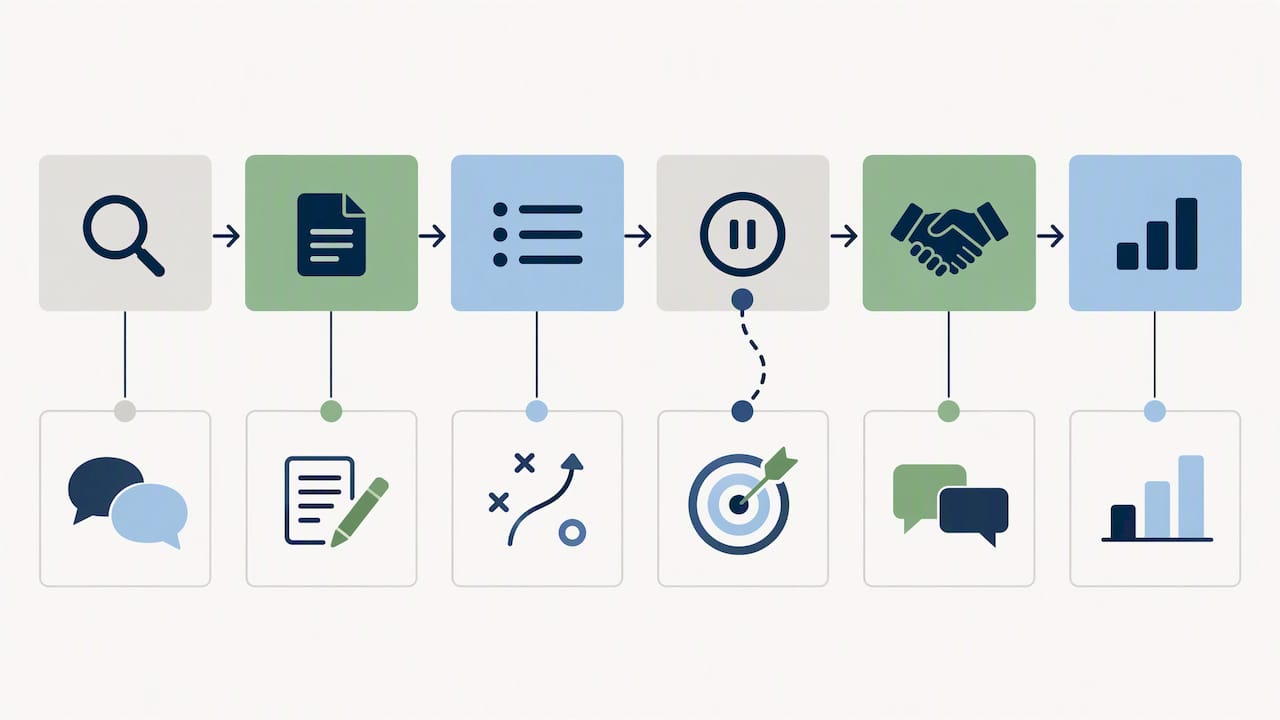
This matters for two reasons. First, it means the skills get reinforced every time a rep works their pipeline, not just during scheduled training sessions. Second, it gives managers a natural coaching trigger: when a deal stalls at a particular CRM stage, that becomes the prompt for a coaching conversation tied directly to what was taught.
Practically, this means involving whoever owns your CRM configuration early in the diagnostic phase, so that any new qualification criteria, objection-handling framework or deal-scoring approach introduced by the training is reflected in the fields and stages reps already use daily. A programme that ignores this tends to create two parallel systems, the training content and the CRM reality, and reps will default to whichever one their manager actually checks.
8. Scalability of bespoke training programs across different team sizes and geographies
A diagnostic-led approach scales differently from a template, because it adapts the curriculum rather than repeating it unchanged for every new audience. For a 50-person team, a pilot cohort might cover an entire department; for a 1,000-person organisation, the same diagnostic principle applies to a representative slice first, with findings used to shape a phased roll-out across regions or business units.
Geography adds its own wrinkle: a sales motion that works in one market, or with one buyer type, may need re-diagnosing for another, since objections, procurement cycles and competitive pressure differ by market. Rather than exporting one curriculum everywhere, the diagnostic step repeats for each distinct market or team segment, with a shared measurement framework (the same core metrics: win rate, ramp time, quota attainment) applied consistently so results stay comparable across the organisation. That consistency in measurement, even where content varies by region, is what lets a sales leader compare a pilot in one office against a roll-out in another with any confidence.
9. A leadership view on prioritising bespoke training
If I were advising a sales leader with one budget cycle to make this work, I’d insist on a pilot with clearly defined KPIs agreed before a single training session happens, not after. Too many programmes get judged on how the room felt rather than what the pipeline did in the following quarter.
The one non-negotiable I’d hold firm on is the diagnostic plus measurement plan, together, before signing anything. A provider who can’t tell you how they’ll measure success before they’ve started designing content probably hasn’t thought hard enough about your actual bottleneck.
The second thing I’d push for is manager involvement from day one, not as an afterthought once the seller training is underway. The evidence on this is consistent enough that skipping it looks like leaving value on the table.
— Jerry
Where Ahead of Sales can help and how to proceed
We’d rather talk through your actual bottleneck than sell you a generic deck, which is the whole reason our approach starts with a diagnostic rather than a brochure.
If you lead a team of 50 to 1,000 people with growth ambitions, our fully customised coaching and consultancy packages are built around your own pipeline and sales stages. If you’re a solo consultant or service business owner, our sales coaching programme is scoped for exactly that profile. Either way, here’s where to start:
- Request a diagnostic conversation to identify your specific commercial bottleneck before any content gets written.
- Review our sales training services to see how cohort and 1:1 formats compare for your team size.
- Check our grants guidance if funding support is relevant to your budget planning.
Get in touch through Aheadofsales to discuss a pilot scoped to your team.
FAQ
What are the benefits of sales training generally?
Sales training aims to improve win rates, shorten the time new hires take to reach full productivity, and increase average deal value by giving sellers sharper objection-handling and negotiation skills. The commercial case strengthens considerably when training is targeted and intensive rather than broad and shallow, according to UK productivity research.
What are the main types of sales training?
Common formats include onboarding or fundamentals training, product knowledge training, objection-handling and negotiation skills, account management training, leadership or manager coaching, consultative selling frameworks, and ongoing reinforcement coaching. Most effective programmes blend several of these formats rather than relying on just one.
What are the typical steps in a sales process?
A typical sales process runs through prospecting, qualifying, needs discovery, presenting or demonstrating, handling objections, negotiating and closing, followed by onboarding and account management. Bespoke training usually maps directly onto these stages so that coaching addresses the specific point where deals in your pipeline tend to stall.
What skills matter most for salespeople?
The skills that consistently separate strong performers include active listening and needs discovery, objection handling, and the ability to negotiate and close without over-discounting. Bespoke programmes tend to prioritise whichever of these is weakest for a given team, based on the diagnostic findings rather than a generic assumption.
How long does it take to see results from bespoke sales training?
Early leading indicators, such as activity quality and opportunity progression, can shift within the first few weeks after training begins, while commercial outcomes like win rate and deal size typically take two to six months to show a clear pattern. Research on training transfer suggests sustained results depend on follow-up coaching rather than the initial session alone.
Sources
- The business case for strategic training investment: Evidence from UK firms on productivity returns
- Online training of salespeople: impact, heterogeneity, and spillover effects
- Online Training of Salespeople: Impact, Heterogeneity, and Spillover Effects (SSRN working paper)