
The most effective sales workshops are short, experiential sessions that practise one measurable behaviour and leave every participant holding something they can use in a live deal. That means role-play cycles, not lectures, tied to structured reflection and follow-up coaching rather than a single memorable afternoon. This article gives you ready-to-run sales workshop ideas, grouped by objective, plus the templates and facilitation rules Ahead of Sales uses to design sessions that move win rate and deal velocity, not just morale.
TL;DR:
- Activities should be anchored to specific selling moments, such as discovery, objection handling, or negotiation, to ensure measurable impact on pipeline metrics.
- Role-play exercises must include a reflection phase to reinforce learning and should rotate roles and scenarios to promote transfer of skills to real deals.
- Workshops are most effective when built around shared team gaps, with clear objectives linked to win rate, deal velocity, or stall rate, and complemented by follow-up reinforcement.
- Remote and hybrid delivery can leverage video tools, breakout rooms, and digital platforms, but shorter sessions and AI tools should supplement, not replace, human coaching.
- For sustained change, combine workshop activities with ongoing coaching, reinforcement plans, and manager checkpoints tailored to the team’s experience level and specific pipeline challenges.
Table of Contents
- Sales workshop activities grouped by objective
- How to design a sales workshop that moves the pipeline
- Facilitation rules that make the practice stick
- Running workshops for remote and hybrid sales teams
- How Ahead of Sales structures these ideas into workshops
- Adjusting workshop content by role and experience level
- Building buyer personas and journey mapping into the workshop
- Workshop, coaching, or a longer programme: which fits your gap?
- Get a workshop that’s built around your actual pipeline
- Sources
- FAQ
Sales workshop activities grouped by objective
The activities below work because each one is anchored to a specific selling moment, not a vague competency. Pick from the group that matches your current gap, and check the duration against how much time you’ve actually got.
Discovery and questioning
1. The Five Whys Discovery Drill (10 to 15 minutes). Pairs take turns as buyer and seller. The seller must ask five consecutive follow-up questions before proposing anything. Materials: a one-page fictional buyer brief. Debrief: which question uncovered something the seller didn’t expect, and what would have happened if they’d pitched two questions earlier?
2. Buyer-Journey Mapping (HubSpot lists this among core workshop staples, 45 to 60 minutes). Small groups map a real, anonymised account against the buyer’s actual journey, marking where the deal stalled. Output: a stakeholder map participants keep and reuse on live accounts.
Pitch and positioning
3. Product-Pitch Relay (15 minutes). Teams race to build a 60-second pitch for a randomly assigned buyer persona, then deliver it live. Pipedrive’s research on sales games recommends tying every relay to a specific KPI, such as clarity of value statement, so the competition reinforces skill rather than becoming pure entertainment.
4. Technology Demonstration Swap (30 minutes). Reps demo a competitor’s product to each other, then swap to defend their own. This forces genuine differentiation language instead of feature lists.
Objection handling
5. Objection Bingo (10 minutes, low prep). Cards list common objections; reps mark a square each time they successfully reframe one during a role-play round. Works well as a warm-up before a longer objection-handling block. Virtual variant: run it in Miro with digital bingo cards and breakout rooms for the role-play pairs.
6. Objection-Handling Role-Play Cycle (30 to 45 minutes). This is the core exercise most workshops build around, and HubSpot’s training ideas place it at the centre of practical skill-building. Rotate three roles: seller, buyer, observer. Ready-made scripts for this exact drill are worth having on hand rather than improvising them on the day, and Ahead of Sales has published twelve sales role-play scenarios built for 5 to 10 minute rounds.
Negotiation and closing
7. The Concession Ladder (20 minutes). Sellers negotiate a mock contract with a buyer who has three hidden must-haves. Debrief on which concessions were given away for free versus traded for something in return.
8. Silent Negotiation (15 minutes). Two reps negotiate using only written notes passed back and forth, no talking. Surprisingly effective at slowing down instinctive over-concession.
Prospecting and outreach
9. Cold-Call Rapid Fire (15 minutes). Reps make three back-to-back mock cold calls to different “buyer” colleagues, each with a different objection style. Recorded-call review afterwards, comparing all three, surfaces patterns individual feedback misses.
10. Trigger-Event Trivia (10 minutes). Quiz format testing reps on the trigger events (funding rounds, leadership changes, expansions) that should prompt outreach to specific accounts. Works well on a leaderboard for energy.
Team and cross-functional exercises
11. Decision-Making Simulation (45 to 60 minutes, half-day track). Teams work through a multi-stakeholder deal scenario with conflicting internal priorities, deciding collectively how to sequence outreach.
12. Mentoring and Shadowing Swap (ongoing, built into the agenda). Pair a stronger performer with someone newer for a structured shadow session, followed by a shared debrief. HubSpot’s research flags mentoring and cross-functional shadowing as consistently underused compared to game-based formats, despite strong transfer of skill.
Low-prep options worth keeping in your back pocket: objection bingo, trigger-event trivia, and silent negotiation all run with minimal materials and still produce a debrief-worthy result. For anything longer than 30 minutes, plan for participants to leave with a physical asset, a script, a stakeholder map, or a completed checklist, because that’s what makes the session pay off after everyone goes back to their desks.
How to design a sales workshop that moves the pipeline
Start by diagnosing whether the gap is core (most of the team struggles with it) or individual (one or two reps need remediation). A workshop is the right tool for the first; 1:1 coaching fits the second far better. Trying to fix an individual performance issue with a group session usually wastes everyone else’s time.
Once you’ve confirmed it’s a shared gap, set one to three measurable objectives and map each directly to a pipeline metric:
- Win rate — objections handling, competitive positioning, proposal quality
- Deal velocity — discovery quality, stakeholder mapping, follow-up discipline
- Stall rate — negotiation confidence, multi-threading, urgency creation
Pro Tip: Pick the metric before you pick the activity. If you can’t name which number should move after the session, the workshop probably needs a sharper objective.
Structure follows scope. A single core gap fits a 90-minute micro-session repeated weekly for a month; two or three related gaps fit a half-day format; a full sales methodology reset justifies a full day, ideally split across morning skill drills and afternoon live-deal application.
Before the session, send pre-work (a short case study or a real anonymised deal), select participants based on who’s actually showing the gap in their numbers, and decide in advance what evidence you’ll collect: recorded role-play clips, completed stakeholder maps, or observer scorecards. Ahead of Sales anchors every workshop to real pipeline examples for exactly this reason. Research on sales workshop design confirms that sessions built around live deals are far more likely to shift actual outcomes than generic seminars built on hypothetical scenarios.
Facilitation rules that make the practice stick
The single biggest failure mode in sales workshops is treating the activity itself as the learning outcome. Experiential-learning research is clear that role-play only produces durable change when it runs as a full cycle: practise, reflect, then reapply in a fresh scenario. Skip the reflection step and you’ve just run an expensive icebreaker.
Structure every role-play block around this rotation:
- Round one: seller and buyer play the scenario cold, observer watches silently
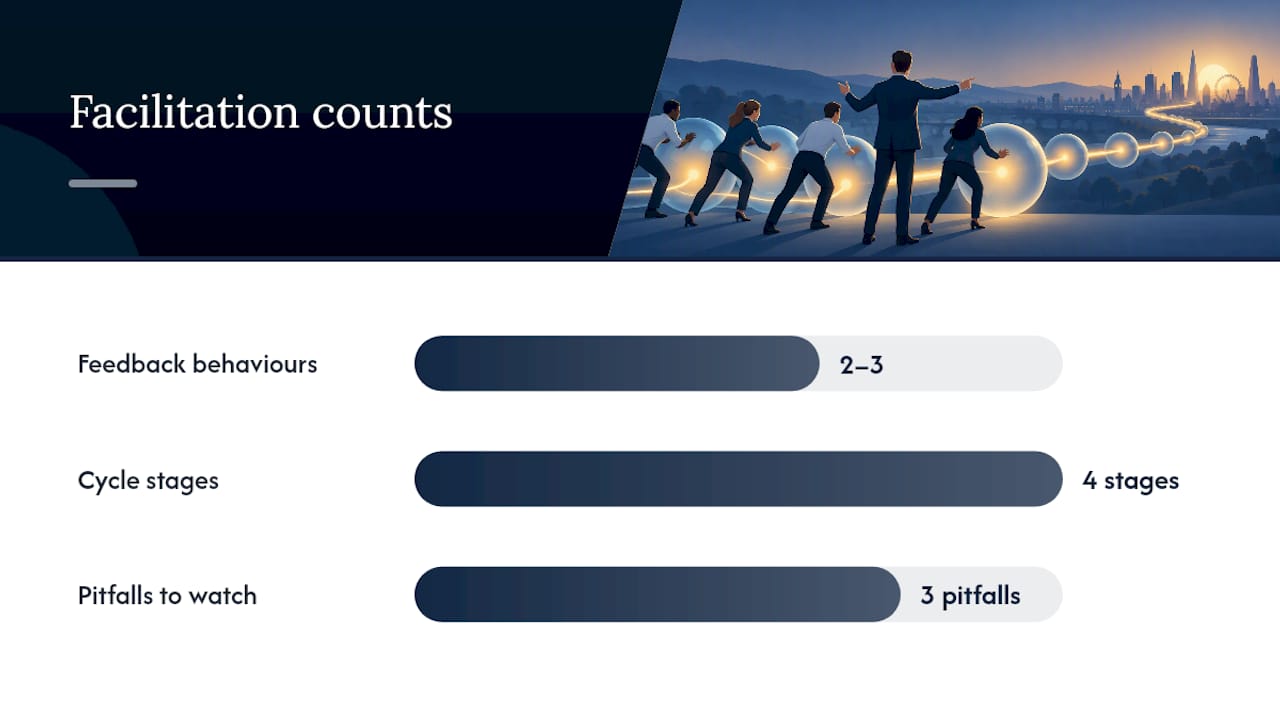
- Reflection: observer gives feedback on two or three defined behaviours only, never a general critique
- Round two: same scenario, roles rotate, seller applies the specific feedback
- Reapply: a new, slightly different scenario tests whether the change transfers
Pro Tip: Cap observer feedback at two or three named behaviours per round. An observer trying to comment on tone, pacing, structure, and content all at once produces feedback nobody can actually act on.
Debrief questions matter more than the activity itself. Ask what specific evidence or question changed the buyer’s response, not “how did that feel”. The three pitfalls to watch for: games that entertain but never connect to a real deal, feedback rounds that run long and dilute into generalities, and role-plays built on hypothetical buyers instead of the account sitting in someone’s actual pipeline.
Running workshops for remote and hybrid sales teams
Every activity above adapts to remote delivery with the right substitution. Breakout rooms handle role-play pairs cleanly; Zoom or equivalent video tools work fine as long as recording is switched on, because recorded-call review becomes your best remote-only exercise. Digital quiz platforms like Kahoot! replace physical bingo and trivia cards without losing the competitive energy, and a shared board in Miro handles stakeholder mapping and buyer-journey exercises just as well as flip charts.
- Keep hybrid rounds shorter than in-person ones; screen fatigue sets in fast during repeated role-play cycles
- Introduce AI-assisted practice tools with a defined use case, not as a blanket replacement for human coaching
- Protect the human feedback slot even when reps practise solo against an AI buyer beforehand, since emerging research on AI-assisted practice recommends monitoring completion rates, not assuming reps actually finish the practice
- Async recorded-call submissions work well for distributed teams across time zones
Ahead of Sales pairs AI-based repetition drills with scheduled human coaching precisely to avoid the gap this research flags, detailed in its guide to AI-supported sales training.
How Ahead of Sales structures these ideas into workshops
Ahead of Sales builds workshops and cohorts around the same principle running through this article: activities tied to real deals, not generic scenarios. Buyers choose between formats depending on scope and team size.
- Sales Training Cohorts for teams running structured group sessions across several weeks
Sessions map to the seven essential sales team training topics and produce a Sales Skill Checklist participants keep, alongside a written reinforcement plan and scheduled manager checkpoints.
Adjusting workshop content by role and experience level
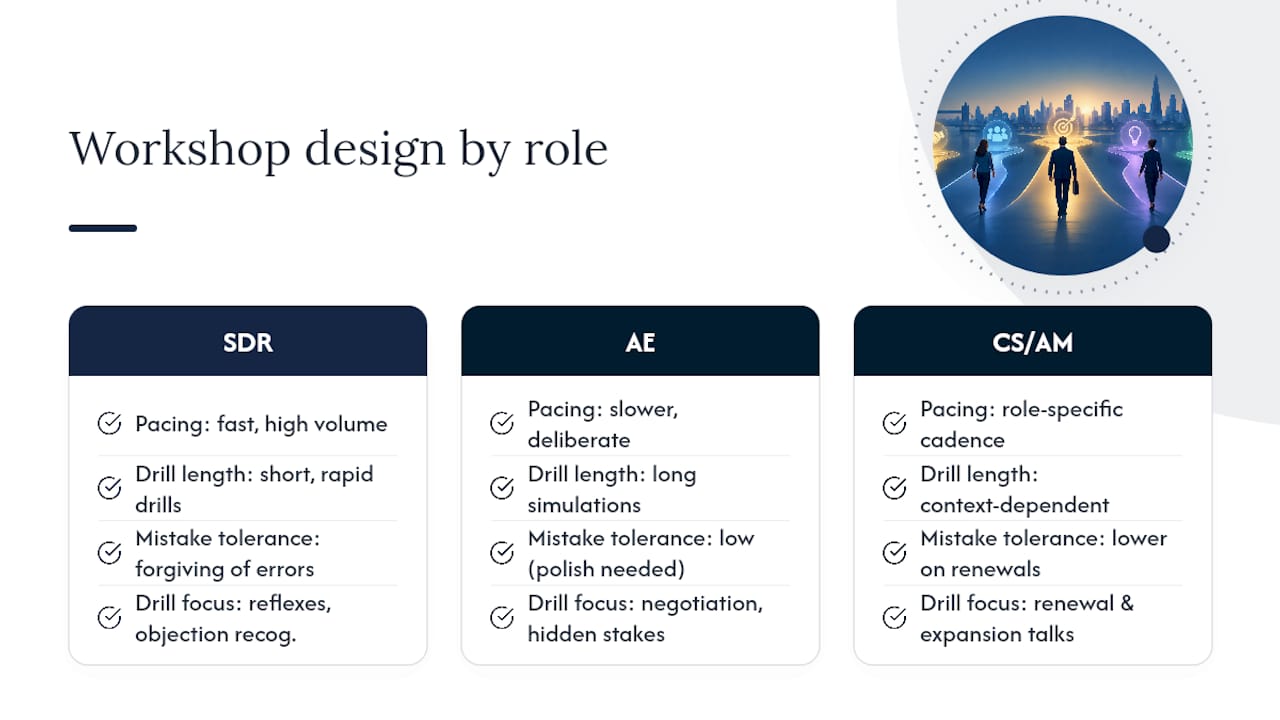
A workshop built for graduate SDRs and one built for senior enterprise account executives should barely resemble each other, even when the underlying skill is the same. An SDR working a first-touch cold-call needs volume and rapid objection recognition; the drills that suit them run fast, short, and forgiving of mistakes, since the goal is building reflexes, not polish.
A senior AE closing six-figure deals needs the opposite pacing. Negotiation simulations for that group should run longer, involve genuinely difficult hidden stakeholder dynamics, and tolerate far less scripted language, because their buyers will spot anything that sounds rehearsed.
Mixed-experience groups create a specific facilitation problem: junior reps can dominate group discussion through sheer volume of participation, while senior reps disengage from anything that feels remedial. The fix isn’t separating them entirely. Pair a junior and senior rep as buyer and seller in role-play rounds, then debrief separately by experience band, so senior reps get negotiation-level feedback while juniors get foundational feedback, from the same shared exercise.
Role also changes which metric matters. An SDR’s workshop objective should tie to activity volume and qualification accuracy; an AE’s should tie to win rate and deal velocity; a customer success or account management workshop should tie to expansion rate and stall diagnosis in renewal conversations. Building one workshop for “the whole sales function” without adjusting for this usually satisfies nobody.
Building buyer personas and journey mapping into the workshop
Buyer-journey mapping only works as a training exercise when it’s built on a real account, not a composite persona invented for the slide deck. Give small groups an actual, anonymised deal from your pipeline and ask them to plot every stakeholder against the buying journey: who champions, who blocks, who signs, and where the deal actually stalled last time it moved through this stage.
The output should be a stakeholder map each participant keeps, not a worksheet that gets binned after the session. That’s the difference between an exercise that produces insight and one that produces a nice afternoon. External guidance on building buyer personas is useful groundwork before the workshop itself, giving reps a shared vocabulary for stakeholder roles before they start mapping real accounts against it.
Run this exercise in pairs or trios rather than as a whole-room discussion. Larger groups tend to produce generic personas nobody quite owns; smaller groups produce a map someone will actually reopen before their next call with that account. Follow the mapping exercise immediately with a short role-play where one participant plays the hardest stakeholder on the map, testing whether the group’s read of that person actually holds up under a live conversation.
Workshop, coaching, or a longer programme: which fits your gap?
A workshop suits a gap most of your team shares; individual coaching fits a single rep’s specific weakness. Use a simple rule: if more than a third of reps show the gap and it’s visibly denting the pipeline, run a workshop. If the cost of leaving it unfixed is high but only affects one or two people, coach them directly instead. Recurring or interconnected gaps justify a sequenced programme, not a one-off session.
— Jerry
Get a workshop that’s built around your actual pipeline
Most of the ideas above work brilliantly as one-off sessions, but they work far better inside a structure that keeps reinforcing them after everyone leaves the room. That’s the real gap between a fun afternoon and a quarter where win rate actually moves. Ahead of Sales builds that structure directly into its packages, combining bespoke 1:1 coaching with the kind of workshop content covered here, so the practice you run this month doesn’t quietly fade by the next quarterly review.
If you’re running a team of quota-carrying reps, the Sales Training Cohorts format gives you a structured group programme rather than a single session. Solo consultants and service business founders typically fit the sales acceleration track, priced £2,995 to £5,995, while teams wanting fully bespoke coaching and consultancy sit in the £4,500 to £8,500 range. Every engagement produces the same practical outputs discussed throughout this article: a completed Sales Skill Checklist, a written reinforcement plan, and scheduled manager checkpoints so the behaviour change actually survives contact with a normal working week. Visit the Ahead of Sales homepage to see current package details and get a quote for your team.
Sources
For further reading beyond this article: HubSpot’s sales training activity list covers a broad catalogue of exercises; Pipedrive’s sales games guide explains gamification tied to KPIs; the experiential-learning research on role-play grounds the practice–reflect–reapply cycle; and the UK apprenticeship assessment framework supports evidence-based workplace measurement.
- 24 Sales training games, activities & ideas to skill up your team
- 12 sales games to level up your team and close more deals
- Experiential-learning research on role-play and reflection
FAQ
What are the 5 C’s of sales?
Definitions vary slightly by source, but a common version covers Customer, Company, Competitors, Collaborators, and Climate, the factors a rep should understand before building a sales strategy. It’s used more as a strategic planning frame than a workshop activity in itself, though it works well as a discussion prompt before a buyer-journey mapping exercise.
What are the 7 golden rules of sales?
There’s no single agreed list, but the principles that recur across sales training consistently include genuine listening, asking better discovery questions, understanding the buyer’s real problem before pitching, handling objections with evidence rather than pressure, following up promptly, and anchoring every conversation to value rather than features. Building a workshop around even three or four of these, tested through role-play, tends to produce more change than trying to cover all seven in one session.
How long should a sales workshop be?
It depends on scope: a single-skill drill fits 15 to 30 minutes, a session covering two or three related gaps needs a half-day, and a full methodology reset justifies a full day split between skill drills and live-deal application. Shorter, more frequent sessions generally produce better retention than one long annual event.
What makes a sales workshop activity actually work, versus just being fun?
An activity works when it’s followed by a structured debrief that asks what specific evidence or question changed the outcome, not a general “how did that feel” discussion. Games and drills without that reflection step, research on experiential learning shows, tend to entertain without producing any lasting change in behaviour.