
Sales mindset training builds the practical habits that make reps calm, confident, and repeatably effective. If you lead a sales team, the single most important decision you can make is to choose a blended programme that pairs frequent behavioural practice with manager coaching — not a one-off workshop that fades within a fortnight.
- What it is: structured training that changes how reps think, respond, and recover under buyer pressure — through repeated practice, not motivational content.
- Who it’s for: new hires building foundations, mid-stage reps losing consistency, and senior reps who need composure under pressure.
- Recommended next step: Aheadofsales offers bespoke team programmes and 1:1 coaching built around measurable outcomes — a practical starting point for UK sales leaders ready to move.
Key takeaways
Sales mindset training produces lasting results only when it combines high-volume behavioural practice, manager coaching, and a clear measurement framework — not when it relies on a single workshop or motivational content alone.
| Point | Details |
|---|---|
| Prioritise practice volume | Behavioural confidence requires repeated exposure to pressure scenarios, not classroom recall. |
| Require a measurement plan | Agree KPIs and a pre/post measurement framework before signing any training contract. |
| Embed manager coaching | Post-programme manager conversations are what prevent skill decay at 30, 60, and 90 days. |
| Match format to need | New hires need full programmes; senior reps often need targeted 1:1 coaching instead. |
| Aheadofsales as your provider | Bespoke blended programmes from £4,500, built around measurable outcomes and quota attainment. |
Table of Contents
- What is sales mindset training, really?
- Core components of an effective sales mindset programme
- Which delivery format suits your team?
- A practical 6-week sample programme
- What outcomes should you expect, and how do you measure them?
- Who benefits most from sales mindset training?
- How to choose a sales mindset training provider
- Aheadofsales in practice: what measurable outcomes look like
- Embedding learning: what to do in the 90 days after training
- The blind spot most sales leaders miss
- How Aheadofsales helps sales teams build lasting confidence
- Sources
What is sales mindset training, really?
Sales mindset training is the deliberate development of behavioural responses, mental resilience, and sales-specific thinking through targeted practice and coaching. It is not a motivation session. It is not a product knowledge refresh. And it is not the same as a skills-only workshop that teaches technique without addressing the beliefs and emotional patterns that stop reps using those techniques under pressure.
The distinction matters. A skills workshop might teach a rep how to handle a price objection.
Three session themes that illustrate the difference:
- Handling price pushback: practising the exact language and pause that keeps a rep grounded when a buyer anchors low.
- Holding the value conversation: building the habit of returning to outcomes and ROI rather than retreating to features.
- Recovery after a difficult call: short reset techniques that prevent one bad conversation from contaminating the next three.
Courses that combine mindset and emotional intelligence explicitly target long-term sales performance by teaching reps to manage emotions and decision moments in client interactions — not just to remember a framework.
Pro Tip: Ask any prospective trainer to show you a session plan. Effective mindset training inverts that.
Core components of an effective sales mindset programme
A well-built programme covers seven interconnected areas. Each one addresses a different point of failure in a typical sales conversation.
- Growth mindset and limiting beliefs: identifying and replacing the fixed beliefs that cause reps to self-select out of deals before they start (e.g. “this prospect is too senior for me”).
- Resilience and stress management: practical techniques for managing activation — recognising when adrenaline is helping versus when it is causing over-talking or avoidance.
- Discovery and questioning: building the habit of genuine curiosity rather than a scripted question list; reps who listen well close more.
- Objection handling: not scripts, but a flexible response architecture that reps can adapt in real time.
- Value articulation: translating product features into buyer outcomes with precision, including the use of concise case stories.
- Closing and next steps: removing the hesitation that causes reps to leave calls without a committed next step.
- Post-call reflection and coaching: structured review habits that turn every call into a learning event.
Behavioural repetition is what makes these modules stick. Classroom-only confidence training produces recall but not behavioural confidence; repeated, judgement-free practice is what builds composure that holds under live buyer pressure. The growth mindset principles that underpin this approach are well-documented in sales performance research — the key is applying them through practice, not through passive learning.
Pro Tip: Run short, high-pressure role-plays at the start of every session — before any content delivery. Starting with pressure primes the brain to absorb the technique that follows as a solution, not as abstract theory.
Which delivery format suits your team?
Format choice depends on team size, ramp speed, and how much behavioural change you actually need. Here is a practical breakdown.
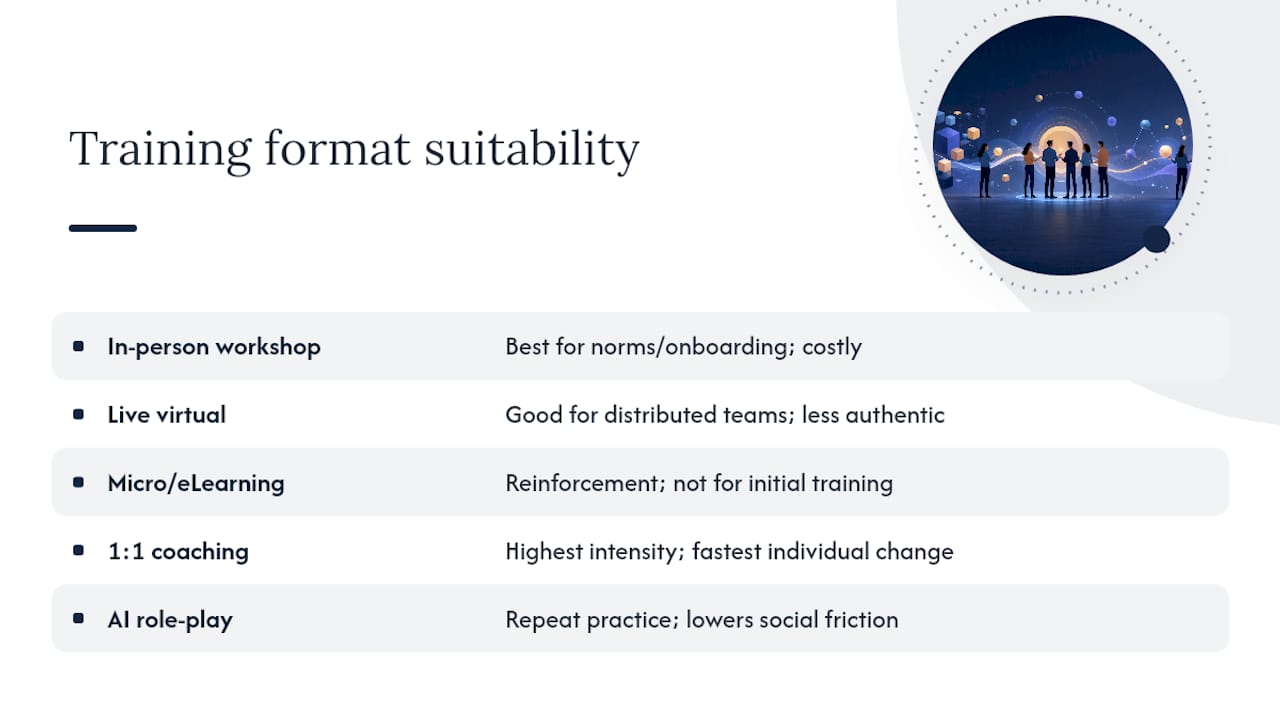
In-person workshops create the highest social intensity and are best for establishing team norms, shared language, and culture. They work well for full-team resets or onboarding cohorts. The limitation is cost per head and the fact that a single day rarely produces lasting behaviour change without follow-up.
Live virtual sessions remove travel cost and work well for distributed teams. Breakout rooms can replicate role-play dynamics reasonably well, though social friction is lower — which means reps may practise less authentically.
Micro-learning and eLearning suit reinforcement rather than initial skill-building. Short modules (5–10 minutes) on a single objection type or a specific verbal habit are most effective when embedded into a weekly rhythm rather than delivered as a standalone course.
1:1 coaching is the highest-intensity format and produces the fastest individual change. It is most valuable for senior reps, team leaders, or anyone whose performance gap is costing the business significant revenue. Deliberate preparation and manager-led behavioural coaching produce measurable improvements in sales call confidence and control — 1:1 coaching is the format that most closely replicates this.
AI-driven and simulated role-play addresses a real problem: most reps avoid peer role-play because social friction makes it feel embarrassing rather than useful. AI role-play platforms reduce that friction and allow reps to achieve the repetition volume necessary for behavioural fluency, with instant feedback and no judgement.
For most B2B sales teams in the UK, a blended programme combining live sessions with structured practice and manager coaching produces the best results. Neither pure eLearning nor a single workshop is sufficient on its own.
A practical 6-week sample programme
This outline gives you a concrete structure to evaluate or adapt. Each week includes a session objective, a practice task, and a manager review point.
- Week 1 — Foundations and beliefs: Identify limiting beliefs and establish a shared growth mindset framework. Homework: each rep records a 2-minute voice note describing their biggest sales fear and shares it with their manager.
- Week 2 — Discovery and emotional intelligence: Practice active listening and high-value questioning. Homework: three live discovery calls with a structured debrief form completed immediately after each.
- Week 3 — Objection handling under pressure: Role-play the five most common objections the team faces, using a flexible response architecture. Manager review: listen to one recorded call and score objection handling against a shared rubric.
- Week 4 — Value articulation and case stories: Build two concise case stories (problem, action, result) and practise delivering them in under 90 seconds. Small verbal habits — dropping hedge words, controlling pace — materially increase perceived confidence and trustworthiness on calls, so this week includes a verbal audit exercise.
- Week 5 — Closing and next steps: Practise asking for the next step without softening the ask. Homework: five role-plays with a peer or AI simulator, each ending with a committed next step.
- Week 6 — Integration and reset habits: Full scenario role-plays combining all modules. Post-call reset techniques practised in pairs. Manager review: compare call recordings from week 1 and week 6 against the behavioural rubric.
| Week | Focus | Key outcome |
|---|---|---|
| 1 | Beliefs and mindset | Reps can name and challenge their limiting beliefs |
| 2 | Discovery | Improved questioning quality on live calls |
| 3 | Objection handling | Composure under price and competitor pressure |
| 4 | Value articulation | Two ready-to-use case stories per rep |
| 5 | Closing | Consistent next-step commitment rate |
| 6 | Integration | Measurable behavioural improvement vs. baseline |
What outcomes should you expect, and how do you measure them?
Training without measurement is an expense. Training with measurement is an investment. Before any programme starts, establish a baseline across these KPIs:
- Conversion rate (lead to opportunity, opportunity to close)
- Opportunity progression rate (deals moving stage within a defined period)
- Average deal size
- Quota attainment (individual and team)
- Time-to-first-win for new hires
- Objection-handling pass-rate (scored from call recordings against a rubric)
Behavioural metrics matter as much as commercial ones. Practical training should measure behavioural indicators such as objection-handling pass-rate alongside commercial KPIs to show causation between training and results — otherwise you cannot distinguish the effect of training from a seasonal uplift or a product change.
Measurement checklist: Capture baseline data two weeks before the programme starts. Measure again at programme end. Then measure at 30, 60, and 90 days post-programme to track retention. Manager observation rubrics (scored call reviews) should run throughout.
The link between mindset and commercial outcomes is well-established: reps who manage their emotional state more effectively make better decisions in live buyer interactions, which shows up in conversion rates and deal size over time.
| Metric | Measurement method | Cadence |
|---|---|---|
| Conversion rate | CRM data | Monthly |
| Objection-handling pass-rate | Scored call recordings | Weekly during programme |
| Quota attainment | CRM / sales reports | Monthly |
| Time-to-first-win | CRM data | Per new hire cohort |
| Behavioural confidence | Manager observation rubric | Weekly during programme |
Who benefits most from sales mindset training?
The honest answer is: most sales teams benefit, but the intensity of training should match the gap. Here is a practical way to think about it.

New hires need mindset foundations early — before bad habits form. The first 90 days are when limiting beliefs and avoidance patterns take root. A structured programme in weeks 2–8 of onboarding dramatically reduces ramp time.
Mid-stage reps missing consistency are often technically capable but emotionally inconsistent. They close well on good days and underperform on difficult ones. Resilience and reset techniques are the highest-leverage intervention here.
Senior reps needing composure face a different challenge: they have the skills but may have developed defensive habits (over-qualifying, avoiding certain buyer types, softening asks). Mindset work at this level is about removing friction, not adding technique.
Sales leaders who coach are often the most overlooked group. A leader who has not done their own mindset work will unconsciously reinforce the limiting beliefs of their team. Confidence is better framed as a tool for reducing buyer anxiety and transferring belief — leaders who understand this coach very differently from those who treat confidence as bravado.
B2B consultative selling, SaaS, and professional services are the sectors where mindset training produces the most visible results. These are long-cycle, high-stakes sales where composure, value articulation, and resilience under extended buyer scrutiny are directly tied to revenue.
| Participant type | Primary gap | Recommended intensity |
|---|---|---|
| New hires (up to 6 months) | Foundations and habits | Full programme (6–8 weeks) |
| Mid-stage reps | Consistency and resilience | 4-week targeted programme |
| Senior reps | Composure and removing friction | 1:1 coaching (4–6 sessions) |
| Sales leaders | Coaching quality and self-awareness | 1:1 coaching + manager enablement |
How to choose a sales mindset training provider
This is where most buying decisions go wrong. A provider who delivers an engaging workshop is not the same as one who produces lasting behavioural change. Use this checklist.
- Evidence of behavioural practice: ask to see a sample session plan. If the ratio of content to practice is greater than 50:50, the programme will not produce behavioural change.
- Manager enablement: does the programme include coaching support for managers? Training that embeds manager coaching and follow-up review reduces skill decay and helps transfer learned behaviour into real sales activity.
- Measurement plan: ask for the pre/post measurement framework before you sign. If the provider cannot describe how they will demonstrate ROI, that is a problem.
- Trainer credentials: look for a combination of real sales experience and a recognised coaching qualification (e.g. ICF-accredited coaching, a formal sales training certification). Neither alone is sufficient.
- Sample content and references: request a sample module and at least two client references from organisations of similar size and sector.
- Case studies with measurable outcomes: ask for before/after data — quota attainment uplift, conversion rate improvement, ramp-time reduction. Vague testimonials are not evidence.
Questions to ask during vendor calls:
- What is the ratio of practice to content delivery in a typical session?
- How do you measure behavioural change, not just satisfaction scores?
- What does your post-programme reinforcement look like at 30, 60, and 90 days?
- How do you involve managers in the learning process?
- Can you share a case study with specific commercial metrics?
Red flags to watch for:
- A one-off workshop with no follow-up plan
- Vague outcome statements (“reps will feel more confident”)
- No measurement framework
- Trainer who has never sold professionally
- No manager enablement component
UK pricing bands (approximate): team programmes typically range from £4,500 to £8,500 for a structured blended engagement covering 6–8 weeks. Solo operator packages tend to run from £2,995 to £5,995. One-off workshops from generic providers can be cheaper but rarely produce lasting change.
Pro Tip: Negotiate an outcomes-based clause into any contract above £5,000. Ask the provider to agree on two or three measurable KPIs at the outset and tie at least a portion of the engagement to hitting them. A confident provider will agree. One who hedges on this is telling you something.
Aheadofsales in practice: what measurable outcomes look like
The following structure shows the before/after template that Aheadofsales uses with clients — and that you should request from any provider you are evaluating.
- Challenge: Sales team of 12 reps consistently missing quota by 15–20%; conversion from discovery to proposal at 28%; reps avoiding price conversations.
- Intervention: 6-week blended programme covering beliefs, objection handling, and value articulation; weekly 1:1 coaching for the two lowest-performing reps; manager enablement sessions to build a coaching rhythm.
- Measurable result:
The metrics to request from any provider, in this order: quota attainment before and after, conversion rate at each pipeline stage, average deal size, and time-to-first-win for new hires. If a provider cannot show you this data from a comparable client, ask why.
For a detailed view of how bespoke coaching translates to commercial outcomes, the sales training explained page sets out the model clearly. You can also explore consultative selling training as a natural complement to mindset work.
Embedding learning: what to do in the 90 days after training
Training ends. Behaviour change does not happen automatically after it does. The 90 days following a programme are where most of the value is either captured or lost.
- Week 1–2 post-programme: update the sales playbook to reflect the language, frameworks, and objection responses from the training. Reps should be able to open the playbook and find the exact tools they practised.
- Week 3–4: establish a weekly 15-minute coaching conversation between each rep and their manager, structured around one specific behaviour (e.g. “show me how you handled the pricing conversation this week”).
- Month 2: introduce a fortnightly call review session where the team listens to one recorded call together and scores it against the behavioural rubric from the programme.
- Month 3: run a half-day reinforcement session covering the two or three areas where the rubric data shows the most regression. This is not a repeat of the original training — it is targeted correction based on real evidence.
Manager questions that support post-training coaching conversations:
- “Walk me through the moment you felt most under pressure in that call. What did you do?”
- “Did you use the reset technique before the next call? What difference did it make?”
- “Where did you hold the value conversation, and where did you drift back to features?”
Pro Tip: Reward behavioural change explicitly, not just commercial results. When a rep holds a difficult price conversation without discounting — even if the deal does not close — name it in the team meeting. Behaviour that gets noticed gets repeated.
The blind spot most sales leaders miss
The most common mistake I see in sales training is treating mindset as a soft add-on to a skills programme. Leaders invest in objection-handling frameworks, discovery question lists, and closing techniques — and then wonder why reps still freeze when a buyer pushes back hard.
The reason is straightforward: technique without composure collapses under pressure. A rep who has memorised a response to “your price is too high” will still cave if they have not practised delivering that response while their heart rate is elevated and the buyer is visibly impatient. The practice has to replicate the pressure, not just the words.
The habit I recommend above everything else is this: before any coaching conversation, ask the rep to describe the moment in their last call when they felt least in control. That single question surfaces more useful coaching material than any call recording review, because it forces the rep to locate the emotional trigger — which is where the real work is.
How Aheadofsales helps sales teams build lasting confidence
If you have read this far, you are probably a sales leader who knows your team has the potential to perform better — and you want a programme that produces real, measurable change rather than a motivational day out.
Aheadofsales delivers bespoke 1:1 coaching, team workshops, and blended programmes built around the exact principles this guide covers: high-volume behavioural practice, manager enablement, and a clear measurement framework from day one.
Team packages start from £4,500, with solo service business packages from £2,995. Every engagement begins with a diagnostic conversation to establish your baseline and agree the KPIs that will define success.
The next step is straightforward: visit the sales training services page to see the full range of programmes, or book a discovery call to discuss a pilot for your team. If you are in SaaS, the SaaS-specific training page is worth a look first.
Sources
A short list of the most useful external resources used to build this guide, with a note on why each one matters.
- Sales confidence training that holds under pressure – UMU
- Boost New Sales Rep Confidence with AI Training | QUOTA — QUOTA Training
- How to Improve Sales Call Confidence Fast – Power In Excellence
- Sales Mindset & Emotional Intelligence, Foundations for …
- How to Sound More Confident Than 99% of Salespeople
One Response