
When a prospect objects on a cold call, run this five-step sequence before you reply: listen fully → acknowledge → clarify → respond → confirm. That single habit, applied consistently, is what separates reps who lose calls at the first pushback from those who convert them into booked meetings. Research confirms that most sales objections cluster into a small number of categories — budget, timing, authority, and need — which means a short, repeatable framework covers the vast majority of what you will hear.
Here are three lines you can use on your next call right now:
- “Busy / no time” — “Completely understand. I only need a brief moment — if it’s not relevant, I’ll let you go straight away. Fair enough?”
- “Send me an email” — “Happy to. Before I do, can I ask one quick question so the email is actually useful to you?”
- “Not interested” — “That’s fair. Out of curiosity, is it that you’re not looking at this area at all, or just not right now?”
When to defer vs when to press on:
- Defer when the prospect is genuinely mid-task, emotionally heated, or clearly the wrong contact — book a specific time and move on.
- Press on (gently) when the objection is vague, the prospect is still on the line, and one clarifying question could surface real interest.
- Always propose a concrete next step before you hang up, even if it is only a 10-minute call next Tuesday.
Pro Tip: Slow down when you hear an objection. A rushed reply signals panic. A two-second pause before you speak signals confidence and gives you a moment to choose your words.
Key takeaways
Consistent cold call objection handling comes down to one repeatable framework applied before, during, and after every call — and practised with real material, not hypothetical scripts.
| Point | Details |
|---|---|
| Use the five-step framework | Listen, acknowledge, clarify, respond, confirm — in that order, every time, before you reply. |
| Ask one clarifying question first | Clarifying before responding surfaces the real objection and prevents wasted rebuttals. |
| Prepare upstream to reduce objections | Signal-based targeting and authority mapping lower objection volume before you dial. |
| Confirm resolution explicitly | Always ask “Does that address your concern?” before proposing the next step. |
| Aheadofsales builds this into your team | Bespoke coaching and workshops fix recurring objection gaps using your own call library. |
Table of Contents
- How does the five-step cold call objection-handling framework actually work?
- The most common cold-call objections and how to respond
- How to prepare so objections are fewer and shorter
- What to do when you’re blindsided mid-call
- How to confirm resolution and book the next step
- Common mistakes reps make when handling objections
- Team-level changes that reduce objections before the call
- Emotional intelligence skills to use during objection handling
- How to turn objections into opportunities for rapport and added value
- Why the framework matters more than the script
- Aheadofsales helps you close the objection gap for good
- Sources
How does the five-step cold call objection-handling framework actually work?
The five steps are listen, acknowledge, clarify, respond, and confirm. They sound simple, but each one has a specific micro-action that prevents the most common mistakes reps make under pressure.
1. Listen — Do not interrupt. Let the prospect finish their full sentence, even if you already know what they are going to say. Interrupting is the fastest way to kill rapport.
2. Acknowledge — Validate the concern without agreeing it is a deal-breaker. “That makes sense” or “I hear you” costs nothing and lowers the prospect’s guard immediately.
3. Clarify — Ask one open question before you respond. “When you say the timing isn’t right, what would need to change for it to be?” This step is where most reps fail: they skip straight to the rebuttal and miss the real objection entirely.
4. Respond — Now you have the real concern, answer it specifically. Use a short, evidence-backed reply (15–30 seconds maximum). The Feel-Felt-Found framework works well here: “I understand how you feel — others felt the same way — and what they found was…”
5. Confirm — Check that your response actually landed. “Does that address your concern?” or “Does that make sense given what you’ve told me?” If it does not, you have another clarifying question to ask, not another rebuttal to fire.
A compact checklist to rehearse before your next calling session:
- Pause for two seconds after the objection lands.
- Name the emotion or concern back to the prospect in one sentence.
- Ask one clarifying question — only one.
- Deliver your response in under 30 seconds.
- Confirm resolution and propose the next step.
Pro Tip: Phrase your clarifying question as a genuine curiosity, not a challenge. “Help me understand what you mean by that” lands very differently from “What do you mean by that?” The word “help” signals collaboration, not interrogation.
The most common cold-call objections and how to respond
Nine cold-call objections cover the overwhelming majority of what you will encounter: busy/no time, send me an email, not interested, already using a supplier, price/too expensive, wrong person/authority, timing/not right now, we only do inbound, and emotional/grumpy. Here is what each one usually masks, a clarifying question to surface the real issue, and a tight script to use on the call.
“I’m busy / no time right now”
What it masks: Genuine busyness, or a polite brush-off because the opening pitch did not land.
Clarifying question: “Completely understand — when would be a better 90 seconds for you?”
Script: “I respect your time. I only need a brief moment. If it’s not relevant, I’ll let you go — and I mean that. Can I take 27 seconds now?”
Next step: If they say no, book a specific time: “How does Tuesday at 9am look?”
“Send me an email”
What it masks: A polite exit, or genuine interest but no time to talk.
Clarifying question: “Of course — so the email is useful, can I ask what your biggest challenge is with [relevant area] right now?”
Script: “Happy to send something across. I want to make sure it’s relevant rather than just another email in your inbox. One quick question first…”
Next step: Get a commitment to read it by a specific date, or book a follow-up call.
“Not interested / we don’t need it”
What it masks: A lack of perceived relevance, or a previous bad experience with a similar product.
Clarifying question: “Is it that this area isn’t a priority at all, or more that you haven’t seen a solution that fits yet?”
Script: “That’s fair. Most people I speak to said the same thing before they saw [specific result]. I’m not asking you to buy anything — just 90 seconds to see if there’s a fit. If not, I’ll leave you alone.”
Next step: Ask for 90 seconds, not a meeting.
“We already use a supplier”
What it masks: Loyalty, switching costs, or genuine satisfaction — but often just inertia.
Clarifying question: “That’s great to hear. Are you completely happy with them, or are there areas where you feel there’s room for improvement?”
Script: “Understood. Most of our clients were using someone else before they came to us. We’re not asking you to switch today — just to have a short conversation to see if there’s anything we do differently that might be worth knowing about.”
Next step: Offer a no-commitment comparison conversation.
“It’s too expensive / price”
What it masks: Budget constraints, a lack of perceived value, or a comparison to a cheaper alternative.
Clarifying question: “When you say expensive, is that compared to your current budget, or compared to another solution you’ve seen?”
Script: “I understand cost is always a factor. Can I ask — if the price weren’t an issue, would this be something you’d want to move forward with? That helps me understand whether it’s a value question or a budget question.”
Next step: Separate value from budget before discussing numbers.
“You’ve got the wrong person / I don’t have authority”
What it masks: A genuine misdirect, or a deflection to avoid the conversation.
Clarifying question: “Appreciate you saying that — who would be the right person to speak to about [specific area]?”
Script: “No problem at all. Could you point me in the right direction? And just so I approach them correctly — is this something that sits with [department/role], or is it more of a shared decision?”
Next step: Get a name and a warm introduction if possible.
“The timing isn’t right / not right now”
What it masks: A genuine delay, budget cycle timing, or a soft no.
Clarifying question: "What would need to change for the timing to work?
Script: “Completely understand. A lot of the people I work with said the same thing, and then [specific trigger event] happened and they wished they’d had the conversation earlier. I’m not asking you to do anything now — just to have a 15-minute call so you’re informed when the time does come.”
Next step: Book a specific future date, not a vague “call me in three months.”
“We only do inbound / we don’t take cold calls”
What it masks: A policy, a personal preference, or a test of your persistence.
Clarifying question: “I respect that. Is that a company policy, or more of a personal preference?”
Script: “I appreciate you telling me. I’ll be honest — I wouldn’t be calling if I didn’t think there was a genuine reason to. Can I take 30 seconds to explain why I thought it was worth reaching out, and you can decide from there?”
Next step: If they say no, send a personalised email referencing the call.
Emotional / grumpy prospect
What it masks: A bad day, previous frustration with cold callers, or a genuine dislike of interruptions.
Clarifying question: Do not ask one immediately. Acknowledge first: “I can hear this isn’t a great time.”
Script: “I completely understand — I’ll be brief. I’m not here to waste your time. If after 30 seconds you want me to go, I will. Fair enough?”
Next step: If they remain hostile, exit gracefully: “I’ll let you go. I’ll drop you a short note instead.”
Clarifying questions mapped to discovery outcomes:
| Objection | Clarifying question | Discovery outcome |
|---|---|---|
| Busy / no time | “When would be a better 90 seconds?” | Finds a real window or confirms a brush-off |
| Send me an email | “What’s your biggest challenge with [area] right now?” | Surfaces a real pain point before you write |
| Not interested | “Is this not a priority, or not the right solution yet?” | Separates irrelevance from poor fit |
| Already using a supplier | “Are you completely happy, or is there room for improvement?” | Identifies dissatisfaction or switching intent |
| Too expensive | “Is that a budget question or a value question?” | Clarifies whether to reframe value or explore budget |
| Wrong person | “Who would be the right person to speak to?” | Gets a warm referral to the decision-maker |
| Timing not right | “What would need to change for the timing to work?” | Identifies the real trigger or delay |
Pro Tip: Finance buyers respond to ROI framing; operations buyers respond to efficiency and risk reduction; IT buyers respond to integration and security. Swap one word in your script — “cost savings” for finance, “fewer manual steps” for operations, “no disruption to your stack” for IT — and the same objection response lands very differently.
How to prepare so objections are fewer and shorter
The best cold call objection handling happens before you dial. Upstream interventions — better qualification, intent signals, and reaching the right decision-maker first — reduce the volume of defensive objections you face on every call.
Pre-call preparation checklist:
- Intent signals: Has the company recently hired for a relevant role, raised funding, or changed their tech stack? These signals indicate readiness to engage and reduce “not right now” objections.
- Authority mapping: Confirm you are calling the right person before you dial. A call to the wrong contact generates a “wrong person” objection that wastes both parties’ time.
- Account context: Know the company’s size, sector, and any recent news. A personalised opening line cuts through far more effectively than a generic pitch.
- Competitor/supplier indicators: Check LinkedIn and company websites for clues about existing suppliers. This prepares you for the “already using someone” objection before it arrives.
Building an objection library from recorded calls is one of the highest-leverage things a team can do. Pull the five objections your reps hear most often, write a tight script for each, and rehearse them weekly. The gap between a scripted answer and a natural, confident reply closes quickly with repetition.
Signal-based outreach — timing calls around funding events, hiring surges, or technology changes — materially affects how receptive a buyer is when you reach them. A prospect who has just hired three salespeople is far more likely to engage with a sales training conversation than one who has not. This is not luck; it is preparation.
For a full pre-call preparation checklist, the sales call preparation guide from Aheadofsales covers the key steps in detail.
Pro Tip: The most effective role-play drill is not “pretend you’re a prospect.” It is this: play a real recorded call, pause it just before the rep responds to an objection, and ask the rep to give three different replies. That single drill builds more in-call agility than an hour of scripted rehearsal.
What to do when you’re blindsided mid-call
Even with perfect preparation, you will occasionally hear an objection you did not anticipate. The instinct is to fill the silence immediately. Resist it.
Decision rules for unexpected objections:
- Pause and clarify when the objection is vague or you genuinely do not understand what the prospect means. One question buys you thinking time and often reveals the real concern.
- Defer when the objection requires information you do not have on the call (a specific pricing query, a technical integration question). “That’s a great question — I want to give you an accurate answer rather than guess. Can I come back to you on that by end of day?”
- Loop in support when the objection is outside your remit — a legal or procurement concern, for example. Name the person or team you will involve and give a timeline.
Lines to buy thinking time without sounding evasive:
- “That’s a fair point — let me make sure I understand what you’re asking.”
- “Good question. Before I answer, can I ask what’s driving that concern?”
- “I want to give you a proper answer rather than a quick one. Can I take a moment?”
A quick triage checklist when you are blindsided:
- Ask one question to clarify the real concern.
- Reframe the objection as a shared problem to solve, not a barrier.
- Propose a concrete next step, even if it is only “let me find out and come back to you.”
The goal is not to have a perfect answer for everything. It is to stay composed, keep the prospect talking, and move the conversation forward.
How to confirm resolution and book the next step
Handling the objection is only half the job. Confirming that the prospect is actually satisfied — and then securing a clear next step — is where many reps leave value on the table.
A question-led, empathic approach consistently outperforms a hard close after an objection. The prospect needs to feel heard before they will agree to move forward.
Step-by-step close after handling an objection:
- Confirm resolution: “Does that address your concern, or is there something else on your mind?”
- Acknowledge any remaining hesitation: “I hear you — what would make you more comfortable moving forward?”
- Propose one clear next step: Make it low-friction. A 15-minute call, a short demo, or a relevant case study — not a full proposal.
- Nail down the calendar: “Does Tuesday at 10am or Thursday at 2pm work better for you?” Two specific options are easier to say yes to than an open-ended “whenever suits.”
- Send a brief follow-up email: Confirm what was agreed, attach any promised resource, and restate the next step in writing.
A short email template after the call:
Pro Tip: Frame the next step as something that benefits the prospect, not you. “I’d love to show you how this works” is about you. “This will give you a clearer picture of whether it’s worth exploring” is about them. That shift in framing reduces resistance significantly.
Common mistakes reps make when handling objections
Most objection-handling failures come down to a handful of repeatable errors. Here is what to watch for, and a quick rewrite for each.
Interrupting the prospect
Reps jump in before the objection is fully stated, which signals impatience and misses the real concern.
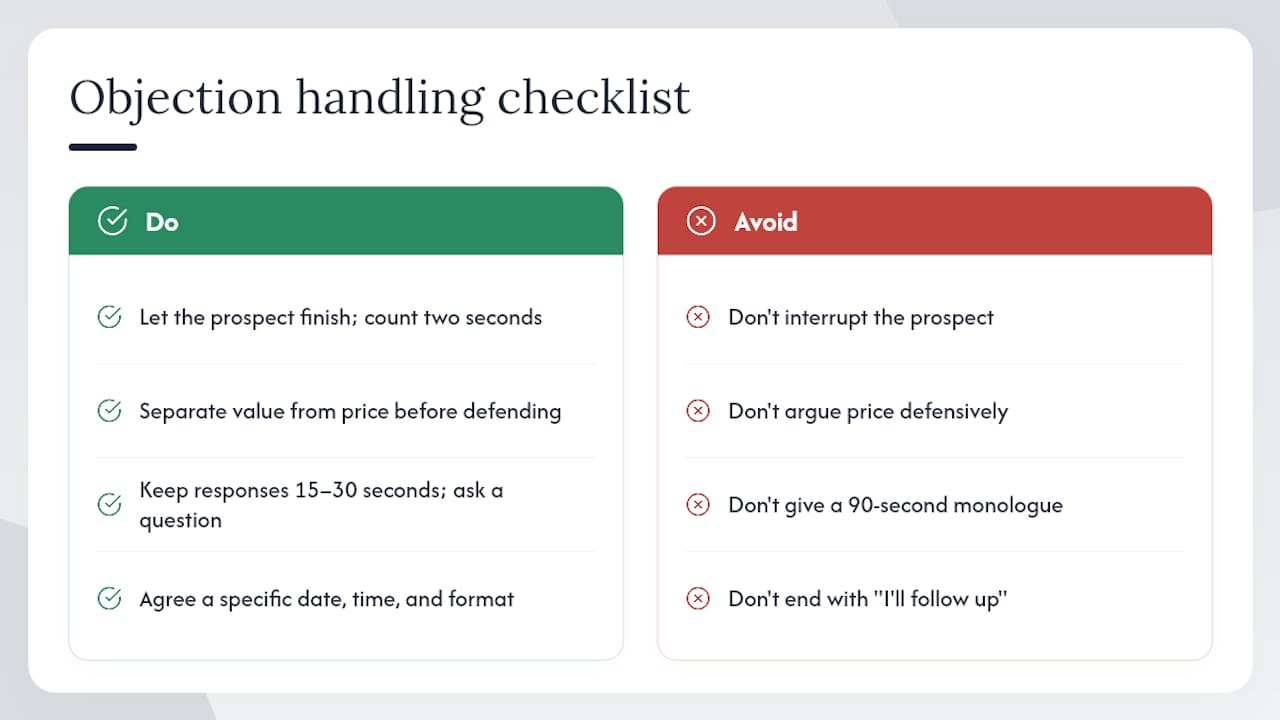
Rewrite: Let the prospect finish. Count to two after they stop speaking before you reply.
Arguing about price
“Actually, we’re very competitively priced” is a defensive response that puts the prospect on the back foot.
Rewrite: “I understand cost is a real consideration. Can I ask — if the price were right, would this be something you’d want to move forward with?” Separate value from price before defending either.
Over-explaining
A 90-second monologue after an objection loses the prospect’s attention and sounds rehearsed.
Rewrite: Keep your response to 15–30 seconds. Then ask a question to re-engage: “Does that make sense given what you’ve told me?”
Failing to confirm resolution
Reps assume the objection is handled and move on. The prospect is still unconvinced.
Rewrite: Always ask “Does that address your concern?” before proposing the next step.
Not booking a next step
The call ends with “I’ll follow up” — which means nothing.
Rewrite: Before you hang up, agree a specific date, time, and format for the next interaction. Put it in the calendar while you are still on the call.
On voice and pacing: a rushed reply after an objection signals anxiety. Slow your pace slightly, lower your register, and speak with deliberate calm. Prospects read tone as much as words, and a composed delivery makes your response more credible regardless of what you say.
Team-level changes that reduce objections before the call
Individual technique matters, but recurring objection patterns are usually a team-level problem. If your reps are hearing “not right now” on eight out of ten calls, the issue is not their scripts — it is the targeting.
Signal-based timing — reaching buyers when a relevant trigger event has occurred — materially lowers the frequency of defensive objections. A company that has just expanded its sales team, changed its CRM, or entered a new market is in a different buying posture than one that has not. Timing outreach to those signals changes the conversation before it starts.
Consider a hypothetical SaaS sales team that shifts from a broad list of 2,000 contacts to a signal-filtered list of 400 accounts showing active hiring and recent funding. The volume of “not right now” objections drops, not because the reps improved their scripts, but because the prospects were genuinely more ready to engage. Better qualification upstream produces better conversations downstream.
Small, repeated coaching interventions — weekly call libraries and micro-coaching sessions — produce measurable improvements in how reps handle objections, consistently outperforming one-off training days. The mechanism is simple: reps hear real objections in real calls, practise responses in a low-stakes environment, and build muscle memory before the next live call.
Checklist for sales leaders:
- Review recorded calls weekly and tag the three most common objections.
- Build a shared objection library that every rep contributes to and draws from.
- Run a 20-minute role-play session at the start of each week using real call excerpts.
- Track objection-to-conversion rate by rep to identify coaching priorities.
- Use consultative question patterns to improve discovery and reduce late-stage objections.
- Measure improvement monthly, not quarterly — small changes compound quickly.
Objection frequency vs upstream fix:
| Recurring objection | Likely upstream cause | Fix |
|---|---|---|
| “Not right now” | Poor timing / no trigger signal | Switch to signal-based outreach |
| “Wrong person” | Inaccurate contact data | Improve contact enrichment before dialling |
| “Already using a supplier” | No competitive differentiation in opening | Research existing suppliers and tailor the pitch |
| “Not interested” | Irrelevant opening line | Personalise the first sentence using account context |
| “Too expensive” | Value not established before price is mentioned | Reorder the conversation to lead with outcomes |
Emotional intelligence skills to use during objection handling
Emotional intelligence (EI) is not a soft extra in cold calling — it is the mechanism that makes every technique in this guide actually work. A rep who can read a prospect’s emotional state and adjust in real time will outperform a rep with a better script every time.
The core EI skills to develop are self-regulation, empathy, and social awareness.
Self-regulation means managing your own reaction when a prospect is hostile or dismissive. The instinct is to defend, justify, or speed up. The effective response is to slow down, lower your voice, and stay curious. Prospects who are initially abrasive often become engaged once they feel they are not being sold to.
Empathy in a cold call context is not about being warm and friendly — it is about demonstrating that you understand the prospect’s world. “I imagine you’re fielding a lot of calls like this” is a small acknowledgement that lands disproportionately well because it shows you see the situation from their side.
Social awareness means picking up on cues in the prospect’s tone and pacing. If they are speaking quickly and clipping their answers, they are genuinely busy or disengaged. Match their pace briefly, then slow down — it is a subtle but effective way to shift the energy of the call.
A question-led, empathic approach consistently reduces resistance and surfaces the real objection beneath the initial statement. Asking “help me understand what’s driving that” is not just a technique — it is a signal that you are listening, not just waiting to respond.
How to turn objections into opportunities for rapport and added value
An objection is not a rejection. It is a signal that the prospect is still engaged enough to tell you something. The rep who treats every objection as a buying signal — a chance to learn more and offer something genuinely useful — will have very different conversations from the one who treats it as an obstacle.
The reframe is straightforward: an objection tells you what matters to the prospect. “Too expensive” tells you cost is a priority. “Not right now” tells you timing is the constraint. “Already using a supplier” tells you they have thought about this area before. Each one is a door, not a wall.
Practically, this means using the clarifying question not just to handle the objection, but to deepen the conversation. When a prospect says “we’re happy with our current supplier,” the question “are there any areas where you feel there’s room for improvement?” often opens a 10-minute conversation about real frustrations they have never voiced to their existing supplier. That conversation is worth more than any script.
Adding value in the moment can be as simple as sharing a relevant insight, a short benchmark, or a question the prospect has not considered. “Most companies your size find that [specific challenge] becomes a bigger issue as they scale — is that something you’re already thinking about?” This positions you as a thinking partner rather than a vendor, which changes the entire dynamic of the call.
The objection handling complete guide from Aheadofsales covers this reframing approach in depth, with additional scripts for turning common objections into discovery conversations.
Why the framework matters more than the script
Here is my honest view after years of working with sales teams across the UK: the reps who struggle most with objections are not the ones with bad scripts. They are the ones who treat the script as the answer.
A script is a starting point. The five-step framework — listen, acknowledge, clarify, respond, confirm — is the structure that makes the script work. Without the framework, even the best rebuttal sounds rehearsed and hollow. With it, even an imperfect response lands well because the prospect feels heard before they hear it.
The two practice experiments I recommend to every team I work with are these. First, the call-library drill: pull three real calls from the past week, identify the objection moment in each, and have every rep write two alternative responses. Do this for 20 minutes every Monday morning. Second, the paired coaching session: pair reps up, play a real call excerpt, pause it at the objection, and have each rep respond live while the other gives immediate feedback. Ten minutes of this is worth more than an hour of solo script reading.
The teams that improve fastest are not the ones with the most training days. They are the ones who practise the most frequently, with real material, in short bursts.
Aheadofsales helps you close the objection gap for good
If your team is hearing the same objections on every call and the scripts are not sticking, the gap is usually in consistency, voice, and upstream qualification — not effort.
Aheadofsales works with B2B sales teams of 50–1,000 people across the UK to fix exactly that. Bespoke 1:1 coaching builds the in-call confidence and EI skills that no generic training day can replicate. Team workshops address the specific objections your reps face in your market, with scripts built from your own call library. And for teams where the problem starts before the dial, sales consultancy covers qualification frameworks, signal-based targeting, and contact enrichment.
Packages start from £4,500, and every engagement is built around your team’s actual objection patterns — not a generic playbook. Solo service businesses can access focused sales acceleration packages from £2,995.
The clearest next step is a conversation. Visit the sales training services page to see what a tailored engagement looks like, or get in touch to have your objection library audited as a starting point.
Sources
- The Objection-Handling Playbook for B2B Sales Reps
- 9 Cold Calling Objections and How to Respond for More Sales
- Objection Handling: 25 Common B2B Sales Objections & How to Respond
- How To Overcome Objections in B2B Sales: Step by Step | SyncGTM
- Otter
- 7 Winning Steps for Effective Objection Handling | Salesforce
- Gartner: B2B buying journey (sales insights)