
Sales coaching for SaaS isn’t just about fixing underperformers. Many leaders mistakenly assume coaching suits only struggling reps, but research proves it benefits all performance levels, improving incremental growth across teams. This guide explains how tailored SaaS sales coaching accelerates quota attainment, shortens ramp times, and unlocks sustainable revenue growth through structured, data-driven approaches designed specifically for subscription-based selling.
Table of Contents
- Introduction To Sales Coaching In SaaS
- Why SaaS Sales Coaching Differs From Traditional Sales Coaching
- Common Misconceptions About Sales Coaching For SaaS
- A Framework For Effective SaaS Sales Coaching Programmes
- Quantifiable Impact Of Sales Coaching On SaaS Sales Performance
- Implementing Sales Coaching To Accelerate Your SaaS Team’s Growth
- Discover Tailored Coaching Solutions For SaaS Growth
- Frequently Asked Questions About Sales Coaching For SaaS
Key takeaways
| Point | Details |
|---|---|
| SaaS coaching differs | Subscription models and recurring revenue demand coaching focused on renewals, expansions, and customer lifetime value, not just new logos. |
| Proven performance gains | Structured coaching boosts quota attainment by nearly 20% and cuts new hire ramp-up time by up to 50%. |
| Framework essentials | Effective programmes combine customer-centric methods, data-driven insights, and continuous feedback loops aligned to SaaS metrics. |
| Long-term commitment | Sustained coaching cycles over 6-12 months, integrated with CRM analytics, deliver measurable growth rather than quick fixes. |
Introduction to sales coaching in SaaS
Sales coaching tailored for SaaS companies addresses the unique demands of subscription-based selling. Unlike traditional product sales, SaaS revenue depends on recurring subscriptions, making renewals and expansions as critical as initial acquisitions. Generic coaching programmes ignore these realities, leaving teams unprepared for the complexities of multi-touch buyer journeys, ongoing customer relationships, and value-driven renewals.
In SaaS, renewals and expansion constitute over 70% of total revenue. Coaching must therefore span the entire customer lifecycle, not just prospecting. Sales leaders in UK SaaS firms face distinct challenges: longer sales cycles, technical product complexity, and the need to demonstrate ongoing value to prevent churn. Bespoke coaching equips reps to navigate these hurdles, improving quota attainment and driving sustainable growth.
Core SaaS sales cycle traits that shape coaching needs include:
- Subscription models requiring continuous value demonstration
- Recurring revenue targets demanding focus on retention and upsells
- Complex buyer journeys involving multiple stakeholders and lengthy evaluations
- High customer lifetime value calculations influencing sales strategies
- Data-rich CRM environments enabling personalised coaching insights
Effective SaaS sales coaching integrates these factors, moving beyond outbound prospecting to address the full spectrum of subscription selling. When aligned with strategic SaaS sales approaches, coaching becomes a growth engine. Early-stage SaaS startups particularly benefit from structured coaching that accelerates team capabilities and shortens the path to consistent revenue.
Why SaaS sales coaching differs from traditional sales coaching
Traditional sales coaching prioritises closing individual deals quickly, often emphasising outbound prospecting and one-time transactions. SaaS sales coaching operates differently, focusing on recurring revenue, customer retention, and expansion opportunities. The subscription model fundamentally changes how sales teams operate and what coaching must prioritise.

| Aspect | Traditional coaching | SaaS coaching |
|---|---|---|
| Primary focus | Closing new deals | Renewals, expansions, lifetime value |
| Sales cycle | Short, transactional | Long, relationship-driven |
| Revenue model | One-time purchases | Recurring subscriptions |
| Success metrics | Deal volume, conversion rate | Quota attainment, churn reduction, expansion revenue |
| Coaching tools | Role-play, objection handling | CRM analytics, pipeline data, retention strategies |
SaaS-specific challenges demand tailored coaching methods:
- Subscription economics require reps to articulate ongoing value, not just initial benefits
- Multi-year contracts involve complex negotiations spanning technical, financial, and executive stakeholders
- Churn prevention becomes as crucial as new customer acquisition
- Expansion selling to existing accounts often generates more revenue than new logos
Pro Tip: Resist coaching approaches focused solely on quick wins. SaaS growth comes from sustained efforts aligned with recurring revenue models. Scaling SaaS sales effectively demands patience and consistent coaching investment rather than short-term tactics.
Integrating CRM and analytics into coaching sessions provides actionable insights. Sales leaders can identify pipeline bottlenecks, track deal progression patterns, and personalise coaching based on individual rep data. Since renewal and expansion selling represent over 70% of recurring revenue, coaching must equip teams to excel in these areas, not merely at prospecting.
Common misconceptions about sales coaching for SaaS
Three widespread myths prevent sales leaders from maximising coaching effectiveness in SaaS environments.
-
Only underperformers benefit from coaching. Many leaders believe coaching suits struggling reps exclusively. Evidence proves otherwise: coaching benefits sales reps at all performance levels, enhancing skills and incremental growth consistently. Top performers refine advanced techniques, mid-tier reps accelerate towards quota, and underperformers gain foundational skills. Coaching creates a culture of continuous improvement across the entire team.
-
Coaching delivers quick sales fixes. Some expect immediate revenue spikes after a few coaching sessions. SaaS sales cycles span weeks or months, and meaningful skill development takes time. Effective coaching operates over sustained periods, typically 6-12 months, enabling gradual habit changes and competency building. Quick fixes rarely address underlying skill gaps or process inefficiencies.
-
Outbound prospecting coaching is sufficient for SaaS growth. While prospecting matters, it represents only one phase of the SaaS sales journey. Coaching that ignores renewals, expansions, and customer success alignment leaves significant revenue untapped. SaaS teams need coaching across the full lifecycle: prospecting, discovery, demo delivery, negotiation, onboarding, retention, and expansion.
Research consistently demonstrates that structured coaching programmes improve quota attainment, shorten ramp-up times, and enhance win rates across diverse performance levels within SaaS sales teams.
By dispelling these misconceptions, sales leaders can design coaching programmes that address real needs and deliver measurable outcomes aligned with SaaS business models.
A framework for effective SaaS sales coaching programmes
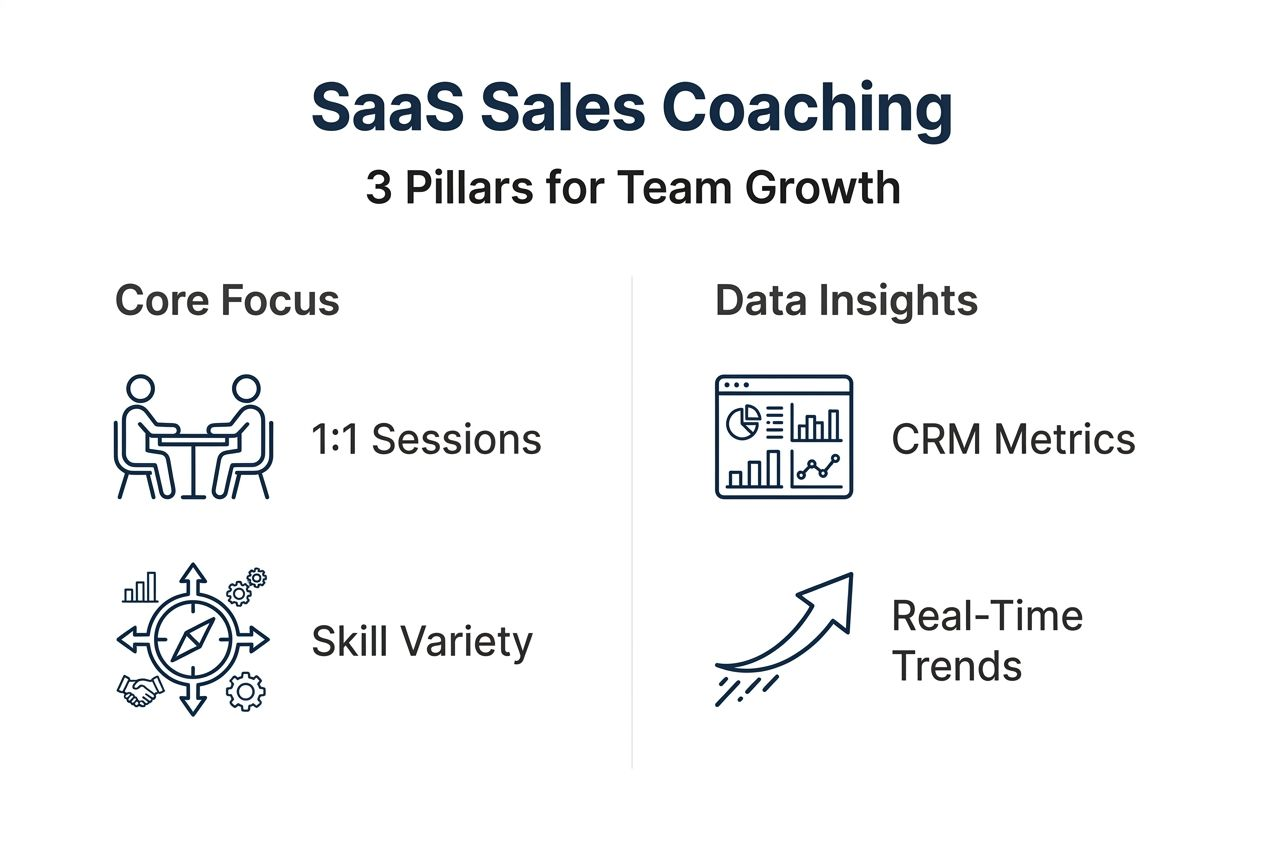
A structured framework ensures coaching aligns with SaaS-specific goals and delivers consistent results. The three-pillar approach combines customer-centric methods, data-driven insights, and continuous feedback loops.
| Framework pillar | Description | Benefits |
|---|---|---|
| Customer-centric coaching | Focus on understanding buyer journeys, pain points, and value delivery throughout subscription lifecycle | Improves renewal rates, expansion revenue, and customer satisfaction |
| Data-driven coaching | Leverage CRM analytics, pipeline metrics, and performance data to personalise coaching sessions | Identifies specific skill gaps, tracks progress objectively, and informs targeted interventions |
| Continuous feedback loop | Establish regular coaching cycles with periodic evaluations, peer reviews, and ongoing skill development | Builds sustained improvement culture, adapts to changing market conditions, and reinforces learning |
Implementing this framework involves several key steps:
- Assess current team skill gaps relative to SaaS KPIs such as quota attainment, renewal rates, and expansion revenue
- Define coaching objectives aligned with business growth targets and individual development needs
- Blend 1:1 coaching sessions with group training to balance personalised attention and team collaboration
- Integrate CRM and pipeline data into coaching conversations for evidence-based discussions
- Schedule regular coaching cycles over 6-12 months rather than one-off sessions
- Measure progress using clear metrics: win rates, average deal size, ramp-up speed, and quota achievement
Pro Tip: Integrate CRM and pipeline data for personalised coaching insights. Real-time analytics reveal exactly where reps struggle, enabling targeted interventions that address specific bottlenecks rather than generic advice.
Blending 1:1 and group coaching maximises engagement and skill variety. Individual sessions address personal challenges and career development, whilst group training builds team cohesion and shares best practises. Structured frameworks combining role-playing, pipeline analytics, and blended coaching drive measurable improvement by maintaining consistency whilst adapting to individual needs.
Quantifiable impact of sales coaching on SaaS sales performance
Data proves that structured coaching significantly enhances SaaS sales outcomes. Organisations investing in tailored coaching programmes see measurable gains across critical performance indicators.
| Metric | Typical improvement | Impact |
|---|---|---|
| Quota attainment | Up to 20% increase | More reps hit targets consistently |
| Ramp-up time | 50% faster | New hires contribute revenue sooner |
| Win rates | 15-25% improvement | Higher conversion from pipeline to closed deals |
| Renewal rates | 10-15% increase | Reduced churn and improved customer retention |
| Expansion revenue | 20-30% growth | Existing accounts generate more recurring revenue |
Research shows bespoke SaaS sales coaching can boost quota attainment by nearly 20% and speed ramp-up time by up to 50%. These gains translate directly to revenue growth and improved team productivity. Faster ramp-up means new hires become productive contributors within months rather than a year, enabling SaaS firms to scale teams efficiently.
UK SaaS companies implementing structured coaching report tangible results. One mid-market SaaS firm reduced new hire ramp-up from 9 months to 4.5 months through targeted coaching focused on product knowledge, discovery techniques, and objection handling. Another enterprise SaaS business increased annual renewal rates from 82% to 93% by coaching account managers on value articulation and customer success alignment.
Metrics sales leaders should track to evaluate coaching success include:
- Quota attainment percentage across the team
- Average ramp-up time for new hires to reach full productivity
- Win rates at each sales stage from qualification to closed-won
- Renewal rates and churn percentages
- Expansion revenue as a proportion of total recurring revenue
- Sales cycle length and pipeline velocity
Real-world coaching examples demonstrate that consistent, data-driven coaching creates compounding benefits over time. Initial improvements in individual skills lead to better team performance, which builds momentum and reinforces a culture of excellence.
Implementing sales coaching to accelerate your SaaS team’s growth
Designing and sustaining a SaaS-specific coaching culture requires deliberate steps aligned with your business goals.
-
Assess team skill gaps relative to SaaS KPIs. Analyse current performance data to identify where reps struggle: prospecting, discovery, demo delivery, negotiation, or renewals. Use CRM analytics to pinpoint specific bottlenecks and skill deficiencies.
-
Define clear coaching objectives. Align coaching goals with business targets such as 50% annual growth or quarterly quota achievement. Establish measurable outcomes for each coaching cycle.
-
Blend 1:1 and group coaching formats. Individual sessions address personal challenges and career development, whilst group training shares best practises and builds team cohesion. Balance both approaches to maximise engagement.
-
Integrate data tools into coaching sessions. Use CRM and pipeline analytics to inform discussions. Review deal progression, win/loss patterns, and activity metrics to ground coaching in evidence rather than assumptions.
-
Establish ongoing coaching cycles. Schedule regular sessions over 6-12 months rather than treating coaching as a one-off event. Periodic evaluations track progress and adapt coaching focus as skills develop.
-
Build a coaching culture supported by management. Ensure leadership actively participates in coaching initiatives and models continuous learning. Align incentives and recognition with coaching goals.
Pro Tip: Establish a coaching culture supported by management and aligned to SaaS sales metrics. When leaders demonstrate commitment to coaching and celebrate skill development, teams embrace continuous improvement as core to their roles.
Avoid common pitfalls such as focusing coaching exclusively on outbound prospecting or treating it as a remedial measure for underperformers. Sustained coaching cycles over 6-12 months combined with CRM analytics enable measurable SaaS sales growth by addressing the full lifecycle from acquisition through renewal and expansion.
Effective sales team management workflows integrate coaching into daily operations rather than treating it as an isolated activity. Regular pipeline reviews, deal coaching sessions, and skills workshops become routine, reinforcing learning and accelerating performance gains.
Discover tailored coaching solutions for SaaS growth
You’ve seen how structured sales coaching accelerates SaaS performance and drives sustainable growth. Now it’s time to bring these insights into action for your team.
Ahead of Sales specialises in bespoke 1:1 coaching programmes designed specifically for SaaS sales teams. Our tailored approach combines proven coaching frameworks with data-driven insights, helping UK SaaS firms achieve at least 50% annual sales growth and ensure quarterly quota attainment. Whether you’re scaling a team of 50 or managing 1000 reps, our customised programmes align with your unique SaaS sales cycles, KPIs, and growth objectives.
Explore why sales training matters and discover essential training topics that complement coaching efforts. Learn about effective training methods that accelerate team capabilities and revenue growth. Book a consultation today to start your tailored coaching journey and unlock your team’s full potential.
Frequently asked questions about sales coaching for SaaS
What metrics best measure SaaS sales coaching success?
Focus on quota attainment percentage, ramp-up time for new hires, win rates at each sales stage, renewal rates, and expansion revenue as a proportion of total recurring revenue. These metrics directly reflect coaching effectiveness in improving skills that drive SaaS growth. Track pipeline velocity and average deal size to identify improvements in sales efficiency.
How long before I see results from sales coaching in SaaS?
Expect initial improvements within 3-6 months, with substantial gains emerging after 6-12 months of sustained coaching. SaaS sales cycles are longer than traditional sales, so meaningful skill development and behaviour change take time. Consistency matters more than quick fixes. Early wins include better discovery questions and improved demo delivery, whilst renewal and expansion improvements manifest over longer periods.
Can sales coaching improve renewal and expansion sales?
Absolutely. Coaching focused on value articulation, customer success alignment, and relationship management significantly improves renewal rates and expansion revenue. Since renewals and expansions represent over 70% of SaaS revenue, coaching in these areas delivers substantial business impact. Reps learn to identify upsell opportunities, demonstrate ongoing value, and navigate renewal negotiations effectively.
What role does technology play in SaaS sales coaching?
CRM and analytics tools provide data-driven insights that personalise coaching sessions. Technology enables sales leaders to track rep activity, identify pipeline bottlenecks, and measure skill development objectively. Sales coaching software facilitates session scheduling, progress tracking, and performance analytics, making coaching scalable and consistent across growing teams.
How to ensure team-wide adoption of coaching practises?
Secure leadership commitment to model continuous learning and actively participate in coaching initiatives. Align incentives and recognition with coaching goals, celebrate skill development publicly, and integrate coaching into regular workflows rather than treating it as an extra task. Create peer coaching opportunities and share success stories to build momentum and demonstrate tangible benefits across the team.
One Response