
A 1:1 sales coaching plan is a written, rep-specific development plan: where the salesperson stands today, the one behaviour they need to change next, how you will practise it together and the date you will check whether it showed up in real calls. The plan itself is simple. What makes or breaks it is the follow-up, because most coaching ends on advice rather than evidence. We built our own coaching around that gap, and below is the full plan, a template you can copy, a worked 90-day example and a straight answer on group versus 1:1.
TL;DR
- A good plan has one skill focus per rep, a baseline, an observable target behaviour, a practice method, a review date and a log of what actually changed.
- Run a 30-minute 1:1 where the rep talks most of the time, finishing with one or two written actions with owners and dates.
- Coach one skill at a time over 30 to 60 days, and judge it on behaviour in live calls first and win rate second.
- Use group sessions to teach shared skills and 1:1 coaching to change an individual’s habits. Most teams need both.
- If you are a founder or sales leader without the hours to run this weekly, bespoke 1:1 coaching with an outside coach takes the structure and the follow-up off your desk.
Table of Contents
- What a 1:1 sales coaching plan actually is
- The six parts of a plan that works
- How to run the 30-minute 1:1
- How often, and how to track it
- A worked 90-day example
- Tailoring the plan to the person
- Group or 1:1 sales coaching?
- Where we come in
- Our perspective
- FAQ
- Sources
What a 1:1 sales coaching plan actually is
It helps to separate three things that often get blurred in a manager’s diary.
Deal coaching advances one opportunity: who to call, what to say to the finance director this week. Pipeline review looks at the health of the whole book: forecast, stalled deals, bottlenecks. Skill coaching is different: it improves how a particular person sells, and it is the only one of the three that carries over into future deals. This is the distinction Prolifiq draws between the three kinds of conversation, and it is a useful one to keep in mind when you design your plan.
A coaching plan is the document that governs the third kind. It should be specific to the person, it should change as they improve and it should guide every weekly conversation. If it is the same for everyone on your team, it is a training outline, not a coaching plan.
For a business owner or SVP of Sales, the aim is blunt: a rep who sells differently in the room next month than they do today, in a way you can see and measure. Quarterly targets follow from that, not the other way round.
The six parts of a plan that works
The published templates vary in length (some run to a dozen columns) but they all boil down to the same six jobs. Keep one page per rep.
| Part | What goes in it | Example |
|---|---|---|
| 1. Baseline | Current evidence: call recordings, win rate, stage conversion | Discovery calls move to proposal 22% of the time |
| 2. Skill focus | One skill, and why this one now | Discovery questioning: reps pitch before the pain is clear |
| 3. Target behaviour | What you will see or hear, stated so anyone could observe it | Asks at least three impact questions before presenting |
| 4. Practice method | How the skill is rehearsed between sessions | Role-play the opening twice; rewrite one talk track |
| 5. Commitments log | Weekly actions, each with owner and date | Use the new question set on four calls by Friday |
| 6. Review | Review date, what changed, what carries forward | Day 30: check six recorded calls |
Two habits keep the plan honest. First, choose a leading measure (something the rep controls, such as how often the new question set is used) and one lagging measure (such as discovery-to-proposal conversion) before coaching starts. Second, write the review date into the plan on day one. A plan without a review date and a record of what changed is a to-do list, not a coaching loop.
Trying to fix everything at once is the most common way leaders waste this document. One skill, one period, one measurable outcome. If a rep has five weaknesses, you have five plans in sequence, not one crowded plan.
How to run the 30-minute 1:1
The structure below blends the two UK-published frameworks we found most practical: a coaching guide from Diploma PLC’s Sales Excellence material, which uses the GROW model (Goal, Reality, Options, Will: a four-step way of moving from what the person wants to what they will commit to), and a 30-minute 1:1 framework from PatchPath.
Before the session: 15 minutes
This is where most managers skimp, and it shows. Preparation should cover five things, as set out in this one-to-one coaching guide:
- Pick a call by a rule, not by mood (for example, the most recent discovery call over 20 minutes).
- Find one observable behaviour in it.
- Mark the timestamp of a 30 to 60 second clip.
- Write your opening question.
- Check whether the step agreed last time showed up in new calls.
The Diploma PLC guide also asks you to know which sales goal the session supports (win rate or new accounts, say), and to choose one or two strengths and one or two areas to develop. Tailor your approach to the person’s personality, style and experience: a ten-year veteran and a first-year seller need different conversations about the same skill.
In the session: 25 to 30 minutes
- Minutes 0 to 5: the person. A genuine check-in. Pressure at home or a lost deal last week will colour everything that follows.
- Minutes 5 to 15: their view, then the evidence. Ask how the call went in their words. Then play the clip. Let them spot the moment before you point to it.
- Minutes 15 to 25: practise. Agree what they would say differently, write it down and have them say it aloud twice. Reps get better by doing, not by hearing.
- Minutes 25 to 30: commitments. Agree one or two written actions that are specific, measurable and time-bound, each with an owner, a due date and which calls you will check.
The Diploma PLC guide recommends the salesperson talks around 70% of the time and the coach 30%, and Ambition’s CARE framework makes the same case: when reps put the problem and the solution into their own words, accountability becomes theirs rather than yours. In practice that means more questions than statements. If you are talking for 20 minutes of a 30-minute session, you are briefing, not coaching.
After the session: the part that decides everything
The step most often skipped is verification: checking in later calls that the agreed behaviour actually happened. Without it, the same advice circulates week after week and each session starts from zero. Put the check date in the diary before you leave the room, and listen to the calls.
How often, and how to track it
There is no single correct cadence, but a workable rhythm for a sales team looks like this:
- Weekly: a 30 to 45 minute 1:1 as the core coaching session.
- Fortnightly: a separate pipeline review, kept apart from skill coaching so deals do not swallow the whole hour.
- Monthly: a longer development review to look at progress against the plan and reset priorities for the next 30 days.
Some published templates add daily 10-minute check-ins on priorities and blockers. That suits a large inside-sales floor more than a team of six field sellers, so scale it to your size.
For tracking, think in three layers:
- Performance: quota attainment, win rate, average deal size, stage conversion.
- Observation: is the rep applying the coaching in real calls, and are you keeping to your own coaching rhythm?
- Culture: satisfaction, retention and promotion frequency in the team.
Be patient with the first layer. Win rate lags behaviour by weeks, sometimes a full sales cycle. If your average deal takes four months, do not judge a 30-day plan on closed revenue. Judge it on the leading measure, and let conversion catch up.
A worked 90-day example
Imagine a services firm with a seller called Priya. She is warm, well liked by prospects and loses deals at the proposal stage, because she presents before she has uncovered the commercial impact of the problem.
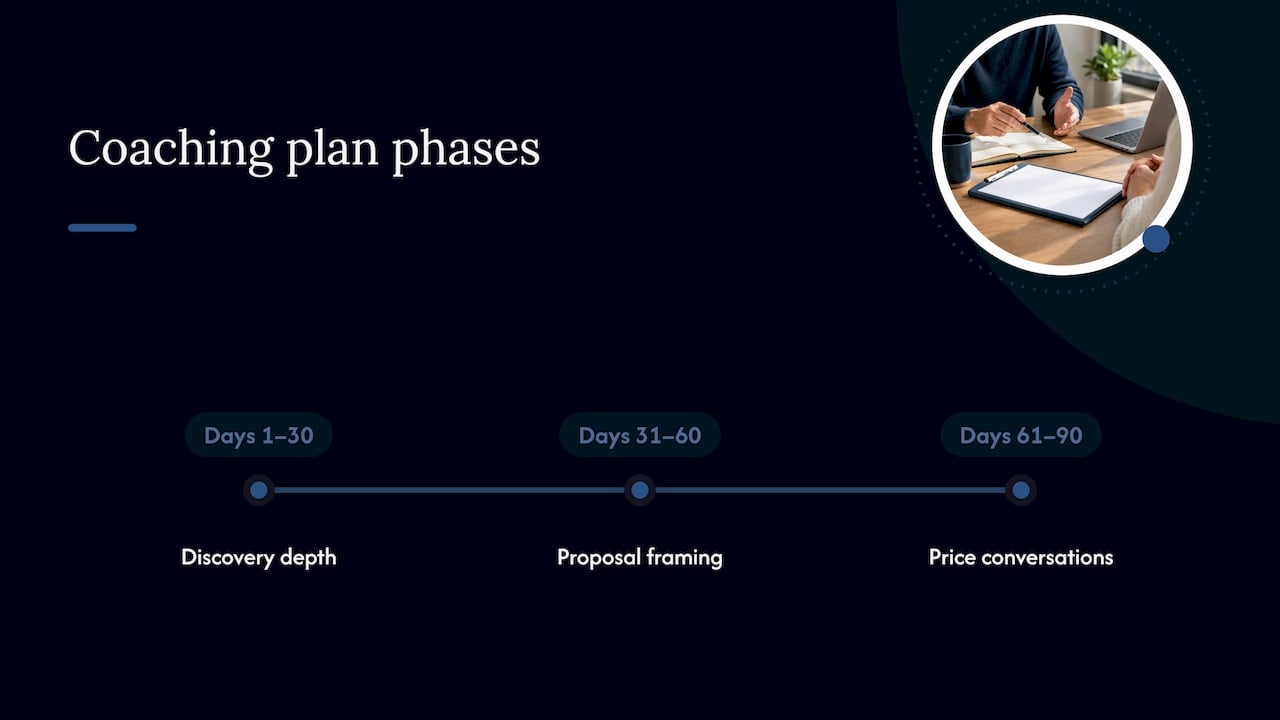
Days 1 to 30: discovery depth. Baseline: of ten recorded discovery calls, two included a question about cost or consequence. Target behaviour: at least three impact questions before any mention of the solution. Practice: role-play the first five minutes twice per session. Leading measure: impact questions per call. Lagging measure: discovery-to-proposal conversion.
Days 31 to 60: proposal framing. Once the skill is demonstrated consistently across several calls, you reset. The new focus is how the proposal restates the buyer’s own numbers. The old skill stays on the plan as a standing check.
Days 61 to 90: price conversations. The target is holding price without an automatic discount. A measurable outcome might be average discount given falling from 18% to under 10%, which is the sort of concrete figure a coaching plan should aim for.
At day 90 you review the whole quarter, decide what carries forward and write the next plan. Notice that every block has one skill, one behaviour, one practice method and one measure.
If you want a ready-made version of this logic, our own one-page, six-skill rubric shows how to structure coaching over 90 days, and our examples of sales coaching include goal setting and tracking in practice.
Tailoring the plan to the person
The plan is only as good as its fit with the individual. A few principles:
- Start with their self-assessment. Ask them to rate their own call before you give your view. Gaps between the two are the richest coaching material.
- Match the method to experience. A newer seller usually needs modelling: show what good looks like with a real recording. A senior seller often needs challenge and a sparring partner, not a script.
- Let them co-write it. People commit to what they help build. Ask the rep to draft the target behaviour in their own words.
- Separate development from deals. Open with the highest-risk deal if you must, but protect time for skill work, or it will never happen.
If you are a solo consultant or coach, the same logic applies with you as both coach and seller. Record your own calls, pick one skill and set a review date. The difficulty is not the template. It is that nobody is there to notice when you quietly skip the review, which is where an outside coach earns their fee.
Group or 1:1 sales coaching?
This is a question of what you are trying to change.
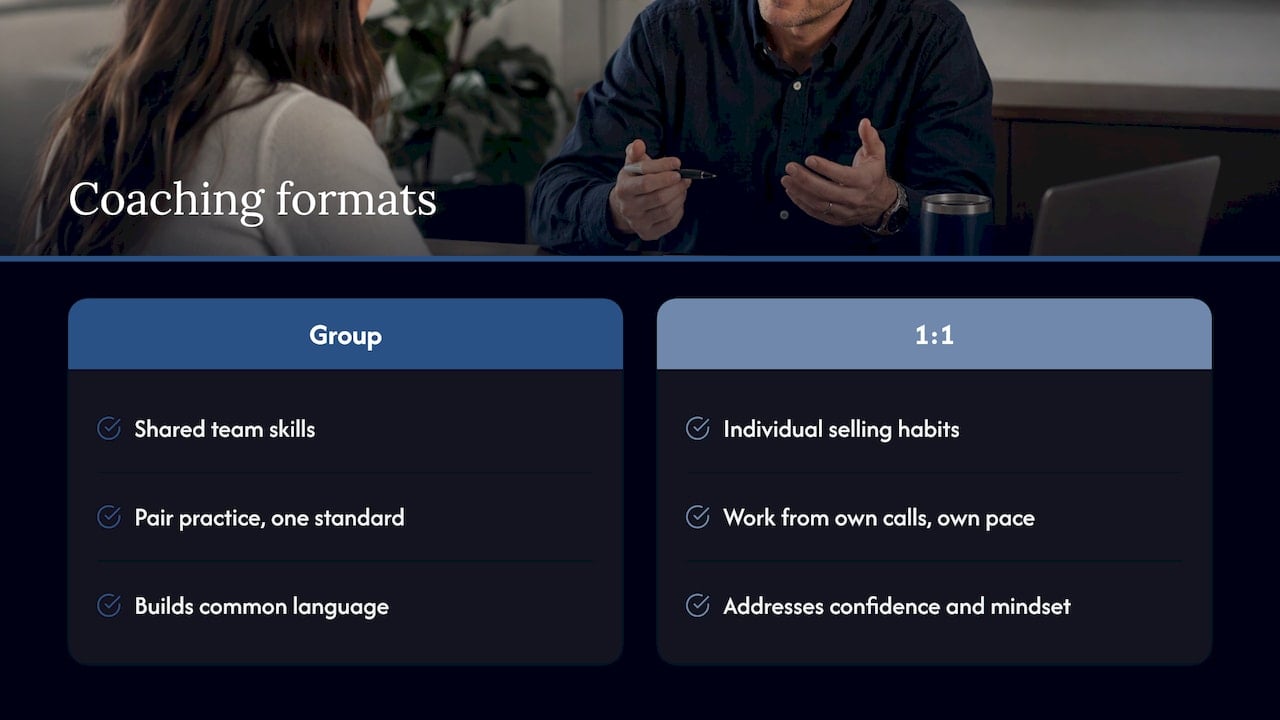
Group sessions suit shared skills. If the whole team struggles with the same thing (a new qualification process, a change to your pitch, a common objection) it is efficient to teach it once, practise in pairs and agree a standard. A group also builds a common language and a bit of healthy peer pressure.
1:1 coaching suits individual habits. Why one rep discounts too early, why another avoids calling senior buyers, why a third talks through the buyer’s answer: these are personal patterns, often tied to confidence and mindset. They are rarely fixed in a room of twelve, because nobody wants to expose them there. A 1:1 plan lets you work from that person’s own calls and move at their pace.
The best results usually come from combining both. Teach the shared standard in a cohort or workshop, then use 1:1 coaching to embed it in each person’s real calls. Our sales team coaching techniques piece goes further on how to blend the two, and our article on why 1:1 coaching lifts team performance covers the individual side in more detail.
Where we come in
We combine bespoke 1:1 coaching with traditional training and consultancy, so the plan, the practice and the follow-up are handled in one engagement rather than squeezed into a busy leader’s week. Our team-based bespoke coaching and consultancy engagements are £4,500 to £8,500 one-off, and our sales acceleration track for solo service businesses and consultants is £2,995 to £5,995 one-off. If you would rather start with a monthly membership, The Sage Collective is £990 per month. Our approach is designed to help teams hit their quarterly targets and deliver at least 50% sales growth a year.
For teams, see our coaching and consultancy packages. If you are a solo business owner, look at the sales coaching programme. If you need a leader as well as coaching, our fractional sales director service is built for that.
Our perspective
We have sat on both sides of the table, and the pattern is the same almost every time: the plan is rarely what fails. A manager writes a sensible one-page plan, runs two good sessions, and then a big deal lands, the diary fills and the review date slips. Three weeks later the advice is stale and nobody has checked a single call.
That is why we pair 1:1 coaching with consultancy and training. The coaching changes the individual. The consultancy fixes the structure around them: the process, the scorecard, the cadence. The training gives the whole team the same standard to work from. Each piece makes the others stick.
We also think mindset gets too little airtime in coaching plans. Objection handling is a skill, but hesitating to ask for the sale or to hold your price is often a belief. A plan that only lists behaviours will miss it. A coach who works with someone one-to-one, call after call, will not.
If you take one thing from this article, make it this: put the review date in the diary before the first session, and listen to the calls.
Jerry
FAQ
How long should a 1:1 sales coaching plan run?
A single skill focus usually runs for 30 to 60 days, inside a 90-day plan that has two or three focus areas in sequence. Reset when the behaviour shows up consistently in live calls, not when the calendar says so.
What should a sales coaching plan template include?
The rep’s name, coaching period and coach, one skill focus and the reason for it, a baseline, an observable target behaviour, the practice method, a weekly commitments log with owners and dates, leading and lagging measures, and a review date with the outcome. Keep it to one page per person.
How is a coaching session different from a pipeline review?
A pipeline review asks what will close and when, and looks at forecast and risk across the book. A coaching session asks how this person sells and what they will do differently on their next call. Keeping them in separate slots stops deals from taking over the time meant for skills.
Is group or 1:1 coaching better for a sales team?
Neither wins outright. Group sessions are efficient for shared skills and standards, while 1:1 coaching changes individual habits and mindset. Teaching the standard in a group and embedding it through 1:1 coaching is the strongest combination.
Sources
- One on One Sales Coaching: Playbook and Template, Prolifiq
- Sales Coaching guide, Diploma PLC Sales Excellence
- How to Run a Great 1-1 With Your ASM, PatchPath
- One to one sales coaching: how to run it well, Triplesession
- The CARE Framework: A Simple Formula for Effective 1:1s, Ambition