
TL;DR:
- Series B funding is a growth-stage round that raises $30 to $40 million to scale a proven business model. It requires companies to demonstrate strong financial metrics, operational discipline, and governance readiness, including audited financials and documented sales processes. Investors at this stage focus on execution ability and detailed growth plans, making early preparation essential for success.
Series B funding is defined as the second major round of institutional growth capital raised by a startup to scale a proven business model aggressively. It follows Series A and targets companies that have already demonstrated product-market fit, repeatable revenue, and the operational foundations needed to expand. Round sizes typically range from $30M to $40M, with post-money valuations between $120M and $160M and founder dilution of roughly 15–18%. If you are an entrepreneur preparing for this stage, understanding what investors expect and how to prepare is not optional. It is the difference between raising successfully and joining the majority who do not.
What is series B funding and how does it work?
Series B funding is the growth-stage investment round that takes a startup from early traction to market-scale operations. Where Series A capital funds the search for a repeatable model, Series B funds aggressive execution to capture market share. Investors at this stage are not underwriting an idea. They are underwriting your ability to execute at scale.

The capital raised typically goes towards expanding sales and marketing teams, entering new markets, building out engineering capacity, and professionalising the management structure. Investors expect a clear capital utilisation plan tied directly to growth targets. Vague plans about “growing the team” will not satisfy a Series B investor conducting rigorous due diligence.
The gap from Series A to Series B now averages approximately 24 months, reflecting increased investor scrutiny on capital efficiency. That timeline has extended because investors want to see sustained performance, not a single strong quarter. You need to show consistent execution across multiple periods before the conversation about Series B becomes serious.
What financial metrics define readiness for Series B?
Series B readiness is defined by a specific set of financial and operational benchmarks, not by ambition or narrative. Companies typically need $5M–$10M in annual recurring revenue (ARR), 80–120% year-over-year growth, a burn multiple below 2x, and a CAC payback period under 18–24 months to attract serious investor interest.
The Rule of 40 is a widely used benchmark at this stage. It states that your growth rate percentage plus your profit margin percentage should equal or exceed 40. A company growing at 80% with a negative 30% margin scores 50, which passes. A company growing at 30% with a negative 20% margin scores 10, which does not. Investors use this to separate genuine growth businesses from companies burning cash without proportionate returns.
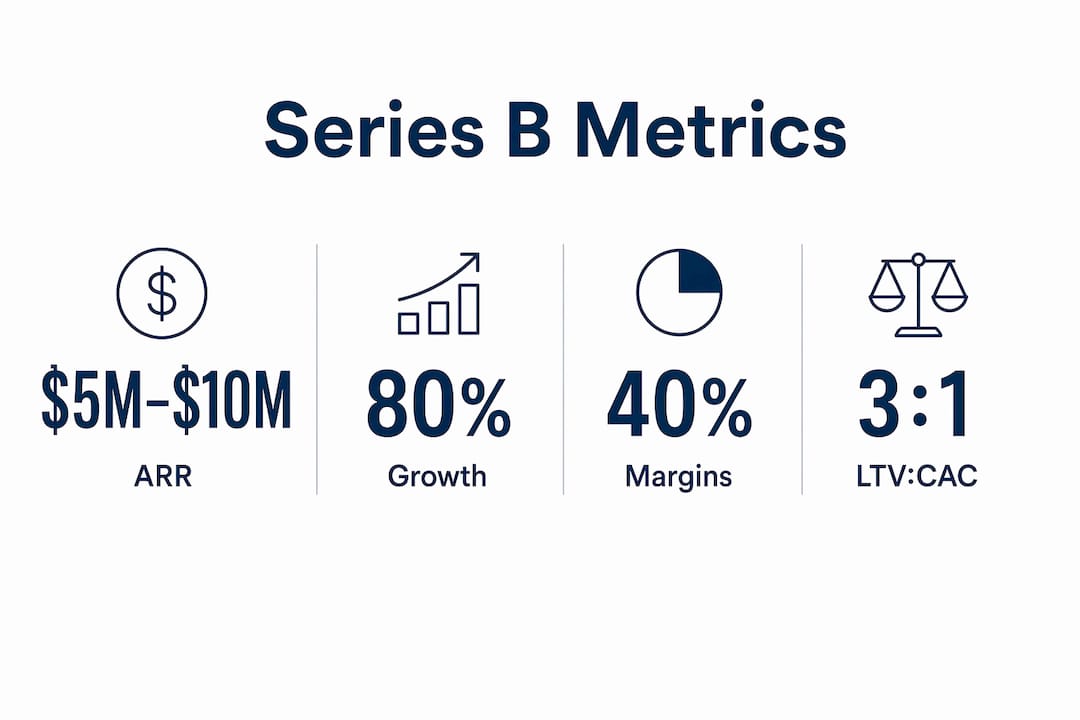
The LTV:CAC ratio matters equally. A ratio below 3:1 signals that your unit economics are not yet strong enough to justify aggressive expansion. Series B investors will model your economics forward, so weak ratios today translate directly into a lower valuation or a failed raise.
| Metric | Series B threshold |
|---|---|
| Annual recurring revenue (ARR) | $5M–$10M |
| Year-over-year growth | 80–120% |
| Burn multiple | Below 2x |
| CAC payback period | Under 18–24 months |
| LTV:CAC ratio | 3:1 or above |
| Rule of 40 score | 40 or above |
Pro Tip: Build a single-page metrics dashboard before you start investor conversations. Investors will ask for these numbers in the first meeting. Having them prepared, audited, and trended over 12 months signals operational maturity.
Only 30–40% of startups that raise Series A progress to Series B, which means the majority stall at this stage. The most common reason is failing to optimise unit economics before approaching investors. If your numbers are not there yet, the right move is to delay the raise and fix the fundamentals.
How does Series B differ from Series A and later rounds?
Series A and Series B serve fundamentally different purposes, and conflating them is one of the most common mistakes founders make when planning their fundraising. Series A is about finding and validating a repeatable business model. Series B is about scaling that model with speed and discipline, assuming the hard discovery work is already done.
The investor risk profile changes significantly between the two rounds. Series A investors accept higher uncertainty in exchange for lower valuations. Series B investors conduct far more rigorous due diligence on revenue quality, margins, cash flow, and the credibility of your growth plan. They want audited financials, not management accounts. They want a named pipeline, not a market size slide.
Governance provisions also increase substantially at Series B. Board composition shifts, anti-dilution clauses are introduced, and liquidation preferences become more complex. These terms carry through to future rounds and exits, so the decisions made at Series B permanently shape how your company is governed.
| Feature | Series A | Series B | Series C and beyond |
|---|---|---|---|
| Primary purpose | Validate repeatable model | Scale proven model | Dominate market or prepare for exit |
| Typical round size | $5M–$15M | $30M–$40M | $50M+ |
| Investor focus | Product-market fit | Execution and unit economics | Market leadership and profitability |
| Due diligence depth | Moderate | Rigorous | Extensive |
| Governance complexity | Low to moderate | Moderate to high | High |
Series C and beyond shift focus again, moving towards market dominance, international expansion, or preparation for an IPO or acquisition. Series B sits in the middle: past the uncertainty of early stage, but still far from the structured processes of a pre-IPO company.
What governance terms should you expect at Series B?
Series B is a governance event, not just a financing event. The legal and structural changes introduced at this stage affect your control of the company for years. Founders who treat it purely as a capital transaction often find themselves surprised by the implications six months later.
The key governance terms to understand are:
- Preferred stock: Series B investors receive preferred shares, not ordinary shares. These carry rights that ordinary shareholders do not have, including priority in a liquidation event.
- Liquidation preferences: Investors typically receive 1x their investment back before ordinary shareholders receive anything in a sale or wind-down. Some deals include participating preferences, which allow investors to take their preference and then share in remaining proceeds.
- Anti-dilution protections: These clauses protect investors if you raise a future round at a lower valuation (a down round). Broad-based weighted average anti-dilution is the most common and most founder-friendly form.
- Board seat negotiations: Series B investors almost always require a board seat. This changes the balance of power in board decisions and can affect future hiring, strategy, and exit decisions.
- Information rights: Investors will require monthly or quarterly financial reporting, often to audited standard. This is a significant operational commitment if you do not already have financial infrastructure in place.
These governance provisions carry through future financings and exits, which means the terms you accept at Series B set the baseline for every subsequent negotiation. Getting specialist legal advice before you sign is not a luxury at this stage. It is a necessity.
Pro Tip: Negotiate governance terms before you are under time pressure. Once you have a signed term sheet and a closing deadline, your negotiating position weakens considerably. Engage a specialist startup lawyer during the term sheet stage, not after.
How should you prepare for a Series B raise?
Preparation for Series B starts at least 12 months before you plan to raise. The companies that raise successfully are not the ones that scramble to fix their metrics in the six weeks before investor meetings. They are the ones that built the right foundations during the preceding year.
-
Build a repeatable sales process. Founders who lack clear customer segmentation and a repeatable sales process consistently struggle to convince Series B investors. You need documented playbooks, defined sales stages, and a pipeline that does not depend on the founder closing every deal. Working with a specialist like Aheadofsales to build and stress-test your sales process before investor conversations is a practical way to close this gap quickly.
-
Professionalise your executive team. Installing a CFO, VP of Sales, and VP of Engineering before seeking Series B is a strong signal to investors that you are building a company, not just a product. Investors at this stage are backing the team as much as the metrics.
-
Achieve audit-ready financials. Series B investors expect audited accounts or, at minimum, financials prepared to audit standard. If your bookkeeping has been informal, fix it now. A clean financial history removes a major objection from the due diligence process.
-
Prepare a detailed capital utilisation plan. Investors want to know exactly how you will deploy the capital raised and what milestones it will unlock. A plan that maps funding tranches to specific growth targets, headcount additions, and market expansion steps is far more persuasive than a general growth narrative.
-
Understand the benefits of sales consultancy for your growth plan. Many founders underestimate how much investor confidence is built by demonstrating a structured, externally validated approach to revenue generation. A well-documented sales methodology, supported by specialist coaching, signals that your growth is repeatable and not founder-dependent.
The shift from founder-led to standardised, scalable processes is the single most important operational change you need to make before Series B. Investors are not just buying your current metrics. They are buying your ability to sustain and accelerate them with a larger team and a bigger budget.
Key takeaways
Series B funding is the execution round: companies that raise it successfully have proven their model and can demonstrate the metrics, governance readiness, and operational discipline to scale it at speed.
| Point | Details |
|---|---|
| Series B definition | Second major growth capital round, scaling a proven model rather than discovering one. |
| Financial readiness | Target $5M–$10M ARR, 80–120% year-over-year growth, and a burn multiple below 2x. |
| Governance impact | Board seats, liquidation preferences, and anti-dilution clauses introduced at Series B carry through all future rounds. |
| Conversion reality | Only 30–40% of Series A companies reach Series B, making metric optimisation critical. |
| Preparation timeline | Start building audit-ready financials and a repeatable sales process at least 12 months before raising. |
The part most founders get wrong about Series B
I have worked with a lot of founders who approach Series B the same way they approached Series A: with a compelling story, strong momentum, and confidence that the numbers will speak for themselves. That approach works at Series A. At Series B, it falls apart quickly.
The shift that catches most founders off guard is the move from narrative to proof. Series B is less risky than Series A for investors, which sounds reassuring until you realise it means they have far less tolerance for uncertainty. They are not backing potential. They are backing demonstrated execution, and they will pull apart your metrics in ways that Series A investors simply did not.
The other thing I see consistently is founders underestimating the governance implications. They focus entirely on the valuation and the dilution percentage, and they sign terms without fully understanding what the board seat provisions or liquidation preferences mean in practice. Three years later, when they are trying to raise Series C or negotiate an acquisition, those terms come back to constrain them in ways they did not anticipate.
The mindset shift from a craft workshop to a factory is real and it is hard. Founders who built the company on instinct and relationships have to accept that Series B investors are buying a system, not a person. The sooner you build that system, with documented processes, professional management, and clean financials, the stronger your position will be when you sit across the table from a Series B investor.
My honest advice: treat the 12 months before your raise as a preparation programme, not a waiting period. Fix your unit economics, build your sales playbook, hire your CFO, and get your accounts audited. Do not walk into those investor meetings hoping the story is enough.
— Jerry
How Aheadofsales helps scaling startups prepare for Series B
Raising Series B requires more than strong metrics on a slide deck. Investors want to see a revenue engine that runs without the founder in every deal. That is precisely where Aheadofsales works.

Aheadofsales combines bespoke 1:1 coaching with structured sales training and consultancy to help growth-stage businesses build the repeatable sales processes that Series B investors expect. For SaaS companies specifically, the SaaS sales training programme is designed to move your team from founder-dependent selling to a documented, scalable methodology. Packages start from £4,500, making specialist support accessible well before your raise. If your sales process is not investor-ready, Aheadofsales can help you get it there.
FAQ
What is the typical size of a Series B funding round?
Series B rounds typically range from $30M to $40M, with post-money valuations between $120M and $160M as of 2026. Founder dilution at this stage is generally 15–18%.
How long does it take to go from Series A to Series B?
The average gap from Series A to Series B is approximately 24 months, reflecting the time needed to build the metrics and operational maturity that Series B investors require.
What percentage of Series A companies raise a Series B?
Only 30–40% of startups that raise Series A go on to raise Series B. The primary barrier is failing to optimise unit economics and growth efficiency before approaching investors.
What comes after Series B funding?
Series C follows Series B and focuses on market dominance, international expansion, or preparation for an IPO or acquisition. Rounds at this stage are typically $50M or more and involve institutional investors with a strong preference for near-profitability or clear paths to exit.
Who invests in Series B rounds?
Series B investors are typically institutional venture capital firms specialising in growth-stage companies. They conduct rigorous due diligence on revenue quality, margins, and cash flow, and require credible growth plans with specific capital use cases before committing.