
TL;DR:
- Pipeline management, often treated as administrative, is actually a strategic process guiding opportunities through specific stages. Properly managing it aligns sales, marketing, and finance, enabling predictable revenue growth and accurate forecasts. Building skills and adopting a proactive, data-driven approach transforms selling into a scalable, reliable system.
Nearly 40% of sales teams identify improving sales productivity as their single biggest challenge, and the root cause is almost always the same: pipeline management treated as an administrative chore rather than a strategic discipline. If you are a business owner or sales leader in a mid-sized UK company, you have probably seen this first-hand. Deals sit untouched in your CRM, forecasts are educated guesses, and your team reacts to problems rather than preventing them. This guide will clarify exactly what pipeline management is, why it matters, and how to apply it with confidence.
Table of Contents
- What pipeline management means and why it matters
- The distinction between pipeline and funnel: what every business should know
- Building effective pipeline stages based on real buyer actions
- Managing pipeline health: reviews, hygiene and preventing pipeline bloat
- Using pipeline metrics and coverage ratios to boost sales predictability
- Why pipeline management must be seen as a revenue control system, not admin
- Build your sales pipeline skills with tailored training and consultancy
- Frequently asked questions
What pipeline management means and why it matters
Let us start with a precise definition, because vague definitions lead to vague execution. Pipeline management is the proactive process of guiding, tracking, and improving sales opportunities through a defined series of stages, from first contact through to a closed deal.
The key word is proactive. Most teams track their pipelines. Far fewer actually manage them. Tracking is passive. You record what has happened. Managing is active. You decide what needs to happen next, by whom, and by when.
“Pipeline management is a discipline of guiding, tracking, and improving opportunities through defined sales stages, serving as a shared language across sales, marketing, finance, and leadership.” — ZNI CRM
That phrase “shared language” is worth pausing on. When your pipeline is properly managed, your sales director, your finance team, and your marketing lead are all working from the same picture of reality. There are no conflicting forecasts, no surprised board members, and no end-of-quarter scrambles. You can read more about why sales pipelines matter in terms of broader business performance.
Think of pipeline management as a revenue control system. It tells you where every deal sits, what action is needed, and whether your business is on track to hit its numbers. That is not admin. That is one of the most important jobs in your company.
The distinction between pipeline and funnel: what every business should know
This is one of the most common points of confusion I see in mid-sized businesses, and it genuinely costs teams time and money when it is not understood properly.
A sales funnel represents the buyer’s journey. It shows how many people enter your awareness stage, how many move to consideration, and how many convert. It is buyer-centric, and while you can influence conversion rates, you cannot directly control them.
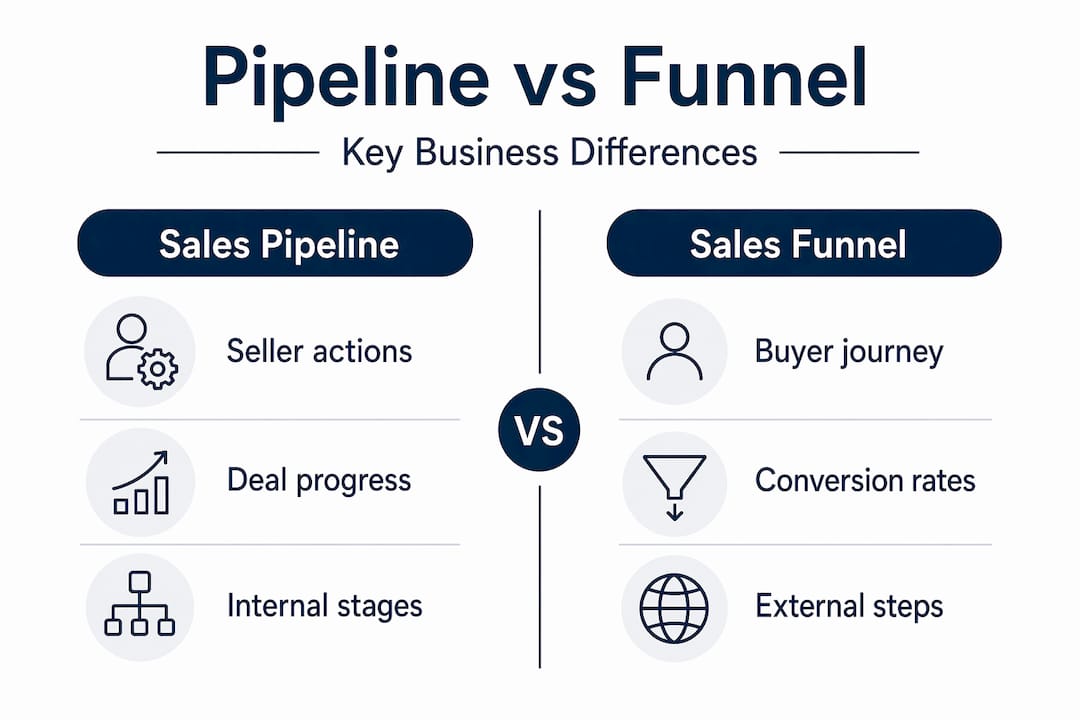
A sales pipeline, by contrast, is your team’s internal, action-oriented roadmap. As the research puts it, the pipeline is seller-focused, tracking the specific steps your sales team takes to close a deal, while the funnel visualises buyer behaviour and drop-off rates.
Why does this distinction matter in practice? Because when your team conflates the two, they spend energy worrying about things they cannot control and not enough energy on the things they can. Pipeline management puts your focus firmly on controllable actions: sending the right proposal, booking the next call, securing a decision-maker meeting.
| Dimension | Sales pipeline | Sales funnel |
|---|---|---|
| Focus | Seller’s actions and deal progress | Buyer’s journey and conversion rates |
| Orientation | Internal and action-driven | External and behaviour-driven |
| What you control | Directly | Indirectly |
| Primary use | Deal tracking and forecasting | Marketing and conversion analysis |
| Measurement | Deal value, stage, velocity | Lead volume, drop-off rates, conversion |
Understanding this table changes how you run your weekly sales meetings. You stop asking “where is the lead in their journey?” and start asking “what is the next specific action we are taking to move this deal forward?” That is a profound shift. For a deeper look at how these concepts work together, the sales pipeline explained guide is well worth reading.
Building effective pipeline stages based on real buyer actions
Here is where many businesses get pipeline management wrong. They create stages that reflect internal hopes rather than verifiable buyer actions. Stages like “Interested,” “In discussion,” or “Warm lead” tell you almost nothing useful because they are based on a seller’s interpretation, not on anything the buyer has actually done.
Effective pipeline stages must represent specific, verifiable buyer actions, each with clear exit criteria that must be met before a deal advances.
Consider this more reliable set of stages for a mid-sized B2B business:
- Qualified: The prospect meets your ideal customer profile and has confirmed a specific business need
- Discovery complete: A structured discovery conversation has taken place, and key pain points, timelines, and budget indicators are confirmed
- Proposal sent: A written proposal or commercial overview has been formally submitted
- Commercial agreed: Pricing and terms have been verbally agreed by a decision-maker
- Contract signed: Legal sign-off has been received and the deal is formally closed
Notice that each stage has a concrete, observable exit condition. This is what separates a forecasting tool that actually works from one that produces wishful thinking. If your stage exit criteria are fuzzy, your forecast will be too.
Linking your team’s daily activities to these stages is equally important. Every call, email, and meeting should connect to moving a specific deal from one verified stage to the next. This is where consultative selling techniques become genuinely powerful, because they help your reps uncover the buyer evidence needed to advance deals with confidence.

Pro Tip: Review your current pipeline stages and ask: “Could a new sales hire look at this stage name and know exactly what the buyer has done to get here?” If the answer is no, the stage needs rewriting.
Managing pipeline health: reviews, hygiene and preventing pipeline bloat
You can have beautifully defined stages and still end up with a dysfunctional pipeline. That happens when deals are allowed to sit idle, quietly rotting while inflating your reported pipeline value.
Weekly reviews for sales reps and monthly reviews for sales managers are the baseline for keeping deals moving and identifying risks before they become write-offs. These are not optional. They are the heartbeat of effective pipeline management.
Here is a practical review cadence that works well for mid-sized UK sales teams:
- Daily: Each rep checks their own active deals and confirms whether any actions are overdue
- Weekly (rep level): A focused 20-minute review of every open deal, confirming next action, next meeting, and stage accuracy
- Weekly (manager level): A deal-by-deal pipeline conversation with each rep, focused on deals at risk and coaching interventions
- Monthly (leadership level): A review of pipeline coverage, forecast accuracy, and team-wide velocity trends
The second major threat to pipeline health is what is known as pipeline bloat. Pipeline bloat happens when deals linger in your pipeline without genuine buyer interest, which distorts your forecast and gives leadership a false sense of security. A clear rule, removing or flagging any deal that has shown no movement in over 30 days, keeps your pipeline an accurate picture of real revenue potential rather than aspiration.
Automated alerts within your CRM can flag these stagnant deals, prompting a coaching conversation rather than just a silent deletion. For practical techniques on how to keep deals moving, consultative selling methods offer useful frameworks that can be applied directly in these review conversations. You might also find value in how multi-channel approaches can reinvigorate stalled opportunities by reaching buyers through different touchpoints.
Pro Tip: Do not just remove dead deals. Before you archive them, ask your rep: “What would need to be true for this buyer to re-engage?” Sometimes the answer reveals a genuine future opportunity worth scheduling a follow-up for in three months.
Using pipeline metrics and coverage ratios to boost sales predictability
Managing pipeline health through reviews and hygiene is essential, but you also need the right metrics to know whether your pipeline will actually deliver the revenue your business needs.
High-performing sales teams aim for a pipeline coverage ratio of 3 to 4 times their quota. So if your quarterly target is £500,000, your active pipeline should hold between £1.5 million and £2 million in qualified opportunities to account for deals that will inevitably be lost or slip.
| Metric | What it measures | Why it matters |
|---|---|---|
| Pipeline coverage ratio | Pipeline value versus quota | Tells you if you have enough potential to hit target |
| Pipeline velocity | Speed at which deals move through stages | Reveals how fast revenue is being generated |
| Average deal size | Mean value of closed deals | Helps forecast revenue and prioritise effort |
| Win rate by stage | Percentage of deals closed from each stage | Identifies where deals most commonly stall or die |
| Stage conversion rate | Movement from one stage to the next | Shows where your process needs improvement |
Pipeline velocity is particularly useful because it connects three variables: the number of active deals, your average deal size, and your average sales cycle length. If velocity drops, you either have fewer deals, smaller deals, or deals taking longer to close. Each scenario calls for a different response from your leadership team.
Tracking these metrics weekly, rather than just at month or quarter end, means you can spot problems early enough to do something about them. A well-managed sales team workflow builds metric reviews into the rhythm of the week so they become habit rather than a fire drill.
Why pipeline management must be seen as a revenue control system, not admin
I want to be direct about something I see repeatedly when working with mid-sized UK businesses: pipeline management is routinely undervalued because it looks like administration. Reps feel they are updating fields rather than selling. Managers treat pipeline reviews as box-ticking. Leadership checks the top-line number and moves on.
This is a costly mistake.
When pipeline management is treated strategically, it turns selling into a repeatable system with clear stages, verifiable evidence, defined next steps, and genuine accountability. It stops being about heroic individual effort and starts being about process that scales.
The mindset shift required is this: tracking is reactive, managing is proactive. Reactive teams update their CRM after deals die. Proactive teams use exit criteria, automated alerts, and coaching conversations to prevent momentum from being lost in the first place.
I have seen businesses with strong products and talented salespeople consistently miss targets simply because nobody owned the pipeline as a strategic asset. The moment leadership starts treating pipeline management as a revenue control discipline, things change. Forecasts become reliable. Coaching conversations become specific. And crucially, the team starts hitting its numbers with far less end-of-quarter panic.
The cultural shift matters as much as the process. Your reps need to understand that pipeline hygiene is not paperwork. It is the difference between a business that grows predictably and one that lurches between feast and famine. If you want to explore how sales consultancy support can accelerate this mindset shift across your team, the return on that investment is typically very clear.
Build your sales pipeline skills with tailored training and consultancy
Understanding pipeline management is one thing. Embedding it consistently across a sales team of ten, fifty, or two hundred people is another challenge entirely.

At Ahead of Sales, we work with mid-sized UK businesses to do exactly that. Our bespoke sales training programmes help your team master pipeline disciplines, from building stages with genuine exit criteria through to running reviews that actually improve forecast accuracy. Our sales consultancy services go deeper, aligning your pipeline strategy with your broader business goals so that sales, marketing, and finance are all working from the same picture. If you want your team to hit target every quarter rather than occasionally, start by getting the pipeline right. Our sales team workflow support makes that practical and achievable, not theoretical.
Frequently asked questions
What is the main difference between a sales pipeline and a sales funnel?
A sales pipeline focuses on the seller’s actions and deal progress you directly control, while a sales funnel represents the buyer’s journey and conversion rates you influence but cannot directly control.
How often should sales teams review their pipelines?
Weekly reviews for reps and monthly reviews for sales managers are recommended to track deal progress, identify stalled opportunities, and maintain forecast accuracy.
What causes pipeline bloat and how can it be prevented?
Pipeline bloat occurs when deals remain open without genuine buyer interest; enforcing a policy to flag or remove deals inactive for 30 days keeps your forecast grounded in real potential.
Why is pipeline management considered a revenue control system?
Because it creates clarity, accountability, and predictability across sales and finance teams, making selling a repeatable, scalable system rather than a series of unpredictable individual efforts.
What pipeline coverage ratio should sales teams aim for?
High-performing teams aim for a coverage ratio of 3 to 4 times their sales quota to ensure enough potential revenue to reliably hit targets despite inevitable deal losses.