
Every growth-focused sales leader knows that waiting for leads is never enough in competitive British SaaS markets. Outbound sales delivers a proactive strategy where your team reaches out to prospects before they even realise your solution exists. Getting the fundamentals right empowers your company to control your pipeline, personalise outreach, and achieve consistent revenue targets no matter the quarter.
Table of Contents
- Understanding Outbound Sales Fundamentals
- Outbound vs Inbound Sales: Key Differences
- Types of Outbound Sales Outreach Channels
- Essential Roles and Technology in Outbound Sales
- Risks, Compliance, and Common Pitfalls
Key Takeaways
| Point | Details |
|---|---|
| Effective Outbound Sales Strategies | Successful outbound sales require precise target audience identification and compelling communication to convert leads into lasting relationships. |
| Integration of Approaches | Balancing outbound and inbound sales methods together maximises engagement and revenue generation opportunities. |
| Utilisation of Technology | Advanced technologies are essential for automating processes and enhancing the effectiveness of outreach efforts. |
| Compliance Management | Robust systems for tracking consent and managing data protection are crucial to mitigate legal risks in outbound sales. |
Understanding Outbound Sales Fundamentals
Outbound sales represents a strategic approach where sales representatives actively seek out and engage potential customers, rather than passively waiting for leads to arrive. Unlike inbound strategies, outbound sales involve proactively initiating communication through deliberate, targeted outreach methods.
The core of outbound sales involves several fundamental techniques:
- Cold calling potential prospects directly
- Sending personalised email campaigns
- Leveraging social media prospecting
- Conducting targeted network introductions
- Using account-based marketing strategies
Modern outbound sales increasingly rely on sophisticated technologies to enhance efficiency. Advanced engagement technologies now enable sales teams to automate initial contact processes, qualify leads more rapidly, and maintain sophisticated communication pipelines.
Successful outbound sales strategies require a structured approach. Sales representatives must develop:
- Precise target audience identification
- Compelling communication scripts
- Robust follow-up mechanisms
- Consistent performance tracking
- Adaptable communication techniques
Relationship building remains the cornerstone of effective outbound sales. By understanding prospect needs, demonstrating genuine value, and maintaining professional communication, sales teams transform initial cold contacts into potential long-term business partnerships.

Pro tip: Invest in continuous training and technology that helps your sales team personalise outreach and understand prospect pain points more effectively.
Outbound vs Inbound Sales: Key Differences
In the dynamic world of sales, two primary approaches dominate modern strategies: outbound and inbound sales. While both aim to generate revenue, they differ fundamentally in their communication initiation and lead engagement methods.
Strategic communication approaches reveal distinctive characteristics of each sales methodology:
-
Inbound Sales:
- Prospects initiate first contact
- Content-driven attraction
- Lower acquisition costs
- Warmer, more informed leads
- Marketing-generated interactions
-
Outbound Sales:
- Sales representatives initiate contact
- Proactive prospecting techniques
- Direct targeting of potential customers
- Higher control over engagement
- Immediate demand generation
The primary difference lies in communication initiation. Inbound sales attract customers through valuable content and strategic marketing, creating a pull mechanism. Outbound sales, conversely, employ a push strategy where sales professionals actively reach out to potential clients through cold calling, emailing, and targeted networking.
Successful sales organisations increasingly recognise the importance of integrating both approaches. By balancing the scalability of inbound methods with the precision of outbound techniques, businesses can create a comprehensive sales strategy that maximises reach and conversion potential.
Modern sales strategies require a nuanced blend of inbound and outbound approaches to effectively navigate complex market dynamics.
Each approach offers unique advantages. Inbound sales typically generate more qualified leads with lower acquisition costs, while outbound sales provide immediate engagement and greater control over the prospecting process.
Pro tip: Develop a hybrid sales approach that leverages the strengths of both inbound and outbound strategies to create a more robust and flexible revenue generation system.
Types of Outbound Sales Outreach Channels
Outbound sales leverage multiple communication channels to proactively engage potential customers, each offering unique advantages in reaching and converting prospects. Modern outbound marketing tactics encompass a diverse range of strategic approaches designed to capture attention and generate meaningful business interactions.
The primary outbound sales channels include:
-
Cold Calling:
- Direct telephone communication
- Immediate personal interaction
- Opportunity for real-time dialogue
- Quick qualification of potential leads
-
Email Prospecting:
- Scalable communication method
- Personalised messaging
- Ability to track engagement
- Cost-effective approach
-
Social Selling:
- Networking through professional platforms
- Building relationships digitally
- Leveraging mutual connections
- Soft approach to initial contact
-
Networking Events:
- Face-to-face professional interactions
- Direct relationship building
- Industry-specific engagement
- Opportunities for referrals
Successful outbound strategies rarely rely on a single channel. Instead, they create a coordinated multichannel approach that increases touchpoints and improves overall response rates. By carefully integrating different communication methods, sales teams can craft a more comprehensive and effective outreach strategy.
Effective outbound sales require strategic coordination across multiple channels, ensuring consistent and personalised communication.
Each outreach channel demands a nuanced understanding of potential customer preferences, communication styles, and industry-specific engagement techniques. Sales professionals must continually adapt their approach, personalising communication and selecting the most appropriate channel for each potential prospect.
Pro tip: Develop a systematic approach to tracking and measuring the effectiveness of each outreach channel, allowing for data-driven refinement of your sales strategy.
Essential Roles and Technology in Outbound Sales
The landscape of outbound sales is rapidly transforming, driven by technological innovations and evolving professional roles. Sales technology integration has become critical in creating more efficient and targeted sales approaches.
Key roles in modern outbound sales include:
-
Sales Development Representatives (SDRs):
- Prospect identification
- Initial lead qualification
- First point of customer engagement
- AI-assisted lead enrichment
-
Account Executives (AEs):
- Relationship management
- Complex deal negotiation
- Closing strategic opportunities
- Advanced pipeline strategy
-
Sales Operations Specialists:
- Technology implementation
- Performance analytics
- Process optimization
- Cross-functional coordination
Technological advancements are fundamentally reshaping sales methodologies. Artificial Intelligence and automation tools now enable more sophisticated targeting, personalisation, and engagement strategies that dramatically enhance sales team productivity.
Modern sales professionals must seamlessly blend human insight with technological capabilities to maintain competitive advantage.
The integration of multi-channel engagement platforms, AI assistants, and advanced Customer Relationship Management (CRM) systems has transformed how sales teams approach prospect interactions. These technologies provide unprecedented insights, allowing for more strategic and data-driven decision-making.
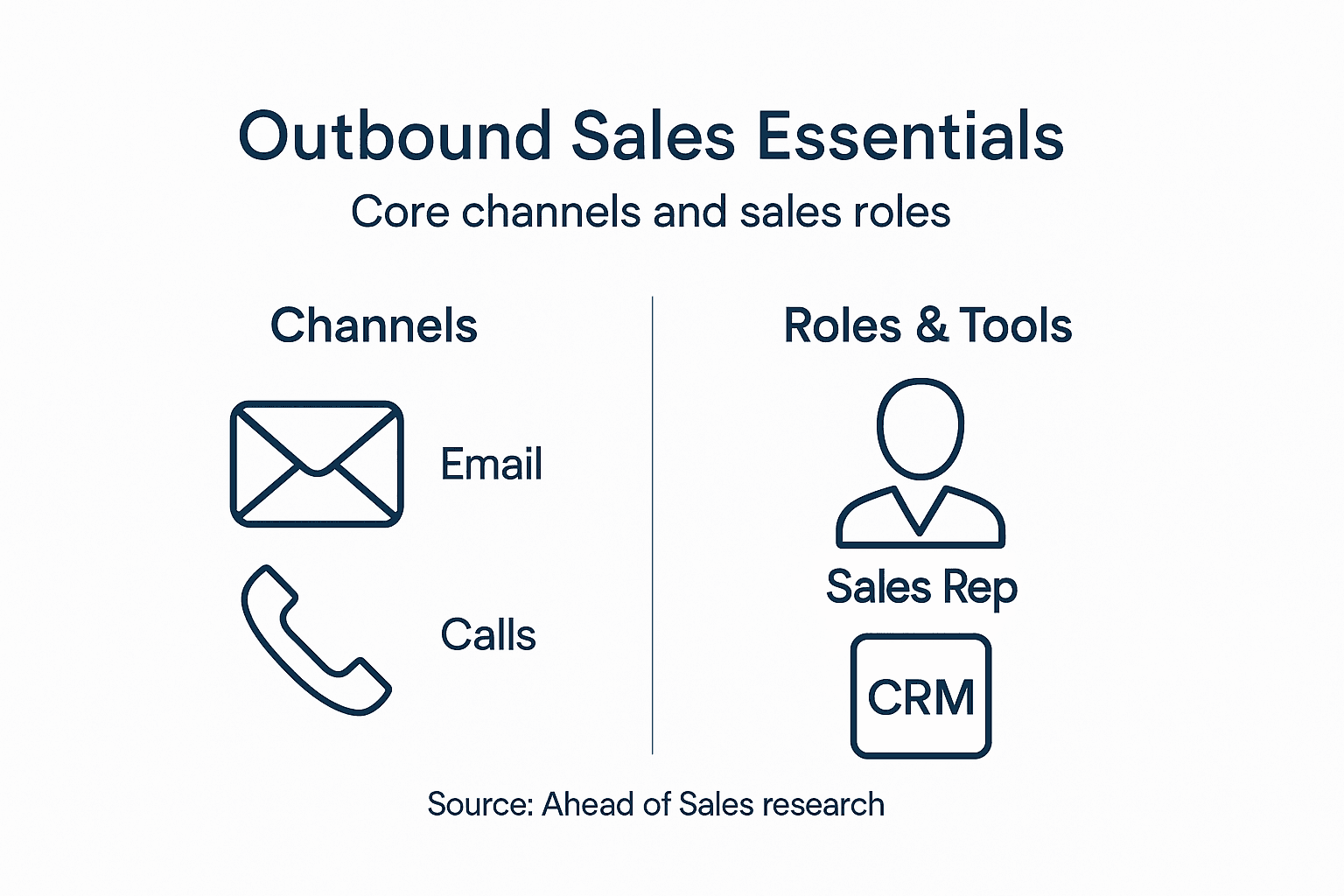
The table below summarises the strategic business impact of key outbound sales roles and technologies for modern sales teams:
| Role/Technology | Main Function | Business Impact |
|---|---|---|
| Sales Development Rep. | Identifies and qualifies leads | Increases quality of prospect pool |
| Account Executive | Manages and negotiates deals | Drives revenue and closes business |
| Sales Operations | Implements processes/tech | Boosts team efficiency and reporting |
| AI/Automation Tools | Enhances targeting and outreach | Saves time, personalises interactions |
| CRM Systems | Centralises customer data | Improves relationship management |
Pro tip: Invest in continuous training that helps sales professionals understand and leverage emerging technologies while maintaining authentic human connection.
Risks, Compliance, and Common Pitfalls
Outbound sales strategies carry significant legal and operational risks that require meticulous management and understanding. Compliance in communication channels has become increasingly complex, with multiple regulatory frameworks governing customer interactions.
Key regulatory risks and compliance challenges include:
-
Data Protection Regulations:
- GDPR compliance
- Personal data handling
- Consent management
- Privacy protection
-
Communication Restrictions:
- Telephone marketing rules
- Email communication guidelines
- Do-not-contact list management
- Calling time restrictions
-
International Sales Complexities:
- Cross-border legal variations
- Cultural communication differences
- Local trade regulation compliance
- Market-specific communication standards
Non-compliance can result in substantial financial penalties, operational disruptions, and significant reputational damage. Sales teams must develop robust systems to track, validate, and manage customer communication permissions systematically.
Proactive compliance management is not just a legal requirement, but a critical component of building trust with potential customers.
Modern sales organisations are increasingly adopting technological solutions that automate compliance tracking, helping to mitigate risks associated with manual communication processes. These platforms provide real-time monitoring, consent management, and comprehensive audit trails to ensure regulatory adherence.
Here is a comparison of risk management approaches for outbound sales compliance:
| Compliance Aspect | Manual Strategy | Automated Solution |
|---|---|---|
| Consent Management | Intensive manual monitoring | Real-time automated tracking |
| Regulatory Updates | Requires regular staff training | Instant digital updates |
| Audit Trails | Paper or spreadsheet records | System-generated logs |
| Penalty Prevention | Prone to human error | Reduces risk of violations |
Pro tip: Implement a comprehensive compliance training programme and invest in automated compliance tracking tools to minimise legal risks and protect your organisation’s reputation.
Elevate Your Outbound Sales Strategy with Expert Coaching
Understanding what outbound sales entails and why it matters is one thing. Mastering it to consistently hit targets and generate impressive growth is another. This article highlights key challenges such as effective prospecting, personalised outreach, and compliance. These pain points demand a strategic, hands-on approach that blends skill development with emerging sales technologies and proven methodologies.
At Ahead of Sales we specialise in helping businesses overcome these challenges through bespoke 1:1 coaching combined with traditional training and consultancy. Our tailored packages are designed to help sales teams unlock at least 50 percent growth every year with a focus on refining outbound sales techniques from cold calling to multichannel outreach. Discover how to transform your outbound efforts by exploring more insights in our Sales Strategy Archives – Ahead of Sales.
Ready to take control of your outbound sales pipeline and exceed your targets consistently Get in touch with Ahead of Sales today and let us guide your team towards measurable success. Visit Ahead of Sales now to learn more or explore our Uncategorized Archives – Ahead of Sales for additional resources. Act now and empower your sales team with the expertise to build lasting customer relationships and boost revenue.
Frequently Asked Questions
What is outbound sales?
Outbound sales is a proactive sales approach where sales representatives actively seek out and engage potential customers through methods like cold calling, email prospecting, and social selling, rather than waiting for leads to come to them.
How does outbound sales differ from inbound sales?
Outbound sales involves sales professionals initiating contact with potential customers, while inbound sales relies on attracting customers through valuable content and marketing, where prospects reach out first.
What are some effective techniques for outbound sales?
Effective techniques for outbound sales include cold calling, sending personalised email campaigns, leveraging social media for prospecting, conducting networking introductions, and using account-based marketing strategies.
Why is relationship building important in outbound sales?
Relationship building is crucial in outbound sales as it helps sales teams understand prospect needs, demonstrate value, and maintain professional communication, ultimately transforming initial contacts into long-term business partnerships.