
TL;DR:
- Net dollar retention measures revenue growth from existing customers after accounting for expansion, contraction, and churn. A rate above 100% indicates organic growth without new customer acquisition, while below 100% signals a need for operational improvements. Tracking NDR reliably helps SaaS leaders assess product value and customer loyalty over time.
Net dollar retention (NDR) is defined as the percentage change in recurring revenue from an existing customer cohort over a set period, accounting for expansion, contraction, and churn. Also referred to as net revenue retention (NRR), it is the single metric that tells you whether your current customers are generating more or less revenue than they were at the start of the period. For SaaS finance leaders, NDR cuts through vanity metrics and shows the true organic growth potential sitting inside your existing base. Investors prioritise NDR for assessing scalability and unit economics precisely because it separates revenue efficiency from the cost of acquiring new customers.
How to calculate net dollar retention
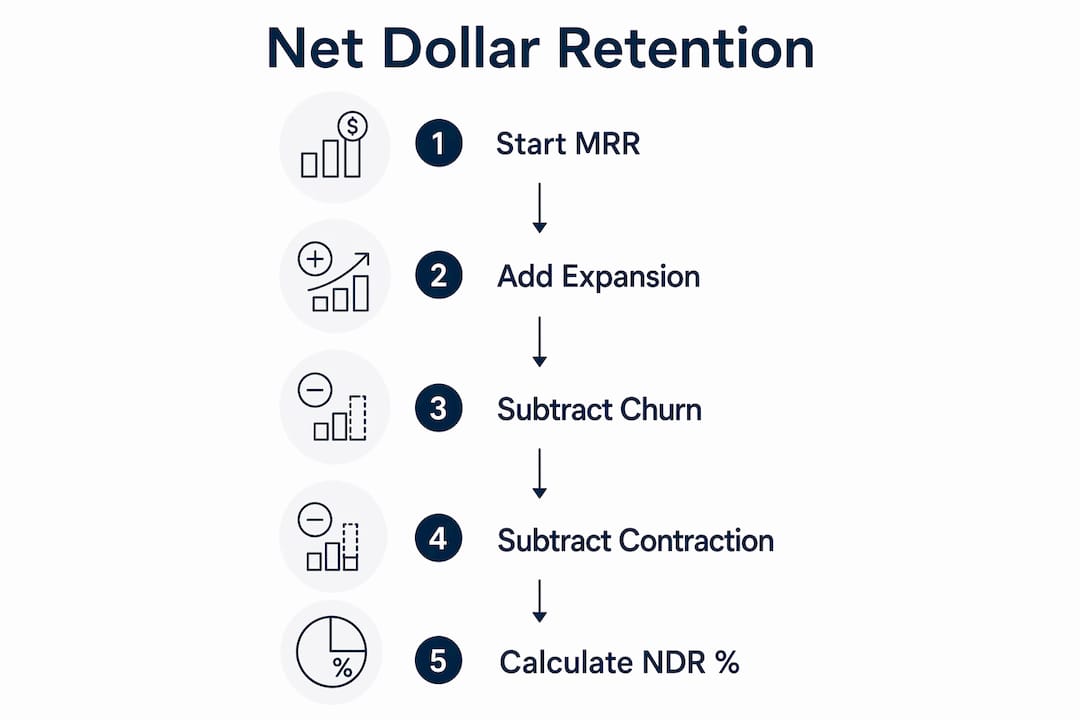
The NDR formula is straightforward: ((Starting MRR + Expansion – Contraction – Churn) / Starting MRR) × 100%. Each component has a precise definition, and getting any one of them wrong produces a figure that misleads rather than informs.
Here is what each component means in practice:
- Starting MRR is the monthly recurring revenue from your chosen customer cohort at the beginning of the measurement period. This is your baseline.
- Expansion revenue covers any additional recurring revenue from that same cohort during the period. Upsells to higher tiers and cross-sells of additional modules both count here.
- Contraction is the reduction in recurring revenue caused by downgrades. A customer moving from an enterprise plan to a starter plan reduces your MRR without fully cancelling.
- Churn is the recurring revenue lost from customers who cancel entirely during the period.
To make this concrete: imagine you start january with £100,000 MRR from an existing cohort. During the month, upsells add £15,000, downgrades reduce revenue by £5,000, and cancellations remove £8,000. Your NDR is ((£100,000 + £15,000 – £5,000 – £8,000) / £100,000) × 100% = 102%. That 102% tells you your existing customers are generating 2% more revenue than they were at the start of the month.
The same formula applies to quarterly or annual measurement windows. The key is consistency: consistent reporting periods and cohort definitions prevent volatility that makes trend analysis unreliable.

Pro Tip: Always run NDR on a fixed cohort. If a customer signed in february and your measurement period starts in january, exclude that customer entirely. Mixing new and existing customers inflates the figure and masks real retention performance.
A common calculation error is including new customers’ revenue in the expansion figure. New customer revenue belongs in acquisition metrics, not NDR. Including it overstates organic growth and gives leadership a false sense of security about existing account health.
What does your NDR rate mean? Benchmarks and interpretation
Median NDR for SaaS companies at IPO is 106.5%, with the top 10 averaging 125.7% and the top 20 averaging 118.2%. Those numbers set a clear performance ladder for finance leaders benchmarking their own figures.
| NDR range | What it signals | Typical company profile |
|---|---|---|
| Below 90% | Severe churn and contraction | Early-stage or product-market fit issues |
| 90%–99% | Net revenue loss from existing base | Needs urgent customer success intervention |
| 100%–109% | Stable with modest expansion | Healthy mid-market SaaS |
| 110%–119% | Strong expansion motion | Mature product with clear upsell paths |
| 120%–140% | Top-quartile SaaS performance | Best-in-class enterprise SaaS |
An NDR above 100% means your existing customers are generating more revenue than they were at the start of the period, even after accounting for every cancellation and downgrade. That is organic revenue growth without spending a pound on new customer acquisition.
“NDR above 100% is the closest thing SaaS has to a perpetual motion machine. Your existing base funds its own growth, reduces pressure on new business targets, and signals to investors that the product delivers enough value for customers to spend more over time.”
NDR below 100% signals that churn and contraction are outpacing expansion. The business is losing ground on its existing revenue base, and no volume of new customer acquisition will sustainably fix that without addressing the underlying cause. Finance leaders who see NDR dip below 100% need to treat it as an operational alert, not a lagging indicator to revisit next quarter.
NDR also functions as a proxy for customer satisfaction and product-market fit. When customers consistently upgrade and rarely downgrade, the product is solving a problem well enough that they want more of it. That signal matters as much to product strategy as it does to finance.
How does net dollar retention compare with gross revenue retention?
Gross revenue retention (GRR) and NDR measure different things, and you need both to get a complete picture of customer revenue health.
GRR is a baseline measure capped at 100%, reflecting customer stickiness without any expansion revenue. It measures only what you kept, not what you grew. The formula strips out upsells and cross-sells entirely, leaving only the revenue that survived churn and contraction.
| Metric | Includes expansion | Maximum value | Primary use |
|---|---|---|---|
| Gross revenue retention (GRR) | No | 100% | Measures pure retention and stickiness |
| Net dollar retention (NDR) | Yes | Unlimited | Measures net revenue growth from existing base |
NDR, by contrast, shows net revenue change from existing customers including every upsell and cross-sell. It can exceed 100% because expansion revenue offsets losses. That is why NDR is the growth metric and GRR is the retention metric.
A business with high GRR but low NDR is retaining customers but failing to grow them. A business with high NDR but lower GRR is expanding accounts aggressively, but may be masking a churn problem with upsell revenue. Tracking both together reveals whether growth is coming from genuine product value or from a sales motion that papers over retention weaknesses.
For SaaS finance leaders building board-level reporting, presenting GRR and NDR side by side gives a far more honest view of customer revenue health than either metric alone. You can explore the relationship between these metrics further in this net revenue retention guide from Aheadofsales.
How to improve net dollar retention in your SaaS business
Improving NDR requires working on three levers simultaneously: reducing churn, reducing contraction, and increasing expansion revenue. Pulling only one lever rarely moves the overall figure enough to matter.
- Invest in proactive customer success. Reactive support waits for customers to raise problems. Proactive customer success identifies at-risk accounts before they downgrade or cancel. Assign customer success managers to accounts above a revenue threshold and set quarterly business reviews as a minimum cadence.
- Build structured upsell and cross-sell paths. Expansion revenue does not happen by accident. Map the natural upgrade triggers in your product, whether that is seat count, usage volume, or feature access, and build those triggers into your customer success playbooks. A SaaS sales strategy that integrates expansion motions into the post-sale process consistently outperforms one that treats upselling as an afterthought.
- Track contraction separately from churn. Most SaaS finance teams report churn as a single figure. Separating contraction (downgrades) from full cancellations reveals whether the problem is product dissatisfaction or budget pressure. The interventions are completely different.
- Measure NDR by cohort and by segment. Enterprise customers and SMB customers behave differently. An NDR figure blended across all segments can hide a collapsing SMB base or a struggling enterprise cohort. Segment your reporting and you will know exactly where to focus.
- Align product roadmap decisions with retention data. Features that drive upgrades and reduce cancellations should receive priority. NDR data, reviewed monthly, gives product leaders a revenue-weighted signal about which capabilities matter most to paying customers.
Pro Tip: Run a monthly NDR review with your customer success and finance leads together. When both teams see the same cohort data, the conversation shifts from “whose fault is churn?” to “what do we do about it?” That shift alone tends to accelerate improvement.
Consultants working with SaaS client portfolios consistently find that the fastest NDR improvements come from combining structured expansion playbooks with earlier churn detection, not from one or the other in isolation.
For a deeper look at the customer-level behaviours that drive these numbers, the Aheadofsales guide on client retention for business leaders covers the qualitative side of what the NDR formula quantifies.
Key takeaways
Net dollar retention is the definitive measure of whether a SaaS business grows revenue from its existing customer base, and an NDR above 100% means the business can grow without acquiring a single new customer.
| Point | Details |
|---|---|
| NDR formula | ((Starting MRR + Expansion – Contraction – Churn) / Starting MRR) × 100%. |
| Industry benchmark | Median NDR at SaaS IPO is 106.5%; top-quartile companies reach 120%–140%. |
| NDR above 100% | Existing customers generate net revenue growth, reducing dependence on new acquisition. |
| NDR vs GRR | GRR measures pure retention capped at 100%; NDR measures net growth and can exceed 100%. |
| Improving NDR | Combine proactive customer success, structured upsell paths, and segment-level cohort tracking. |
Why NDR is the metric I always look at first
When I work with SaaS leadership teams, NDR is the first number I ask for. Not ARR growth, not new logo count. NDR. The reason is simple: it tells me whether the business has a product that customers value enough to stay and spend more, or whether the growth story depends entirely on replacing lost revenue with new customers.
I have seen businesses with impressive new business numbers that were, in reality, running hard just to stand still. Their NDR was sitting at 88%, meaning every pound of new revenue was partly going to fill a hole left by churned and downgraded accounts. That is an exhausting and expensive way to grow.
The calculation mistakes I see most often are not complex. Teams include new customer revenue in their expansion figure, or they change cohort definitions between quarters and wonder why the trend looks erratic. Consistency in how you define and measure NDR matters as much as the number itself.
What I find most useful is treating NDR as a customer health indicator rather than a finance metric. When NDR rises, it usually means customers are getting genuine value and finding more uses for the product. When it falls, something in the customer experience has broken down, whether that is onboarding, support, product fit, or pricing. The number points you toward the problem. Your job is to go and find it.
— Jerry
How Aheadofsales helps SaaS teams grow recurring revenue
SaaS businesses that understand their NDR but struggle to move it upward often have a sales and customer success execution problem, not a data problem.

Aheadofsales works with SaaS companies to build the sales capability that drives expansion revenue and reduces churn at the account level. Through bespoke 1:1 coaching, structured training programmes, and hands-on consultancy, the team helps sales and customer success professionals convert product value into measurable revenue growth. If your NDR is below where it should be, or you want to push it into the top quartile, SaaS sales training from Aheadofsales gives your team the frameworks and skills to make that happen. Packages start from £4,500 for teams of 50 or more.
FAQ
What is net dollar retention in simple terms?
Net dollar retention measures whether your existing customers are paying you more or less than they were at the start of a period, after accounting for upgrades, downgrades, and cancellations. An NDR above 100% means existing customers are generating net revenue growth.
What is a good net dollar retention rate for SaaS?
The median NDR for SaaS companies at IPO is 106.5%. Top-quartile companies achieve between 120% and 140%. Any figure below 100% indicates that churn and contraction are outpacing expansion revenue.
How does net dollar retention differ from gross revenue retention?
Gross revenue retention excludes expansion revenue and is capped at 100%, measuring only what revenue you retained. NDR includes expansion revenue and can exceed 100%, making it a measure of net revenue growth from existing customers.
Why do investors focus on net dollar retention?
NDR identifies how efficiently a SaaS business grows revenue from its existing base, separate from the cost of acquiring new customers. A high NDR signals that the business can scale without proportionally increasing acquisition spend.
How often should you calculate your NDR?
Monthly calculation is the standard for operational decision-making, with quarterly and annual figures used for board reporting and investor communications. Consistent reporting periods and fixed cohort definitions are critical for accurate trend analysis.