
TL;DR:
- A market penetration strategy focuses on increasing sales of existing products within an existing market to grow market share. It involves tactics like pricing, distribution, marketing, and loyalty programs, but must be executed carefully to avoid risks like price wars and margin erosion. Successful implementation requires specific targets, realistic timing, and aligning tactics with company strengths, along with proactive competitor response modeling.
A market penetration strategy is the systematic approach a business uses to increase sales of its current products or services within its existing market to capture larger market share and grow revenue. Positioned as the lowest-risk growth strategy in the Ansoff Matrix, it avoids the costs of R&D, new product launches, or unfamiliar territories. The core levers are penetration pricing, distribution expansion, promotional campaigns, and loyalty programmes. Understanding how to deploy these levers correctly, and when to hold back, is what separates businesses that grow methodically from those that spin their wheels.
What is market penetration strategy and how does it work?
Market penetration strategy means selling more of what you already have to the customers you already know. That simplicity is its greatest strength. You are not betting on a new product working or a new market accepting you. You are competing harder where you already have a foothold.

The Ansoff Matrix places this strategy in the lowest-risk quadrant because it operates entirely within known territory. Existing customer relationships, established brand recognition, and proven product-market fit all reduce execution risk compared to diversification or market development. That said, low risk does not mean no risk, and I will come to that shortly.
The strategy works through four primary mechanisms: reducing price to attract more buyers, increasing marketing frequency to stay top of mind, expanding distribution channels to reach more of the existing market, and deepening loyalty among current customers. Most businesses use a combination, though the most effective penetration strategies focus on one or two levers rather than attempting everything at once.
One point worth clarifying early: the term “market penetration” refers to both a metric and a strategy. The metric measures how much of your addressable market you currently serve. The strategy describes the plan to grow that figure. Keeping these two definitions distinct in planning conversations avoids confusion and keeps your team aligned.
How is market penetration rate measured?
The market penetration rate is calculated as: (number of current customers ÷ total addressable market) × 100. The result is a percentage that tells you how much of your potential market you currently reach. A software business with 4,000 clients in a market of 50,000 companies has a penetration rate of 8%.
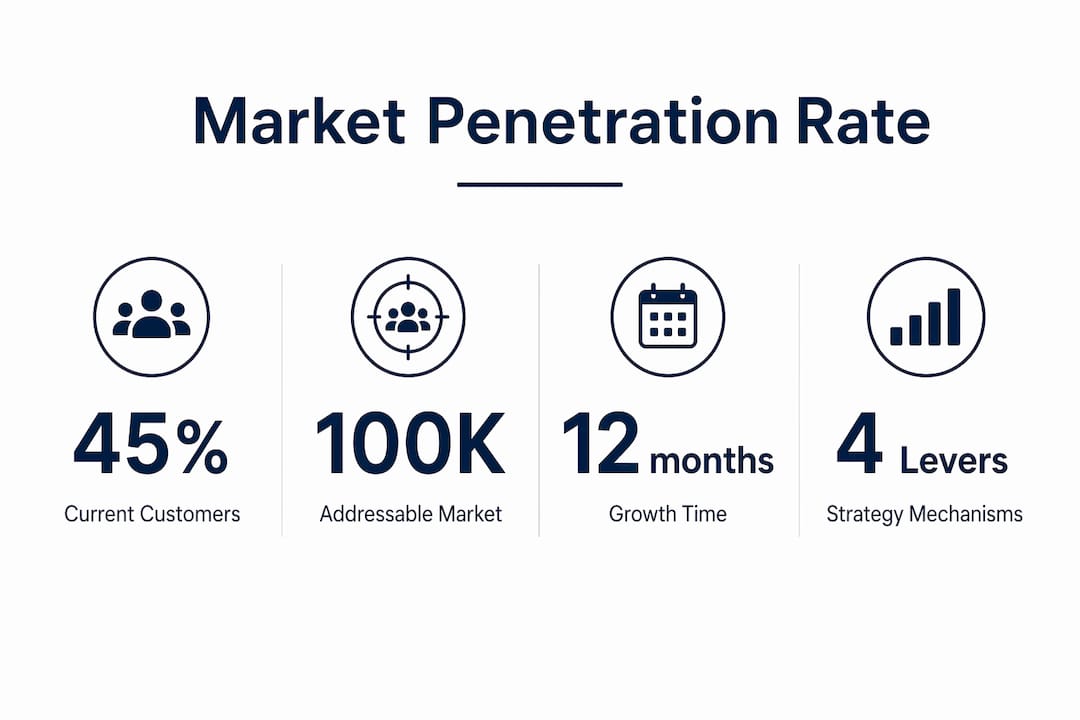
That figure is only as useful as the market size data behind it. Using trusted sources like Statista or IBISWorld for market sizing prevents arbitrary KPIs and misdirected strategy. If your total addressable market figure is wrong, every target you set from it will be wrong too.
| Metric | Description |
|---|---|
| Current customers | Total paying clients or accounts in the existing market |
| Total addressable market | Full pool of potential buyers for your product or service |
| Penetration rate | (Current customers ÷ Total addressable market) × 100 |
| Target penetration rate | The specific percentage you aim to reach within a defined timeframe |
Once you have your baseline rate, you can set a specific, measurable target tied to a segment, tactic, and timeframe. For example: increase penetration in the mid-market manufacturing segment from 8% to 12% by Q4 2026. That level of specificity makes your strategy testable and your team accountable.
The penetration rate also reveals where effort is most worthwhile. A 6% rate in a large, growing market signals significant headroom. A 40% rate in a mature, slow-growth market suggests diminishing returns and may prompt a shift toward market development instead.
What tactics and levers drive market penetration?
The most commonly used tactics in a market penetration plan are:
- Penetration pricing: Setting a lower price than competitors to attract price-sensitive buyers. This works best when you have a genuine cost advantage, because sustained low pricing without cost discipline destroys margins.
- Distribution expansion: Adding new channels, such as online platforms, retail partnerships, or direct sales teams, to reach buyers who are already in your market but not yet your customers.
- Increased marketing frequency: Raising the volume and consistency of outreach through paid media, email campaigns, or content to stay visible and relevant.
- Account-based marketing (ABM): In B2B contexts, ABM targets specific high-value accounts within the existing market with tailored messaging. This is particularly effective for professional services and SaaS businesses. A solid B2B sales strategy integrates ABM directly into the penetration plan.
- Loyalty programmes: Increasing purchase frequency among existing customers through rewards, contracts, or service upgrades.
- Localisation: Adjusting pricing and messaging to reflect regional cultural differences within a diverse existing market. This is often overlooked but meaningfully improves conversion rates.
Pro Tip: Pick one or two levers and execute them well before adding more. Running five tactics simultaneously makes it nearly impossible to attribute results and increases the risk of margin compression.
The prerequisite for each lever differs. Penetration pricing requires a cost advantage or a willingness to accept short-term margin reduction for long-term share gain. Distribution expansion requires channel relationships and logistics capacity. ABM requires quality data and sales capability. Match the tactic to your actual strengths, not to what sounds most impressive in a board presentation.
What risks and challenges come with market penetration?
Market penetration carries real risks that business leaders frequently underestimate. The most serious is competitive retaliation. When you cut prices or increase promotional spend, competitors notice. Without a cost advantage to sustain price cuts, a price war erodes margins across the entire market, often leaving everyone worse off.
- Margin compression: Sustained low pricing without a structural cost advantage reduces profitability. This is the most common failure mode in penetration strategies.
- Competitor retaliation: Rivals can match your price cuts, increase their own marketing spend, or lock in customers through long-term contracts before you reach them.
- Diffused effort: Executing multiple tactics simultaneously complicates attribution and spreads resources too thin, reducing the impact of each individual lever.
- Poor market sizing: Overestimating the total addressable market leads to unrealistic targets and misallocated budget.
- Slow results: Meaningful share growth typically takes 12–18 months to materialise. Businesses that expect quick wins often abandon the strategy before it has time to work.
Pro Tip: Before changing your pricing or launching a major promotional campaign, model how your top two or three competitors are likely to respond. If their most probable reaction would wipe out your margin gain, reconsider the tactic or build a cost advantage first.
The “lowest risk” label in the Ansoff Matrix refers to the risk of entering unknown territory, not the risk of execution. A poorly planned penetration strategy in a competitive market can damage profitability and brand positioning simultaneously. Treat it as a serious strategic commitment, not a default option.
How does market penetration compare to other growth strategies?
The Ansoff Matrix organises growth strategies by two variables: whether the product is existing or new, and whether the market is existing or new. Market penetration sits in the lowest-risk quadrant because both variables are known quantities.
| Strategy | Product | Market | Risk level |
|---|---|---|---|
| Market penetration | Existing | Existing | Lowest |
| Market development | Existing | New | Medium |
| Product development | New | Existing | Medium |
| Diversification | New | New | Highest |
Market development means taking a product you already sell into a new geography or customer segment. The product risk is low, but you face the costs and uncertainties of entering unfamiliar territory. A UK software firm expanding into Germany faces regulatory, cultural, and competitive unknowns that a domestic penetration play does not.
Product development introduces R&D risk and the possibility that the new product fails to resonate with your existing customers. Diversification compounds both risks simultaneously, which is why it demands the strongest financial position and the clearest strategic rationale.
Market penetration avoids both. You know the product works. You know the market exists. The question is purely whether you can win more of it. That clarity makes it the natural starting point for most growth-minded businesses, particularly those with 50–1,000 staff who have the capacity to execute but cannot absorb the cost of a failed product launch or market entry. A well-structured sales strategy guide will typically position penetration as the first growth lever to exhaust before moving up the risk curve.
Key takeaways
A market penetration strategy is the most direct path to sales growth because it builds on existing strengths in a known market rather than introducing new variables.
| Point | Details |
|---|---|
| Definition is precise | Market penetration means growing sales of existing products in existing markets to increase market share. |
| Measure before you plan | Calculate your penetration rate using reliable market size data from sources like Statista or IBISWorld before setting targets. |
| Focus your tactics | Choose one or two levers such as penetration pricing or ABM and execute them fully before adding more. |
| Anticipate competition | Model competitor responses to pricing and promotional moves before committing, to protect margins. |
| Expect a long timeline | Meaningful market share growth takes 12–18 months; short-term thinking leads to premature strategy abandonment. |
Why most penetration strategies fail before they start
I have worked with a lot of business leaders who treat market penetration as the “safe” option, something to default to when they are not sure what else to do. That framing is the first mistake. A penetration strategy executed without a clear baseline rate, a defined target segment, and an honest assessment of competitive dynamics is not a strategy. It is wishful thinking with a budget attached.
The businesses I have seen succeed with this approach share one habit: they set targets that are specific enough to be uncomfortable. Not “grow market share,” but “increase penetration in the SME accountancy sector from 11% to 16% by Q3.” That specificity forces honest conversations about what tactics are actually capable of delivering the number, and it exposes gaps in sales capability early, before money is spent.
The other pattern I notice is that leaders underestimate how much sales execution matters. A well-designed penetration plan with a poorly trained sales team produces mediocre results. The strategy creates the opportunity. The sales team converts it. Combining a penetration plan with structured sales consultancy consistently produces better outcomes than either element alone. If you are serious about growing market share, invest in both the plan and the people delivering it.
— Jerry
How Aheadofsales supports your market penetration plan
Knowing the theory is one thing. Executing it against real competitors, with a real sales team, under quarterly pressure is another matter entirely.

Aheadofsales works with businesses of 50–1,000 staff to build and deliver growth plans that combine bespoke 1:1 coaching, structured sales training programmes, and consultancy that covers competitor risk modelling, target setting, and tactical prioritisation. Every engagement is designed to produce at least 50% sales growth per year and ensure your team hits target every quarter. If you are ready to move from planning to execution, Aheadofsales is the partner to make it happen.
FAQ
What is the market penetration definition in simple terms?
Market penetration is the process of increasing sales of an existing product within an existing market to grow your share of that market. It is the lowest-risk quadrant of the Ansoff Matrix growth framework.
How do you calculate market penetration rate?
Divide your current number of customers by the total addressable market, then multiply by 100. The result is your penetration rate as a percentage.
What is penetration pricing?
Penetration pricing is setting a lower price than competitors to attract more buyers in an existing market. It works best when the business has a structural cost advantage to sustain the lower price without eroding profitability.
How long does a market penetration strategy take to work?
Meaningful market share growth typically takes 12–18 months to materialise. Businesses that abandon the strategy before that window closes rarely see the returns the plan was capable of delivering.
What is the biggest risk of a market penetration strategy?
Competitive retaliation is the most serious risk. When you cut prices or increase promotional spend, rivals can respond in kind, triggering a price war that compresses margins across the market without producing lasting share gains.