
TL;DR:
- Customer lifetime value measures the total profit a business expects from a customer over the relationship’s duration. It guides budget allocation, customer acquisition, and relationship-building strategies for sustainable growth. Improving CLV through retention, loyalty, and tailored marketing enhances long-term profitability and competitive advantage.
Customer lifetime value (CLV) is defined as the total net profit a business expects to earn from a single customer over the entire duration of their relationship. This metric is the most reliable indicator of whether your business model is built for sustainable growth or just short-term wins. Understanding what is customer lifetime value changes how you allocate budgets, hire salespeople, and decide which customers to pursue. It shifts your focus from closing the next deal to building relationships worth thousands of pounds over years. This guide covers the CLV formula, the factors that drive it, and the practical steps you can take to grow it.
What is customer lifetime value and why does it matter?
CLV is a forward-looking metric representing the total net profit a business expects from a customer over the full relationship. The key word is “net.” CLV is not about gross revenue. It accounts for the cost of serving that customer, making it a true measure of profitability.
The metric matters because it sets a rational upper limit on how much you should spend to acquire a new customer. If a customer is worth £5,000 over their lifetime, spending £4,000 to win them is a sound investment. Spending £6,000 is not. Without CLV, acquisition budgets are guesswork dressed up as strategy.
CLV also shifts managerial focus from transactional thinking to relationship-focused thinking. A business that measures CLV stops asking “how do we close this sale?” and starts asking “how do we keep this customer for five years?” That is a fundamentally different and more profitable question.
How is customer lifetime value calculated?
The basic customer lifetime value formula is straightforward:
CLV = Average purchase value × Purchase frequency × Customer lifespan
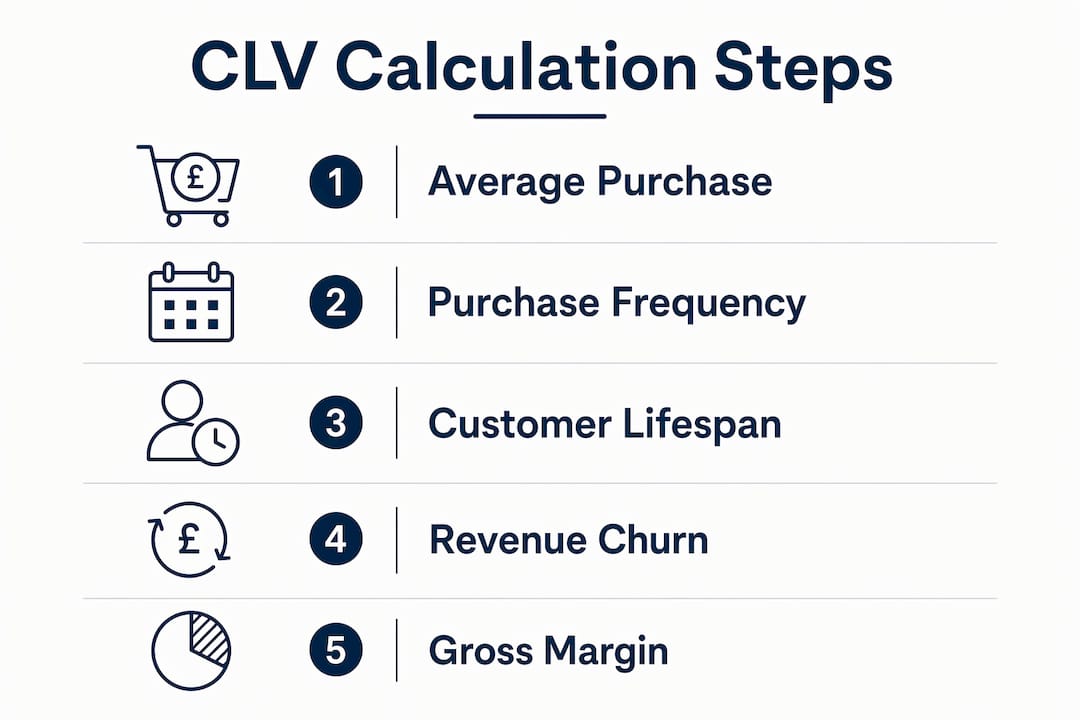
For example, a client who spends £1,000 per engagement, buys three times a year, and stays for four years has a CLV of £12,000. Multiply that across your customer base and you start to see the real scale of what retention is worth.
For subscription businesses, the formula adjusts to reflect recurring revenue dynamics:
CLV = (Average Revenue Per Account × Gross Margin %) ÷ Revenue Churn Rate
This version captures the ongoing nature of subscription income and the drag that churn creates on lifetime value.
| Model | Best suited for | Key inputs |
|---|---|---|
| Basic CLV | Retail, project-based services | Purchase value, frequency, lifespan |
| Subscription CLV | SaaS, memberships, retainers | ARPA, gross margin, churn rate |
| Discounted CLV | Long relationships, high inflation | Future cash flows, discount rate |
Advanced CLV models incorporate a discount rate to account for the time value of money. A pound received in year five is worth less than a pound received today. In inflationary environments, ignoring this distorts your profitability picture significantly.
Pro Tip: Calculate CLV separately by acquisition channel and cohort. Customers acquired through referrals often have a materially higher CLV than those acquired through paid advertising. Knowing this tells you exactly where to concentrate your marketing spend.
What factors affect customer lifetime value?
Several variables drive CLV up or down, and each one is measurable.
Retention rate and churn. Retention is the single biggest lever in the CLV formula. Acquiring a new customer costs between 5 and 25 times more than retaining an existing one, according to Bain & Company research. That cost differential makes every percentage point of improved retention enormously valuable. If you want to understand client retention in depth, the mechanics are worth studying carefully.

Loyalty programmes. 84% of loyalty programme members are more likely to make repeat purchases. That directly increases the purchase frequency component of your CLV formula. A well-designed loyalty programme does not just reward customers. It conditions buying behaviour.
Customer experience quality. This factor is underestimated by most businesses. 46% of consumers report that bad service experiences from two or more years ago still affect their buying behaviour. A single poor interaction can shorten a customer’s lifespan with your business by years.
“Customer experience increasingly drives long-term buying behaviour, making stellar service a direct lever for enhancing CLV.” — Zendesk
Upselling and cross-selling. Both tactics increase average purchase value without increasing acquisition costs. A customer who starts on a basic package and moves to a premium tier over 18 months has a dramatically higher CLV than one who stays on the entry level indefinitely.
Subscription renewals. For businesses with recurring revenue models, renewal rate is the most direct expression of CLV health. A renewal rate below 80% signals that your CLV projections are likely optimistic.
Why is customer lifetime value vital for your business strategy?
CLV gives every department a shared language for prioritising decisions. Cross-functional alignment on CLV across sales, service, marketing, and product teams significantly improves how businesses invest in customer success. Without that alignment, sales chases volume, marketing chases clicks, and service is treated as a cost centre. CLV fixes that.
The metric also clarifies acquisition investment decisions. If your average CLV is £8,000, you can afford to spend more to acquire a customer than a competitor whose CLV is £2,000. That gives you a structural advantage in competitive markets. You can outbid rivals for the best customers and still be profitable.
Pro Tip: Use CLV to set your Customer Acquisition Cost (CAC) ceiling. A healthy business typically maintains a CLV to CAC ratio of at least 3:1. If your ratio falls below that, your growth is likely unprofitable regardless of revenue figures.
The comparison below shows why retention economics are so compelling:
| Approach | Cost profile | Long-term profit impact |
|---|---|---|
| Acquisition-focused | High, recurring spend | Diminishing returns as market saturates |
| Retention-focused | Lower per customer | Compounding profit as CLV grows |
Businesses that focus on high-CLV customers can justify upfront acquisition costs even at an initial loss, because the long-term profit more than compensates. This is the logic behind free trials, onboarding subsidies, and generous first-year pricing in subscription businesses.
What practical strategies can increase customer lifetime value?
Growing CLV requires deliberate action across several areas. These are the approaches that produce consistent results.
-
Implement a structured loyalty programme. Design it around purchase frequency, not just spend. Reward customers for returning quickly, not just for spending large amounts. This directly increases the frequency variable in your CLV formula.
-
Personalise your marketing communications. Segment customers by purchase history and send offers relevant to their behaviour. Generic email blasts have low conversion rates. Personalised messages based on past purchases perform materially better.
-
Invest in customer service speed and quality. Given that poor service experiences affect buying behaviour years later, every service interaction is a CLV event. Train your team to resolve issues at first contact. Measure resolution time and customer satisfaction scores monthly.
-
Use predictive CLV modelling. Predictive models can estimate a customer’s total lifetime value from early relationship signals within 30 to 90 days. This lets you identify high-value customers early and invest in retaining them before competitors do.
-
Segment customers by CLV and tailor your offers. Your top 20% of customers by CLV likely generate the majority of your profit. Give them priority access, dedicated account management, and first sight of new products. Treating all customers identically is a missed opportunity.
-
Evaluate acquisition channels by CLV, not just conversion rate. A channel that delivers customers at a low cost per acquisition but with a short lifespan is less valuable than a channel with higher acquisition costs but customers who stay for years. Cohort analysis by channel reveals this clearly.
Pro Tip: Run a quarterly CLV review by customer segment. Look for segments where CLV is declining and investigate whether the cause is service quality, product fit, or competitive pressure. Early detection gives you time to act before churn accelerates.
Improving customer retention strategies is not a one-off project. It requires consistent measurement, team accountability, and a willingness to invest in relationships that pay off over years rather than quarters. For practical guidance on improving client retention in service businesses, the principles translate directly to CLV growth.
Key takeaways
Customer lifetime value is the most important profitability metric a business can track, because it determines how much you can rationally spend to acquire and retain each customer.
| Point | Details |
|---|---|
| CLV definition | Total net profit expected from a customer over the full relationship, not just one transaction. |
| Core formula | Average purchase value × purchase frequency × customer lifespan gives your baseline CLV. |
| Retention economics | Acquiring a new customer costs 5–25 times more than retaining one, making retention the highest-return investment. |
| Loyalty impact | 84% of loyalty programme members make repeat purchases, directly raising purchase frequency and CLV. |
| Strategic alignment | When sales, marketing, and service teams share CLV as a common metric, customer investment decisions improve across the board. |
CLV is the metric that changed how I think about sales
I have worked with business owners who obsess over monthly revenue targets and ignore the customers quietly churning in the background. The revenue line looks fine until it suddenly does not. CLV is the metric that exposes that problem before it becomes a crisis.
The most common misconception I encounter is that CLV is a finance team metric. It is not. It belongs to every person who touches the customer relationship. When your salespeople understand that a client retained for three years is worth three times a one-year client, they sell differently. They ask better questions. They focus on fit rather than just closing.
The data challenge is real. Many businesses do not have clean enough records to calculate CLV accurately from day one. My advice is to start simple. Use the basic formula with your best available data. A rough CLV is infinitely more useful than no CLV. Refine the inputs as your data improves.
The businesses I see growing consistently are the ones where the whole team, from the sales director to the account manager, understands which customers are worth the most and why. That shared understanding changes how everyone prioritises their time. It is the foundation of sustainable growth, not just a number in a spreadsheet.
— Jerry
How Aheadofsales helps you build higher-value customer relationships
Understanding CLV is one thing. Building the sales behaviours that grow it is another. Aheadofsales works with businesses of 50 to 1,000 staff to develop sales teams that focus on long-term client value, not just short-term targets.
Our sales training programmes are built around the skills that directly improve CLV: consultative selling, retention-focused account management, and upselling with integrity. We also offer sales acceleration packages for solo service businesses looking to grow revenue from their existing client base. If your team is ready to shift from transactional selling to relationship-led growth, we should talk.
FAQ
What is the simplest customer lifetime value formula?
The simplest formula is: Average purchase value × purchase frequency × customer lifespan. This gives you a baseline CLV figure you can calculate with basic sales data.
How does customer retention affect CLV?
Higher retention directly extends the customer lifespan variable in the CLV formula. Research from Bain & Company confirms that retaining customers costs 5–25 times less than acquiring new ones, making retention the most cost-efficient way to grow CLV.
What is a good CLV to CAC ratio?
A healthy CLV to CAC ratio is at least 3:1. A ratio below this suggests your acquisition costs are too high relative to the profit each customer generates over their lifetime.
How quickly can predictive CLV models produce results?
Predictive CLV models can estimate a customer’s lifetime value from early behavioural signals within 30 to 90 days of the relationship starting, allowing faster and more targeted retention decisions.
Why do loyalty programmes improve customer lifetime value?
Loyalty programmes increase purchase frequency, which is a direct input in the CLV formula. Industry data shows that 84% of loyalty programme members are more likely to make repeat purchases, raising both frequency and overall lifetime value.