
TL;DR:
- Most businesses mistake their value proposition for a catchy tagline rather than a clear, customer-focused statement explaining why they are the best choice. An effective value proposition addresses customer needs, provides measurable benefits, and differentiates from competitors, helping sales teams communicate confidently and shorten sales cycles. Successful businesses continuously refine their propositions based on customer feedback, evidence, and market changes to drive sustained growth and sales success.
Most businesses think their value proposition is a catchy tagline or the opening line of a brochure. It is not. A genuine value proposition is the clearest, most compelling answer you can give to the question every prospective customer is silently asking: “Why should I choose you over everyone else?” Get this right and your sales team has a foundation for consistent, repeatable growth. Get it wrong and you will keep losing deals to competitors who, frankly, may not even be better than you. This guide will show you exactly how to define, build, and deploy a value proposition that creates real sales impact.
Table of Contents
- Defining a value proposition in sales growth
- The anatomy of a compelling value proposition
- Using the Value Proposition Canvas to align with customer needs
- From definition to sales deployment: activating your value proposition
- Why most value propositions fail (and what top sales leaders do differently)
- Accelerate your value proposition and sales growth
- Frequently asked questions
Key Takeaways
| Point | Details |
|---|---|
| Real value, not slogans | A true value proposition clearly explains why your offering matters and stands out to your ideal customer. |
| Fit drives results | Successful value propositions align what you offer directly with customer needs, pains, and desired outcomes. |
| Proof builds trust | Support your value proposition with substantive evidence to create confidence and credibility with buyers. |
| Activate in sales | Translate your clear proposition into team talk-tracks, case studies, and collateral for consistent sales impact. |
Defining a value proposition in sales growth
Having set the stage for why value propositions matter, let’s clarify what they actually mean for sales leaders. There is a persistent confusion between a slogan, a mission statement, and a value proposition. They are not the same thing, and mixing them up costs businesses real revenue.
A slogan is a memorable phrase designed for brand awareness. A mission statement describes what a company exists to do. A value proposition, by contrast, is a clear statement of why a customer should choose your product or service, explaining the specific benefits delivered and how it solves the customer’s needs versus alternatives. It is customer-facing, evidence-led, and commercially focused.
For mid-sized UK businesses with sales teams of any size, a strong value proposition does three specific things:
- Gives your salespeople a consistent, confident message that does not change depending on who is presenting that day.
- Shortens sales cycles because prospects understand quickly whether you are the right fit.
- Reduces price sensitivity because buyers who understand your specific value are less likely to shop purely on cost.
The three core elements of any effective value proposition are relevance (does it address a real problem your target customer has?), quantified value (can you demonstrate the benefit in measurable terms?), and differentiation (why you, rather than a competitor or doing nothing at all?). Remove any one of these and you have a weaker proposition, not a stronger one.
“A value proposition is not what you say about yourself. It is what your customer believes you can do for them, backed by evidence they can trust.”
Clarity is everything here. If your sales team cannot explain your value proposition in two sentences to a new prospect, it is not clear enough. I have worked with many UK businesses where every salesperson gave a slightly different answer when asked “why should we choose you?” That inconsistency is expensive. Explore value selling for growth to understand how leading teams build this consistency into their process. You can also see how consulting value propositions are structured for professional services firms, which offers useful perspective for B2B contexts.
The anatomy of a compelling value proposition
Now that you know what a value proposition is, it is time to dissect what makes one work and how sales teams can use it. A strong value proposition is built on three pillars: a clearly defined target customer, a specific pain or gain being addressed, and credible evidence that you can deliver on your promise.
The benefits, both tangible and intangible, serve as a promise of value to a customer segment. Tangible benefits include things like cost savings, time reduction, or revenue increase. Intangible benefits include reduced risk, peace of mind, or improved reputation. The most powerful value propositions combine both.
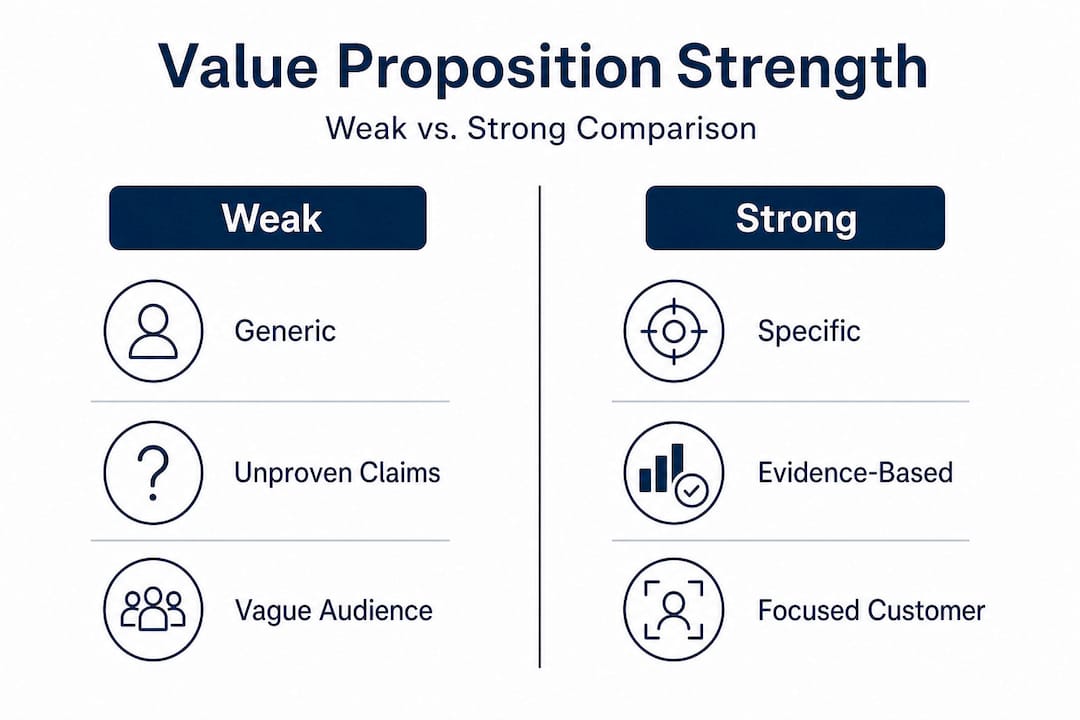
Here is a comparison that illustrates the difference between a weak and strong B2B value proposition:
| Element | Weak value proposition | Strong value proposition |
|---|---|---|
| Target customer | “Businesses of all sizes” | “UK manufacturers with 50 to 200 staff” |
| Pain addressed | “We help you grow” | “We reduce sales cycle length by 30%” |
| Evidence | “We are the best in the market” | “Clients report 47% more qualified leads in 90 days” |
| Differentiation | “Great service and expertise” | “Dedicated 1:1 coaching, not generic group training” |
The difference is stark. One sounds like every other company. The other gives a prospect a specific, believable reason to take the next step.
Here is a practical numbered process for building the anatomy of your value proposition:
- Identify your ideal customer profile with as much specificity as possible. Sector, size, geography, and role of the decision-maker all matter.
- List the top three pains your ideal customer experiences that your product or service directly addresses.
- List the top three gains your customer wants to achieve, whether that is revenue growth, operational efficiency, or competitive advantage.
- Match your solution’s features to those pains and gains explicitly, not generically.
- Add proof. Use statistics, case studies, client testimonials, or independent benchmarks to substantiate every claim.
Pro Tip: Avoid adjectives without evidence. Saying “we are the most experienced” means nothing. Saying “we have delivered sales growth for 47 UK businesses in the last three years, with an average 52% revenue increase” means everything. See how sales presentation best practices translate this into compelling client-facing content. You can also see a value proposition in action within a competitive marketplace context for further inspiration.
Using the Value Proposition Canvas to align with customer needs
With the building blocks covered, let’s move to a practical framework sales leaders can use right now. The Value Proposition Canvas is one of the most practical tools available for aligning your offer with what customers actually need, and it is surprisingly underused by UK sales teams.
The canvas works by mapping two sides: the Customer Profile and the Value Map. The Value Proposition Canvas aligns a Customer Profile covering jobs, pains, and gains with a Value Map covering pain relievers and gain creators. When these two sides align well, you have what is called “product-market fit” at the messaging level.
Here is how the two sides compare in a B2B UK sales context:
| Customer profile | Value map |
|---|---|
| Customer jobs (what they are trying to achieve) | Products and services (what you offer) |
| Pains (frustrations, risks, obstacles) | Pain relievers (how you reduce those frustrations) |
| Gains (desired outcomes, aspirations) | Gain creators (how you produce those outcomes) |
The canvas is particularly powerful because it forces you to stop talking about your product and start talking about your customer’s world. Most UK sales teams do the opposite. They lead with features and benefits from their own perspective, rather than framing everything through the customer’s experience.
To build a canvas for your business right now, work through these questions:
- What are the three most important tasks or goals your ideal customer is trying to accomplish this quarter?
- What obstacles or frustrations are getting in the way of those goals?
- What does success look like for them, and how would they measure it?
- Which of your services directly removes a specific obstacle?
- Which of your services directly helps them achieve a specific goal?
Pro Tip: Do not guess the answers. Interview three to five of your best existing clients and ask them directly. You will almost always discover that the pains and gains they describe are different from what your internal team assumed. This is the insight that sharpens your proposition from generic to genuinely compelling.
The consultative selling process is built on exactly this kind of customer-first thinking, and understanding the advantages of consultative selling will help you see why the canvas is such a natural companion to this approach. For businesses looking at broader customer experience frameworks, the canvas integrates well with CX-led thinking too.
From definition to sales deployment: activating your value proposition
You now have the tools to design a value proposition; the next step is real-world execution. Having a well-crafted proposition sitting in a PowerPoint deck is not enough. It needs to live inside your sales team’s daily conversations, emails, proposals, and presentations.

The best approach is to build your value proposition from customer pains and desired outcomes, differentiate it with substantiated proof, and then translate it into talk-tracks and evidence such as case studies, performance statistics, and benchmarks that your sales team can deploy consistently.
Here is a practical deployment process:
- Create a core messaging document. Write the value proposition in full, then create a shorter two-sentence version for verbal use and a headline version for written collateral.
- Build talk-tracks. A talk-track is a structured but conversational script that helps salespeople introduce the proposition naturally during discovery calls, demos, and follow-up conversations.
- Develop supporting evidence. Identify two or three case studies that directly illustrate your proposition in action. Include specific numbers wherever possible.
- Embed it into your CRM and proposal templates. Every touchpoint should reflect the same core message, even if the language is adapted for the specific prospect.
- Train your team regularly. Run monthly role-plays where salespeople practise delivering the proposition and handling objections rooted in it.
- Create a feedback loop. After every lost deal, ask: did the prospect understand our value proposition clearly? If not, refine it.
“The biggest mistake I see UK sales teams make is launching a new value proposition with a one-off training session and then never revisiting it. Markets change, customer priorities shift, and competitors evolve. Your proposition needs to evolve too.”
A common pitfall is generic messaging. Saying “we deliver exceptional results through our expert team” is not a value proposition. It is noise. Every competitor says something similar. The antidote is radical specificity: name the customer type, the exact problem, the precise outcome, and the evidence that proves it.
The role of ongoing training here cannot be overstated. Explore sales best practices for a structured approach to keeping your team sharp, and consider what a dedicated sales consultant can do to accelerate this process for your business. For businesses navigating digital project alignment, embedding your value proposition into digital sales workflows is equally important.
Why most value propositions fail (and what top sales leaders do differently)
I have seen hundreds of value propositions across UK businesses of all sizes, and the pattern of failure is remarkably consistent. Most propositions fail not because the business lacks genuine value, but because the proposition is written from the inside out rather than the outside in.
Here is what I mean. When a leadership team sits in a room and writes their value proposition, they naturally talk about what they are proud of: their team, their technology, their process, their experience. None of that is inherently wrong. But it becomes a problem when it is not connected to what the customer actually cares about. The customer does not care about your process. They care about their problem and whether you can solve it faster, cheaper, or more reliably than anyone else.
The businesses I have seen grow fastest, including those achieving 50% or more year-on-year sales growth, share a specific habit. They continuously gather customer feedback and use it to refine their messaging. They do not write a value proposition once and consider it done. They treat it as a living document that gets sharper with every client conversation, every won deal, and every lost one.
Radical specificity is the other differentiator. Instead of saying “we help businesses grow,” the best sales leaders say “we help UK IT services companies with 50 to 150 staff increase their close rate by 35% within six months.” That level of specificity feels almost uncomfortable when you first write it, because it appears to narrow your market. In practice, it does the opposite. It attracts the right prospects and repels the wrong ones, which makes your sales team more efficient and your win rate higher.
Evidence over adjectives is the third principle. Top sales leaders never describe themselves as “innovative,” “passionate,” or “market-leading” without immediately following it with a number, a case study, or a client quote. Adjectives are cheap. Evidence is credible. Understanding how sales consultancy drives growth for UK businesses gives you a practical lens for seeing this principle at work.
Accelerate your value proposition and sales growth
If this article has prompted you to look critically at your current value proposition, that is a very good sign. It means you are already thinking like a growth-focused sales leader. The next step is turning that thinking into action.
At Ahead of Sales, we work specifically with mid-sized UK businesses to build, refine, and deploy value propositions that drive measurable sales results. Our bespoke 1:1 coaching and consultancy programmes are designed to help your team hit target every quarter and generate at least 50% sales growth year on year. Whether you are starting from scratch or refining an existing message, our sales acceleration packages give you a structured, proven route to stronger sales performance. Explore our sales growth strategies for 2026 and find out why sales training is the investment that keeps paying back.
Frequently asked questions
What is the difference between a value proposition and a sales pitch?
A value proposition defines your core promise and differentiation for a target market, while a sales pitch tailors that message to an individual prospect or deal. The value proposition serves as a promise of value to a segment, whereas the pitch is the live, personalised version of that promise.
How can I quickly test if our value proposition resonates with customers?
Share it with three to five existing clients and ask them which specific benefits stand out and how it compares to the alternatives they considered. Their language will tell you immediately whether your proposition is landing or missing the mark.
Why is the Value Proposition Canvas useful for B2B sales?
It forces alignment between what you offer and what customers actually need, by mapping your solution directly to customer jobs, pains, and gains rather than starting from your product’s features.
Can a value proposition change over time?
Yes, absolutely. As customer needs evolve, markets shift, and competitors adapt, a strong business regularly revisits and refines its value proposition to maintain relevance and competitive advantage. Treating it as a fixed document is one of the most common and costly mistakes a sales leader can make.