
TL;DR:
- Continuous learning in sales teams, supported by reinforcement and coaching, significantly improves performance and quota attainment. Effective programmes are role-based, microlearning-focused, and integrated into daily workflows, with managers playing a crucial role. Measuring real-world behaviour and business outcomes, rather than attendance, ensures sustainable skill development and lasting results.
Most sales managers think training is something you do once, maybe twice a year, and then get on with hitting targets. That assumption costs businesses more than they realise. The role of learning in sales teams is far more dynamic than a two-day workshop followed by a motivational email. It’s an ongoing, systematic process that directly determines whether your people hit quota, ramp quickly, and stay competitive. If your approach to developing your team hasn’t changed in the last three years, your results probably haven’t either.
Table of Contents
- Key takeaways
- The role of continuous learning in sales teams
- Designing effective sales learning programmes
- The role of managers in sustaining learning
- Measuring the impact on performance
- Building a continuous learning culture
- My take on the sales learning mindset
- How Aheadofsales supports your team’s growth
- FAQ
Key takeaways
| Point | Details |
|---|---|
| Continuous learning outperforms one-off events | Weekly micro-sessions with managerial follow-up consistently deliver stronger ROI than annual seminars. |
| Reinforcement prevents knowledge loss | Without structured practice, reps forget up to 80% of training content within 90 days. |
| Managers drive behaviour change | Manager-led coaching and role plays are what convert training into real selling behaviour. |
| Measure outcomes, not attendance | Track skill adoption in live deals and link learning to quota attainment, not just completion rates. |
| Learning culture starts with design | Role-based, modular programmes with peer input and technology support embed learning into daily workflow. |
The role of continuous learning in sales teams
The formal term for what we’re describing here is continuous professional development, though in a sales context it’s often called ongoing sales enablement. Whatever you call it, the principle is the same: learning must be woven into the daily and weekly rhythms of a sales team, not treated as a calendar event.
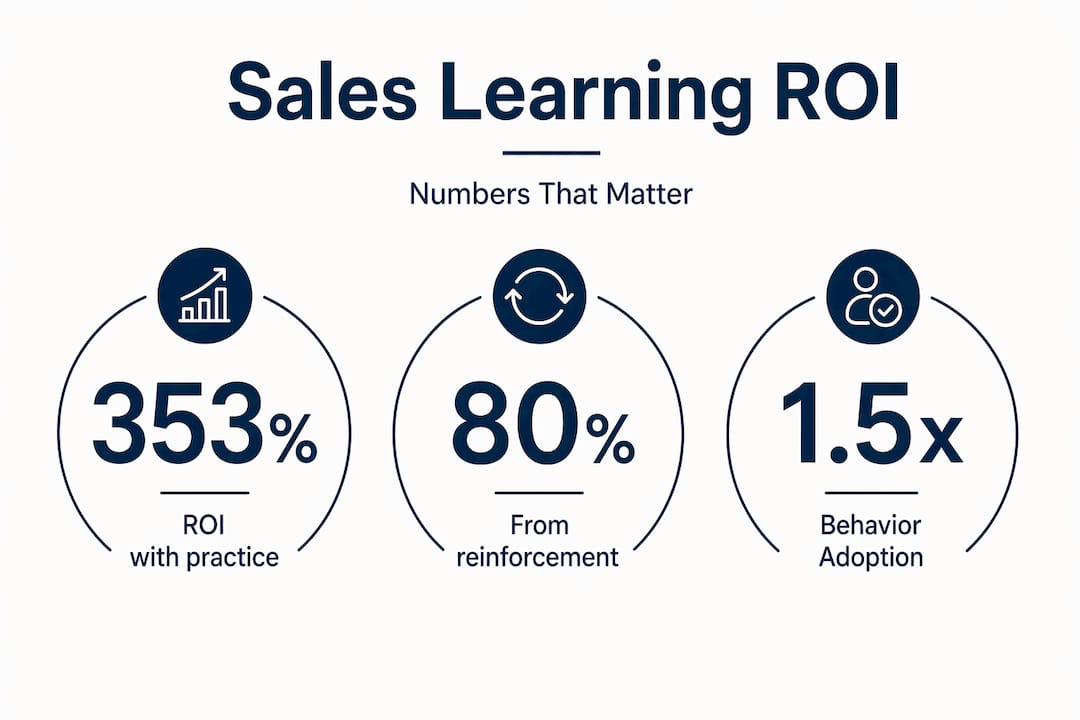
Here’s why this matters so much. Sales training ROI averages 353%, but only when continuous practice is built into the programme. One-off seminars simply don’t replicate those numbers. The difference lies not in the content of the training, but in the frequency and quality of reinforcement that follows.
There’s a psychological principle behind this. Research consistently shows that reps forget 80% of training within 90 days without reinforcement. This is often referred to as the forgetting curve, and it’s one of the most expensive problems in sales development. You spend thousands getting your team trained, and within three months, most of it is gone.
The most effective learning programmes share a common structure:
- Diagnostic phase – assess each rep’s current skill gaps before building their learning path.
- Personalised content – deliver role-specific modules rather than generic material.
- Practice and application – use role plays and scenario-based exercises to build skill automaticity.
- Structured feedback – provide specific, timely feedback tied to real deals, not hypothetical situations.
- Managerial follow-up – have managers reinforce key behaviours in weekly check-ins and deal reviews.
Reinforcement accounts for 80% of behaviour change in training budgets. That means the majority of your training investment should be focused on what happens after the initial session, not during it.
Designing effective sales learning programmes
Getting the structure right from the start is what separates programmes that produce measurable results from those that generate positive feedback forms and nothing else. The impact of learning on sales performance is almost entirely dependent on how well the programme is designed and delivered.
Strong programmes are built around a few non-negotiable principles:
- Role-based content: A new business development rep and an account manager need different training. Generic programmes dilute impact. Product training is most effective when it is continuous, role-specific, and tied to how reps actually use that knowledge in the field.
- Microlearning modules: Short, focused sessions of 5 to 15 minutes are far more likely to be completed and retained than hour-long lectures. Weekly micro-sessions on objection handling, discovery questioning, or closing techniques compound over time.
- Scenario-based practice: Real buying situations, replicated in training, help reps build the decision-making muscle they need when it counts. Role-aligned role plays repeated frequently enough are what build skill automaticity. Generic role play misses this.
- Peer and manager involvement: Learning does not happen in isolation. Build structured opportunities for reps to share what’s working, debrief on lost deals, and practise with colleagues.
- Technology and LMS platforms: AI coaching boosts sales performance by 25% and can reduce ramp-up times by up to 50%. AI-powered voice simulations, CRM-integrated learning resources, and adaptive platforms allow personalisation at scale.
Pro Tip: Don’t wait until onboarding is complete to start continuous learning. The habits your reps form in their first 90 days will define their approach for years. Build microlearning into onboarding from day one.
Technology is a tool, not a substitute for good coaching. The best programmes use platforms to track progress, deliver content, and surface insights, but they rely on human conversation to make the learning stick.
The role of managers in sustaining learning
Managers are, without question, the single biggest lever in any sales learning strategy. Not the content. Not the platform. The manager who debriefs a deal, runs a role play, and asks the right question on a Monday morning is what converts training into changed behaviour.

Manager-led reinforcement includes role plays, refreshers, and coaching tied to live opportunities. When managers do this consistently, reps adopt new behaviours faster and revert to old habits less. When managers don’t, even the best-designed programme fades within weeks.
The most effective reinforcement systems tend to include:
- Weekly one-to-ones where managers reference specific skills covered in recent training
- Deal reviews that explicitly connect learning content to live pipeline opportunities
- Regular team sessions for sharing best practices and lessons from recent wins and losses
- Structured reflection time after significant deals, won or lost
Peer learning is equally underestimated. Sharing best practices and lessons learned through story and failure analysis creates safer learning environments and drives behaviour adoption across the team. This only works, though, when the team culture makes it psychologically safe to discuss what went wrong.
The best sales teams I’ve worked with treat learning as a team sport. Knowledge sharing is built into the weekly rhythm, not reserved for the annual off-site.
When knowledge stays siloed in the heads of your top performers, the whole team suffers. Building peer learning into your operating model is one of the highest-return changes you can make as a sales leader.
Measuring the impact on performance
You cannot improve what you don’t measure. Yet the vast majority of sales teams still measure training success by one metric: attendance. That tells you almost nothing about whether the investment is working.
Here’s a more useful way to think about measurement:
| Metric type | Example | What it tells you |
|---|---|---|
| Activity metric | Training sessions completed | Whether reps are participating |
| Skill metric | Pre/post assessment scores | Whether knowledge has been acquired |
| Behaviour metric | Adoption of discovery framework in live deals | Whether learning is translating to action |
| Outcome metric | Quota attainment, win rate, ramp time | Whether learning is driving business results |
Measuring beyond training attendance to behaviour adoption in actual deals is where the real picture emerges. Tracking pre and post skill scores alongside business outcomes like win rates gives a far clearer ROI picture.
The goal is to connect what reps learn to what they do, and then connect what they do to what the business achieves. That chain of evidence is what justifies the investment and guides you on where to focus next.
Sales reps learn better when learning is embedded in daily workflow, with CRM-accessible resources and managerial coaching translating training into deal-level action. If your reps have to leave their workflow to access training content, most of them won’t.
Building a continuous learning culture
Understanding the principles is one thing. Putting them into practice is another. Here’s a practical sequence for building or improving your team’s learning culture:
- Run a diagnostic first. Identify skill gaps at the individual and team level before deciding on content. A blanket programme rarely addresses the actual problems.
- Build personalised learning paths. Use the diagnostic output to assign role-specific content and development priorities to each rep.
- Schedule microlearning into the weekly routine. Treat it like a standing meeting. If it’s optional, it won’t happen.
- Train your managers to coach, not just manage. The best consultative selling techniques require managers who can model and reinforce them, not just explain them.
- Use technology to track and adapt. Review what’s being accessed, what’s being skipped, and what’s correlating with performance improvement. Adjust accordingly.
- Create space for peer learning. A monthly session where reps share a recent win or a tough loss builds the kind of reflective practice that accelerates growth.
Pro Tip: Start with your managers. If they aren’t bought into the learning programme and actively reinforcing it, no amount of content or technology will save it. Manager readiness is the most overlooked prerequisite in sales team development.
Product knowledge training should be ongoing and role-specific to keep reps confident and consistent in their messaging throughout the buying process. This applies to any product or service, not just technical ones.
My take on the sales learning mindset
I’ve worked with a lot of sales teams over the years, and I’ll be honest with you: the vast majority of them are significantly underinvesting in what happens after training. They spend real money on the initial programme and then expect the results to materialise on their own. They don’t.
What I’ve come to believe, based on experience rather than theory, is that traditional one-off seminars produce a spike in motivation by day three and no lasting behaviour change by month two. This is almost universal. The problem isn’t the content; it’s the absence of a system that keeps the learning alive.
I’ve also seen something that surprises most managers: teams with modest training budgets but strong managerial coaching consistently outperform teams with expensive platforms and no follow-up. Technology is genuinely useful, particularly for building skills that last at scale. But it amplifies good practice. It doesn’t replace it.
The teams that grow fastest treat learning as a permanent operating system, not a quarterly project. That shift in mindset, from learning as an event to learning as an ongoing discipline, is what separates the top quartile from everyone else. If you’re a sales manager reading this, the most important question isn’t which platform to invest in. It’s whether your managers are actually coaching, and whether your team is actually practising.
— Jerry
How Aheadofsales supports your team’s growth
At Aheadofsales, we’ve built our entire approach around the principles covered in this article. We don’t deliver one-off training days and call it done. Our programmes combine bespoke 1:1 coaching with structured training and consultancy, designed specifically to create the kind of continuous learning environment that produces consistent performance gains.
Whether your team is 50 people or 500, our tailored sales training services are built around your specific roles, your product, and your sales process. We also offer role-specific programmes for SaaS sales teams through our specialist SaaS training offering. Every programme includes manager enablement, so the learning doesn’t stop when the session ends. Our clients target at least 50% sales growth per year. If that kind of result interests you, get in touch and let’s talk about what’s possible.
FAQ
What is the role of learning in a sales team?
Learning in a sales team drives skill development, confidence, and consistent performance. When structured as an ongoing practice rather than a one-off event, it directly improves quota attainment, reduces ramp time, and retains top talent.
How often should sales teams train?
Weekly microlearning sessions, supported by monthly reinforcement from managers, consistently outperform annual training events. Short, frequent practice builds retention and embeds new behaviours into daily selling habits.
What makes sales training effective long-term?
Effectiveness depends on reinforcement, not just content delivery. Manager coaching, peer learning, role-specific practice, and tracking behaviour adoption in live deals are what convert training into lasting performance improvement.
How do you measure whether sales training is working?
Move beyond attendance metrics. Track skill scores before and after training, monitor behaviour adoption in real deals, and connect learning outcomes to business results like win rates and quota attainment.
Why do so many sales training programmes fail?
Most fail because reinforcement is absent after the initial session. Without structured follow-up, manager coaching, and repeated practice, reps revert to old habits within weeks, regardless of how good the original training was.