
TL;DR:
- Territory management is a dynamic, ongoing strategic process that influences revenue, fairness, and retention. Proper design and continual refinement using data-driven insights can significantly optimize sales performance and team morale. Regular measurement and adjustments prevent imbalances, enhance resource utilization, and support sustainable growth.
Territory management is one of those topics where most sales managers think they already have it covered. You’ve split your accounts by region, assigned reps to postcodes, and called it done. But many believe territory management is simply assigning accounts by region, when in reality it is a dynamic, ongoing strategic process that directly shapes how much revenue your team generates, how fairly work is distributed, and whether your best salespeople stay or leave. Get it right, and you unlock faster growth, better morale, and smarter use of your team’s time. Get it wrong, and you are quietly leaving money on the table every single quarter.
Table of Contents
- What is territory management and why does it matter?
- How do companies design and define territories?
- Best-practice mechanics: balancing, updating, and refining
- Measuring and monitoring success in territory management
- UK case studies: real-world territory optimisation in action
- What most guides miss about territory management
- Take your territory management to the next level
- Frequently asked questions
Key Takeaways
| Point | Details |
|---|---|
| Beyond borders | Territory management is a dynamic strategy, not just drawing lines on a map. |
| Workload balance | Balancing opportunities and workloads boosts both sales performance and team wellbeing. |
| Ongoing process | Effective territory management requires regular review and adjustment as markets and teams evolve. |
| Measure what matters | Tracking the right KPIs—like coverage and pipeline health—enables timely improvements. |
| Local results | UK case studies show territory design and optimisation directly increase time with customers and utilisation rates. |
What is territory management and why does it matter?
Let’s be precise about what we mean here. Territory management is the process of designing, assigning, monitoring, and optimising customer account coverage by sales teams. It is not simply drawing borders on a map. It involves decisions about which accounts go to which reps, how workloads are balanced, how skills are matched to opportunity, and how the whole structure evolves as your market and team change.
A core aim is workload and opportunity balancing, enabling fair, achievable coverage and rebalancing as conditions shift. Think about what happens when one rep is overwhelmed with 150 accounts while another manages 60. The overloaded rep drops the ball on smaller but growing accounts. The underutilised rep has spare capacity but no strategic direction to fill it. Both situations cost you revenue.
Here is what good territory management actually delivers:
- Fair distribution of accounts so no rep is set up to fail or coast
- Better resource utilisation by matching rep strengths to account types
- Reduced rep churn because workloads feel manageable and achievable
- Improved customer experience because accounts get consistent attention
- Clearer accountability since ownership of each account is unambiguous
“Territory management is not a one-time administrative task. It is a living system that needs attention, data, and discipline to produce real commercial results.”
The common misconception is that once territories are drawn, the job is done. In reality, static territory plans become outdated within months as reps leave, markets shift, and new opportunities emerge. You can find practical guidance on managing this complexity in our sales team optimisation guide, which covers how to structure and scale your team for consistent growth.
How do companies design and define territories?
Once you understand what territory management really is, the next question is how you actually structure those territories. There is no single right answer, and the best approach depends on your product, market, team size, and customer base.
Territories can be as small as a town or as large as a nation and may be divided by geography, vertical, or segment. A national infrastructure supplier might assign territories by region (North, Midlands, South East). A software company targeting the legal sector might assign territories by vertical, giving each rep a specific set of industries regardless of location. A larger business might use a hybrid model combining both.

Here is a comparison of the three main design approaches:
| Approach | Best suited for | Strengths | Weaknesses |
|---|---|---|---|
| Geographic | Field sales, local relationships | Clear boundaries, easy to manage | Ignores account value differences |
| Segment-based | Sector specialists, complex sales | Aligns rep expertise to buyer needs | Travel time can increase significantly |
| Hybrid | Mid-to-large teams, diverse markets | Balances coverage and specialisation | More complex to design and manage |
When designing territories, consider these key criteria alongside geography:
- Account potential (current revenue vs. projected growth)
- Industry vertical (so specialists can build deeper relationships)
- Account complexity (enterprise accounts need different attention than SMEs)
- Rep experience and skills (match the account type to the person best placed to win it)
Pro Tip: Avoid designing territories using a single criterion. Pure geography ignores account value; pure vertical ignores travel time and feasibility. Using multi-criteria design from the outset prevents gaps, overlaps, and the resentment that follows when one rep has an obviously better patch than another.
For further reading on how to structure these processes day to day, our guide on management workflow in sales walks through the operational discipline needed to keep things running smoothly. You will also find our sales planning methods resource useful when it comes to building the annual plan around your territory structure.
Best-practice mechanics: balancing, updating, and refining
Designing territories is the start. Maintaining them is where most mid-sized businesses fall short. Effective territory management is an ongoing discipline, not a one-off process, involving regular realignment based on data. Here is a practical step-by-step approach I recommend to the teams we work with:
-
Map your market potential. Before assigning anything, understand the total addressable opportunity in each area or segment. Use existing CRM data, market intelligence, and firmographic data to build a realistic picture of where the revenue is.
-
Segment your accounts. Group accounts by size, potential, buying stage, and complexity. This gives you the raw material to build territories that are comparable in value, not just comparable in number of accounts.
-
Match rep skills to account types. A rep who excels at consultative, long-cycle enterprise deals should not be assigned a territory full of transactional SME accounts, and vice versa. Alignment here directly affects win rates.
-
Assign with equity in mind. Aim for territories that are roughly comparable in revenue potential and workload. Perfect equality is impossible, but obvious imbalance creates resentment fast.
-
Build in feedback loops. Ask reps regularly what they are seeing in their patch. Are certain segments unresponsive? Are there pockets of untapped opportunity? Rep insight is invaluable for keeping your territory design connected to reality.
-
Schedule biannual health checks. Set a fixed calendar date every six months to review territory performance, realign accounts where needed, and adjust for any team changes.
Common mechanics include mapping market potential, segmenting, matching skills, and feedback loops for continuous refinement. This is a discipline, not a project.
“The teams that grow fastest are not those with the most reps. They are the ones where every rep knows exactly what they own, why they own it, and what success looks like in their territory.”
Pro Tip: When a rep leaves, do not simply hand their accounts to the next available person. Treat it as an opportunity to review whether the territory itself still makes sense. Account redistribution is one of the highest-leverage moments for improvement. Our consultative selling guide is also worth reviewing here, as the way reps engage accounts within their territory matters as much as how those territories are structured.
Measuring and monitoring success in territory management
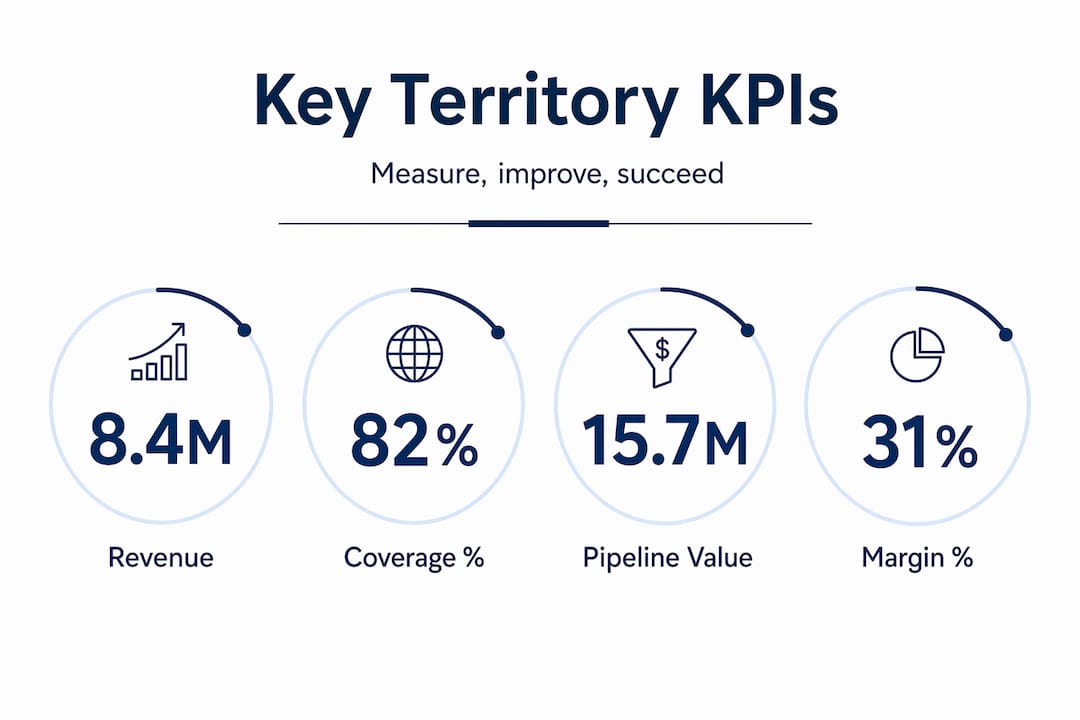
You cannot improve what you do not measure. Measurement focuses on territory-level coverage and pipeline health, with KPIs such as revenue per account, gross margin, market share, and pipeline signals. These metrics tell you whether your territory structure is working or quietly failing.
Here is a sample KPI comparison across three hypothetical territories:
| KPI | Territory A | Territory B | Territory C |
|---|---|---|---|
| Revenue per account (£) | £12,400 | £8,200 | £15,600 |
| Pipeline coverage ratio | 3.2x | 1.8x | 4.1x |
| Quota attainment (%) | 94% | 71% | 108% |
| Accounts contacted per month | 42 | 28 | 37 |
| Customer retention rate | 88% | 79% | 91% |
Territory B in the example above is a clear warning signal. Low pipeline coverage, low quota attainment, and fewer customer contacts per month suggest this rep is either under-resourced, overloaded, or the territory itself is poorly designed.
Key metrics to monitor regularly include:
- Pipeline health at territory level (not just team-wide totals)
- Quota attainment per rep and per territory
- Revenue per account to spot underperforming accounts within well-performing territories
- Utilisation rate (how much of a rep’s time is spent on actual selling activities)
- Territory coverage (the percentage of accounts meaningfully contacted within a set period)
“When you measure territory performance consistently, you stop guessing about why one rep is struggling and start making evidence-based decisions about where to intervene.”
Regular measurement also prevents the slow drift where territories become unequal over time as new accounts are added arbitrarily. Running a sales health check on your territories at least twice a year helps you catch these imbalances before they turn into rep churn or lost revenue.
UK case studies: real-world territory optimisation in action
It is easy to talk about territory management in the abstract. Let me show you what it looks like in practice for UK businesses.
Territory optimisation can lead to up to 79% of field sales time spent with customers, 100% of visits completed, and improved workload balance in UK firms. These are not small gains. For a field sales team, moving from 55% customer-facing time to 79% is the equivalent of adding nearly half a rep’s working week to productive selling activity, without hiring anyone new.
The lessons from UK territory optimisation projects consistently point to the same factors:
- Time and capacity planning matter enormously. When territories are designed without factoring in realistic travel times, reps spend more time in the car than in front of customers. This is particularly relevant in rural and mixed urban-rural territories across the UK.
- What-if scenario modelling pays for itself. Businesses that model the impact of territory changes before implementing them avoid costly mistakes and get buy-in from their sales teams faster.
- Workload fairness drives engagement. When reps feel their patch is achievable and fair, discretionary effort increases. When it feels impossible or unfair, disengagement follows quickly.
- Coverage metrics reveal hidden gaps. Some accounts that appear to be managed are actually receiving very little meaningful contact. Regular coverage audits surface these gaps before they become lost accounts.
For mid-sized UK sales teams, the implication is clear. Territory optimisation is not just a structural exercise. It is a direct lever for revenue growth and staff retention. Our guide on sales prospecting for UK growth connects well here, showing how prospecting activity within well-structured territories produces dramatically better results.
What most guides miss about territory management
I want to share something that most articles on this topic overlook entirely, because I think it is genuinely important for anyone managing a sales team right now.
The biggest failures I see in territory management are not about the wrong geographic boundaries. They are about weak data and static thinking. Segmentation and assignment based on weak data can lead to duplicate ownership, missed high-value segments, and unfair workloads. And this is far more common than most sales managers want to admit.
Here is what I mean in practice. A company builds its territories using last year’s CRM data, which has not been properly cleaned or updated. Some accounts are assigned to reps who left months ago. High-potential prospects in a new postcode area fall into no one’s territory because the original design did not account for that geography. Meanwhile, one rep has inherited a large account list from two predecessors and is simply firefighting, with no capacity for proactive development.
The hidden cost of ignoring travel time is also enormous, especially for field sales teams. I have worked with businesses where reps were driving three to four hours a day because their territories were geographically incoherent. That is selling time destroyed. Fixing the territory design gave those reps back 30 to 40 minutes of additional customer-facing time every day, which compounded into measurable pipeline growth within a quarter.
My strong recommendation is to review territory plans at least every six months, ideally with external input. It is very difficult to see your own blind spots from inside the business. Working with our sales consultancy services is one way to get that independent perspective and identify the imbalances that internal reviews consistently miss.
The other thing most guides miss is the people side of this. Territory changes feel personal to salespeople. Handle them clumsily and you risk losing your best rep. Handle them well, with clear rationale and genuine fairness, and you build the kind of trust that makes your team genuinely coachable and performance-focused.
Take your territory management to the next level
If this article has helped you see territory management differently, the next step is putting it into action. Whether you need to redesign your territory structure from scratch, introduce proper measurement frameworks, or simply build the habit of regular review, getting expert support accelerates everything.

At Ahead of Sales, we work with mid-sized UK businesses to build the sales structures, skills, and disciplines that produce at least 50% year-on-year growth. Our UK sales training services include bespoke 1:1 coaching and consultancy that addresses territory design as part of a complete sales performance system. If you are running a smaller service business and want focused support, our sales acceleration packages are designed to help you grow faster with clear, structured guidance. Reach out and let’s talk about where your biggest territory opportunities are hiding.
Frequently asked questions
How often should sales territories be reviewed or realigned?
Territories should be reviewed at least every six months and adjusted as market or team conditions change. Updates based on performance data are far more effective than waiting for an annual review cycle.
What key metrics should I track to measure territory management success?
Track pipeline health, territory coverage, revenue per account, gross margin by territory, and utilisation rates. KPIs such as revenue per account and pipeline health give you the clearest early warning signals when a territory is underperforming.
Is territory management only about geography?
No, territories can also be based on market segments, industry verticals, or customer types, not just geography. Territories may be set by industry verticals or geographic area, depending on what best serves your sales model and customer base.
How does territory management help sales team performance?
Effective territory management balances workload, prevents rep churn, and enables higher customer engagement and growth. Balanced assignments boost workload fairness and strategic focus, giving reps the conditions they need to consistently hit target.