
Here’s the agenda you can copy into your next invite, right now: 0 to 5 minutes on last quarter’s headline outcome, 5 to 15 on the scorecard, 15 to 30 on results and ROI, 30 to 40 on risks, 40 to 55 on the next-quarter plan, and the final five minutes reading back every commitment out loud. That’s a 60-minute skeleton, and it works for most B2B accounts without modification.
The rule that makes it work matters more than the timing. Every single agenda item has to close with a Decision, an Owner, and a Date before you move on. No decision, no owner, no date means the item wasn’t finished, it was discussed, and discussion without commitment is exactly what turns a QBR into an hour nobody remembers by Friday.
- Open and outcomes (0 to 5 minutes) — one slide, the headline number, nothing else.
- Scorecard (5 to 15 minutes) — 3 to 5 KPIs with trend arrows, no raw data dumps.
- Results and ROI (15 to 30 minutes) — proof of value, tied to what the account actually cares about.
- Risks (30 to 40 minutes) — ranked, not listed alphabetically.
- Next-quarter plan (40 to 55 minutes) — metrics, owners, dates.
- Read-back and close (55 to 60 minutes) — say every commitment out loud, twice if needed.
If you’re running a smaller account or a lighter touchpoint, drop to 45 minutes. If you’re dealing with multiple stakeholders across a complex account, extend to 90. If nobody’s calendar allows a live session at all, an async version can still work, provided the discipline around decisions doesn’t slip.
Key Takeaways
A sales QBR agenda succeeds only if every item concludes with a named decision, owner, and date, not merely polished slides.
| Point | Details |
|---|---|
| Time-box the meeting | Set duration (e.g., 45, 60, or 90 minutes) based on account complexity; avoid a default length for all. |
| Send the pre-read 48 hours ahead | Provide the scorecard, value proofs, top risks, and proposed decisions in advance to enable productive discussion. |
| Cap the scorecard at 3 to 5 KPIs | Limit live KPIs to those impacting behavior; place others in the appendix to preserve decision time. |
| Enforce Decision, Owner, Date | Require all agenda items to have these elements, and read them aloud before meeting close. |
| Separate internal and customer-facing QBRs | Maintain different decks: internal for pipeline and quotas; customer-facing focused on ROI and risks. |
Table of Contents
- Three ready sales QBR agenda templates for 45, 60 and 90 minutes
- What are the nine components every QBR agenda needs?
- What should a QBR pre-read include and when to send it?
- How do you run a QBR meeting minute by minute?
- Common QBR mistakes and how to fix them this quarter
- How Ahead of Sales helps you run better QBRs
- Who should you invite to a sales QBR and what roles do they play?
- How does an internal sales QBR differ from a customer-facing one?
- How do you keep stakeholders engaged during a QBR?
- How should the QBR agenda change by team or industry?
- What actually separates a good QBR from a wasted hour
- Sources
Three ready sales QBR agenda templates for 45, 60 and 90 minutes
A quarterly business review only earns its slot on a busy calendar if the format matches the account. A 60-minute exec review crammed into a 45-minute SMB slot leaves the room half-briefed. A 90-minute strategic session compressed into 45 minutes leaves stakeholders talking over each other. Match the format to the account first, then build the agenda.
The 45-minute SMB agenda
Run this when the account has one or two stakeholders with low deal complexity. The account manager leads; no separate facilitator is required.
- Outcomes and scorecard combined
- Results and ROI
- Risks and next-quarter plan combined
- Read-back
For this format, do not use an appendix. Metrics needing more than a brief explanation should be included in the pre-read. The output should be a concise next-quarter plan with a few key commitments.
The 60-minute exec-ready agenda
This is a standard format for sales leaders. A senior account executive or customer success manager facilitates, with a sales leader attending for contract or renewal discussions.
| Minutes | Section | Lead |
|---|---|---|
| 0–5 | Open and headline outcome | Account owner |
| 5–15 | Scorecard | Account owner |
| 15–30 | Results and ROI | Account owner or CS lead |
| 30–40 | Risks | Sales leader |
| 40–55 | Next-quarter plan | Account owner |
| 55–60 | Read-back | Facilitator |
The 90-minute strategic agenda
Reserve this for enterprise accounts with three or more stakeholders, where each function (procurement, technical champion, budget holder) needs its own subsection. Build in 10 minutes per stakeholder group inside the results and risks sections, and add a genuine strategic planning block at the end, not just a next-quarter task list. Individual rep diagnostic sessions running around 75 minutes, followed by a separate 60-minute team synthesis, is the pattern that surfaces account-wide themes rather than one rep’s isolated view.
The async variant
Use this only when a live slot genuinely cannot be found, or for lower-tier accounts that don’t justify a live session every quarter. Circulate the full pre-read with the scorecard, ROI proof and proposed decisions, then require written sign-off on each decision within 48 hours. The expected output is identical to a live QBR: decisions, owners, dates, just captured asynchronously rather than read back in real time.
Pro Tip: Never run an async QBR for an account where the decision maker hasn’t already seen at least one live version. Without that context, written sign-off tends to be a rubber stamp rather than a genuine decision.
What are the nine components every QBR agenda needs?
A decision-focused QBR reviews what happened, then commits to what changes. Each of the nine components below needs a minimum standard of evidence before it’s ready for the live meeting; anything short of that standard belongs back in prep, not on the agenda.
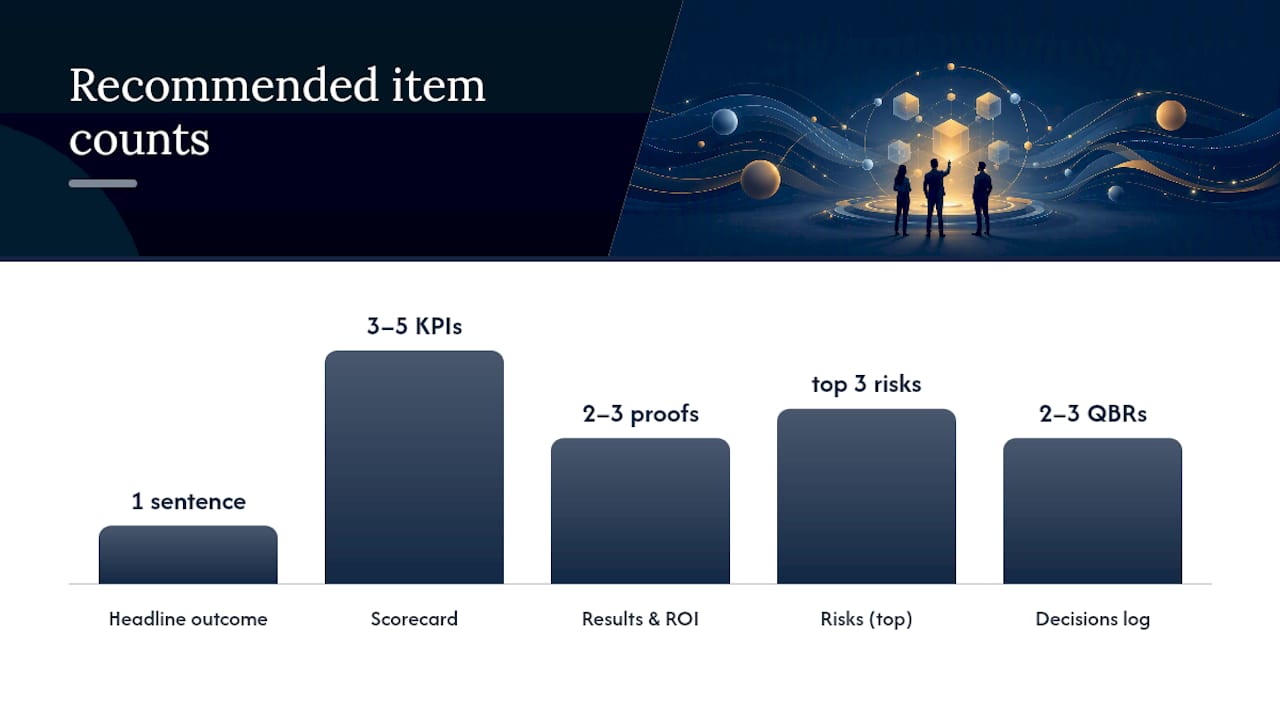
- Headline outcome. One sentence, one number. If you can’t state the quarter’s result in a single line, you haven’t finished analysing it.
- Scorecard. Three to five KPIs, each shown with a red, yellow or green trend against a stated benchmark range, not just a raw figure with no context.
- Results and ROI. Two or three proof artefacts, such as a usage chart, a cost-saving calculation or a specific outcome the account has already validated.
- Risks. Ranked by revenue exposure, not listed in the order someone thought of them.
- Next-quarter plan. Every line tied to a metric, an owner and a date, never a vague intention.
- Pipeline health. Coverage ratio and stage velocity, particularly where the QBR feeds into forecasting.
- Stakeholder map. Who’s engaged, who’s gone quiet, and who needs re-engaging next quarter.
- Decisions log. A running record of what’s been agreed across the last two or three QBRs, so nobody re-litigates old ground.
- Appendix. Everything else. Detailed data, historical trends, edge-case explanations.
On the scorecard specifically, resist the temptation to show everything you track. Limiting live-meeting KPIs to the three metrics that will genuinely change behaviour next quarter, and pushing the rest into an appendix, keeps the room focused on decisions rather than dashboards.
Risk ranking deserves particular attention because it’s where most QBRs quietly fail. A risk section that lists concerns without forcing a choice between them produces sympathy, not action. Rank by likelihood times revenue impact, present only the top three, and force a decision on each before moving to the next-quarter plan.
The appendix is the pressure valve for the whole meeting. Whatever data would only be useful to answer a follow-up question, rather than to prompt a decision in the room, goes there. This alone can shave fifteen minutes off a QBR that’s ballooned to 90 without anyone quite noticing why.
What should a QBR pre-read include and when to send it?
The pre-read is what turns a QBR from a presentation into a genuine discussion, and it needs to land with enough lead time for stakeholders to actually engage with it. Sending it 48 hours before the meeting is the standard most templates converge on, and there’s a practical reason for it: shorter than that, and busy stakeholders skim it on the way into the room; longer than that, and it’s forgotten by the time the meeting starts.
Keep the pre-read to one or two pages, covering exactly five things.
- The scorecard, with trend arrows already applied.
- Two or three value proofs, ideally numbers the account has already agreed on.
- The top three risks, ranked.
- Proposed decisions, phrased as choices rather than open questions.
- A draft next-quarter plan the room can amend rather than build from scratch.
Internally, split the prep work across defined owners well before that 48-hour window. Someone pulls the raw metrics from the CRM or reporting tool. Someone else drafts win/loss notes from the quarter, ideally the account owner who was closest to the deals. A third person, often the sales leader or a fractional sales director, drafts the proposed decisions, because decisions proposed by the person accountable for hitting target tend to get taken more seriously than decisions proposed by whoever built the slide deck.
Store the finished QBR somewhere the whole account team can already see it, rather than buried in a slide deck that only exists in one person’s downloads folder. Building it where the account plan already lives, whether that’s a Notion workspace or directly linked inside the CRM record, means the next QBR starts by referencing the last one instead of rebuilding context from scratch.
How do you run a QBR meeting minute by minute?
Facilitation is what separates a QBR that changes behaviour from one that’s forgotten by Monday. The pattern that works is reviewing past performance first to establish what actually happened, then shifting deliberately into planning and decisions, rather than blurring the two together for the whole hour.
Open with a single sentence, not a slide full of agenda bullets: “Last quarter closed at [outcome]. Today we’re deciding on three things.” That framing tells the room this isn’t a status update before it’s even begun.
When risks surface, resist the instinct to problem-solve them live. Ask instead: “What decision does this risk require from someone in this room today?” That question either produces a decision or reveals that the risk needs a follow-up meeting with different attendees, which is itself useful information.
If the decision maker is absent, don’t run the decision section as if they were there. Park it explicitly, name who will approve it and by when, and move on. Pretending a decision has been made without the right person in the room is how QBRs quietly lose credibility over successive quarters.
Pro Tip: If the meeting starts drifting back into status updates during the risks or planning sections, interrupt with one line: “That’s useful context, let’s capture it in the appendix and come back to the decision.” It protects the clock without shutting anyone down.
The behavioural shift that matters most is moving the room’s default question from “what happened” to “what we will change.” A behavioural scorecard approach built around measurable next-quarter commitments, rather than a purely historical report, forces that shift by design rather than relying on the facilitator to steer it every time.
Common QBR mistakes and how to fix them this quarter
Most QBRs fail in one of four predictable ways, and each has a specific, testable fix.
- The data dump. Fix: cap the live scorecard at 3 to 5 KPIs and move everything else to the appendix.
- No decision maker in the room. Fix: confirm attendance of the actual approver before sending the pre-read, not after.
- Too many KPIs competing for attention. Fix: ask “which of these will change behaviour next quarter?” and cut anything that fails the test.
- Decisions with no named owner. Fix: enforce Decision, Owner, Date on every single agenda item, with zero exceptions.
Beyond fixing individual failures, three habits compound across quarters: timebox every section strictly, send the pre-read 48 hours ahead without fail, and circulate a written recap within 24 hours of the meeting closing. That recap should list every decision, owner and date from the read-back, nothing more.
Measuring whether a QBR actually changed anything is simpler than most sales leaders assume. Track the percentage of committed actions completed by the following QBR, not just whether the meeting happened.
Pro Tip: Add one line to every recap email: “Open items from last quarter: X of Y completed.” Publishing that number, even informally, does more to improve follow-through than any amount of facilitation skill.
How Ahead of Sales helps you run better QBRs
Templates get you most of the way. What most sales teams actually lack is the discipline to run the meeting the same way every quarter, and the accountability to check whether commitments got done. That’s the gap our coaching engagements close.
- Live facilitation support for your first two or three QBR cycles, so the format sticks before you’re running it solo.
- Pre-work templates built around your account tiers, not a generic 60-minute skeleton.
- Post-QBR accountability checks, tracking whether decisions from last quarter actually got completed.
Our sales training and coaching packages start from £4,500 to £8,500 for teams of roughly 50 to 1,000 staff, and we also run sales acceleration packages from £2,995 to £5,995 for solo service businesses that want the same discipline without a full team engagement.
Sales leaders who run structured QBRs with clear owners and dates get more from their pipeline reviews than those relying on ad hoc updates.
If you’re running a growth-focused sales team and want the QBR to be the moment quarterly targets get hit, not just discussed, that’s exactly where our sales consultancy services come in.
Who should you invite to a sales QBR and what roles do they play?
Three roles have to be in the room, or the meeting risks becoming a rehearsal for a decision that gets made somewhere else afterwards.
The account owner presents the scorecard and results, because they hold the closest relationship with the numbers and the account history. The decision maker, usually a sales leader or director, has to actually be present, not represented by someone relaying their views secondhand. Decisions made in their absence tend to get quietly reversed or re-litigated in a follow-up call, which defeats the point of ranking risks live.
The champion, whether that’s a customer success manager or a technical lead who understands delivery detail, fills in the gaps the account owner can’t speak to with authority, particularly around product usage or implementation friction.
Beyond those three, keep the guest list tight. A finance representative only needs to attend if pricing or contract terms are genuinely on the table. A product specialist only needs to attend if a specific technical risk has already been flagged in the pre-read. Every additional attendee who isn’t contributing to a decision adds fifteen minutes to the meeting and reduces the odds anyone speaks candidly about a risk.
For fractional sales director engagements, this role clarity matters even more, because an external decision maker walking into an unfamiliar room needs the pre-read to do the work that shared history would normally do.
How does an internal sales QBR differ from a customer-facing one?
The confusion here causes more wasted meetings than almost any other QBR mistake. Treating a customer success QBR and a sales QBR as interchangeable leads to mission drift, where neither audience gets what they actually need.
An internal sales QBR is about your own team’s performance against target: pipeline health, win rates, rep-level behaviour, and what needs to change to hit next quarter’s number. The audience is your sales leadership and the reps or account owners themselves. Nobody outside the business sees this deck, which means the risks section can be blunt about what’s not working.
A customer-facing QBR, by contrast, is about the account’s outcomes, not your internal targets. The scorecard shown to a customer focuses on their ROI, their usage trends, their risks, not your quota attainment. Mixing the two, presenting your internal pipeline metrics to a client, or presenting a customer’s usage data to your own leadership as though it were a performance review, produces a meeting that satisfies neither audience properly. Keep the frameworks structurally similar (scorecard, results, risks, next-quarter plan) but keep the content and the audience strictly separated.
How do you keep stakeholders engaged during a QBR?
Engagement drops the moment a QBR turns into one person reading slides aloud to a silent room. The fix starts before the meeting: if the pre-read has done its job, stakeholders arrive already knowing the numbers, which frees the live session for actual discussion rather than a first reveal.

During the meeting itself, ask direct questions rather than pausing for comments. “What’s your read on this trend?” gets a response; “any questions?” usually doesn’t. Direct the question to a specific person by name rather than the room in general, particularly with quieter stakeholders who won’t volunteer unprompted.
Give each stakeholder group ownership of at least one section relevant to them. A technical champion presenting the usage data themselves, rather than having it presented to them, changes the entire tone of the risks conversation that follows.
Finally, close every decision with a verbal confirmation from the specific person who owns it, not a general nod from the room. “[Name], you’re confirming you’ll have this to us by [date]?” takes ten seconds and eliminates the ambiguity that lets commitments quietly evaporate before the next QBR.
How should the QBR agenda change by team or industry?
A field sales team selling capital equipment needs more time on stakeholder mapping than a SaaS team selling self-serve software, because the buying committee is larger and slower to move. Extend the risks section for these accounts and be prepared to run the 90-minute strategic format more often than the 60-minute default.
SaaS teams, particularly at Series B and beyond, tend to have cleaner usage data available, which means the scorecard section can run shorter and the results and ROI section can lean harder on quantified product usage rather than anecdotal wins. Our sales training for SaaS teams leans into this, building QBR scorecards around activation and expansion metrics rather than generic pipeline figures.
Professional services and consultancy-led sales teams often need a heavier next-quarter plan section, because the deliverable itself changes quarter to quarter in a way product sales doesn’t. If your team sells project-based work, expect the risks and next-quarter plan sections to take up more of the 60 minutes than the template above suggests.
Solo operators and small teams running acceleration-style engagements should default to the 45-minute SMB format every time, resisting the temptation to import a 90-minute enterprise structure that doesn’t match their account complexity. If contract renewal terms or year-end fiscal timing are part of the discussion, it’s worth reviewing year-end planning considerations alongside the commercial risks section, particularly for accounts renewing close to a financial year boundary.
What actually separates a good QBR from a wasted hour
Most advice on this topic obsesses over slide design and KPI selection, and both matter less than people assume. What the research behind this article actually supports is blunter: a QBR succeeds or fails based on whether the decision maker attends and whether decisions get a name and a date attached before the room disperses.
The conventional advice oversells the scorecard. Teams spend hours perfecting trend colours while the next-quarter plan gets ten rushed minutes at the end because the meeting overran. That’s backwards. If you’re short on time, protect the last twenty minutes and compress the scorecard, not the other way round.
Prioritise the read-back. It costs five minutes and it’s the single habit most QBRs skip entirely, which is exactly why so few commitments survive past the meeting they were made in. Get that right before you touch the deck design.
— Jerry
Sources
- Quarterly Business Review Examples, Templates, And Agendas — Gong
- Running a sales QBR: Everything you need to know — Mural
- QBR Template: Free Agenda, Structure, and Examples — NoteLinker
- Sales QBR Template: The Format Top Managers Use — AmpUp