
TL;DR:
- Sales performance tracking measures key metrics to enhance team effectiveness and revenue growth. It requires balancing leading indicators like activity and pipeline velocity with lagging revenue outcomes and organizing tracking by weekly, monthly, and quarterly cadences. Building a reliable system involves defining objectives, selecting clear KPIs, coaching from segmented data, and ensuring accurate data integration to drive consistent performance improvement.
Sales performance tracking is the systematic process of measuring and analysing key sales metrics to improve team effectiveness and drive revenue growth. Most sales managers know they should be tracking performance, but far fewer do it in a way that actually changes behaviour. The difference between a team that consistently hits target and one that scrapes through each quarter usually comes down to whether the manager is reading the right numbers at the right time. This guide covers the key metrics for sales performance, how to organise your tracking cadence, which tools support the process, and how to build a system that coaches your team rather than just monitors them.
What is a sales performance tracking guide and why does it matter?
Sales performance tracking is defined as the ongoing measurement of sales activities, pipeline health, and revenue outcomes against agreed targets. The industry term for this practice is sales performance management, and it sits at the heart of every high-performing commercial team.
Revenue is a lagging indicator. It tells you what already happened, not what is about to happen. True performance management requires balancing revenue data with leading indicators such as call volume, pipeline velocity, and lead-to-opportunity rate. Without that balance, you are always reacting rather than coaching.
The business case is straightforward. When you track the right metrics consistently, you can identify exactly where deals are stalling, which reps need support, and where your pipeline is thin before it becomes a missed quarter. Data-driven metrics form a shared language between managers and reps, which makes coaching conversations more productive and far less subjective.
What are the essential sales performance metrics to track?
Metrics fall into three categories: activity, efficiency, and outcome. Each category answers a different question about your sales operation.
Activity metrics measure what your reps are doing: calls made, emails sent, meetings booked, and follow-ups completed. These are pure leading indicators. Activity metrics predict outcomes 2–4 weeks ahead, which means they give you enough time to intervene before a problem shows up in revenue. If call volume drops this week, win rates will likely drop next month.
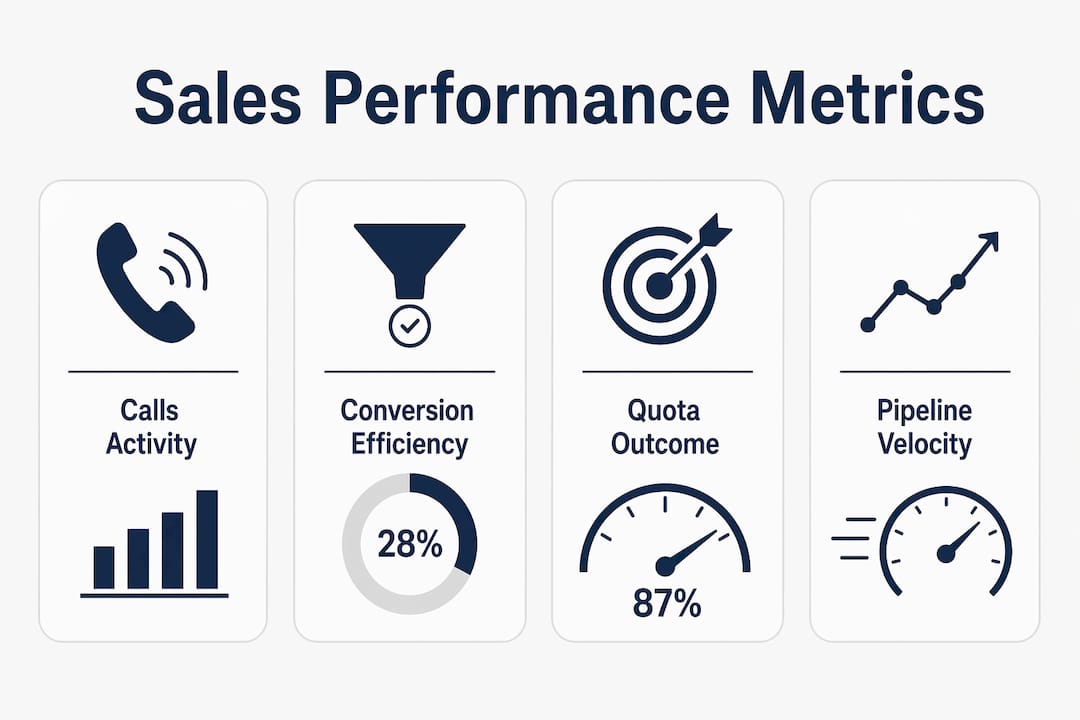
Efficiency metrics measure how well your team converts effort into progress: lead-to-opportunity rate, opportunity-to-close rate, and sales cycle length. These reveal whether your process is working, not just whether your reps are busy.
Outcome metrics measure results: quota attainment, average deal size, and total revenue. These are lagging indicators. They confirm what happened but offer no guidance on what to do next.
The single most powerful composite metric is Pipeline Velocity, calculated as: SQLs multiplied by average deal size multiplied by win rate, divided by sales cycle length. It combines speed and volume into one number that predicts whether you will hit your revenue target. If Pipeline Velocity is falling, you know to look at one of its four components rather than simply pushing the team to “close more deals.”
| Metric type | Example metrics | What it tells you |
|---|---|---|
| Activity (leading) | Call volume, emails sent, meetings booked | Whether reps are generating enough pipeline input |
| Efficiency (leading) | Lead-to-opportunity rate, sales cycle length | Whether the sales process is converting effort into progress |
| Outcome (lagging) | Quota attainment, win rate, revenue | Whether the team delivered results this period |
Pro Tip: Pick no more than three metrics per category to start. A dashboard with fifteen metrics is a dashboard nobody reads. Start with Pipeline Velocity, Win Rate, and Call Volume, then add metrics only when you have a specific coaching question they would answer.
How should you organise sales tracking across weekly, monthly, and quarterly cadences?
Tracking everything at the same frequency creates noise. Sales leaders should track metrics across three cadences: weekly for tactical adjustments, monthly for pipeline health, and quarterly for investment decisions.
Weekly tracking focuses on activity metrics. Call volume, contact rates, and follow-up completion tell you whether reps are executing the process. Weekly reviews should be brief, focused, and forward-looking. The question is not “why did you miss last week?” but “what does this week look like?”
Monthly tracking shifts to efficiency and pipeline metrics. Win rates, MQL (marketing qualified lead) volume, and pipeline coverage ratios belong here. Monthly data gives you enough signal to spot trends without overreacting to a single bad week.
Quarterly tracking covers outcome and investment metrics: customer acquisition cost (CAC), lifetime value (LTV), and the Magic Number (a ratio that measures sales efficiency relative to marketing spend). These metrics inform hiring decisions, territory planning, and budget allocation.
Weekly metrics for your team:
- Call volume per rep
- Meetings booked
- Follow-up completion rate
- New opportunities created
Monthly metrics for your pipeline review:
- Win rate by rep and by product
- MQL to SQL conversion rate
- Average sales cycle length
- Pipeline coverage ratio (pipeline value divided by target)
Quarterly metrics for leadership decisions:
- Quota attainment by rep and team
- Customer acquisition cost
- Lifetime value
- Forecast accuracy (target: within 10% variance)
Pro Tip: Metrics should be tiered by coaching cadence to avoid micromanagement. Reviewing call volume daily signals distrust. Reviewing it weekly signals accountability. The frequency of your review communicates your expectations as clearly as the metric itself.
What tools and systems support effective sales performance tracking?
Four categories of platform support a complete tracking system. Each serves a different function, and the gaps between them are where data problems usually hide.

CRM platforms are the foundation. They capture deal stage, activity history, and pipeline value. Without a CRM that your team actually uses consistently, every other metric is unreliable. The most common failure mode is a CRM with incomplete data because reps log calls inconsistently.
Sales analytics tools sit on top of CRM data and produce the dashboards and reports your managers need. They aggregate data across reps, territories, and time periods, and they surface trends that raw CRM data obscures. A marketing dashboard that connects to your sales data can also reveal which lead sources produce the highest win rates.
Incentive management systems handle commission calculations. Commission payout errors diminish rep trust, and accuracy must be near 0%. Manual commission calculations in spreadsheets introduce errors that erode morale and distract reps from selling. Automated incentive management removes that risk.
Learning management systems (LMS) track training completion and skill development alongside performance data. When you can see that a rep’s win rate improved after completing a negotiation module, you have evidence to replicate that intervention across the team.
| System type | Primary function | Key risk if absent |
|---|---|---|
| CRM platform | Activity and pipeline capture | No reliable data foundation |
| Sales analytics tool | Trend identification and reporting | Managers work from raw data only |
| Incentive management | Commission accuracy | Rep distrust and disputes |
| Learning management | Skill development tracking | No link between training and performance |
Pro Tip: Integrate your CRM with your incentive management system before anything else. Commission disputes are the fastest way to destroy team morale, and they almost always stem from data living in two separate places.
How to build a sales performance tracking system step by step
A tracking system that actually changes behaviour requires more than a dashboard. It requires a clear process from objective setting to coaching action.
-
Set your objectives. Define what “good performance” looks like for your team this quarter. Quota attainment targets, pipeline coverage ratios, and forecast accuracy thresholds all belong here. Without agreed objectives, metrics have no context.
-
Select your KPIs. Choose three to five metrics per category (activity, efficiency, outcome). Create a KPI dictionary with clear definitions so your team and finance agree on how each metric is calculated. “Win rate” means different things to different people unless you define it precisely.
-
Design your dashboards. Build one dashboard per cadence: a weekly activity view, a monthly pipeline view, and a quarterly outcomes view. Each dashboard should answer one question. Avoid combining all metrics into a single screen.
-
Coach from the data. Use your weekly activity data to run focused one-to-one conversations. If a rep’s call volume is high but their meeting conversion rate is low, the coaching conversation is about call quality, not effort. Segmenting metrics by volume, efficiency, and quality reveals whether challenges stem from insufficient leads, low conversion, or small deal sizes.
-
Review and adjust. At the end of each quarter, review which metrics predicted outcomes accurately and which did not. Drop metrics that generated noise without insight. Add metrics that answer questions you could not answer this quarter.
| Step | Action | Expected outcome |
|---|---|---|
| Set objectives | Define targets for quota, pipeline, and forecast accuracy | Clear performance benchmarks for the team |
| Select KPIs | Build a KPI dictionary with agreed definitions | Consistent measurement across reps and finance |
| Design dashboards | One dashboard per cadence | Managers review the right data at the right time |
| Coach from data | Use leading indicators in one-to-one sessions | Specific, targeted coaching rather than generic pressure |
| Review and adjust | Quarterly metric audit | Tracking system improves with each cycle |
You can find a practical sales performance metrics checklist that covers weekly leading indicators in detail if you want a ready-made starting point.
What common challenges arise in sales performance tracking?
The most common problem is visibility gaps. A manager who can only see revenue has no way to diagnose why revenue is low. Is it a volume problem (not enough leads), an efficiency problem (poor conversion), or a quality problem (small deal sizes)? Without segmented metrics, every intervention is a guess.
The second problem is relying on gut feel. Relying on gut feel instead of consistent data undermines trust and coaching effectiveness. When a manager tells a rep to “make more calls” without data to support it, the rep has no reason to believe the advice is targeted at their specific situation.
Commission errors are the third major challenge. Inaccurate payouts create anxiety and disputes that distract reps from selling. Even a small error repeated across a team compounds into a significant trust problem over time.
Troubleshooting tips for common tracking failures:
- If your forecast is consistently more than 10% off, check whether your pipeline stages have clear exit criteria or whether reps are moving deals forward based on optimism rather than evidence.
- If win rates vary widely between reps, segment by lead source and deal size before assuming it is a skills problem.
- If reps are disengaged from the tracking process, involve them in selecting the metrics they are measured on. Ownership increases compliance.
- If your CRM data is unreliable, simplify data entry requirements before adding new fields. Complexity is the enemy of adoption.
- If coaching conversations feel generic, use leading indicators for early intervention rather than waiting for monthly outcome data.
For a broader view of where your team stands against industry norms, the sales performance benchmarks guide for leaders is worth reviewing alongside your own data.
Key takeaways
Effective sales performance tracking requires a balanced mix of leading and lagging indicators, organised by cadence and connected directly to coaching conversations.
| Point | Details |
|---|---|
| Balance leading and lagging indicators | Track activity and pipeline metrics alongside revenue to manage performance proactively. |
| Use three tracking cadences | Weekly for activities, monthly for pipeline, quarterly for outcomes and investment decisions. |
| Build a KPI dictionary | Agree on metric definitions with your team and finance to avoid misalignment. |
| Coach from segmented data | Identify whether issues stem from volume, efficiency, or quality before intervening. |
| Protect commission accuracy | Near-zero payout errors are non-negotiable for maintaining rep trust and focus. |
What I have learned from tracking sales performance in real teams
Here is something most guides will not tell you: the metrics themselves are rarely the problem. The problem is what managers do with them.
I have worked with sales leaders who had beautiful dashboards and still missed quarter after quarter. When I dug into their process, the issue was always the same. They were reviewing outcome metrics in their one-to-ones and asking reps to explain results rather than using leading indicators to coach behaviour before results were set. By the time revenue data confirmed a problem, it was already too late to fix it that quarter.
The shift that changes everything is moving your coaching conversations from lagging to leading data. When you sit down with a rep and say “your contact rate dropped three weeks ago and your pipeline has thinned out as a result, so let us talk about what changed,” you are having a genuinely useful conversation. When you say “your numbers are down this month,” you are just creating stress.
The other thing I see consistently is managers who track too many metrics because they are afraid of missing something. A dashboard with twenty metrics is a manager’s anxiety made visible. Pick the five metrics that answer the questions you actually ask in your coaching sessions, and ignore the rest until you have a specific reason to add them.
Accurate sales forecasting is the natural output of a well-run tracking system. If your forecast is regularly more than 10% off, that is not a forecasting problem. It is a tracking problem. Fix the data, and the forecast fixes itself.
The teams I have seen grow fastest are not the ones with the most sophisticated tools. They are the ones where every rep understands exactly which three or four numbers matter this week, why they matter, and what they need to do differently if those numbers are off. That clarity comes from a manager who has done the work of building a tracking system that serves coaching rather than just reporting.
— Jerry
How Aheadofsales helps teams put tracking into practice
Knowing which metrics to track is one thing. Building a culture where your team takes those metrics seriously and acts on them is another challenge entirely.

Aheadofsales works with sales teams of 50 to 1,000 people to build the skills, habits, and systems that turn performance data into consistent revenue growth. The sales training programmes combine bespoke one-to-one coaching with practical workshops designed around your actual metrics, not generic frameworks. Every engagement is built around the goal of at least 50% sales growth per year and a team that hits target every quarter. If you want to see what that looks like in practice, the sales training overview covers the full range of options available.
FAQ
What is sales performance tracking?
Sales performance tracking is the systematic measurement of sales activities, pipeline health, and revenue outcomes against agreed targets. It combines leading indicators (activities, pipeline) with lagging indicators (revenue, quota attainment) to give managers a complete picture of team performance.
What are the most important sales performance metrics?
Pipeline Velocity, Win Rate, and Quota Attainment are the three most widely used metrics. Pipeline Velocity (SQLs multiplied by deal size multiplied by win rate, divided by sales cycle length) is the best single composite metric for predicting whether a team will hit its revenue target.
How often should sales performance be reviewed?
Activity metrics should be reviewed weekly, pipeline and efficiency metrics monthly, and outcome metrics quarterly. This tiered cadence avoids micromanagement while ensuring managers have enough data to coach proactively at each level.
Why is revenue alone not enough to measure sales performance?
Revenue is a lagging indicator that confirms what already happened. Without leading indicators such as call volume and pipeline velocity, managers cannot identify problems early enough to intervene before a quarter is lost.
How do commission errors affect sales performance?
Commission payout errors erode rep trust and create disputes that distract teams from selling. Accuracy must be near 0%, which requires integrating CRM and incentive management systems rather than relying on manual spreadsheet calculations.