
TL;DR:
- Most sales teams miss quotas due to lacking structured strategies, culture, and coaching, not effort. Implementing specific, measurable goals, fostering transparency, and coaching regularly drive sustainable performance improvements. Focusing on data quality, targeted technology use, and consistent measurement accelerates sales growth.
Most sales leaders face a deeply uncomfortable truth. 69% of reps missed quota in 2024, with average attainment sitting at just 43%. That is happening even as many organisations report revenue growth overall. If your team is putting in the effort but the numbers are not reflecting it, the problem is rarely effort. It is almost always the absence of focused, structured sales performance improvement steps that address the real gaps: strategy, culture, technology, and coaching, all working together.
Table of Contents
- Key takeaways
- The right foundations for sales improvement
- Building a high-performance sales culture
- Using technology to drive sales performance
- Coaching and training as performance drivers
- Measuring what actually matters
- My honest take on what actually works
- How Aheadofsales can accelerate your results
- FAQ
Key takeaways
| Point | Details |
|---|---|
| Start with SMART goals | Align sales targets directly to your company strategy before changing anything else. |
| Culture drives results | Shared accountability and transparent metrics outperform short-term motivation tactics every time. |
| Technology needs hygiene | AI and CRM tools only deliver value when your underlying data is clean and well-managed. |
| Coach consistently, not occasionally | Regular coaching lifts quota attainment by over 10 points, so frequency matters as much as quality. |
| Measure leading indicators | Track discovery-to-demo conversion and pipeline coverage, not just revenue, to catch issues early. |
The right foundations for sales improvement
Before you change a process or invest in new technology, you need to know exactly where you are starting from. That sounds obvious. Most organisations skip it anyway.
Set SMART goals that connect upward. Specific, Measurable, Achievable, Relevant, and Time-bound targets only work when they are tied directly to broader company objectives. A rep with a £500k annual target needs to understand how that figure connects to the company’s three-year growth plan. Without that context, the number is just a number. When reps understand why the target matters, the work behind it changes.
Define your ideal customer profile (ICP) precisely. A clear sales strategy starts with knowing exactly who you are selling to and why they buy. This means going beyond job title and industry. You need firmographic detail, the specific pain points your solution resolves, and the triggers that prompt a buying decision. Once that is sharp, your messaging and sales playbook follow naturally.
Conducting a structured skills assessment is the third part of this foundation. This is not a one-question manager review. It combines self-assessment from reps, direct observation from managers during live calls, and data pulled from recorded conversations. You are looking for specific gaps, not general impressions.
- Which reps struggle with discovery questions?
- Who loses momentum after the first demo?
- Where does the pipeline consistently stall?
Pro Tip: Use conversation intelligence tools to review call recordings before your skills assessment. Patterns in language, objection handling, and talk-to-listen ratios give you objective data that observation alone cannot match.
These three foundations, goals, strategy, and skills, are your plan of action to increase sales in a way that holds up over time.
Building a high-performance sales culture
Here is where many improvement efforts fall short. Leaders focus on motivation: incentives, competitions, inspirational meetings. Those things have a place. But they do not build a culture. Culture is structural.
High-performing sales cultures rely on three things: shared accountability, transparent performance metrics, and continuous skill development. Motivation tactics give you a short-term spike. These three give you compounding growth.

Shared accountability means more than the sales team. Marketing needs to be accountable for the quality of leads they pass over. Operations needs to own the delivery experience that directly affects renewal rates. Customer success needs to flag churn risk early enough for sales to act. When these functions align, cross-functional alignment produces 23% higher quota attainment than fragmented teams.
Transparency in metrics does not mean putting a leaderboard on the wall and leaving it there. It means reviewing performance openly, discussing what is working and what is not, and making that conversation normal rather than threatening. When reps understand where they stand relative to pipeline coverage, deal velocity, and customer satisfaction, they can make better decisions daily.
The sales cultures that sustain growth are not the loudest or the most competitive. They are the most honest. When data is visible and feedback is frequent, reps self-correct faster and managers coach more precisely.
Regular performance discussions accelerate skill development by 32% compared to annual reviews. That gap is significant. It means the cadence of feedback matters as much as its content.
For a deeper look at proven sales strategies that support culture building, the fundamentals are consistent regardless of sector.
Using technology to drive sales performance
Technology is where organisations tend to over-invest and under-prepare. The tool is not the solution. Clean data and disciplined adoption are.
Start with your CRM. Most CRM systems are underperforming not because the platform is wrong but because the data inside is unreliable. Reps enter information inconsistently, fields are left blank, and activity is logged late or not at all. Automated CRM data capture resolves this by auto-logging calls, emails, and meetings without requiring manual entry. The result is data you can actually trust for forecasting and lead scoring.
| Manual CRM management | AI-assisted CRM management |
|---|---|
| Relies on rep discipline for data entry | Auto-logs calls, emails, and meetings |
| Inconsistent activity tracking | Consistent, timestamped activity records |
| Forecasting based on incomplete data | Forecast accuracy improves significantly |
| Time consumed by administrative tasks | Sellers reclaim time for selling activity |
| Lead scoring is subjective | Lead scoring is data-driven and weighted |
AI integration works best when it fits into existing workflows rather than demanding new ones. The fastest wins come from automating the tasks reps already do, such as follow-up emails, meeting summaries, and next-step reminders. This reduces administrative burden and makes adoption far more likely.
Call transcription and AI-generated summaries are particularly valuable. A manager reviewing ten call summaries in an hour, rather than listening to ten full recordings, can coach more reps more frequently. That directly affects the quality and frequency of feedback at scale.
Pro Tip: Before adopting any AI sales tool, audit your CRM data quality first. If your existing data is unreliable, AI will amplify those errors rather than fix them. Clean data is the prerequisite, not an afterthought.
For context on AI productivity gains more broadly, the returns depend almost entirely on how well the tool is embedded in day-to-day workflows.
Coaching and training as performance drivers
Regular coaching improves quota attainment by over 10 points and win rates by 6.6%. Those are not small numbers. Yet many sales leaders treat coaching as something that happens when there is time, rather than as a structured part of the working week.
Here is a practical framework for embedding coaching properly:
- Schedule non-negotiable 1:1s. Weekly or fortnightly, depending on team size. These are not pipeline reviews. They are skill development conversations grounded in specific call data or deal outcomes.
- Run structured group sessions. Monthly or bimonthly, focused on a single skill: objection handling, discovery questioning, or closing techniques. Use real examples from your own team’s calls, with permission.
- Integrate microlearning into the daily routine. Short videos, scenario cards, or brief exercises that take ten minutes or less. Reps retain far more from frequent, small doses than from a quarterly training day.
- Use onboarding as your first coaching investment. Companies with strong sales culture see 17% faster ramp times for new reps. Structured onboarding that includes role-play, shadowing, and feedback loops from day one builds habits that last.
- Measure coaching ROI directly. Track conversion lifts by rep before and after focused coaching interventions. This tells you which coaching formats work and where to invest more.
Overcoming resistance to coaching is a real challenge. Some experienced reps see regular coaching as criticism rather than development. The framing matters. Position each session around data rather than judgement, and you shift the dynamic from evaluation to collaboration.
Pro Tip: Use a coaching software comparison to find tools that allow managers to comment directly on call recordings. This makes feedback specific, time-stamped, and far easier for reps to act on.
Measuring what actually matters
You cannot improve what you do not measure. That is true. What is equally true, and often overlooked, is that you can measure the wrong things and still miss problems until it is too late.
Lagging indicators like revenue, closed deals, and quota attainment tell you what happened. Leading indicators tell you what is about to happen. Leading indicators like discovery-to-demo conversion allow early intervention before a weak month becomes a weak quarter.
The core KPIs worth tracking for any sales performance improvement guide are these:
- Pipeline coverage ratio: How many times over does your current pipeline cover your target? Three times is typically the minimum threshold for confidence.
- Win rate by stage: Where are you losing deals? A drop-off after demo tells a different story from a drop-off after proposal.
- Sales cycle length: If cycles are lengthening, something in the process or the market has changed. Find out what.
- Customer acquisition cost: Rising CAC with flat revenue signals an efficiency problem that training and process can often address.
Review cadence matters as much as the metrics themselves. Weekly pipeline reviews catch issues in time to act. Biweekly coaching conversations address skill gaps before they harden. Quarterly strategy reviews assess whether your broader approach needs adjustment.
The most practical way to implement this is through a 30-60-90 day plan. Use the first 30 days to audit and baseline. Use days 31 to 60 to test specific interventions with a subset of the team. Use days 61 to 90 to review results, adjust, and scale what is working. This avoids the trap of changing everything at once and then not knowing what moved the needle.
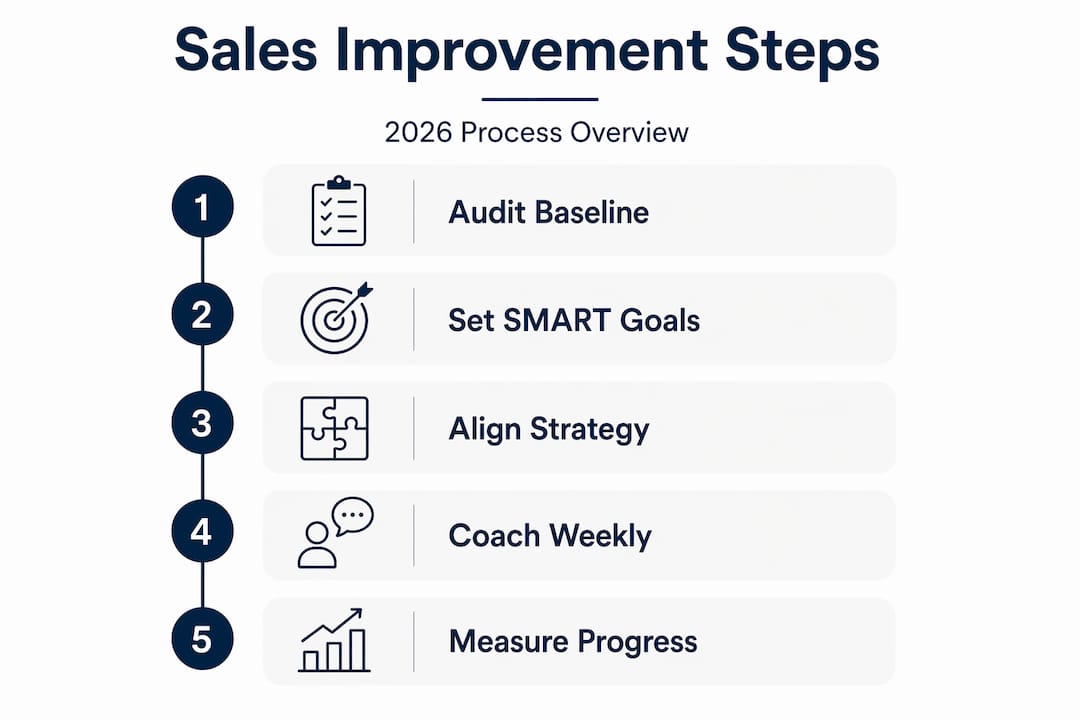
Sales performance measurement at this level of consistency improves quota attainment significantly. The discipline of measurement is not a nice-to-have. It is the mechanism that turns any sales strategy enhancement into durable results.
My honest take on what actually works
I have worked with enough sales teams to know that the biggest obstacle to improvement is rarely skill. It is distraction. Leaders adopt five new tools in a quarter, launch two initiatives at once, and wonder why nothing sticks.
In my experience, the organisations that improve fastest are the ones that pick two or three changes, implement them with discipline, and measure the outcome before moving on. Culture and coaching are the highest-leverage areas. They compound over time in a way that technology alone never does.
Technology is genuinely useful, but I see too many businesses treat AI adoption as the solution rather than the accelerator. If your coaching is infrequent and your data is unreliable, AI will not fix either problem. It will make both more visible.
What I have found is that the teams who hit target consistently are not the ones with the most sophisticated stack. They are the ones where managers show up every week, feedback is specific and acted on, and reps understand exactly what good looks like. If you get those things right first, the tools become genuinely powerful.
Commit to measuring. Run short experiments. Adjust based on what the data shows. The steps to increase sales are not secret. They just require consistency most organisations are not willing to sustain long enough to see the return.
— Jerry
How Aheadofsales can accelerate your results
If you are ready to put these steps into practice but want expert support to get there faster, Aheadofsales works with businesses of 50 to 1,000 staff to deliver at least 50% sales growth year on year. The combination of bespoke 1:1 coaching, hands-on training workshops, and strategic consultancy means every intervention is built around your team’s specific gaps, not a generic programme.
Whether you need sales training for your team to sharpen skills across the board, targeted sales consultancy to redesign your strategy and culture, or specialist support through SaaS-specific sales training, Aheadofsales has a package designed for where you are right now. Packages start from £4,500 and are built to deliver measurable returns every quarter.
FAQ
What are the most important sales performance improvement steps?
The most impactful steps are setting SMART goals aligned to company strategy, building a coaching culture with weekly feedback, using AI-assisted CRM tools to improve data quality, and measuring both leading and lagging indicators consistently.
How often should sales coaching sessions happen?
Weekly or fortnightly 1:1 coaching sessions, supported by monthly group skill sessions, produce the best results. Regular coaching lifts quota attainment by over 10 points compared to infrequent reviews.
Which KPIs matter most for sales performance analysis?
Pipeline coverage ratio, win rate by deal stage, sales cycle length, and customer acquisition cost are the four metrics that give you the clearest picture of where performance is strong and where it is breaking down.
How do I improve sales performance without adding headcount?
Focus on efficiency first. Automate administrative tasks through AI-assisted CRM tools, increase coaching frequency to accelerate skill development, and tighten your ICP to reduce time wasted on low-fit prospects. More activity from the same team, directed more precisely, produces significantly better results.
How long does it take to see results from a sales improvement plan?
A structured 30-60-90 day plan typically shows measurable changes in leading indicators, such as conversion rates and pipeline coverage, within the first 60 days. Revenue impact from broader changes in culture and coaching usually becomes clear within one to two quarters.