
TL;DR:
- A sales and marketing manager plays a vital role in uniting these functions to prevent billions in annual waste. They create shared goals, structures, and incentives, fostering alignment that significantly boosts revenue growth and profitability.
A sales & marketing manager is the leader responsible for uniting two functions that, when misaligned, cost businesses an estimated $1 trillion annually. That figure is not an abstraction. It shows up in wasted campaigns, poor lead quality, and sales teams that ignore marketing content entirely. The formally recognised industry title is “sales and marketing director” or “commercial manager” at senior levels, but the sales & marketing manager role is the operational engine beneath that. In mid-sized companies especially, this person sets the tone for whether revenue grows or stalls. This article covers what that role demands, what best practices look like, and how to build the kind of alignment that actually sticks.
What does a sales & marketing manager actually do?
The sales & marketing manager owns the connection between demand generation and revenue conversion. That sounds straightforward, but only 8% of companies report strong alignment between their sales and marketing teams. The gap is enormous, and it falls squarely on this role to close it.
A strong marketing manager job description for this position goes well beyond campaign oversight. It includes setting shared revenue targets, defining what a qualified lead looks like, and holding both teams accountable to the same pipeline outcomes. The digital marketing manager dimension of the role has grown significantly too, with CRM data, paid media performance, and content attribution all requiring active interpretation.
The role also demands sales team leadership skills that most pure marketers lack. You need to understand objection handling, deal velocity, and why a rep ignores a particular piece of content. Without that fluency, you cannot build marketing that actually supports the sales process.
How does a sales & marketing manager drive team alignment?
Misalignment between sales and marketing is primarily a structural problem, not a personality one. Friction stems from mismatched incentives rather than poor communication. Fix the structure, and the communication improves on its own.
The most effective structural fixes include:
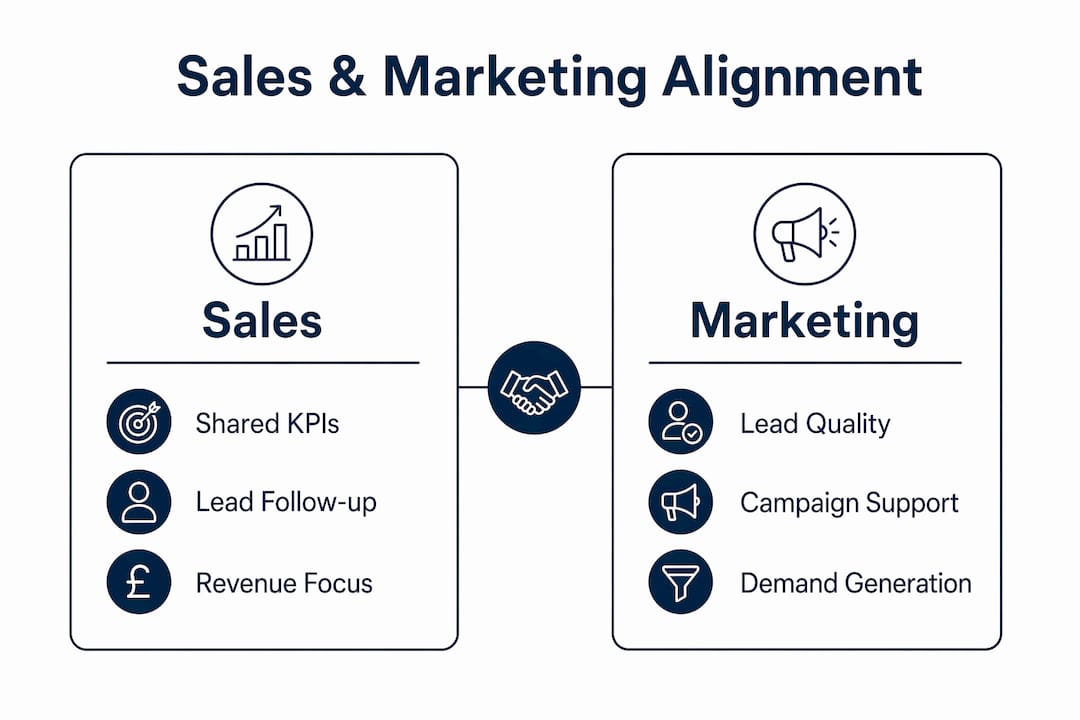
- Shared KPIs. 85% of business leaders identify shared KPIs as essential to operational alignment. Moving both teams onto a shared pipeline contribution target removes the incentive to blame each other.
- Sales and marketing SLAs. A Service Level Agreement defines what marketing commits to deliver (volume and quality of leads) and what sales commits to do with them (follow-up timelines, feedback on lead quality). Marketing SLAs with clear MQL definitions and feedback mechanisms drive accountability and improve lead-to-sale conversions.
- Joint incentive models. When marketing bonuses are tied to revenue closed, not just leads generated, behaviour changes fast. The same applies to sales reps who are rewarded for providing lead quality feedback to marketing.
- Regular joint reviews. A weekly or fortnightly pipeline review attended by both marketing and sales leadership surfaces problems before they compound.
Pro Tip: Avoid siloed metrics at all costs. If marketing reports on MQLs and sales reports on closed revenue with no shared number in between, accountability disappears. Build one shared dashboard that both teams review together.
90% of marketing and sales executives admit their functional priorities conflict. That statistic tells you alignment is the exception, not the norm. The sales & marketing manager who builds genuine alignment creates a real competitive advantage.
How to run marketing campaigns that sales teams actually use
60–70% of B2B content is never used by sales. That is an extraordinary waste, and it happens because marketing creates content without understanding what happens in actual sales conversations. The fix is straightforward: involve sales earlier and more often.
A practical approach to campaign planning looks like this:
- Start with sales objections. Before briefing any content, collect the top five objections your reps hear most often. Every campaign asset should address at least one of them directly.
- Involve sales as subject matter experts. Content created without sales input is often unused. Bringing reps into content planning sessions, even for 30 minutes, produces material that maps to real buyer concerns rather than assumed ones.
- Include marketing in sales meetings. Marketing leadership in sales pipeline meetings gives marketers direct insight into buyer objections and deal dynamics. This single habit improves campaign relevance more than most content audits.
- Close the feedback loop via CRM. Every lead that enters the pipeline should carry notes on what content influenced the buyer. Sales reps tagging lead quality and engagement history feeds directly into the next campaign cycle.
- Review campaign performance together. A joint marketing campaigns overview session, held monthly, keeps both teams honest about what is working and what needs to change.
Pro Tip: Sales reps are your best content researchers. Ask them to record a short voice note after each call describing the buyer’s biggest concern. Feed those notes directly into your content planning. The quality difference is immediate.
A well-structured sales team management workflow supports this kind of cross-functional rhythm. Without it, campaign planning reverts to guesswork and the content library fills with assets nobody uses.
How does technology unify sales and marketing functions?
Technology is the infrastructure that makes alignment visible and measurable. Without a unified tech stack, even well-intentioned teams operate on different data and reach different conclusions about the same pipeline.
The core components of an effective integrated stack are:
- Unified CRM. The CRM handoff failure point often arises from a lack of context-sharing. Closed-loop feedback from sales improves marketing targeting because reps can see what content a lead engaged with before the call, and marketing can see which leads converted and why.
- Marketing automation connected to CRM. When automation and CRM share data in real time, lead scoring reflects actual buyer behaviour rather than assumed intent.
- AI-powered predictive lead scoring. AI removes subjective bias from lead handoffs, increasing pipeline transparency. 83% of marketers report clear sales pipeline impact through AI analytics. That clarity reduces the “these leads are rubbish” argument that poisons most sales and marketing relationships.
- Shared dashboards. Both teams should see the same numbers in real time. Separate reporting systems create separate realities.
The role of technology in sales has expanded well beyond CRM. Conversation intelligence tools, intent data platforms, and attribution software all contribute to a clearer picture of what is driving revenue. The risk is fragmentation. A stack of disconnected tools creates more noise than insight.
| Technology component | Primary benefit | Common failure mode |
|---|---|---|
| Unified CRM | Shared lead context across teams | Incomplete data entry by reps |
| Marketing automation | Behaviour-based lead nurturing | Disconnected from CRM data |
| Predictive lead scoring | Removes bias from handoffs | Trained on poor historical data |
| Shared dashboards | Single source of truth | Not reviewed in joint sessions |

75% of highest-growth firms will adopt Revenue Operations (RevOps) models by 2025, yet only 39% report full maturity. The gap between adoption and maturity is where most mid-sized companies currently sit. Closing that gap requires deliberate governance, not just better software.
How to embed alignment as a permanent organisational capability
Most alignment initiatives fail because they are treated as projects rather than permanent structures. Only 15% of companies sustain alignment sufficient for profitable growth. The rest see initial progress followed by a slow drift back to silos.
The companies that sustain alignment do three things differently. First, they formalise cross-functional revenue teams where marketing and sales share a single P&L or pipeline target. Second, they build Account-Based Marketing (ABM) Centres of Excellence that embed shared processes into how campaigns are planned, not just how they are reviewed. Third, they tie compensation to shared outcomes at every level, from the sales & marketing manager down to individual contributors.
The business case for getting this right is clear. Companies with tightly aligned sales and marketing grow revenue 24% faster and profits 27% faster than misaligned peers. Highly aligned companies grow revenue 58% faster with 72% greater profitability. Those numbers represent the difference between a company that hits its targets and one that consistently falls short.
A useful way to think about the maturity journey is to contrast ad-hoc alignment with embedded alignment. Ad-hoc alignment depends on goodwill and individual relationships. Embedded alignment depends on structure, governance, and shared incentives. The former collapses when key people leave. The latter persists.
Developing a marketing strategy for organic growth becomes significantly more effective when the sales function is genuinely integrated into the planning process. The insights that sales teams carry about buyer behaviour are among the most underused assets in most mid-sized businesses.
Key takeaways
A sales & marketing manager who builds structural alignment, not just cultural goodwill, delivers measurably faster revenue growth and stronger profit margins than one who relies on goodwill alone.
| Point | Details |
|---|---|
| Alignment is structural | Fix incentives and shared KPIs before attempting cultural change. |
| SLAs create accountability | Define MQL standards, follow-up timelines, and feedback loops in writing. |
| Sales input improves content | Involve reps in campaign planning to reduce unused content and improve relevance. |
| Technology needs governance | A unified CRM and shared dashboards only work when both teams review them together. |
| Embed, do not just align | Cross-functional revenue teams and ABM Centres of Excellence sustain alignment across market cycles. |
What I have learned about alignment after years in the field
Here is the uncomfortable truth I have seen play out repeatedly: most sales and marketing alignment problems are not communication problems. They are incentive problems dressed up as communication problems. You can run as many joint workshops as you like, but if marketing is rewarded for lead volume and sales is rewarded for revenue closed, you will always have conflict. Always.
What actually moves the needle is changing what people are paid to do. When I work with mid-sized companies through Aheadofsales, the first thing I look at is the incentive structure. Not the CRM. Not the content library. The incentives. Once those are aligned, the communication and technology questions become much easier to solve.
The second thing I have noticed is that the sales & marketing manager role is often under-resourced in terms of authority. The person in the role knows what needs to change but cannot enforce it because they lack budget control over both functions or direct line management of both teams. If that describes your situation, the most important conversation you can have is with your leadership team about giving this role the authority it needs to actually function. Without that, you are asking someone to fix a structural problem with goodwill. It rarely works.
Start with one shared metric, one joint weekly review, and one piece of content built directly from sales objections. Those three actions, done consistently, produce more progress than a six-month alignment programme that nobody follows through on.
— Jerry
How Aheadofsales supports sales and marketing managers
If you recognise the alignment gaps described in this article, you are not alone. Most mid-sized companies are somewhere between ad-hoc coordination and genuine integration, and the distance between those two states is where revenue is lost.

Aheadofsales works with businesses of 50–1,000 staff to build the kind of structural alignment that produces consistent quarterly results. Through bespoke 1:1 coaching, sales training programmes, and hands-on consultancy, we help sales and marketing managers build the systems, incentives, and team habits that drive at least 50% sales growth year on year. Our sales consultancy services are designed for companies with a genuine growth mindset. Packages start from £4,500. Get in touch to discuss a plan built around your specific situation.
FAQ
What is the main role of a sales & marketing manager?
A sales & marketing manager is responsible for aligning sales and marketing teams around shared revenue goals, ensuring that lead generation, campaign execution, and sales conversion work as a single integrated process rather than separate functions.
Why do sales and marketing teams so often conflict?
Conflict stems primarily from mismatched incentives. When marketing is measured on lead volume and sales is measured on revenue closed, both teams optimise for different outcomes, which creates friction at the handoff point.
What are the best sales strategies for improving marketing alignment?
The most effective approach combines shared KPIs, formal SLAs defining lead quality and follow-up timelines, and joint pipeline reviews where both teams review the same data and agree on priorities together.
How does a digital marketing manager differ from a sales & marketing manager?
A digital marketing manager focuses on online channels, campaign performance, and digital audience growth. A sales & marketing manager holds broader accountability for revenue outcomes, including sales team performance, pipeline health, and cross-functional alignment.
What sales performance metrics should both teams share?
Both teams should track pipeline contribution, lead-to-opportunity conversion rate, content usage by sales reps, and revenue closed from marketing-sourced leads. These metrics create a shared language and remove the blame dynamic from pipeline reviews.