
TL;DR:
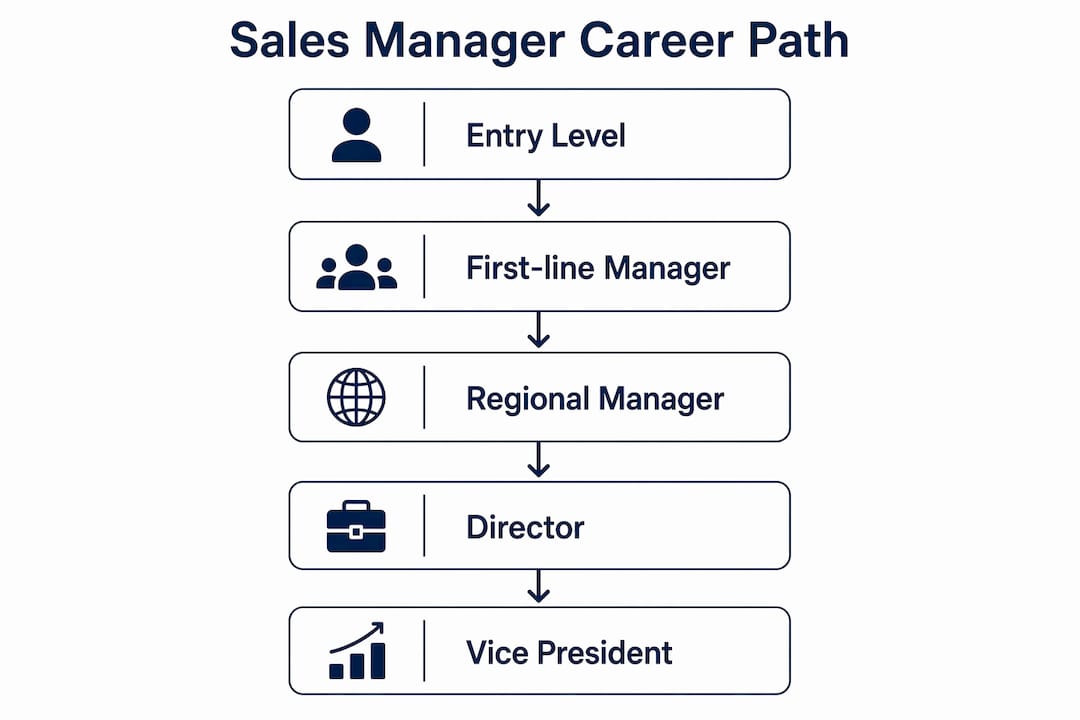
- A sales manager directs a team of sales representatives to meet revenue targets by coaching, pipeline management, and hiring. Success depends on prioritizing coaching, data-driven leadership, and pipeline quality, not closing deals. The typical career path progresses from first-line manager to VP of sales, with increasing scope and compensation.
A sales manager position is defined as a leadership role responsible for directing a team of sales representatives to meet or exceed revenue targets through coaching, pipeline management, hiring, and performance oversight. This is not a senior sales rep role with a fancier title. The job exists because translating strategy into daily execution at the rep level requires dedicated management that senior directors simply cannot provide at scale. A typical first-line sales manager oversees five to eight quota-carrying reps, balances seven recurring responsibilities each week, and carries on-target earnings that reflect the commercial weight of the role. If you are considering this career move, understanding what the job actually demands will save you from the most common mistakes people make when stepping into management for the first time.
What are the primary responsibilities of a sales manager position?
The sales manager role is built around seven recurring jobs, and the way you split your time between them determines whether your team hits target or misses it. A first-line manager’s week typically breaks down like this:
- 1-on-1 coaching (25%): Weekly sessions with each rep to review performance, develop skills, and address blockers.
- Pipeline and deal reviews (20%): Examining active opportunities to assess quality, identify risks, and guide rep strategy.
- Hiring (15%): Sourcing, interviewing, and selecting new talent to fill gaps and raise team capability.
- Forecasting (15%): Building accurate revenue projections for leadership based on pipeline data.
- Cross-functional collaboration (10%): Working with marketing, product, and finance to align on campaigns, pricing, and go-to-market plans.
- Ad-hoc management (15%): Handling escalations, performance issues, and unexpected operational demands.
The most important thing to understand about this breakdown is what is not on the list. You are not closing deals. A single account executive may be managing 15 to 40 active deals simultaneously. Your job is to make sure your reps close those deals, not to step in and do it for them.
Forecast accuracy and pipeline hygiene sit at the heart of the operational side of the role. A pipeline full of stale, poorly qualified opportunities will produce an inaccurate forecast every time. Reviewing pipeline quality weekly, not just quantity, is what separates managers who predict revenue reliably from those who are constantly surprised at month end.

Pro Tip: Block your coaching time in your calendar at the start of each week and treat it as non-negotiable. The moment ad-hoc tasks start eating into coaching slots, your team’s development stalls and performance follows.
What qualifications are required for a sales manager role?
Entry-level sales management roles typically require three to five years of proven sales experience. Senior or specialised positions, particularly in B2B markets, often require seven to ten or more years, including three to five years specifically in senior sales management. That distinction matters. Hiring managers are not just looking for someone who has sold well. They want evidence that you have led others to sell well.
The core qualifications and skills employers look for include:
- Coaching ability: Can you develop reps who are struggling and accelerate those who are already performing?
- Data-driven leadership: Do you use leading indicators like pipeline coverage and conversion rates to manage performance, or do you rely on gut feel?
- Pipeline management: Can you assess deal quality accurately and coach reps on how to move opportunities forward?
- Hiring and talent assessment: Have you built a team before, or contributed meaningfully to recruitment?
- Forecasting: Can you produce a reliable revenue projection and explain the assumptions behind it?
- Cross-functional communication: Can you represent your team’s needs clearly to marketing, finance, and senior leadership?
Travel requirements vary considerably by role type. Field-based sales management positions typically involve travel of around 10–20% of working time, while fully remote roles may require little to none. If you are targeting a specific sector, check whether the role is structured around territory management or account-based selling, as this shapes the travel expectation significantly.
A degree is listed as preferred in many sales manager job descriptions, but it is rarely a hard requirement. Demonstrated performance data, a track record of developing others, and strong references from previous managers carry more weight than academic credentials in most hiring processes.
How do effective sales managers lead teams to outperform targets?
The best sales managers share one defining characteristic: they shift their identity from top seller to team developer the moment they step into the role. Managers who fail to make this shift create a dependency problem. Reps stop developing because the manager keeps jumping in to save deals. The team’s ceiling becomes the manager’s personal capacity, which is a very low ceiling.
Here is what the best practices for sales managers actually look like in practice:
-
Prioritise coaching over closing. Managers who spend 50% or more of their time coaching consistently produce stronger team results than those focused on administrative tasks. Coaching is the highest-leverage activity available to you.
-
Hire with rigour. A team of eight strong reps can outperform a team of eight average reps by two to three times. Hiring well reduces the time you spend on performance management and raises the floor of your entire team.
-
Manage with leading indicators. Metrics like pipeline coverage ratio, stage-by-stage conversion rates, average deal size, and sales cycle length tell you where performance is heading before it shows up in the numbers. Waiting for lagging indicators like closed revenue means you are always reacting too late.
-
Build a consistent culture. High-performance sales cultures are built through consistent leadership behaviours, not motivational speeches. Weekly 1-on-1s, fair and transparent performance conversations, and clear expectations repeated consistently create the environment where reps thrive.
-
Protect your team from noise. Sales teams are constantly pulled by internal requests, process changes, and cross-functional demands. Your job includes absorbing that noise so your reps can focus on selling.
Tracking the right sales performance metrics is not optional. It is the mechanism through which you catch problems early, coach with specificity, and forecast with confidence. Managers who rely on anecdote rather than data tend to coach the same reps repeatedly while missing the ones who are quietly underperforming.
Pro Tip: Use a simple weekly dashboard covering pipeline coverage, deals progressed, and conversion by stage for each rep. It takes 20 minutes to review and gives you a precise coaching agenda for the week.
What is the typical compensation and career path for sales managers?
Compensation for first-line sales managers reflects the commercial responsibility of the role. On-target earnings typically range between $200,000 and $280,000 in 2026, with a base-to-variable split of 50/50 to 60/40. In UK terms, first-line sales manager OTE commonly sits between £80,000 and £140,000 depending on sector, company size, and team quota. The variable element is usually tied to team quota attainment, not individual deal closing.
Career progression in sales management follows a clear path, though the pace depends on company size and performance:
| Level | Typical scope | Compensation range (OTE) |
|---|---|---|
| Sales manager (first-line) | 5–8 reps, single territory or segment | £80,000–£140,000 |
| Senior sales manager | 8–15 reps or multiple segments | £120,000–£180,000 |
| Sales director | Multiple teams, manages managers | £150,000–£250,000+ |
| VP of sales | Full revenue function, board-level reporting | £200,000–£400,000+ |
Each step up increases span of control and shifts focus further from day-to-day rep management toward organisational design, hiring strategy, and revenue planning. The skills that make a great first-line manager, specifically coaching, pipeline rigour, and hiring quality, remain relevant at every level. They just get applied at greater scale.
Executive coaching becomes increasingly valuable as you move into director and VP roles, where decisions carry larger commercial consequences and the feedback loops are slower. Investing in your own development at the manager level sets you up for faster progression later.
Key takeaways
A sales manager position succeeds or fails on the quality of coaching, hiring, and data-driven pipeline management the manager applies consistently every week.
| Point | Details |
|---|---|
| Role definition | A sales manager leads five to eight reps to hit revenue targets through coaching, pipeline reviews, and forecasting. |
| Time allocation | Coaching (25%) and pipeline reviews (20%) are the highest-priority weekly activities for first-line managers. |
| Qualifications | Most roles require three to five years of sales experience; senior roles require seven to ten or more years including management experience. |
| Leadership best practice | Managers who spend 50% or more of their time coaching produce consistently stronger team results. |
| Career progression | The path runs from first-line manager to senior manager, director, and VP, with OTE rising at each stage. |
What I have learned about succeeding in sales management
The single biggest mistake I see aspiring sales managers make is treating the role as a promotion for being a great salesperson. It is not. The skills that made you a top rep, personal drive, deal instinct, and closing ability, are largely irrelevant once you are managing a team. What matters now is whether you can develop those qualities in others.
Hiring is where I would focus your energy first. Recruiting top talent multiplies your team’s productivity faster than any amount of coaching can. One strong hire can change the dynamic of an entire team. One weak hire can consume 30% of your management bandwidth for months.
The other thing I would warn you about is micromanagement disguised as support. Jumping into deals to “help” your reps feels productive. It is not. It signals to your team that you do not trust them, and it stops them from developing the skills they need to close independently. Your job is to coach before the deal, not rescue during it.
Protect your coaching time as if it were a client meeting. The weeks where admin and escalations eat your schedule are the weeks your team drifts. Discipline here is not optional. It is the difference between a team that grows and one that flatlines.
— Jerry
How Aheadofsales supports your sales management career
Stepping into a sales manager role without structured support is one of the most common reasons talented people plateau early in their management careers. Aheadofsales works with sales managers and their teams through bespoke 1:1 coaching, practical leadership development, and pipeline management training built around the real demands of the role.

Whether you are preparing for your first management role or looking to sharpen the skills that drive consistent quarterly performance, the sales training programmes at Aheadofsales are designed to close the gap between where you are and where your team needs you to be. Businesses with 50 to 1,000 staff working with Aheadofsales target at least 50% sales growth per year, with teams hitting target every quarter. If that is the standard you want to hold yourself to, it is worth a conversation.
FAQ
What does a sales manager do day to day?
A sales manager spends the majority of their week on 1-on-1 coaching, pipeline reviews, forecasting, and hiring. The role focuses on developing rep performance rather than closing deals personally.
How do I become a sales manager?
Most sales manager roles require three to five years of proven sales experience, along with demonstrated coaching ability and pipeline management skills. Building a track record of developing junior colleagues strengthens your candidacy significantly.
What are the most important skills for a sales manager?
Coaching, data-driven performance management, hiring, and accurate forecasting are the four skills that most directly determine a sales manager’s success. Relying on intuition rather than leading indicators is the most common performance gap.
What is a typical sales manager salary in the UK?
First-line sales manager on-target earnings in the UK commonly range between £80,000 and £140,000, with a base-to-variable split of roughly 50/50 to 60/40 depending on sector and company size.
What is the career path after sales manager?
The typical progression runs from first-line sales manager to senior sales manager, then sales director, and ultimately VP of sales, with each level carrying a broader team scope and higher on-target earnings.