
TL;DR:
- A sales manager oversees team revenue, hiring, coaching, forecasting, and pipeline management to meet targets.
- Effective managers focus on coaching, data-driven decisions, and team development rather than personal deal closing.
A sales manager is defined as the leader accountable for a team’s revenue performance, responsible for hiring, coaching, forecasting, and pipeline oversight to hit quarterly targets. The role sits between strategic direction and rep-level execution, making it one of the most consequential hires any growth-minded business makes. A weak sales manager job description attracts the wrong candidates and sets the wrong expectations from day one. This guide gives you the precise language, structure, and benchmarks to write a role specification that attracts candidates who can genuinely lead a team to consistent, measurable growth.
What are the essential duties in a sales manager job description?
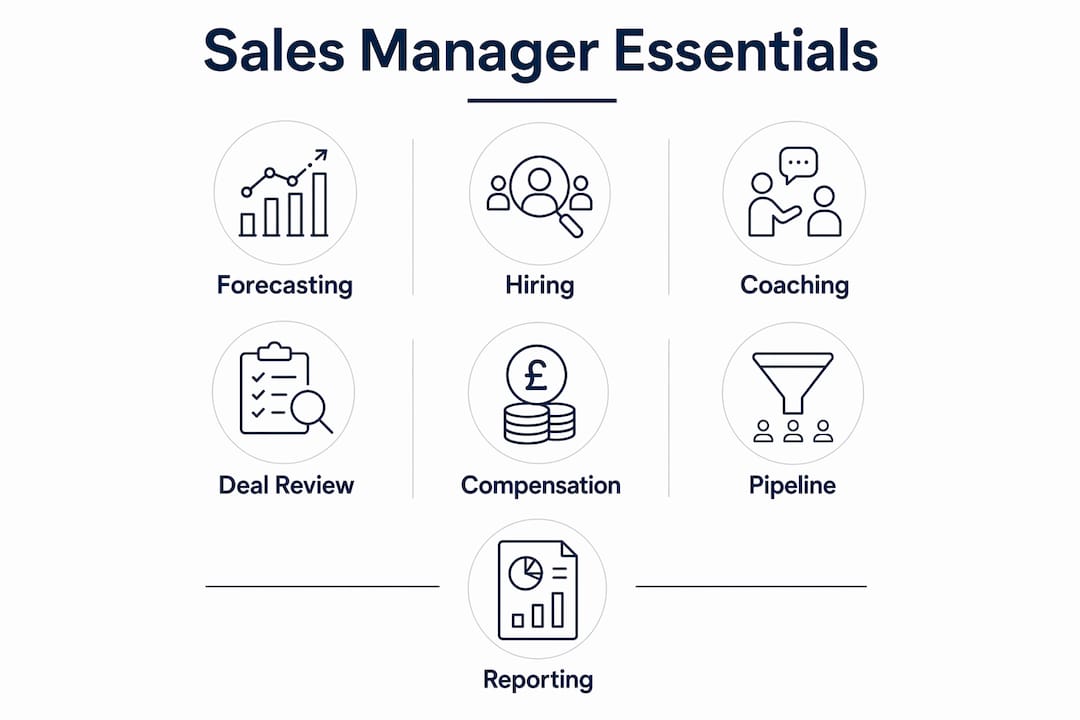
A standard first-line sales manager oversees a team of 5–8 quota-carrying representatives and executes seven core recurring tasks. Those tasks are: revenue forecasting, hiring, weekly one-on-one coaching, deal reviews, compensation plan execution, pipeline reviews, and team morale management. Each one is a discipline in its own right, not a checkbox.

Forecasting sits at the top of the list for good reason. Forecast accuracy within 5% is the credibility metric that earns a sales manager trust and autonomy from senior leadership. A three-touch weekly forecasting routine, where the manager reviews rep-level data, adjusts for risk, and commits a number upward, is the standard cadence that separates credible managers from guessers.
One-on-one coaching is the highest-impact weekly activity a manager performs. It catches deal risks early, surfaces rep skill gaps before they cost revenue, and builds the trust needed to have difficult performance conversations. Sales managers allocate around 25% of their working week to one-on-ones, with a further 15% each dedicated to hiring and forecast preparation. That time allocation tells you exactly where the role’s value is created.
Cross-functional collaboration is the underrated part of the job. Sales managers spend 10–15% of their time working with marketing, product, operations, and customer success to align commercial efforts. Your job description should name this explicitly, because candidates who resist collaboration rarely succeed in the role long-term.
- Revenue forecasting and weekly pipeline reviews
- Structured one-on-one coaching for every direct report
- Hiring and onboarding quota-carrying representatives
- Deal reviews to identify risk and accelerate close
- Compensation plan management and attainment tracking
- Cross-functional collaboration with marketing and product
- Team morale management and performance culture
Pro Tip: Include the forecasting cadence directly in your job description. Candidates who have never owned a forecast number will self-select out, saving you weeks of interviewing.
Which skills make a sales manager genuinely effective?
Effective sales leadership is built on clear expectations, rigorous data management, and continuous coaching rather than individual deal-closing. The most common hiring mistake is promoting the top-performing sales rep and assuming the skills transfer. They rarely do. The skills that make a brilliant individual contributor are almost entirely different from those that make a brilliant manager.
The critical capabilities to screen for are:
- Coaching ability. The manager must diagnose a rep’s specific skill gap and prescribe a targeted fix, not just demonstrate how they would close the deal themselves.
- Data-driven decision making. Reading a pipeline report, identifying where deals stall, and adjusting rep behaviour accordingly is a daily requirement.
- Recruiting instinct. Knowing what a high-performing rep looks like before they have a track record is a rare and valuable skill.
- Motivation and conflict resolution. Managing a team of competitive individuals requires patience, fairness, and the ability to address underperformance without destroying morale.
- Cross-department communication. Sales managers present to senior leadership, negotiate with marketing on lead quality, and align with product on customer feedback. Presentation skills matter.
Pro Tip: During interviews, ask candidates to describe a time they improved a rep’s performance without closing the deal for them. The answer reveals whether they coach or rescue.
The most effective managers prioritise developing team capabilities over personal selling, using data-driven coaching to build trust and accountability. That shift from “I sell” to “I build sellers” is the defining transition the role demands. If your job description still lists “proven ability to close deals” as a top requirement, you are writing a description for a senior rep, not a manager.
How to structure sales manager compensation and reporting lines in 2026
Compensation is where many job descriptions lose strong candidates before the first interview. Median on-target earnings for a first-line sales manager in tech-adjacent roles range between $200,000 and $280,000, typically structured on a 50/50 to 60/40 base-to-variable split. The variable component ties directly to team quota attainment, not the manager’s personal sales.
The reporting structure follows a clear hierarchy. First-line managers report to sales directors or VPs who oversee larger revenue segments or multiple teams. The span of control at the first-line level is 5–8 direct reports. Beyond that number, coaching quality drops and forecast accuracy suffers.
| Role | Typical span of control | Reports to | Variable basis |
|---|---|---|---|
| Sales manager | 5–8 reps | Sales director or VP | Team quota attainment |
| Sales director | 3–5 managers | VP of Sales | Divisional revenue target |
| VP of Sales | 2–4 directors | CRO or CEO | Total revenue target |
The distinction between a sales manager and a sales director matters enormously in a job description. A manager is in the detail: running one-on-ones, reviewing individual deals, managing daily pipeline hygiene. A director is in the pattern: identifying structural problems across teams, setting hiring strategy, and owning a larger revenue number. Conflating the two in a single job description produces a role that nobody can do well.
What hiring and team development practices maximise sales team performance?
Hiring is the single highest-impact activity a sales manager performs. Recruiting high-performing reps produces a team that outperforms average teams by a factor of 2–3x. That multiplier is set at the recruitment stage, not the coaching stage. A manager who hires brilliantly and coaches adequately will consistently outperform a manager who hires poorly and coaches brilliantly.
Structured interviews with clear role expectations improve hiring efficiency and candidate fit. Using digital recruitment tools to widen the candidate pool and screen for specific competencies reduces time-to-hire and improves the quality of shortlists. The job description itself is part of the recruitment process. A vague description attracts generalists. A specific one attracts specialists.
The best practices for building a high-performing team are:
- Define the ideal rep profile before opening a role, including the specific skills, behaviours, and track record you need.
- Use structured interview scorecards so every candidate is assessed against the same criteria.
- Build a 90-day onboarding plan that sets clear ramp targets and assigns a peer mentor.
- Conduct monthly performance reviews that separate coaching conversations from compensation conversations.
- Address underperformance within 30 days of identifying it. Delayed action damages the morale of your top performers.
Pro Tip: The sales coaching examples that produce the fastest rep development combine skill-specific feedback with recorded call reviews. Build this into your onboarding process from week one.
A culture of continuous learning is not a nice-to-have. It is the mechanism by which a sales manager compounds team performance over time. Managers who invest in weekly skill development sessions, share win and loss analysis openly, and celebrate learning as much as closing create teams that improve quarter on quarter.
Key takeaways
A well-written sales manager job description defines a leadership role built on coaching, hiring, and forecasting, not personal selling, and that distinction determines whether you attract the right candidate.
| Point | Details |
|---|---|
| Seven core duties | Forecasting, hiring, coaching, deal reviews, compensation, pipeline, and morale are the recurring tasks to list. |
| Coaching over closing | The role demands team development skills, not individual sales ability. Screen for coaching instinct explicitly. |
| Compensation benchmarks | First-line managers in tech-adjacent roles target $200,000–$280,000 OTE on a 50/50 to 60/40 split. |
| Hiring is the multiplier | Recruiting high performers produces 2–3x team output. Prioritise hiring criteria in your job description. |
| Span of control | Five to eight direct reports is the effective range. Beyond that, coaching quality and forecast accuracy decline. |
What I have learned writing sales manager job descriptions that actually work
Writing a sales manager role specification is harder than it looks. The most common mistake I see from employers is writing a description that describes the person they wish they had, rather than the role they actually need to fill. Aspirational language like “visionary leader” and “entrepreneurial mindset” signals that the hiring manager has not thought clearly about what the job actually requires day to day.
The second pitfall is listing personal sales performance as a primary qualification. New managers who continue closing deals personally rather than coaching their teams fall into what experienced practitioners call the “hero” trap. They rescue deals instead of developing the rep who should be closing them. Your job description should explicitly state that the role is measured on team attainment, not personal quota.
The third issue is vague accountability. A job description that says “responsible for sales performance” without specifying forecast ownership, pipeline review cadence, or hiring targets gives a candidate no way to assess whether they are qualified. It also gives you no way to manage the person once they are in the role. Specificity in the description creates specificity in the accountability framework. That is what separates a job description that attracts a manager from one that attracts a rep with ambitions.
My strong advice: write the 90-day success metrics before you write the job description. If you know what the manager needs to achieve in their first quarter, the duties, skills, and qualifications write themselves.
— Jerry
How Aheadofsales helps employers build sales management that delivers
If you are hiring a sales manager, you are also committing to giving them the tools and frameworks to succeed. A strong job description gets the right person through the door. What happens next determines whether they hit target.

Aheadofsales works with businesses of 50–1,000 staff to build sales training programmes that give sales managers the coaching frameworks, pipeline disciplines, and hiring instincts they need to drive consistent quarterly growth. Our bespoke 1:1 coaching model is designed to embed directly into your management structure, not sit alongside it. If you want your next sales manager to lead a team that hits target every quarter, the sales consultancy services at Aheadofsales give you the structure to make that happen.
FAQ
What should a sales manager job description always include?
A sales manager job description must include the seven core duties: forecasting, hiring, one-on-one coaching, deal reviews, compensation management, pipeline reviews, and morale management. It should also specify the span of control, reporting line, and how variable compensation is calculated.
How many direct reports should a sales manager have?
The effective span of control for a first-line sales manager is 5–8 quota-carrying representatives. Beyond eight direct reports, coaching quality and forecast accuracy both decline significantly.
What qualifications should you require for a sales manager role?
Require a demonstrable track record of coaching reps to quota attainment, experience owning a revenue forecast, and structured hiring experience. Avoid listing personal sales performance as the primary qualification, as it selects for the wrong skill set.
How is a sales manager different from a sales director?
A sales manager runs the daily detail: one-on-ones, individual deal reviews, and pipeline hygiene for a team of 5–8 reps. A sales director manages multiple managers, owns a larger revenue segment, and sets hiring and structural strategy across teams.
What is the typical on-target earnings for a sales manager in 2026?
First-line sales managers in tech-adjacent roles typically earn between $200,000 and $280,000 in on-target earnings, structured on a 50/50 to 60/40 base-to-variable split tied to team quota attainment.