
TL;DR:
- A sales development plan links your ICP, sales motions, pipeline math, and qualification criteria to generate predictable revenue.
- Building and operationalizing the plan with clear milestones and CRM discipline ensures consistent execution and growth.
A sales development plan is a structured framework that connects your Ideal Customer Profile (ICP), sales motions, pipeline mathematics, and qualification criteria to produce predictable revenue growth. Without one, your team is essentially guessing. B2B win rates have declined to around 19%, and 76% of sellers missed quota in the first half of 2025. Those numbers tell you that effort alone does not produce results. A plan built on data does. This article breaks down every component you need, the benchmarks that should shape your decisions, and the practical steps to make it work quarter after quarter.
What are the essential components of a sales development plan?
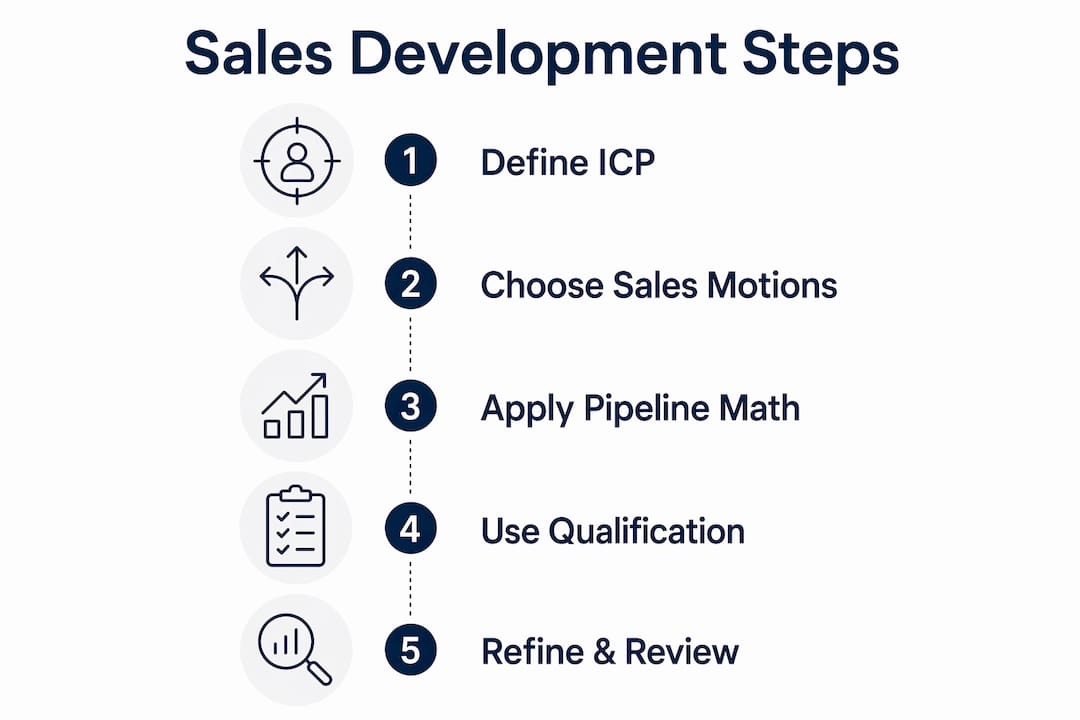
A sales development plan has four core components: your ICP, your sales motions, your pipeline mathematics, and your qualification framework. Each one informs the next. Get one wrong and the whole structure weakens.
Ideal customer profile
Your ICP is the precise definition of the company most likely to buy from you, stay with you, and grow with you. It goes beyond industry and headcount. A strong ICP specifies firmographic data (sector, revenue band, geography), technographic signals (what tools they already use), and behavioural triggers (hiring patterns, funding rounds, product launches). Without a tightly defined ICP, your team wastes time on prospects that will never convert. The ICP is the filter every other decision passes through.
Sales motions
Your sales motion describes how you sell: inbound, outbound, product-led, or a hybrid. The right motion depends on your average contract value (ACV), deal complexity, and team size. A £500 ACV product suits a high-velocity, low-touch motion with automated sequences. A £50,000 ACV enterprise deal demands a consultative, multi-stakeholder motion with longer cycles. Choosing the wrong motion for your ACV is one of the most common and costly mistakes in effective sales planning.

Pipeline mathematics
Pipeline math works backwards from your revenue target to define exactly how many opportunities, meetings, and outreach activities your team needs each month. For example: a £3,000,000 revenue target with a £30,000 ACV means you need 100 closed deals. If your close rate is 25%, you need 400 qualified opportunities. That number drives your meeting targets, your outreach volume, and ultimately your headcount decisions. Pipeline mathematics is the quantitative backbone of the entire plan.
Qualification frameworks
Qualification frameworks like BANT, MEDDPICC, and Challenger each suit different deal types. BANT (Budget, Authority, Need, Timeline) works well for SMB deals with short cycles. MEDDPICC suits complex enterprise deals where economic buyers, decision criteria, and competition all need mapping. Challenger works in commoditised markets where you need to reframe the buyer’s thinking. Choosing the wrong framework creates friction and slows velocity.
| Component | Function | Best applied when |
|---|---|---|
| Ideal Customer Profile | Defines who to target | Before any outreach begins |
| Sales motion | Defines how to sell | Based on ACV and deal complexity |
| Pipeline mathematics | Quantifies activity required | Setting quarterly targets |
| Qualification framework | Filters and advances deals | Throughout the sales cycle |
How do current benchmarks influence your plan design?
The 2025–2026 data reshapes how you should structure your outreach and engagement tactics. Ignoring these benchmarks means building a plan on assumptions that the market has already disproved.
The 19% win rate and 76% quota miss figures are not outliers. They reflect a structural shift toward buyers who are better informed, more risk-averse, and slower to commit. Your plan must account for longer cycles and more decision-makers per account.
Multi-threading is the single highest-leverage tactic the data supports right now. Engaging three or more stakeholders per account increases win rates by up to 30%. That means your plan needs to include deliberate strategies for mapping buying committees and building relationships across multiple contacts, not just the initial champion.
Outreach cadence design also matters more than most teams realise. 42% of all prospect replies come from follow-up touches rather than the first message. The recommended cadence is at least 10 touches over three weeks, spread across email, phone, LinkedIn, and video. That means your first email is rarely the one that gets the meeting. Persistence, structured into a repeatable cadence, is what drives replies.
Here is how to apply these benchmarks in your plan:
- Map every target account to identify three or more potential stakeholders before outreach begins.
- Build a 10-touch, three-week cadence into your CRM as a default sequence.
- Track reply rates by touch number to identify where your cadence loses momentum.
- Review win rates by deal type monthly to spot where multi-threading is underused.
Pro Tip: Set a minimum of three stakeholder contacts per account as a qualification criterion. If your team cannot identify three contacts, the account is not ready to work.
How do you operationalise a sales development plan?
Building the plan on paper is the easy part. Operationalising it so that every rep follows the same process, every week, is where most teams fall short. The key is a phased build with clear milestones.
The phased build
Follow this sequence to avoid building on unstable foundations:
- Define your ICP using existing customer data. Identify your top 20% of accounts by revenue and retention, then extract the common firmographic and behavioural patterns.
- Select your sales motion based on your ACV and team capacity. Do not try to run inbound and outbound simultaneously until you have proven one works.
- Run your pipeline mathematics to set monthly activity targets for each rep. These numbers become your weekly management dashboard.
- Choose and implement your qualification framework. Train every rep on the chosen method before the quarter begins, not during it.
- Set a quarterly review cadence. Review conversion rates at each pipeline stage and adjust activity targets accordingly.
CRM optimisation and process discipline are what sustain this over time. A plan that lives in a spreadsheet dies within six weeks. Your CRM must reflect every stage of the process, with mandatory fields that enforce qualification rigour at each step.
Pipeline mathematics also tells you when to hire. If your pipeline math shows each rep can generate 40 qualified opportunities per quarter and you need 400, you need ten reps. That is a workforce planning tool, not just a sales tool. Understanding this connection between pipeline stage management and headcount decisions separates reactive teams from planned ones.
Pro Tip: Run your pipeline mathematics before you set any rep targets. Targets set without pipeline math are guesses dressed up as goals.
Quarterly reviews should focus on three conversion rates: lead to meeting, meeting to opportunity, and opportunity to close. If any rate drops by more than five percentage points quarter on quarter, investigate the cause before adjusting activity volume. Increasing outreach volume to compensate for a qualification problem only wastes more time.
What are advanced strategies and common pitfalls to avoid?
Once the foundations are in place, there are higher-leverage tactics that separate good plans from great ones. There are also predictable mistakes that undermine even well-designed frameworks.
Advanced strategies worth building in
Signal-based outreach is the most significant shift in B2B prospecting right now. Signal-personalised outreach triggered by specific buying signals achieves reply rates of 15–25%, compared to the industry average of 3–5%. Buying signals include job postings in relevant departments, technology stack changes, leadership appointments, and funding announcements. Building a signal-monitoring process into your plan means your team reaches out at the moment of highest relevance, not at random.
Account-based marketing (ABM) works best when your ICP is tightly defined and your ACV justifies the investment. ABM aligns marketing and sales around a named list of target accounts, with coordinated outreach across multiple channels and stakeholders. It is not a tactic for every business, but for teams selling £20,000 and above ACV deals, it produces measurable pipeline improvement.
Multi-threaded selling extends naturally from multi-threading at the prospecting stage into the full sales cycle. Once you have multiple contacts in an account, map their roles in the decision process and tailor your messaging to each one’s priorities.
Common pitfalls that derail plans
- Overextension: Launching more than two or three strategies simultaneously destroys focus and makes measurement impossible. Pick two, prove them, then add a third.
- ICP paralysis: Spending weeks perfecting your ICP before testing it in the market is a mistake. Define it, test it with 50 outreach attempts, then refine based on real response data.
- Vanity metrics: Measuring email open rates and call volume tells you about activity, not performance. Measure cost per pipeline opportunity, conversion rate by stage, and deal velocity instead.
- Marketing misalignment: A sales development framework that operates independently of marketing produces duplicated effort and inconsistent messaging. Align on ICP, messaging, and content before the quarter begins.
Key takeaways
A sales development plan built on pipeline mathematics, a precise ICP, and the right qualification framework is the most reliable path to consistent quota attainment.
| Point | Details |
|---|---|
| ICP precision drives results | Define your ICP from real customer data before any outreach begins. |
| Pipeline math sets activity targets | Work backwards from revenue goals to set weekly rep-level activity numbers. |
| Multi-threading lifts win rates | Engaging three or more stakeholders per account increases win rates by up to 30%. |
| Cadence persistence wins replies | 42% of replies come from follow-ups, so build a 10-touch, three-week sequence. |
| Limit simultaneous strategies | Run no more than two or three strategies at once to maintain focus and measurable results. |
What I have learned from building sales development plans that actually stick
The biggest mistake I see, again and again, is teams that treat a sales development plan as a document rather than an operating system. They spend a week building it, present it in a kickoff meeting, and then watch it gather dust while reps revert to whatever they were doing before.
The plans that work are the ones where the pipeline mathematics are visible every single week. Not in a quarterly review deck. On the team’s daily dashboard. When every rep knows exactly how many meetings they need this week to hit their monthly number, the plan becomes real. It stops being a strategy and starts being a job description.
I have also seen teams scale too fast on the back of a plan that has not been tested. Pipeline math tells you how many reps you need, but only if your conversion assumptions are accurate. My advice is always to validate your conversion rates with a small cohort first. Run the plan with two or three reps for a full quarter, measure every conversion point, then scale. Scaling a broken conversion rate just multiplies the problem.
The other thing worth saying plainly: the qualification framework matters more than most leaders think. I have worked with teams using BANT on enterprise deals and wondering why their pipeline is full of deals that never close. MEDDPICC feels like more work upfront, but it removes deals that were never going to close anyway. That is not lost time. That is time saved.
The best plans I have seen combine a tight ICP, honest pipeline mathematics, and a qualification framework that the whole team actually uses. Everything else, including the technology, the cadences, and the ABM tactics, is built on top of that foundation. Get the foundation right first.
— Jerry
How Aheadofsales supports your sales development plan
Building a sales development plan is one thing. Executing it consistently, quarter after quarter, is another challenge entirely. Aheadofsales works with businesses of 50 to 1,000 staff to design and implement plans that produce at least 50% sales growth per year, with every rep hitting target every quarter.
Whether your team needs structured sales training to embed the right qualification frameworks, or your business needs a full consultancy engagement to build the pipeline mathematics from scratch, Aheadofsales has a package to fit. Solo operators and small service businesses can access sales acceleration programmes starting from £2,995. Team packages start from £4,500. Every engagement is built around your specific ICP, ACV, and growth targets, not a generic off-the-shelf programme.
FAQ
What is a sales development plan?
A sales development plan is a structured framework that defines your ICP, sales motions, pipeline mathematics, and qualification criteria to produce predictable revenue growth. It connects strategy to daily rep activity through measurable targets.
How do I start building a sales development plan?
Start by defining your ICP from your best existing customers, then run pipeline mathematics to set monthly activity targets before selecting a qualification framework suited to your deal complexity.
Which qualification framework suits B2B sales best?
BANT suits SMB deals with short cycles, MEDDPICC suits complex enterprise deals, and Challenger works in commoditised markets. The right choice depends on your ACV and deal complexity.
How many outreach touches does a prospect need before replying?
42% of replies come from follow-up touches rather than the first message. A minimum of 10 touches over three weeks, across multiple channels, is the recommended cadence.
How does pipeline mathematics help with team sizing?
Pipeline math works backwards from your revenue target to calculate the number of opportunities, meetings, and outreach activities required. Dividing that total by what one rep can realistically produce gives you your headcount requirement.