
The fastest way to build a sales culture that holds is a training programme pairing cohort-based learning with manager coaching and spaced reinforcement, not a single away-day. Cohort training strengthens transfer through peer support, research on coworker participation shows, while Forrester finds coach-like managers are the strongest lever for team performance. Some providers build this combination for teams ready to commission it properly.
TL;DR:
- A successful sales culture training program combines cohort-based learning, manager coaching, spaced practice, senior sponsorship, and blended learning formats.
- Training should be tailored to different seller levels, with clear role responsibilities and outcomes linked to actual business metrics.
- Manager coaching must focus on developing coaching skills, with regular one-on-one sessions, coaching logs, and peer review to embed habits.
- Effectiveness is measurable through leading indicators like coaching frequency and role-play scores, with visible results usually emerging after two to three quarters.
- Engage providers with clear scope, timeline, and metric expectations, and prioritize pilots on improving struggling teams to demonstrate tangible progress.
Table of Contents
- What makes sales culture training actually work?
- How do you design a sales culture training programme?
- Why does cohort training outperform solo learning?
- How do you coach managers to embed the culture?
- Which metrics prove the training is working?
- Ahead of Sales: training-led culture change in practice
- What actually happens in the first six months?
- Ready to build a sales culture that holds under pressure?
- Sources
- FAQ
What makes sales culture training actually work?
Most sales culture training fails for a boring reason: it treats culture as a mood to inspire rather than a set of behaviours to install. The programmes that hold up share five components, and missing any one of them is usually why the enthusiasm from a launch workshop evaporates by month two.
Senior sponsorship with a clear vision. Culture change needs a visible commercial owner, not just an HR sign off. That means a defined sales vision, role definitions for each seller level, and a competency framework everyone can be measured against.
Cohort-based learning. Training whole teams or structured groups together, rather than sending individuals off one at a time, builds a shared vocabulary and mutual accountability that outlasts the session itself.
Manager coaching as a stated objective. Too many programmes train reps and leave managers as spectators. The training itself must teach managers how to coach, because Johns Hopkins’ framing of high-performance sales culture rightly treats leadership and continuous improvement as inseparable from any data-driven sales process.
Spaced practice. A single intensive workshop rarely survives contact with a busy pipeline. Training delivered in shorter, repeated sessions with real application in between produces stronger transfer than one long sitting.
Blended modalities. Workshops, video learning, coached role plays and action learning groups each do a different job, and a curriculum that only uses one of them will always have a weak point.
- Senior sponsorship and role clarity
- Cohort structure over solo training
- Manager coaching built into the curriculum
- Spaced, repeated practice sessions
- A blend of learning formats, not one format overused
How do you design a sales culture training programme?
Building the programme is a sequence, not a checklist you tick off in one meeting. Skip a step and you usually pay for it later, when the training has landed but nothing has changed in how deals actually get won.
- Run a short needs analysis. Tie it to commercial outcomes, not vague skills gaps. Look at win rates, average deal size, and time to competence for new starters, then map those against the role competencies you actually need.
- Map modules to seller levels and manager responsibilities. A graduate hire and a ten-year account director need different content, and managers need a parallel coaching module, not the same deck delivered slower.
- Decide cohort composition and timing. Whole-team cohorts build shared language faster; mixed cohorts across departments work well when you want cross-pollination of ideas. Either way, spread sessions out rather than compressing them into one week.
- Set the delivery rhythm. A typical structure runs a workshop, followed by 1:1 coaching, then an action learning group to apply the material to live deals, then a follow-up check-in.
- Put governance in place. Name an owner, agree KPIs before you start, set a review cadence, and pilot with one team before you roll out company-wide.
If you’re refining an existing curriculum rather than starting from scratch, this step-by-step approach to conducting sales training covers how to sequence the rollout without losing momentum halfway through.
Pro Tip: Run your pilot with your most improvable team, not your best one. A struggling team that improves gives you a visible before-and-after story that makes the case for wider rollout far more convincingly than another win for your top performers.
Why does cohort training outperform solo learning?
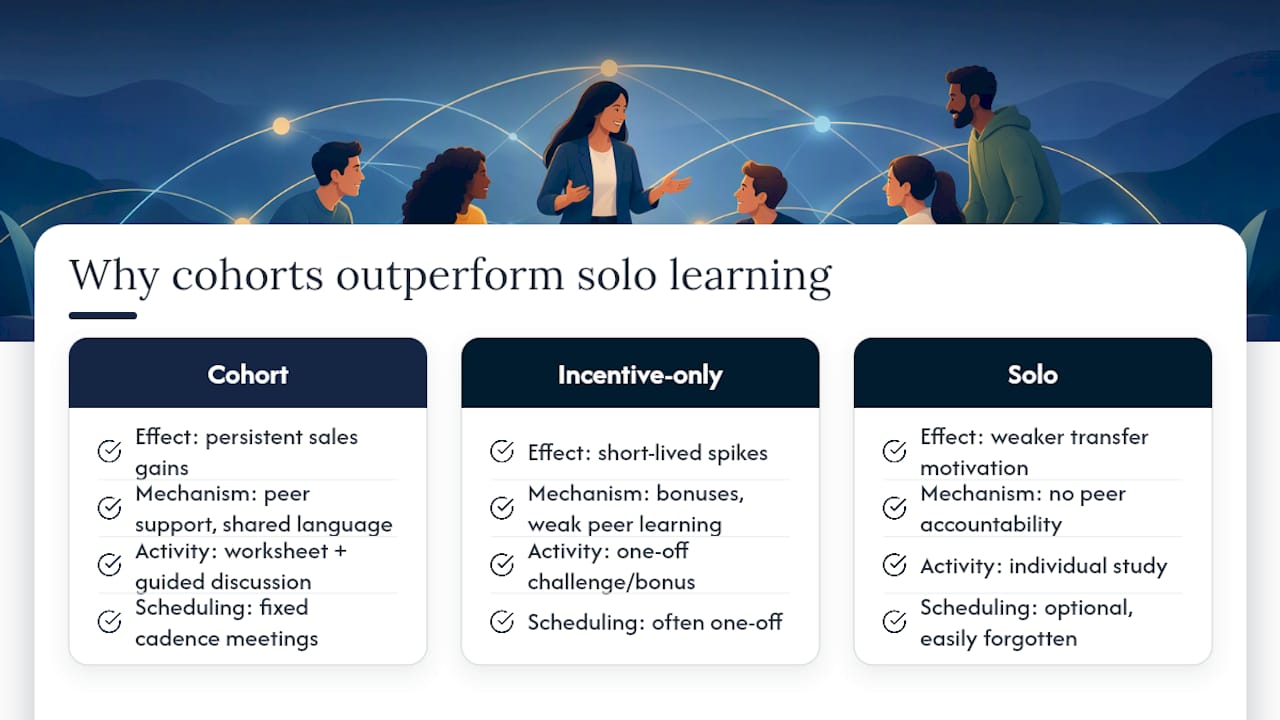
Peer support is not a nice-to-have bolted onto training. It’s one of the strongest predictors of whether new skills survive contact with the job. Research on coworker participation found that when several colleagues attend training together, the effect of peer support on transfer motivation is significantly stronger than when individuals train alone, because shared language and mutual accountability lower the social cost of trying a new approach on a live call.
Structured meetings that lower the effort required to exchange knowledge between peers produced persistent sales gains in field experiments, while pairings built around incentives alone produced only short-lived spikes.
That distinction matters for how you design cohort activities. A quick worksheet paired with a brief, guided discussion between two colleagues does more for durable behaviour change than a bonus tied to a one-off challenge, according to field experiment findings on workplace knowledge flows. Schedule these exchanges on a fixed cadence, not as an optional extra people forget when the diary fills up.
There’s a caveat worth taking seriously: cohorts placed into an unsupportive performance environment, where managers punish mistakes or ignore new approaches, can actually underperform solo training. The peer effect cuts both ways.
How do you coach managers to embed the culture?
Managers are where sales culture either takes root or dies. Forrester’s research found that most first-line B2B sales managers are promoted from individual contributor roles with no formal coaching training, so their one-to-ones default to pipeline reviews rather than genuine development conversations.
Fixing that means training managers in coaching as a skill, not assuming it comes free with a promotion.
- Teach open questioning, structured observation, and specific feedback, not generic encouragement.
- Set a weekly one-to-one cadence with a simple, repeatable agenda covering wins, blockers, and one development target.
- Keep a coaching log so patterns become visible over weeks, not just remembered anecdotally.
- Track time spent coaching and the quality of those conversations, not just deals closed.
- Protect time in the calendar for coaching and reward it explicitly, or it will always lose to whatever is urgent that day.
These manager coaching techniques give a practical starting point if your managers have never been taught to run a proper coaching conversation.
Pro Tip: Ask managers to record one coaching conversation a month against a simple rubric, scored by a peer manager rather than by their own boss. Peer scoring surfaces coaching gaps that self-assessment almost always misses.
Which metrics prove the training is working?
Split your measurement into leading indicators, which move first, and lagging indicators, which prove commercial impact later. Watching only lagging metrics means you find out something’s wrong months after you could have fixed it.
Leading indicators worth tracking weekly or fortnightly:
- Manager coaching frequency and observation scores
- Worksheet or action-plan completion rates from cohort sessions
- Role-play or call-review scores against your competency framework
Lagging indicators to review monthly or quarterly:
- Win rate by cohort or team
- Average deal size
- Time to competence for new starters
- Quota attainment against target
On timing, don’t expect a single workshop to move any of these numbers. Field research on spaced practice in sales training found that sessions spread over time produced stronger transfer and competence gains than the same content delivered in one sitting, which means the first genuine signal usually shows around eight to twelve weeks in, with the clearest commercial impact visible at the next full quarter. Multi-month programmes combining workshops, coaching and action learning have delivered measurable ROI in commercial case studies, including one engagement programme documented by Influence at Work that tracked assets under management alongside behavioural change. Report against your KPIs at a fixed cadence and use the gaps to adjust the next cohort, not to abandon the approach after one flat month.
Ahead of Sales: training-led culture change in practice
Some providers build models combining bespoke 1:1 coaching with cohort-based training and consultancy, aimed at organisations seeking measurable quarterly progress rather than a one-off morale boost. Packages for team engagements run from £4,500 to £8,500, while solo service businesses and consultants get a dedicated sales acceleration track priced between £2,995 and £5,995.
A practical pilot brief to request from any provider, Ahead of Sales included, covers three things: scope (which team, how many sellers, which competencies), timeline (typically a spaced programme over several months rather than a single week), and outcomes (the specific leading and lagging metrics you’ll report against). Ask how the cohort training fits your existing performance reviews before you sign anything, so the training slots into governance you already run rather than sitting alongside it as a separate initiative.
What actually happens in the first six months?
Expect a slow first six to eight weeks, a visible shift in coaching conversations by week twelve, and the first real commercial signal around the next full quarter. The most common failure isn’t poor training content. It’s managers reverting to pipeline-only one-to-ones the moment things get busy, which quietly unwinds the coaching habit before it sets. Protect manager time deliberately, keep reporting on a fixed cadence, and resist judging the whole programme on one quiet month.
— Jerry
Ready to build a sales culture that holds under pressure?
Most sales training gets delivered once and forgotten by the following quarter.
For teams of roughly 50 to 1,000 staff, Sales Training Cohorts combine the peer-support benefits covered above with structured manager coaching, and packages such as The Sage Collective run from £990 per month for ongoing development. If you need a more senior hand on the pipeline itself, the Fractional Sales Director service embeds experienced leadership without a full-time hire. Solo consultants and service business founders may have access to dedicated acceleration tracks priced within a range.
Request a scoping call through Aheadofsales and ask for a pilot brief covering scope, timeline and metrics before you commit to a full rollout.
Sources
- The moderating effect of coworkers’ training participation on the influence of peer support in the transfer process
- Workplace knowledge flows (field experiment summary)
- Sales training: effects of spaced practice on training transfer
- Coach-like managers are the best sales team leaders (Forrester)
FAQ
What is the 3-3-3 rule in sales?
The 3-3-3 rule is a prospecting guideline some sales teams use, typically meaning three touchpoints across three channels within three days of a lead coming in. It’s a tactical rule for follow-up speed rather than a culture framework, so it sits alongside, not instead of, the coaching and cohort structures covered above.
What are the 5 C’s of sales?
Definitions vary across sales training providers, but a common version covers Customer, Company, Competitors, Collaborators and Climate, used as a framework for understanding a deal’s context before pitching. It’s more useful as a discovery checklist than as a culture-building tool on its own.
What are the 7 C’s in sales?
There’s no single agreed industry standard for the “C’s,” and different trainers use the term to mean different things, so treat any specific list you encounter with some caution. If you see it referenced, check what the source actually means by it before applying it to your own process.
What are the 5 P’s of sales?
Sales training providers commonly frame the 5 P’s as Product, Price, Place, Promotion and People, adapted from the marketing mix into a sales context. As with the C’s frameworks, exact definitions shift by trainer, so use it as a discussion prompt rather than a rigid model.
How much does sales culture training cost?
Ahead of Sales runs team-based coaching and consultancy engagements from £4,500 to £8,500 one-off, with a solo sales acceleration track from £2,995 to £5,995, and an ongoing membership option, The Sage Collective, from £990 per month. Exact pricing depends on team size and scope, so a scoping call is the fastest way to get a firm figure.