
TL;DR:
- A structured sales call process involves multiple stages that ensure consistent progress toward closing deals. Effectively preparing, engaging, uncovering needs, addressing objections, and securing next steps are essential for success. Using integrated systems and deliberate techniques enhances scalability, reliability, and overall sales performance.
The sales call process is a structured, repeatable sequence of planned steps designed to guide every conversation from first contact to a confirmed next action. Most sales professionals know the stages in theory. Few execute them with the consistency that actually moves conversion rates. This guide breaks down each stage with precision, covers the data behind what works, and gives you a framework you can apply on your next call.
What are the essential stages of the sales call process?
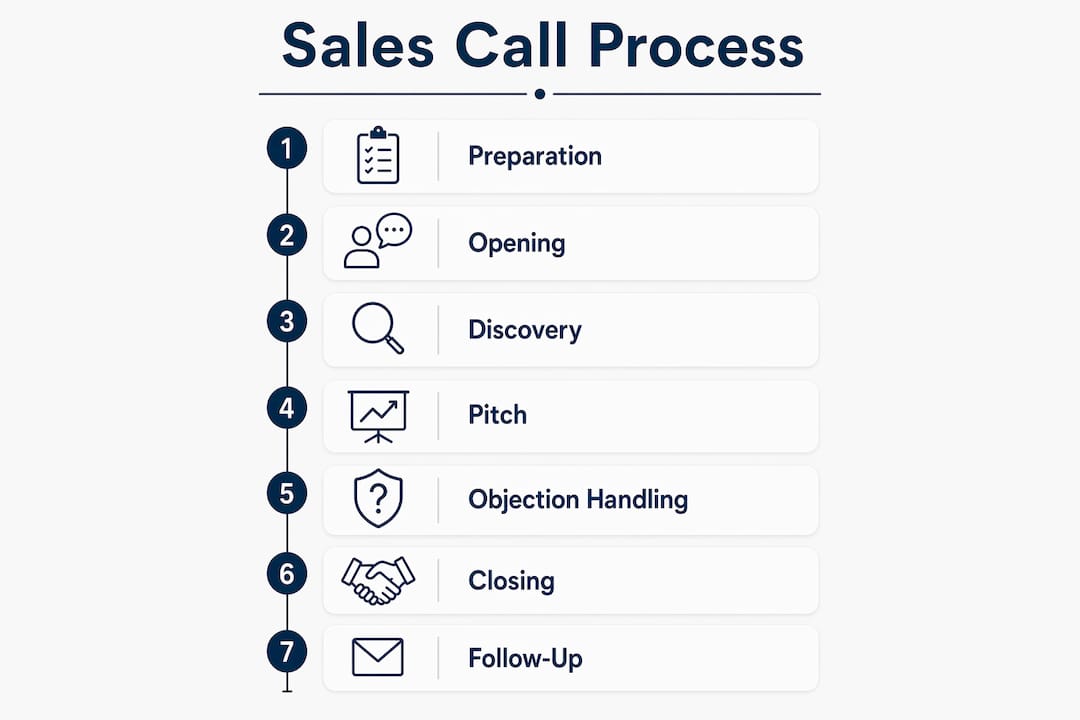
A structured sales call follows 5–7 defined stages: preparation, opener, discovery, pitch, objection handling, closing, and post-call follow-up. Each stage has a clear purpose and a defined exit point. Skipping or rushing any one of them creates gaps that stall deals.
Here is how each stage works in practice:
- Pre-call preparation. Research the prospect, review account history, and set a specific objective for the call. Know what a successful outcome looks like before you dial.
- Opener and agenda-setting. The first 60 seconds determine whether the prospect stays engaged. State your name, your reason for calling, and the agenda clearly. Ask for permission to proceed.
- Discovery. Ask prepared questions to uncover pain points, priorities, and buying criteria. This is the most important stage in the entire process.
- Pitch and positioning. Present your solution in direct response to what the prospect told you in discovery. Generic pitches lose deals. Tailored ones win them.
- Objection handling. Address concerns around price, timing, and fit before they become blockers. Effective objection handling starts well before the close.
- Closing. Secure a calendar-bookable next action. This is not optional. Close rates drop by 71% when the next-step conversation is missed entirely.
- Post-call follow-up. Send a summary email within 24 hours. Confirm agreed actions and keep momentum alive.
Every stage feeds the next. A weak discovery produces a generic pitch. A generic pitch invites objections you cannot answer. The sequence is not arbitrary.
How can you optimise pre-call preparation?
Pre-call preparation is the single most controllable variable in your sales call outcomes. The quality of your research directly determines the quality of your questions, and your questions determine everything else.

For high-stakes discovery calls, industry guidance recommends 45–60 minutes of preparation. For follow-up calls, 10–15 minutes is typically sufficient. The investment scales with the size of the opportunity.
The most valuable preparatory actions are:
- Review account history. Check previous call notes, email threads, and CRM records. Know what was discussed and what was promised.
- Identify pain points. Research the prospect’s business, sector, and recent news. LinkedIn, company websites, and industry publications are reliable starting points.
- Set a specific call objective. “Have a good conversation” is not an objective. “Confirm budget authority and agree a demo date” is.
- Prepare your discovery questions in advance. Do not improvise this on the call.
AI-driven tools are changing preparation significantly. Automated pre-call briefs can reduce manual prep time from 15–30 minutes down to around 5 minutes, while increasing contextual depth. Tools like Sybill generate call summaries and pre-call intelligence that most sales managers have not yet built into their standard workflows.
Pro Tip: Use your CRM to flag the last three touchpoints with a prospect before every call. Knowing what they responded to previously tells you more about their priorities than any amount of external research.
Check the sales call preparation guide from Aheadofsales for a detailed breakdown of preparation stages by call type.
What are the best sales call techniques for discovery, objections, and closing?
Discovery, objection handling, and closing are where most sales professionals either win or lose the deal. Getting these three stages right requires specific techniques, not general confidence.
Running a high-impact discovery
Experienced sales reps maintain a bank of 15–20 discovery questions for flexibility, then select which to use based on how the conversation develops. The practical sweet spot is 11–14 questions per call. Fewer than that and you risk missing critical information. More than that and the prospect starts to feel interrogated.
The best discovery questions are open, specific, and sequenced. Start broad (“What does success look like for your team this year?”), then narrow toward the specific pain (“What’s getting in the way of that right now?”). Listen to the answers without interrupting. The prospect’s exact words are your pitch material.
Handling objections without pressure
Objection handling works best when it starts during discovery, not at the close. If you understand a prospect’s budget constraints and timeline early, you can address them as part of your pitch rather than scrambling to respond at the end.
The three most common objections in B2B sales are price, timing, and internal buy-in. For each one, the response structure is the same: acknowledge the concern, ask a clarifying question, then reframe around value. Avoid dismissing objections or rushing past them. A prospect who feels heard is far more likely to move forward.
Pro Tip: When a prospect says “it’s too expensive,” resist the urge to discount immediately. Ask “compared to what?” first. The answer almost always reveals the real objection.
Closing on a confirmed next step
Closing should be the natural outcome of a well-executed discovery and value alignment, not a standalone event relying on pressure tactics. If the discovery was thorough and the pitch was tailored, the close is a logical next step, not a leap.
The data on this is unambiguous. Sellers who close fastest discuss next steps 53% more often than those who do not. The close is not “let me know if you’re interested.” It is “I’ll send the proposal by Thursday. Can we book 30 minutes for Friday to walk through it together?”
Urgency tactics can support closing, but only when they are genuine. Artificial urgency harms trust and increases churn. If there is a real fiscal year-end deadline or a genuine capacity constraint, use it. If there is not, do not invent one.
For a deeper look at closing frameworks, the sales closing techniques guide from Aheadofsales covers 7 proven methods in detail.
How does post-call follow-up maintain momentum?
Post-call follow-up is where many deals quietly die. The call goes well, both parties feel positive, and then nothing happens for a week. By the time you follow up, the prospect has moved on mentally.
Timely follow-up correlates directly with deal progression. The standard is a summary email within 24 hours of the call. That email should do three things:
- Confirm what was discussed. Summarise the key points from discovery and any commitments made.
- Restate the agreed next action. Include the date, time, and format of the next meeting or deliverable.
- Provide any promised materials. If you said you would send a case study or proposal, it goes in this email.
The most common follow-up mistake is sending a vague “great to speak with you” message that confirms nothing and commits to nothing. That email does not move the deal forward. It just fills an inbox.
If a prospect goes quiet after a follow-up, do not wait indefinitely. A structured re-engagement sequence, typically three touches over two weeks, is more effective than a single chaser. The follow-up workflow guide from Aheadofsales covers this in full.
How do systems and technology support a scalable process?
A sales call process only delivers consistent results when it is built into your systems, not just your habits. Individual discipline matters, but it does not scale across a team.
| Tool Type | Primary Function | Impact on Process |
|---|---|---|
| CRM (e.g., Salesforce, HubSpot) | Stores account history and call notes | Enables informed preparation and consistent follow-up |
| AI call intelligence (e.g., Sybill, Gong) | Analyses call recordings and generates briefs | Reduces prep time and surfaces coaching opportunities |
| Call templates and scripts | Standardises openers, discovery questions, and closes | Creates repeatable structure across the team |
| Stage-gated pipeline tools | Defines exit criteria for each deal stage | Prevents pipeline stalling and improves forecast accuracy |
Defined exit criteria for each sales call stage prevent pipeline stalling and make the process repeatable at scale. Without them, deals sit in “discovery” or “proposal sent” indefinitely because no one has defined what needs to happen before the deal moves forward.
The combination of CRM discipline, AI-assisted preparation, and stage-gated pipeline management is what separates teams that hit target every quarter from those that rely on a few top performers to carry the numbers.
Key takeaways
A structured, stage-gated sales call process with defined exit criteria and a confirmed next action at every close is the single most reliable driver of consistent conversion.
| Point | Details |
|---|---|
| Follow the 7-stage framework | Preparation through post-call follow-up forms the backbone of every winning call. |
| Invest in pre-call research | High-stakes calls warrant 45–60 minutes of preparation to maximise discovery quality. |
| Secure a next step every time | Missing the next-step conversation reduces close rates by 71%; always book the follow-up. |
| Handle objections early | Address price, timing, and buy-in concerns during discovery, not at the close. |
| Build process into your systems | CRM discipline and stage-gated pipelines make good habits repeatable across the whole team. |
What i have learned about sales calls after years in the field
The biggest mistake I see sales professionals make is treating the close as a separate skill from the rest of the call. They spend 20 minutes in discovery, rush through the pitch, and then try to “close” as if it is a distinct event requiring a special technique. It is not. The close is the logical conclusion of everything that came before it.
The second pattern I see constantly is over-reliance on personality. Some reps are naturally engaging and get away with poor preparation for years. Then they hit a more sophisticated buyer, or a more competitive market, and the charm stops working. Process is what protects you when your natural style is not enough.
I am also genuinely excited about what AI tools like Sybill and Gong are doing for preparation and coaching. Most sales managers I speak with have not yet integrated these into their standard workflows. The reps who do are arriving at calls with a level of contextual knowledge that used to take 45 minutes to build. That is a real competitive advantage.
My honest advice: treat your sales call process as a living document. Test one variable at a time, measure the outcome, and adjust. The reps who improve fastest are not the ones with the most natural talent. They are the ones who are most deliberate about what they do and why.
— Jerry
Take your sales calls to the next level with Aheadofsales
If you recognise the gaps in your current process, the good news is that every stage described in this article is trainable. Aheadofsales works with sales teams across the UK to build structured, repeatable call frameworks that deliver measurable results, including at least 50% sales growth per year for clients who commit to the process.
Whether you are managing a team of five or fifty, the sales training programmes from Aheadofsales combine bespoke 1:1 coaching with group workshops and consultancy. For SaaS businesses specifically, the SaaS sales training programme addresses the unique challenges of subscription selling and pipeline velocity. Packages start from £4,500 for teams and £2,995 for solo operators.
FAQ
What is a sales call process?
A sales call process is a structured, repeatable sequence of stages, typically preparation, opener, discovery, pitch, objection handling, closing, and follow-up, designed to guide conversations toward a confirmed next action and, ultimately, a closed deal.
How many discovery questions should i prepare?
Sales reps should prepare 15–20 discovery questions for flexibility, then use 11–14 on the call. This range covers the prospect’s situation thoroughly without creating interrogation fatigue.
Why is securing a next step so critical to closing?
Analysis of 42,945 closing calls shows that close rates drop by 71% when the next-step conversation is missed. Booking a specific, calendar-confirmed follow-up is the single greatest factor in closing success.
How long should pre-call preparation take?
Preparation time depends on call complexity. High-stakes discovery calls warrant 45–60 minutes. Standard follow-up calls require 10–15 minutes. AI tools like Sybill can reduce manual prep to around 5 minutes while maintaining contextual depth.
When should i handle objections in a sales call?
Objection handling works best when it begins during the discovery phase, not at the close. Identifying concerns around price, timing, and internal buy-in early allows you to address them as part of your pitch rather than as last-minute blockers.