
TL;DR:
- A sales business development manager drives sustainable revenue growth through strategic planning, relationship building, and disciplined sales management. Mastering skills like consultative selling, structured BD frameworks, and tech fluency is essential for success through 2026. Building deliberate client relationships and aligning BD with sales planning significantly improves pipeline efficiency and predictability.
A sales business development manager is responsible for generating new business leads, managing client relationships, and implementing growth strategies that directly impact company revenue. The role sits at the intersection of two disciplines: business development, which is medium to long term and focused on creating market conditions for growth, and sales management, which is short term and execution focused. Mastering both is what separates a good performer from a genuinely great one. If you are building towards this role or already in it, the frameworks and techniques in this guide will give you a clear picture of what excellence looks like in 2026.
What does a sales business development manager actually do?
The core responsibilities of this role are identifying new sales leads, pitching to prospective clients, and building long-term strategic relationships. That sounds straightforward, but the reality is considerably more layered. You are simultaneously a planner, a relationship manager, a coach, and a revenue driver.

The industry term for this combined function is Business Development Manager, often abbreviated to BDM. The “sales” prefix signals that the role carries a direct revenue target, not just a pipeline-building remit. That distinction matters when you are negotiating your KPIs or structuring your team.
Structured planning sits at the heart of the role. Without it, BD activities become reactive rather than deliberate, and you end up chasing short-term wins instead of building a sustainable market position. The best BDMs treat their BD plan as a living document, reviewed quarterly and adjusted as market conditions shift.
What key skills distinguish a successful sales business development manager?
Four competency clusters define high performance in this role. Each one builds on the others, and weakness in any single area tends to show up in your pipeline numbers within two quarters.
Penetrative sales and negotiation skills. You need to move beyond surface-level discovery and get to the real business problem your prospect is trying to solve. Consultative selling techniques, where you diagnose before you prescribe, consistently outperform pitch-led approaches in complex B2B sales cycles.
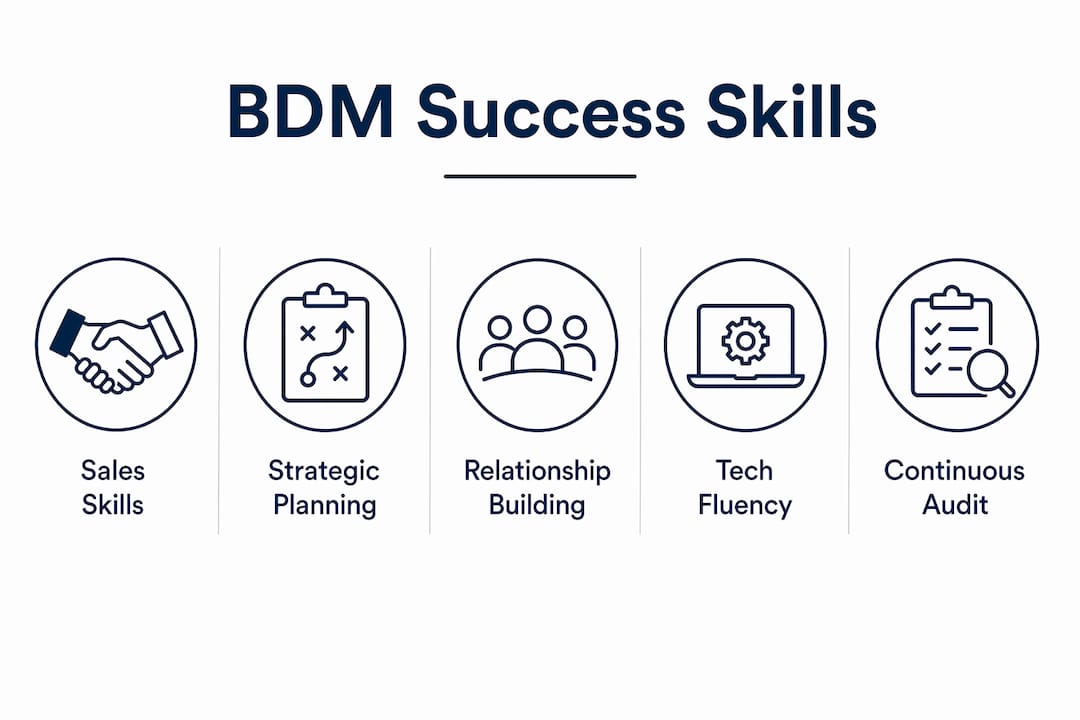
Strategic planning and BD frameworks. A structured BD plan requires five interdependent components: defining objectives, allocating resources, designing strategies, establishing frameworks, and setting performance metrics. Skipping any one of these creates gaps that competitors will exploit. The BDA BoCK (Business Development Association Body of Core Knowledge) provides an internationally recognised standard for designing and measuring BD plans.
Relationship-building and stakeholder management. This goes well beyond keeping a CRM up to date. You need to map the full decision-making unit within a target account and build genuine trust at multiple levels, not just with the day-to-day contact.
Tech fluency. CRM proficiency is table stakes. In 2026, AI-assisted coaching tools and conversation intelligence platforms are becoming standard equipment for high-performing BDMs. Understanding how to use these tools without letting them replace your judgement is a skill in itself.
Pro Tip: Build a personal skills audit every six months. Rate yourself honestly across these four clusters and identify the one area where a 20% improvement would have the biggest impact on your revenue numbers.
How do business development strategies integrate with sales management techniques?
The most common mistake I see in growing businesses is treating BD planning and sales planning as the same thing. They are not. Sales planning is short term and tactical, focused on pipeline conversion and quarterly targets. BD planning is strategic, with a medium to long term focus on creating the conditions for sustainable growth.
| Dimension | BD planning | Sales planning |
|---|---|---|
| Time horizon | 1–3 years | Weekly to quarterly |
| Primary focus | Market creation and positioning | Pipeline conversion and quota attainment |
| Key inputs | Market research, competitive analysis, strategic goals | CRM data, lead volume, conversion rates |
| Key outputs | Growth strategy, partnership frameworks, new market entry | Closed revenue, forecast accuracy, activity metrics |
| Owner | BDM or Head of BD | Sales Manager or Sales Director |
When these two disciplines are aligned, pipeline velocity increases and revenue becomes more predictable. When they operate in silos, you get a classic symptom: a full pipeline that never seems to close, because the BD team is bringing in leads that the sales process is not equipped to convert.
High-performing sales management balances seven core functions: recruiting, training, goal-setting, coaching, motivating, performance monitoring, and forecasting. A BDM who also manages a team needs to run all seven, not just the ones that feel comfortable.
Pro Tip: Run a monthly alignment meeting between your BD and sales planning cycles. Bring your BD pipeline assumptions into the sales forecast conversation. The gaps you find will tell you exactly where your growth strategy needs work.
What modern approaches improve performance in 2026?
The management playbook has shifted considerably in the past two years. Three forces are reshaping how the best BDMs lead their teams and manage their own performance.
AI-enhanced coaching and monitoring. Integrating AI with human coaching delivers better sales performance outcomes than either approach alone. AI tools can flag call quality issues, identify stalled deals, and surface coaching opportunities that a manager would miss in a busy week. The key is using AI to inform your coaching conversations, not to replace them.
Transparent, data-driven sales cultures. Modern sales management in 2026 requires transparency about targets, performance data, and team health. Reps who understand exactly where they stand and why perform better than those managed through vague feedback and end-of-quarter surprises.
Burnout prevention and Gen Z management. The workforce is changing. Gen Z sales professionals respond to purpose-driven work, clear development pathways, and managers who treat wellbeing as a business metric, not a soft extra. Peer coaching models, where experienced reps mentor newer colleagues in structured sessions, reduce turnover and build team capability simultaneously.
The AI productivity gains available to BD and sales teams are real, but they require deliberate adoption. Dropping a tool into a team without process redesign rarely moves the needle. Redesign the workflow first, then layer in the technology.
Incentives beyond quota attainment also matter more than most managers acknowledge. Recognition programmes, skills-based progression, and non-financial rewards keep mid-tier performers engaged. Your top 20% will hit target regardless. It is the middle 60% where your management approach makes the biggest commercial difference.
How can you build strategic client relationships that last?
Relationship building is a non-linear asset. A single trusted referral can be worth far more than dozens of cold outreach attempts, because the trust is already partially established before the first conversation begins. BD professionals who treat referrals as a deliberate strategy, rather than a lucky by-product, consistently build stronger pipelines.
Here is a practical framework for building and sustaining strategic client relationships:
-
Map the full account. Identify every stakeholder who influences the buying decision, including those who rarely appear in meetings. Economic buyers, technical evaluators, and internal champions all need different engagement approaches.
-
Layer your outreach methods. Top BD professionals combine structured follow-ups, thought leadership content, and event presence rather than relying on a single channel. Each touchpoint reinforces the others.
-
Use consultative selling at every stage. Consultative selling techniques keep the conversation focused on the client’s problem, not your product. This builds credibility faster than any amount of feature-led pitching.
-
Track and nurture key accounts in your CRM. Set relationship health scores for your top 20 accounts. Flag any account where you have not had a meaningful conversation in 60 days. Relationships decay faster than most BDMs realise.
-
Ask for referrals deliberately. After a successful project or a strong quarterly review, ask your client directly: “Is there anyone in your network who faces a similar challenge?” Most clients are happy to refer. Most BDMs never ask.
Pro Tip: Assign a “relationship owner” to every key account in your CRM, not just a deal owner. The relationship owner is responsible for the long-term health of the account, regardless of whether there is an active opportunity in the pipeline.
Key takeaways
A sales business development manager drives sustainable revenue growth by combining structured BD planning, disciplined sales management, and deliberate relationship-building across the full client lifecycle.
| Point | Details |
|---|---|
| BD and sales planning are distinct | BD planning is strategic and long term; sales planning is tactical and short term. Run both in parallel. |
| Five-component BD plan | Define objectives, allocate resources, design strategies, establish frameworks, and set performance metrics. |
| Seven sales management functions | Recruiting, training, goal-setting, coaching, motivating, monitoring, and forecasting all require active attention. |
| Referrals outperform cold outreach | A trusted referral carries pre-established credibility. Build a deliberate referral strategy into your BD plan. |
| AI works best alongside human coaching | Technology flags opportunities; your judgement and coaching conversations convert them into performance gains. |
Why the role demands more than most people expect
I have worked with a lot of people who move into a BDM role expecting it to be a natural extension of being a strong individual sales contributor. It rarely is. The skills that make you a great closer, confidence, persistence, competitive drive, are necessary but not sufficient. What catches most new BDMs off guard is the planning discipline the role demands.
The shift from activity volume to structured BD planning is the single biggest lever I see underused. Most BDMs I work with are busy. They are on calls, in meetings, attending events. But busy is not the same as strategic. When I ask them to show me their BD plan, the document that connects their daily activities to a three-year growth ambition, the room often goes quiet.
The other thing I would say is this: do not let technology become a substitute for human skill. AI tools are genuinely useful for monitoring performance and surfacing coaching moments. But the ability to build real trust with a senior decision-maker, to read a room, to know when to push and when to hold back, that still comes from experience and continuous learning. The BDMs who will lead the market in 2026 and beyond are the ones who combine both. They use the tools and they keep sharpening the human skills that no algorithm can replicate.
— Jerry
How Aheadofsales helps sales business development managers grow faster
Aheadofsales works with sales professionals and growing businesses to build the planning discipline, management capability, and relationship skills that this role demands.

Whether you are an individual BDM looking to sharpen your consultative selling approach or a business with a team of 50 to 1,000 people that needs a structured growth programme, Aheadofsales has a package built for your situation. The sales training courses and workshops cover everything from BD planning frameworks to advanced negotiation, with bespoke 1:1 coaching woven throughout. Packages start from £4,500, and every programme is designed to deliver at least 50% sales growth year on year. If you are ready to move from reactive selling to deliberate growth, sales consultancy services from Aheadofsales give you the structure and support to make it happen.
FAQ
What is the difference between a BDM and a sales manager?
A Business Development Manager focuses on identifying new market opportunities and building long-term client relationships, while a sales manager oversees the day-to-day performance of a sales team. In many organisations, a sales business development manager combines both functions.
How do I become a sales business development manager?
Most BDMs progress from individual contributor sales roles, building experience in prospecting, account management, and consultative selling before moving into a management or BD-focused position. Structured training in BD planning frameworks and sales management techniques accelerates this progression significantly.
What does a BD plan include?
A structured BD plan includes five components: defined objectives, allocated resources, designed strategies, established frameworks, and performance metrics. These components connect organisational growth ambitions to day-to-day execution.
How important is CRM for a BDM?
CRM is the operational backbone of the role. It tracks relationship health, pipeline status, and account activity. BDMs who use CRM consistently to monitor key accounts and flag relationship gaps outperform those who treat it as an administrative task.
What is consultative selling and why does it matter for BDMs?
Consultative selling is an approach where you diagnose the client’s problem before proposing a solution. It builds credibility faster than product-led pitching and is particularly effective in complex B2B sales cycles where multiple stakeholders are involved in the buying decision.