
Treating every prospect the same risks wasting effort on leads that will never convert. Sales leaders across the United Kingdom often find themselves chasing poor-fit opportunities simply because their scoring system relies on assumptions rather than proven data. Understanding the fundamentals of lead scoring helps your team prioritise high-value leads, align sales and marketing, and build a process that drives measurable growth. This guide breaks down essential concepts and exposes common myths, offering practical insight for companies aiming to refine their approach.
Table of Contents
- Lead Scoring Explained: Key Concepts And Myths
- Types Of Lead Scoring Models And Criteria
- How Lead Scoring Works In Practice
- Lead Scoring’s Impact On Sales Efficiency
- Common Mistakes And Optimising Your Scoring System
Key Takeaways
| Point | Details |
|---|---|
| Effective Lead Scoring | Prioritises prospects based on their fit and interest, helping sales teams focus on high-probability leads. |
| Data-Driven Decisions | Use historical win data to define scoring criteria, ensuring alignment with genuine customer behaviour. |
| Continuous Improvement | Regularly review and adjust lead scoring to adapt to changing market conditions and maintain relevance. |
| Sales and Marketing Collaboration | Foster collaboration between teams to ensure consistent definitions of a qualified lead and improved conversion rates. |
Lead scoring explained: Key concepts and myths
Lead scoring is fundamentally about ranking your prospects based on their actual value to your business. Rather than treating every enquiry the same, you assign points based on who they are and how they behave.
The methodology uses two types of information to calculate these scores. Explicit data includes company size, industry, job title, and budget. Implicit data comes from behaviour monitoring—website visits, email opens, content downloads, and sales call engagement.
Understanding lead scoring models helps you avoid a common trap: treating all prospects as equally valuable. They’re not. Your scoring system should reflect which prospects align with your ideal customer profile.
Here’s what effective lead scoring actually does:
- Identifies which prospects deserve your sales team’s immediate attention
- Improves alignment between your sales and marketing teams by defining what “qualified” actually means
- Reduces wasted time chasing poor-fit leads
- Increases revenue by focusing effort on high-probability deals
Common myths about lead scoring
Myth one: Lead scoring is purely technical. It’s not. Your system reflects your sales strategy and customer reality. A technical tool can’t replace good judgment about who buys from you.
Myth two: More data equals better scoring. Wrong. Too many scoring criteria creates noise and makes the system unmaintainable. You need the right criteria, not all criteria.
Myth three: You set it once and forget it. This fails consistently. Market conditions change. Your product evolves. Your ideal customer profile shifts. Revisit and refine your scoring quarterly.
Myth four: Marketing and sales will automatically agree on scoring. They won’t—unless you make them collaborate on building it. The best scoring systems come from genuine conversation between teams about what actually converts.
Lead scoring only works when your entire sales and marketing team understands and trusts the system they’re using daily.
Most UK businesses with 50–1000 staff struggle because they’ve built scoring around assumptions rather than evidence. You need data about which characteristics actually correlate with closed deals in your specific business.
Pro tip: Start simple with three to five high-impact criteria based on your historical win data, test it for two months, then expand based on what actually works in your pipeline.
Types of lead scoring models and criteria
Not all lead scoring approaches work the same way. The model you choose depends on your team’s capabilities, data availability, and how much complexity you’re willing to manage. There are three main types worth understanding.
Traditional scoring relies on the experience of your sales and marketing teams. You sit down and decide which characteristics matter most—job title, company size, industry fit—then assign point values based on gut feel and past wins. It’s quick to implement but often misses patterns your team hasn’t consciously noticed.
Explicit scoring focuses purely on demographic and firmographic data. You’re scoring based on what prospects tell you directly: their company size, revenue, location, industry. This works well when you have a clear ideal customer profile, but it ignores how prospects actually behave.
Implicit scoring tracks behaviour instead. Website visits, email engagement, content downloads, and demo requests all generate points. A prospect downloading your pricing page repeatedly signals genuine interest. This approach catches engagement your traditional scoring might miss.
Predictive scoring uses data mining and machine learning to analyse historical data and predict which prospects will convert. The system learns from your closed deals—what characteristics, behaviours, and combinations actually resulted in sales. Predictive models typically outperform other approaches, though they require more data and technical setup.
Here’s how these compare in practice:
Here’s a comparison of lead scoring model types and their suitability:
| Model Type | Data Requirement | Accuracy Potential | Typical UK Usage |
|---|---|---|---|
| Traditional | Experience-driven | Moderate, assumption-based | Small teams |
| Explicit | Demographic firmographics | Limited, misses behaviour | Entry-level SME |
| Implicit | Engagement signal tracking | Captures real interest | Growing firms |
| Predictive | 6–12 months historical data | High, learns win patterns | Larger enterprises |
- Traditional: Fast to build, relies on assumptions, often inaccurate
- Explicit: Works for straightforward sales, ignores engagement signals
- Implicit: Captures real interest, can score prospects too early
- Predictive: Most accurate long-term, requires 6–12 months of data, higher investment
Most UK businesses start with explicit or implicit scoring, then graduate to predictive once they have sufficient conversion data.
Your choice matters because it shapes how your team prioritises daily. Traditional or explicit scoring might push your reps toward large companies that look good on paper but never buy. Implicit scoring catches engaged smaller firms. Predictive scoring balances both.
Pro tip: Begin with explicit plus implicit scoring combined, measure results for two months, then identify which data points actually predict closes so you can build toward predictive scoring.
How lead scoring works in practice
Lead scoring operates on a straightforward principle: you assign numerical points to prospects based on two things—how well they fit your ideal customer, and how interested they actually are.
Fit measures whether a prospect matches your target profile. A company in your industry, the right size, with the right budget and decision-maker title scores higher on fit. These are your explicit attributes—the facts you can verify immediately.

Intent measures engagement. Did they download your whitepaper? Visit your pricing page? Open your email three times? Book a demo? These behaviours signal genuine interest and score separately from fit.
Your scoring system aggregates both. A large firm that looks perfect on paper but never engages gets a moderate score. A small business that doesn’t match your profile but visits your site constantly also gets moderate score. A prospect that matches your profile AND engages heavily? That’s your sales conversation.
Here’s the practical workflow:
- Define your scoring criteria—which attributes and behaviours matter most
- Assign point values—fit attributes (50–100 points each), engagement actions (5–25 points each)
- Set action thresholds—when a lead hits 70 points, sales gets it; at 100 points, immediate outreach
- Monitor and adjust—your thresholds shift as market conditions change
The system dynamically updates scores as new information arrives. When someone books a demo, their score jumps. When six months pass without engagement, it drops. Your team always sees current lead readiness.
What makes this work in practice is simplicity. Too many criteria overwhelms your team. Too few and you miss patterns. Start with five to seven criteria you’re absolutely certain correlate with closed deals.
The best scoring systems are built from historical win data, not assumptions about who should buy.
Most UK sales teams fail because they score based on gut feeling or generic best practices. Your system must reflect your actual customers. If you sell primarily to finance directors at companies over £5 million revenue, score for those. If smaller, nimbler prospects convert better, weight differently.
Your reps should understand the score at a glance. If someone scores 85, they know exactly why—perhaps they’re the right title at a fitting company and downloaded two resources. That clarity drives prioritisation.
Pro tip: Extract your last 20 closed deals, identify the exact characteristics they shared at first contact, then build your initial scoring criteria directly from that reality rather than theory.
Lead scoring’s impact on sales efficiency
Lead scoring transforms how your sales team spends time. Instead of pursuing every prospect equally, your reps focus on those most likely to convert. That single shift dramatically improves efficiency.
Consider what happens without scoring. Your team chases every inbound lead regardless of fit. A £500k company gets the same attention as a £5 million prospect. Someone vaguely interested gets the same effort as someone actively evaluating. You’re spreading effort thin and missing opportunities.
With lead scoring, your reps spend 70% of time on high-probability prospects and 30% on pipeline building. That’s dramatically different from splitting time evenly across all leads.
The tangible benefits show quickly:
- Shorter sales cycles—reps focus on warm leads ready to talk rather than cold prospects
- Higher conversion rates—better quality conversations happen with better-fit prospects
- Reduced wasted effort—stop pursuing unlikely deals that consume time and energy
- Clearer team alignment—marketing and sales share one definition of a qualified lead
- Better resource allocation—your best reps work the most valuable opportunities
Machine learning-based scoring models increase accuracy in predicting which prospects convert, enabling your team to optimise who gets immediate attention versus nurturing sequences.
For UK businesses with 50–1000 staff, this means measurable impact. If your current sales cycle runs 120 days and conversion sits at 15%, lead scoring typically cuts cycle time to 85–95 days whilst lifting conversion toward 22–25%. That’s not marginal improvement.
Sales efficiency gains compound quarterly when your entire team prioritises consistently and abandons time-wasting prospects.
The real power emerges when your team actually trusts the scoring system. If reps ignore high-scoring leads because they don’t feel right, you get no benefit. But when scoring reflects genuine win patterns, reps embrace it and efficiency soars.
One critical point: scoring only works if your team acts on it. A beautifully designed system ignored by your reps creates no value. Buy-in requires transparency—reps need to understand why certain prospects score high and feel ownership over the criteria.
Pro tip: Measure your current average sales cycle length and conversion rate today, implement scoring, then recheck after 90 days to quantify your specific efficiency gains rather than assuming generic benchmarks apply.
Common mistakes and optimising your scoring system
Most UK businesses get lead scoring wrong in predictable ways. Understanding these mistakes helps you avoid them entirely.
Mistake one: overcomplicated models. You create thirty scoring criteria because you think more data equals better results. Wrong. Your team can’t remember all criteria, consistency drops, and the system becomes unmaintainable. Start with five core criteria instead.
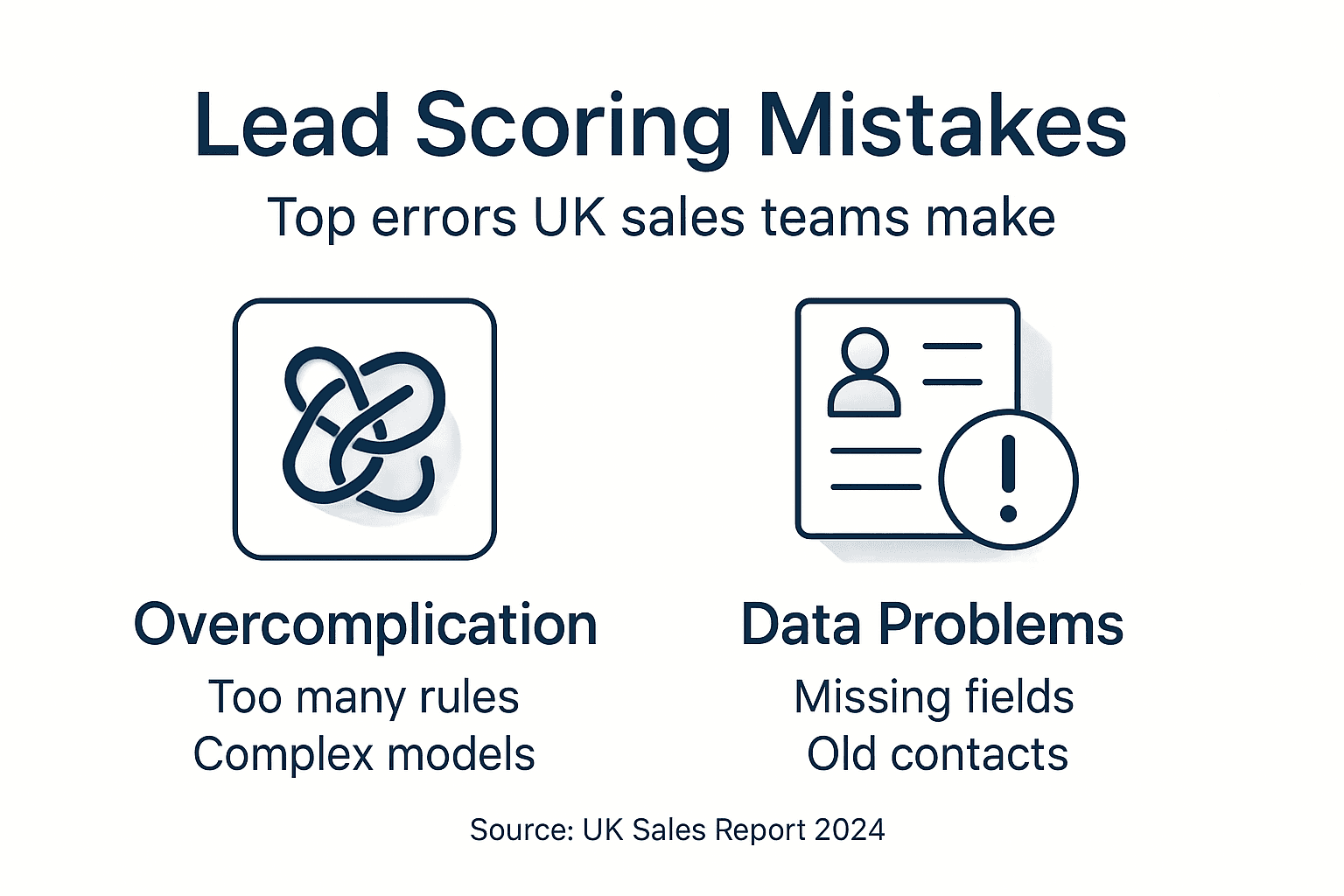
Mistake two: poor or incomplete data. Your CRM contains rubbish data—missing company sizes, outdated job titles, engagement records nobody maintains. Your scoring system reflects that garbage. Spend two weeks cleaning data before building scoring, not after.
Mistake three: no sales-marketing alignment. Marketing defines what a “qualified lead” is. Sales ignores that definition entirely. You end up with angry teams and leads sitting in limbo. Build scoring collaboratively or it fails.
Mistake four: set and forget. You build scoring in January based on last year’s data. By August, market conditions have shifted, your product has evolved, and your scoring is outdated. Your system needs quarterly reviews minimum.
Mistake five: ignoring behaviour. You score purely on demographics—company size, industry, title. A prospect hits your site daily but scores low because they’re at a smaller firm. That’s backwards. Balancing demographic and behavioural data creates more accurate predictions.
Here’s how to optimise:
The following table summarises optimisation steps for an effective lead scoring system:
| Step | Purpose | Expected Outcome |
|---|---|---|
| Data Audit | Ensure information reliability | Accurate scores, fewer errors |
| Sales Interviews | Highlight winning patterns | Custom criteria established |
| Closed Deal Review | Identify success characteristics | Evidence-backed scoring |
| Quarterly Review | Update for market shifts | Consistent conversion improvement |
- Audit your existing lead data for accuracy and completeness
- Interview your top sales performers—what do your best customers look like at first contact?
- Extract your last 30 closed deals and identify common characteristics
- Build three to five scoring criteria directly from that evidence
- Run the system for 60 days and measure results
- Adjust based on what actually converts, not assumptions
Optimising your scoring means testing it against reality every quarter and adjusting ruthlessly when data shows different patterns.
Many teams fear updating scoring because change feels destabilising. But stale scoring is worse than no scoring. Markets shift. Customer priorities evolve. Your scoring must follow.
Set a calendar reminder for quarterly scoring reviews. Fifteen minutes reviewing conversion data reveals what’s working and what needs adjustment.
Pro tip: When you update your scoring, document exactly why you changed each criterion and share that reasoning with your entire team so they understand the logic and buy in to the new system.
Unlock Your Sales Team’s Full Potential with Lead Scoring Expertise
Struggling to focus your sales efforts on prospects who truly matter Understand the critical challenge of aligning your lead scoring system with real customer data and sales behaviour to maximise conversion and reduce wasted effort. At Ahead Of Sales we combine bespoke 1:1 coaching with proven sales acceleration strategies tailored for businesses from 50 to 1000 staff. Our expert guidance helps you implement and optimise lead scoring models so your team prioritises leads effectively and hits sales targets every quarter.
Ready to transform your sales performance and generate consistent growth Start today by exploring how our tailored packages can accelerate your results. Visit Ahead Of Sales and discover personalised coaching and consultancy designed to overcome common lead scoring mistakes and boost your conversion rates rapidly. Don’t wait until next quarter act now and build a scoring system your team trusts and your competitors envy.
Frequently Asked Questions
What is lead scoring?
Lead scoring is a method of ranking prospects based on their potential value to a business by assigning points according to explicit and implicit data such as demographic information and behavioural engagement.
How do I set up a lead scoring system?
To set up a lead scoring system, define your criteria for fit and intent, assign point values to each criterion, establish action thresholds for sales follow-up, and monitor the system regularly to adjust as necessary.
What are the common types of lead scoring models?
The common types of lead scoring models include traditional scoring, explicit scoring, implicit scoring, and predictive scoring, each varying in complexity and data requirements.
How can lead scoring improve sales efficiency?
Lead scoring improves sales efficiency by enabling sales teams to focus their efforts on high-potential leads, thus shortening sales cycles, increasing conversion rates, and reducing wasted efforts on unsuitable prospects.