
Running a sales team can feel like you are always balancing priorities while chasing ever-changing targets. For UK companies committed to growth, staying ahead demands more than relying on instinct or traditional methods. By focusing on structured sales development, businesses can create defined processes, align teams, and transform good intentions into measurable success. This guide uncovers what sales development means and explains how the right strategy turns potential leads into consistent revenue.
Table of Contents
- Defining Sales Development And Its Purpose
- Key Components Of A Sales Development Strategy
- Best Practices For Building High-Performing Teams
- Risks And Costs Of Neglecting Sales Development
- Comparing Alternatives: In-House Vs Outsourced Approaches
Key Takeaways
| Point | Details |
|---|---|
| Importance of Sales Development | Sales development streamlines the transition from marketing leads to sales conversions, ultimately enhancing organisational revenue generation. |
| Benefits of a Structured Approach | Effective sales development leads to faster sales cycles, improved lead scoring, and better collaboration between marketing and sales teams. |
| Role of Technology | Integrating advanced CRM tools and automation enhances efficiency by allowing sales teams to focus on high-potential leads. |
| Risks of Neglecting Development | Failing to invest in sales development can result in high turnover, stagnated performance, and potential revenue loss due to inadequate skills and training. |
Defining Sales Development and Its Purpose
Sales development represents a strategic approach for transforming how organisations manage and nurture potential business opportunities. At its core, sales development is about creating more structured, efficient processes that bridge the gap between marketing leads and actual sales conversions. Sales development strategies have become increasingly critical for businesses seeking systematic growth and improved lead management.
The primary purpose of sales development extends beyond traditional sales tactics. It involves:
- Creating specialised roles focused on lead qualification
- Developing repeatable, scalable lead management processes
- Implementing systematic approaches to identifying and nurturing potential customers
- Enhancing communication between marketing and sales teams
Traditionally associated with technology and SaaS companies, sales development has now evolved into a universal strategy applicable across diverse industries. By establishing clear protocols and dedicated functions, organisations can transform their approach to prospecting, ensuring more targeted and efficient revenue generation.
Companies implementing robust sales development frameworks typically experience significant benefits. These include reduced sales cycle times, more accurate lead scoring, and improved conversion rates. The strategic approach allows sales teams to focus their energy on high-potential prospects, rather than spending excessive time on unqualified leads.
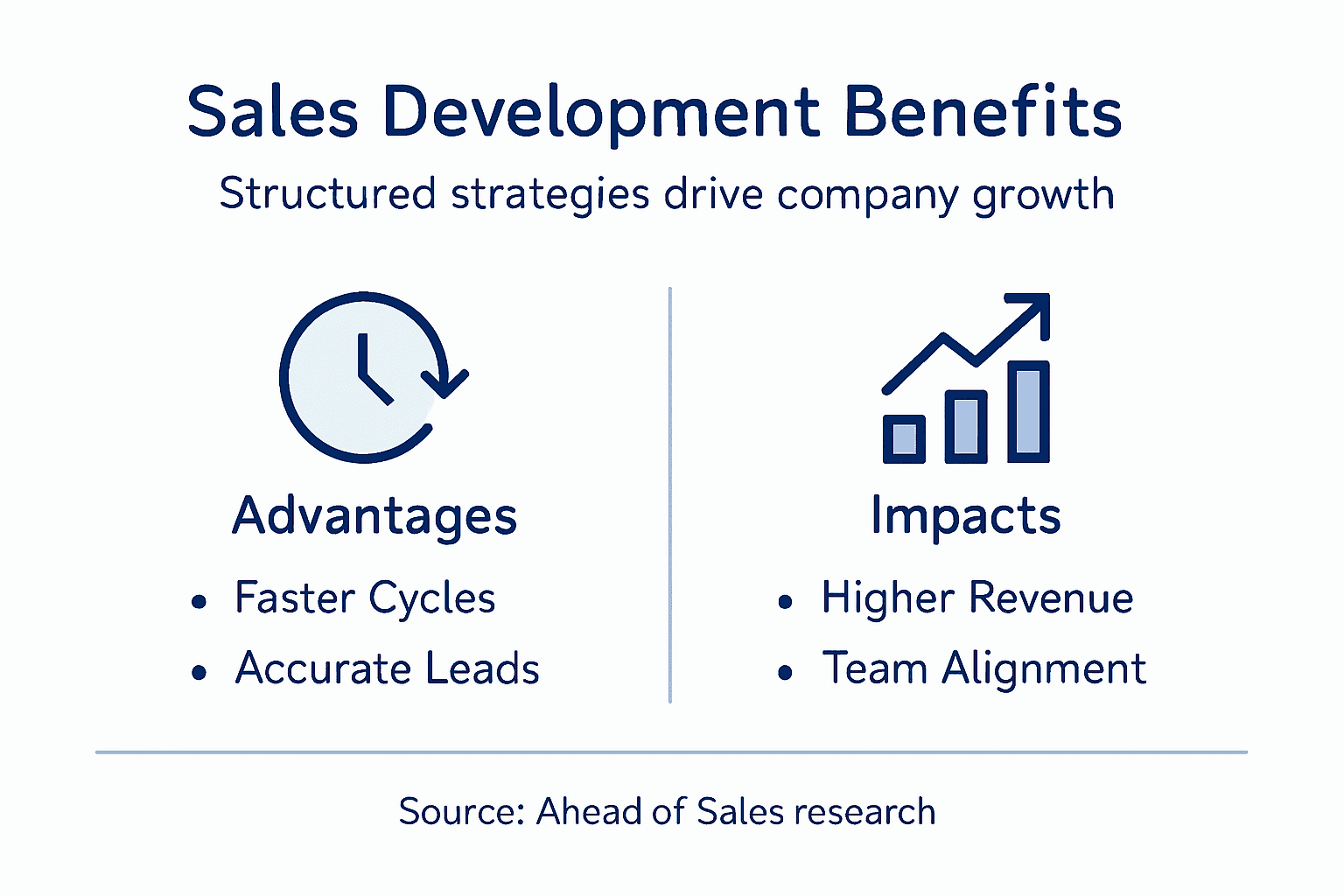
Here is a summary of the key business benefits delivered by structured sales development:
| Benefit | Description | Business Impact |
|---|---|---|
| Faster Sales Cycles | Streamlines qualifying and prospecting steps | Boosts revenue velocity |
| Accurate Lead Scoring | Assesses lead quality systematically | Increases conversion rates |
| Enhanced Collaboration | Improves marketing and sales alignment | Reduces lead leakage |
| Focused Prospecting | Prioritises high-potential opportunities | Maximises team efficiency |
Pro tip: Invest in creating clear, documented sales development processes that align marketing and sales objectives for maximum organisational effectiveness.
Key Components of a Sales Development Strategy
A comprehensive sales development strategy requires a multifaceted approach that goes beyond traditional sales methodologies. Successful sales strategies demand a sophisticated understanding of customer needs, market dynamics, and organisational capabilities. This strategic framework involves creating a robust system that continuously adapts and refines sales processes to drive consistent growth.
The core components of an effective sales development strategy include:
- Defining clear, measurable sales objectives
- Developing detailed buyer personas
- Creating compelling value propositions
- Implementing advanced customer relationship management (CRM) tools
- Establishing systematic lead qualification processes
- Designing performance tracking and analytics mechanisms
Effective sales development strategies prioritise understanding the target audience with extraordinary depth. This means going beyond basic demographic information to develop nuanced insights into customer motivations, pain points, and decision-making processes. By crafting personalised approaches tailored to specific customer segments, organisations can significantly enhance their conversion potential.

Technological integration plays a critical role in modern sales development. Sales automation tools and sophisticated CRM systems enable teams to streamline workflows, track interactions more precisely, and make data-driven decisions. These technologies transform raw customer data into actionable intelligence, allowing sales professionals to focus their energy on high-potential opportunities rather than administrative tasks.
Pro tip: Regularly conduct comprehensive sales strategy reviews, analysing performance metrics and market shifts to ensure continuous adaptation and improvement.
Best Practices for Building High-Performing Teams
Building a truly exceptional sales team requires a strategic and holistic approach that goes far beyond traditional recruitment methods. High-performing sales teams demand a nuanced understanding of individual capabilities, team dynamics, and organisational culture. Success hinges on creating an environment that nurtures talent, encourages continuous growth, and maintains a laser-focused commitment to performance excellence.
Key strategies for developing top-tier sales teams include:
- Implementing rigorous recruitment processes that assess both technical skills and cultural fit
- Designing comprehensive onboarding programmes
- Creating personalised professional development pathways
- Establishing clear, challenging performance metrics
- Developing robust mentorship and coaching frameworks
- Implementing transparent recognition and reward systems
Talent development represents the cornerstone of high-performing sales teams. Continuous learning is not merely an option but a fundamental requirement in today’s rapidly evolving business landscape. Organisations must invest in ongoing training that goes beyond traditional skills development, focusing on adaptive learning techniques that help sales professionals navigate complex customer interactions and emerging market challenges.
Motivational strategies play a critical role in team performance. Successful teams are built on a foundation of psychological safety, where team members feel empowered to take calculated risks, share innovative ideas, and collaborate seamlessly. This involves creating a culture that celebrates individual achievements while emphasising collective success and mutual support.
Pro tip: Conduct quarterly skill assessments and personalised development conversations to ensure your sales team remains agile, motivated, and continuously improving.
Risks and Costs of Neglecting Sales Development
Neglecting sales development is not merely a missed opportunity—it’s a strategic vulnerability that can silently erode an organisation’s competitive potential. Hidden organizational costs emerge when companies fail to invest systematically in their sales talent, creating a cascade of performance-related challenges that compound over time.
The most significant risks of neglecting sales development include:
- Increased staff turnover and recruitment expenses
- Stagnation of individual and team performance
- Weakened client relationship management capabilities
- Reduced adaptability to market changes
- Diminished competitive positioning
- Potential revenue loss and missed growth opportunities
Talent retention becomes particularly challenging when organisations fail to provide clear professional development pathways. Sales professionals are inherently driven by growth opportunities, and without structured learning and advancement mechanisms, top performers will inevitably seek environments that offer more comprehensive career progression. This creates a destructive cycle where the most skilled individuals consistently migrate to companies demonstrating genuine commitment to their professional evolution.
Financial implications extend far beyond immediate talent management concerns. Organisations that underinvest in sales development typically experience prolonged periods of reduced productivity, increased training costs through constant new recruitment, and a gradual erosion of institutional knowledge. The cumulative impact can translate into substantial long-term revenue constraints and competitive disadvantages that are difficult to reverse.
Pro tip: Conduct an annual skills gap analysis to proactively identify and address potential developmental needs within your sales team.
Comparing Alternatives: In-House vs Outsourced Approaches
Navigating the complex landscape of sales development requires carefully evaluating different strategic approaches. Business development strategies reveal multiple pathways for organisations seeking to optimise their sales performance, each with distinctive advantages and potential challenges.
Key considerations for comparing in-house and outsourced sales development include:
- Initial and ongoing investment requirements
- Organisational control and strategic alignment
- Speed of implementation
- Access to specialised expertise
- Scalability and flexibility
- Cultural integration capabilities
- Performance measurement mechanisms
In-house sales development offers unprecedented strategic control and deep alignment with company culture. By building internal capabilities, organisations can develop teams with intimate product knowledge and nuanced understanding of their specific market dynamics. This approach enables more personalised training, direct oversight, and seamless integration of sales strategies with broader organisational objectives.
Outsourced sales development provides alternative advantages, particularly for organisations seeking rapid scalability and specialised expertise. External partners bring extensive experience across multiple industries, advanced technological capabilities, and proven methodological frameworks that can accelerate sales performance. While potential misalignment risks exist, strategic partnerships can mitigate these challenges through robust communication and clearly defined expectations.
The following table compares in-house and outsourced sales development approaches:
| Aspect | In-House Approach | Outsourced Approach |
|---|---|---|
| Control | Direct oversight of team | Limited day-to-day control |
| Expertise | Company-specific knowledge | Broad industry experience |
| Speed of Ramp-Up | Longer setup and training period | Rapid deployment possible |
| Cultural Integration | Fully aligned with corporate values | May require adaptation |
| Cost Structure | Fixed hiring and training expenses | Variable, can scale with usage |
Pro tip: Consider a hybrid approach that combines internal strategic direction with external specialist insights to maximise sales development effectiveness.
Unlock Maximum Growth Through Expert Sales Development
If you recognise the challenges of creating structured sales development processes and aligning your marketing and sales teams for consistent growth this is your moment to act. Many organisations struggle with slow sales cycles and unqualified leads yet the solution lies in tailored coaching and proven strategies that sharpen focus and boost conversion rates. Our approach addresses the exact pain points of lead qualification, performance tracking and team motivation discussed in the article.
Explore our expert insights in the Sales Strategy Archives – Ahead of Sales and discover how bespoke 1:1 coaching combined with hands-on training can transform your sales performance. Whether you lead a growing business or a solo service venture our packages are designed to deliver at least 50% sales growth annually while ensuring your sales team hits targets every quarter. Do not let fragmented sales development slow your momentum. Visit Ahead of Sales to learn more and take the first step towards accelerating your sales success.
Frequently Asked Questions
Why is sales development important for businesses?
Sales development is crucial as it creates structured, efficient processes that bridge the gap between marketing leads and actual sales conversions, leading to systematic growth and improved lead management.
What are the benefits of a structured sales development strategy?
A structured sales development strategy can lead to faster sales cycles, more accurate lead scoring, enhanced collaboration between teams, and focused prospecting, ultimately maximising team efficiency and revenue generation.
How can technology enhance sales development processes?
Technology, particularly sales automation tools and advanced CRM systems, enables teams to streamline workflows, track interactions precisely, and make data-driven decisions, transforming raw customer data into actionable insights.
What are the potential risks of neglecting sales development?
Neglecting sales development can result in increased staff turnover, stagnation in performance, weakened client relationships, and ultimately, a loss of revenue and competitive positioning.