
TL;DR:
- Inside sales management involves leading remote teams through coaching and data-driven processes to generate consistent revenue. It emphasizes proactive coaching, clear metrics, and organizational structure, distinct roles for VP and Director, and the use of multi-channel outreach and signals for better results. Effective management relies on discipline, scalable processes, and leveraging appropriate technology to forecast and improve team performance.
Inside sales management is the practice of leading remote sales teams through structured coaching, data-driven forecasting, and deliberate process design to generate consistent revenue without face-to-face selling. It sits at the intersection of people leadership and operational discipline. A first-line manager typically leads 5–8 quota-carrying reps, with on-target earnings ranging from $200,000 to $280,000 split between base and commission. That team size is not arbitrary. It reflects the coaching load a single manager can carry while still running pipeline reviews, forecasting, and cross-functional work. Get the structure right and everything else becomes easier.
What are the primary responsibilities of an inside sales manager?
Inside sales management is not about being the best closer on the team. The job is to scale results through other people. That shift in mindset separates average managers from exceptional ones.
A manager’s weekly time typically divides as follows:
- Coaching and call reviews: 30–60 minutes per rep per week
- Pipeline and deal review: roughly 20% of available time
- Forecasting: around 15% of the week
- Hiring and onboarding: approximately 15%
- Cross-functional collaboration: the remaining 10%
The coaching allocation is the most important number on that list. One hour of targeted, proactive coaching delivers more revenue impact than four hours of reactive deal review. Most managers get this backwards. They spend the bulk of their time firefighting late-stage deals rather than improving the behaviours that fill the top of the funnel.
Deal reviews matter, but they should catch risks early, not rescue deals that have already stalled. A weekly 1-on-1 that covers one specific skill gap, backed by a recorded call, is far more effective than a general check-in. The same principle applies to hiring. Bringing in the wrong rep costs months of ramp time, so building a repeatable interview process is as important as any coaching framework.

Pro Tip: Keep a shared “coaching log” for each rep. Note the skill you focused on, what changed, and what to revisit next week. Over a quarter, this becomes a performance record that makes appraisals and promotion decisions straightforward.
How do inside sales leadership roles differ and collaborate?
The VP and Director roles in inside sales serve genuinely different purposes. Conflating them creates confusion, misaligned priorities, and gaps in execution.
| Role | Primary focus | Time horizon |
|---|---|---|
| VP of Inside Sales | Business economics, strategy, resource allocation | Quarterly and annual |
| Director of Inside Sales | Team performance, quota attainment, daily execution | Weekly and monthly |
The VP designs the business model and secures the resources the team needs to operate. That means working with finance on headcount plans, with marketing on lead quality, and with the board on growth targets. The Director translates that strategy into daily activity on the sales floor. They run the pipeline reviews, manage rep performance, and own the number each quarter.
When these roles collaborate well, the organisation gets both long-term vision and short-term execution. The VP spots a shift in market conditions and adjusts the go-to-market approach. The Director implements the change with the team within days. Without both layers, either the strategy drifts or the execution stalls. Separating the roles also makes the organisation more scalable. As the team grows from 10 reps to 50, the Director absorbs the operational load while the VP focuses on structure and investment.
What effective tactics and coaching practices drive high-performing inside sales teams?
High performance in inside sales comes from repeatable behaviours, not individual heroics. The manager’s job is to identify which behaviours move the needle and then coach them consistently.
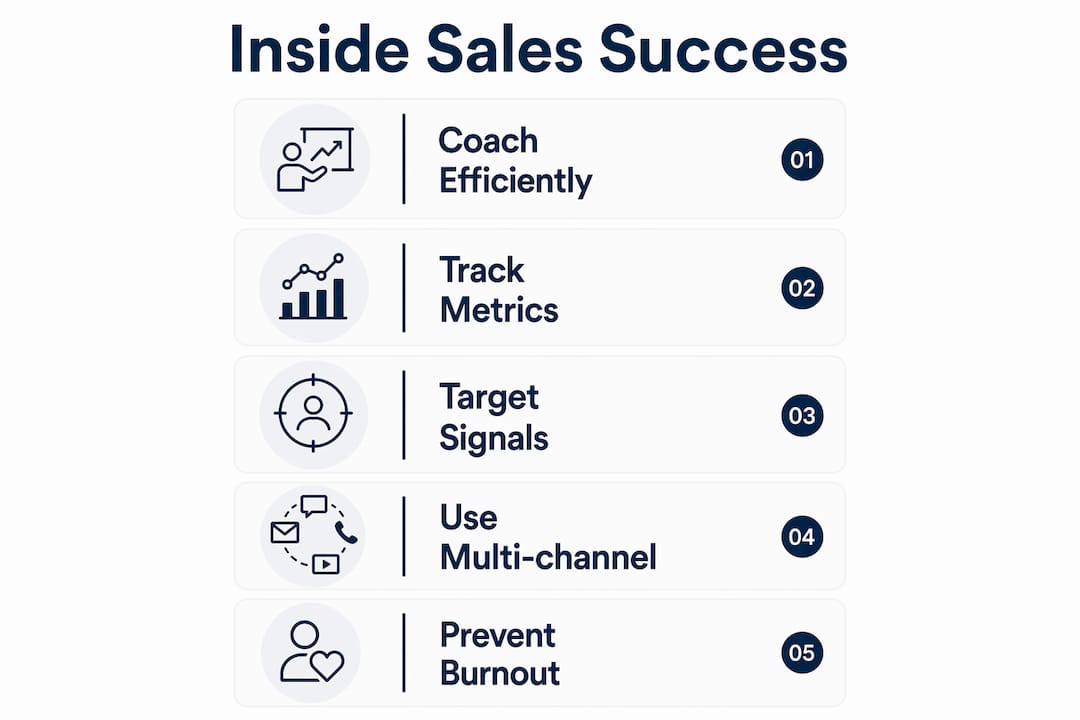
1. Cap coaching time to avoid micromanagement
The best managers balance live call reviews with role-play sessions, capped at 30–60 minutes per rep per week. Going beyond that tips into micromanagement, which kills rep confidence and autonomy. Pick one skill per session and go deep rather than covering five things superficially.
2. Focus on leading indicators, not just revenue
High-performing teams prioritise call-to-meeting conversion rates and pipeline velocity over end-of-quarter revenue totals. Revenue is a lagging indicator. By the time it looks bad, the problem is weeks old. Call-to-meeting conversion tells you today whether your reps are booking enough conversations to hit next month’s number.
3. Use multi-channel outreach sequences
Multi-channel sequences combining email, LinkedIn, and phone produce 32% more meetings booked compared to email-only outreach. That is a significant lift for no additional headcount. The key is sequencing the channels intelligently rather than blasting all three simultaneously.
4. Adopt signal-based targeting
Signal-based targeting produces a qualified meeting booking rate of 3–6% of outreach touches, compared to 1–3% for traditional cold lists. Signals include job changes, funding announcements, technology installations, and intent data from content consumption. Reps who target accounts showing active buying signals spend less time on dead ends and more time on conversations that convert. You can find more on how to apply this through consultative selling techniques that complement signal-based approaches.
5. Prevent burnout with structured routines
Burnout is the silent killer of inside sales performance. Reps who make 80 calls a day with no structure or feedback deteriorate quickly. A predictable daily rhythm, clear activity targets, and regular recognition of progress all reduce attrition. Managers who treat wellbeing as a performance variable, not a soft concern, retain their best reps far longer.
Pro Tip: Run a monthly “wins board” where reps share one deal they are proud of, regardless of whether it closed. Celebrating the process, not just the outcome, builds a culture where reps stay engaged through slow patches.
Which metrics and technologies optimise inside sales management effectiveness?
The right metrics tell you where to coach before problems become crises. The right technology reduces the time you spend gathering data so you can spend more time acting on it.
Key metrics to track
| Metric | What it tells you |
|---|---|
| Pipeline coverage ratio | Whether the team has enough opportunities to hit quota |
| Deal stage conversion rate | Where deals stall and which reps need targeted coaching |
| Call-to-meeting conversion | Whether outreach quality is strong enough to fill the pipeline |
| Forecast accuracy | How reliable the team’s deal assessments are |
| Pipeline velocity | How quickly deals move from first contact to close |
Pipeline coverage ratio is the most underused metric in inside sales. A healthy ratio sits at 3x to 4x quota. If your team needs to close £500,000 this quarter, you want £1.5–2 million in qualified pipeline. Anything below 3x and you are already behind, regardless of what the forecast says.
The three-touch weekly forecast routine
The three-touch weekly forecast routine is a proactive method where reps update their pipeline status three times per week. This prevents the classic end-of-quarter surprise where a deal that looked certain suddenly disappears. It also builds forecasting discipline into the team’s habits rather than treating it as a monthly admin task.
Technology categories that matter
Automated sequence tools integrated with CRM allow managers to focus on exceptions rather than auditing every deal manually. Instead of reviewing 50 open opportunities each week, the system flags the 8 that have gone quiet. That is management by exception, and it is far more efficient than traditional manual auditing.
The three technology categories worth investing in are CRM platforms for data centralisation, engagement platforms for sequence management, and conversation intelligence tools for call review. Conversation intelligence in particular accelerates coaching because managers can review call snippets rather than listening to full recordings. For a detailed comparison of coaching tools, the sales coaching software comparison from Aheadofsales covers the key options available in 2025 and 2026.
How should inside sales management strategies evolve post-2025?
The conditions inside sales teams operate in are shifting. Managers who adapt early will pull ahead. Those who do not will find their teams working harder for diminishing returns.
- AI in sequence management: AI tools now personalise outreach at scale, adjusting messaging based on prospect behaviour. Managers need to understand how these tools work to coach reps on using them well, not just switching them on and hoping for results.
- Signal-based targeting as standard: Cold list outreach is becoming less effective each year. Building processes around intent signals and trigger events will become a baseline expectation, not a competitive advantage.
- Rep wellbeing as a retention strategy: The cost of replacing a trained inside sales rep is significant. Managers who build sustainable workloads and clear career progression paths will retain talent that others lose.
- Multi-channel as the default: The multi-channel approach to outreach is already proving its value in adjacent disciplines. Inside sales teams that treat LinkedIn, email, and phone as a coordinated system rather than separate activities will consistently outperform single-channel teams.
- Continuous skill development: The inside sales training programme you ran two years ago is already partially obsolete. Buyer behaviour, technology, and competitive dynamics all shift. Building a quarterly skills review into your management rhythm keeps the team current.
Key takeaways
Effective inside sales management combines structured coaching, leading-indicator metrics, and the right technology to produce consistent, scalable revenue growth.
| Point | Details |
|---|---|
| Team size and structure | A first-line manager leads 5–8 reps; exceeding this reduces coaching quality and forecast accuracy. |
| Coaching discipline | Cap coaching at 30–60 minutes per rep per week and focus on one skill at a time to avoid micromanagement. |
| Leading indicators | Track call-to-meeting conversion and pipeline velocity weekly, not just end-of-quarter revenue. |
| Dual leadership model | VP and Director roles serve different time horizons; separating them improves both strategy and execution. |
| Multi-channel outreach | Combining email, LinkedIn, and phone produces 32% more meetings than single-channel approaches. |
What I have learned from years inside sales management
The biggest mistake I see managers make is acting like a super-rep. They jump into deals, take over calls, and close opportunities their reps should be closing themselves. It feels productive in the moment. The number goes up this week. But the rep learns nothing, and the manager is now doing two jobs badly instead of one job well.
The managers I have seen build genuinely high-performing teams do the opposite. They remove blockers, improve discovery skills, and create conditions where reps can succeed independently. They use the sales meeting best practices that keep 1-on-1s focused and productive rather than turning them into status updates.
The other thing I would say is this: your forecast is only as good as your pipeline hygiene. If reps are not updating their CRM accurately, your three-touch routine is just theatre. The discipline has to be non-negotiable, and it starts with the manager modelling it themselves.
The teams that consistently hit target are not the ones with the most talented reps. They are the ones with the most consistent processes, the clearest metrics, and a manager who coaches proactively rather than reactively. That is the job. Everything else is noise.
— Jerry
How Aheadofsales can sharpen your inside sales team
Running an inside sales team well requires more than good intentions. It requires a clear system, a coaching framework, and the ability to spot what is holding your team back before it costs you a quarter.
Aheadofsales works with businesses of 50–1,000 staff to build exactly that. Through bespoke 1:1 coaching, structured sales training programmes, and hands-on consultancy, we help inside sales managers move from reactive firefighting to proactive, data-led leadership. Our clients target at least 50% sales growth per year and hit their quarterly numbers consistently. If that is the standard you are working towards, the sales consultancy services at Aheadofsales are built for exactly this kind of work. Packages start from £4,500.
FAQ
What is inside sales management?
Inside sales management is the leadership and operational oversight of a remote sales team, covering coaching, forecasting, pipeline management, and performance tracking. It focuses on driving consistent revenue without face-to-face selling.
How many reps should an inside sales manager lead?
A first-line inside sales manager typically leads 5–8 quota-carrying reps. Exceeding this number reduces the quality of coaching and makes accurate forecasting significantly harder.
What are the most important metrics for inside sales teams?
The most important metrics are call-to-meeting conversion rate, pipeline coverage ratio, deal stage conversion, and pipeline velocity. These leading indicators give managers early warning of performance problems before they affect revenue.
How often should inside sales managers coach their reps?
Managers should allocate 30–60 minutes of focused coaching per rep per week. Proactive coaching based on early performance signals delivers more revenue impact than reactive deal rescue conversations.
What is the difference between a VP and a Director of Inside Sales?
A VP of Inside Sales focuses on business strategy, financial planning, and long-term growth. A Director of Inside Sales manages daily team execution, quota attainment, and operational performance. Both roles are necessary for a scalable inside sales organisation.