
Setting quarterly sales targets is rarely straightforward for growing British businesses. The pressure to deliver results mounts as each new quarter arrives, yet the path to sustained growth often feels unclear without a structured approach. By focusing on SMART targets, careful data analysis, and precise alignment with your organisation’s objectives, you can transform ambitious plans into real-world outcomes your sales team can achieve.
Table of Contents
- Step 1: Assess Current Sales Data And Trends
- Step 2: Define Measurable And Ambitious Targets
- Step 3: Align Targets With Business Objectives
- Step 4: Allocate Quotas By Team And Individual
- Step 5: Track Progress And Adjust Strategies
Quick Summary
| Main Insight | Explanation |
|---|---|
| 1. Analyse Sales Data Thoroughly | Examine historical sales data to understand trends and patterns that influence revenue generation before setting targets. |
| 2. Set SMART Sales Targets | Use the SMART framework to ensure targets are specific, measurable, achievable, relevant, and time-bound for effective goal-setting. |
| 3. Align Targets with Business Goals | Connect sales targets directly with the organisation’s broader strategic objectives to ensure meaningful contributions to overall growth. |
| 4. Implement Fair Quota Allocation | Distribute sales quotas thoughtfully among individuals and teams, balancing potential with historical performance for motivation and fairness. |
| 5. Regularly Track and Adjust Strategies | Continuously monitor performance against targets and adjust strategies based on real-time data to maintain sales momentum and improve outcomes. |
Step 1: Assess Current Sales Data and Trends
To set sustainable sales targets, you must first conduct a thorough analysis of your existing sales performance. This critical step involves examining historical data, identifying trends, and understanding the underlying patterns that drive your business’s revenue generation.
Begin by collecting comprehensive sales data from multiple sources. This includes reviewing monthly and quarterly sales reports, tracking retail sales trends through authoritative industry summaries, and comparing your organisation’s performance against sector benchmarks. The goal is to create a holistic view of your sales landscape.
Key areas to investigate include:
- Total revenue for the past 12-24 months
- Sales performance by product or service category
- Seasonal variations and revenue fluctuations
- Customer acquisition and retention rates
- Average transaction value
- Conversion rates across different sales channels
Utilise both internal data from your customer relationship management (CRM) system and external resources like the monthly retail trade sales reports to validate your findings. This cross-referencing ensures a more robust and accurate assessment.
Here is a comparison of internal versus external sales data sources and their respective advantages:
| Data Source Type | Typical Examples | Key Advantages |
|---|---|---|
| Internal | CRM records, sales reports | Provides granular, company-specific insights |
| External | Industry benchmarks, market reports | Offers competitive context and trend analysis |
Remember: Data without context is just numbers. Seek to understand the story behind the statistics.
Analysing these metrics will provide insights into your current sales trajectory and help you establish realistic, achievable growth targets.
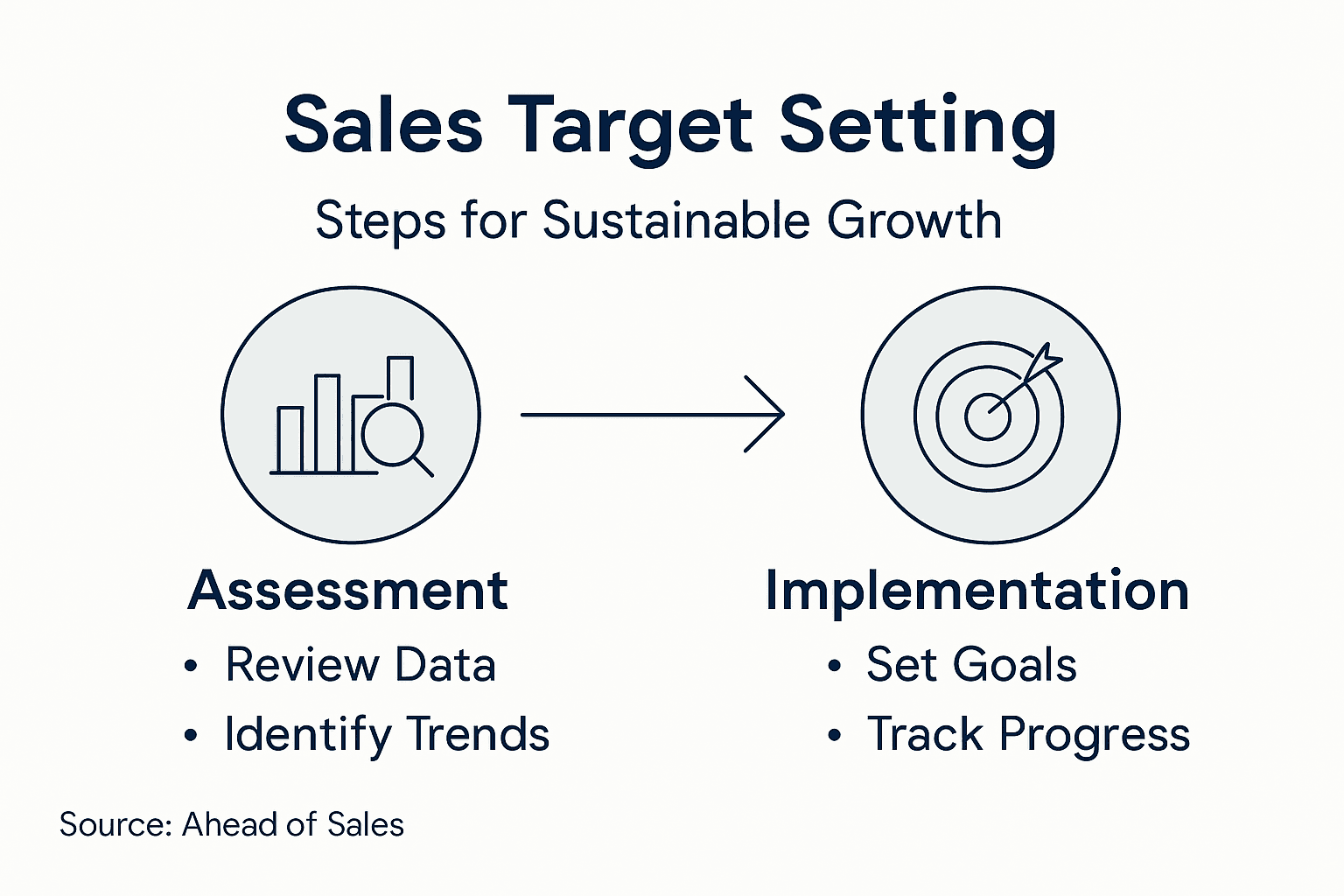
Top tip: Create a visual dashboard that tracks your key performance indicators to make data trends instantly comprehensible at a glance.
Step 2: Define Measurable and Ambitious Targets
Setting strategic sales targets requires a systematic approach that balances aspiration with achievability. Your goals must be challenging enough to drive growth while remaining realistic and motivating for your sales team.
To accomplish this, adopt the SMART goal framework which ensures your targets are comprehensive and actionable. This methodology helps you create objectives that are:
- Specific: Clearly defined and unambiguous
- Measurable: Quantifiable with precise metrics
- Achievable: Realistic given your current capabilities
- Relevant: Aligned with broader business objectives
- Time-bound: Constrained by a specific deadline
When developing targets, consider both percentage growth and absolute revenue figures. For instance, you might set a goal to increase quarterly sales by 15% or achieve £250,000 in new business within six months. Impact mapping techniques can further help align these targets with specific actions and stakeholder expectations.
Ambitious targets motivate teams, but unrealistic goals can demotivate. Find the delicate balance between challenge and attainability.
Ensure your targets are granular, breaking down overarching objectives into smaller, manageable milestones that provide clear direction and frequent opportunities for validation and adjustment.

Top tip: Create a visual target tracking system that allows your team to see real-time progress and celebrate incremental achievements.
Step 3: Align Targets with Business Objectives
Successful sales targeting requires more than arbitrary numerical goals. You must strategically connect your sales targets to your organisation’s broader vision and strategic priorities, ensuring every target contributes meaningfully to overall business growth.
Strategic objectives demand precise alignment between sales performance and organisational goals. This means developing targets that reflect multiple dimensions of business success, including:
- Market positioning
- Innovation capabilities
- Productivity improvements
- Profitability metrics
- Customer satisfaction levels
- Long-term competitive advantages
Each sales target should serve as a building block towards your company’s larger strategic plan. Developing organisational objectives/02%3A_Strategic_Planning/02.3%3A_Developing_Organizational_Objectives_and_Formulating_Strategies) involves creating specific, measurable goals that translate high-level strategic intentions into actionable sales outcomes.
Your sales targets are not isolated metrics, but interconnected drivers of organisational success.
Consider conducting a comprehensive review with leadership to ensure your sales targets genuinely reflect and support the company’s mission, values, and long-term strategic vision.
Below is a summary of how sales targets align with broader business goals:
| Strategic Priority | Example Sales Target | Organisational Benefit |
|---|---|---|
| Market Expansion | Enter two new regions in Q2 | Diversifies revenue sources |
| Innovation | Launch three new products | Enhances customer offering |
| Profitability | Improve gross margin by 5% | Increases financial health |
| Customer Satisfaction | Achieve 90% positive feedback | Builds loyalty and repeat business |
Top tip: Schedule quarterly alignment sessions with senior management to continuously validate and recalibrate your sales targets against evolving business objectives.
Step 4: Allocate Quotas by Team and Individual
Effective quota allocation transforms company-wide sales goals into actionable individual targets that motivate and guide your sales team towards collective success. This critical process requires a nuanced approach that balances organisational objectives with individual capabilities.
Sales quota management involves carefully distributing revenue expectations across teams and individuals. When allocating quotas, consider multiple sophisticated factors:
- Individual historical performance
- Territory potential and complexity
- Sales representative skill levels
- Previous years’ achievement rates
- Market opportunities within specific segments
- Representative experience and tenure
The objective is creating a fair and motivational quota system that challenges each team member while remaining achievable. Successful quota allocation requires ongoing coaching, transparent feedback, and a deep understanding of each sales professional’s unique strengths and potential.
Quotas are not punitive targets, but strategic tools for driving individual and collective performance.
Consider implementing a dynamic allocation model that allows periodic reassessment and adjustment, ensuring your quota structure remains responsive to changing market conditions and individual growth.
Top tip: Conduct individual quota consultation meetings where sales representatives can provide input and understand the rationale behind their specific targets.
Step 5: Track Progress and Adjust Strategies
Constant monitoring and strategic adaptation are essential for maintaining sales momentum and achieving sustainable growth. Your sales tracking approach must be dynamic, responsive, and data-driven to ensure continuous improvement and performance optimisation.
Sales performance tracking requires a comprehensive system of Key Performance Indicators that provide real-time insights into your team’s progress. Essential metrics to monitor include:
- Revenue generation against targets
- Sales conversion rates
- Individual and team quota achievement
- Customer acquisition costs
- Pipeline velocity
- Sales cycle duration
- Average deal size
Effective sales management demands proactive strategy adjustment based on these performance indicators. This means regularly reviewing data, identifying trends, and implementing targeted interventions to address any performance gaps.
Progress tracking is not about punishment, but about understanding and improving your sales ecosystem.
Implement a monthly or quarterly review process that allows for agile strategy refinement, ensuring your sales approach remains aligned with changing market conditions and organisational objectives.
Top tip: Create a visual dashboard that transforms complex sales data into easily digestible insights, enabling quick strategic decisions.
Drive Sustainable Growth by Mastering Sales Target Setting
Are you struggling to set realistic yet ambitious sales targets that truly align with your business goals and sales team capabilities The challenge of transforming data-driven insights into measurable growth can feel overwhelming. This article highlighted the importance of using frameworks like SMART goals and aligning your quotas with organisational objectives to create momentum that lasts.
At Ahead of Sales we specialise in turning these principles into action through bespoke 1 to 1 coaching, traditional training, and consultancy tailored for businesses ready to achieve at least 50 per cent sales growth annually. Whether you lead a growing company with 50 to 1000 staff or a solo service business aiming to hit new performance peaks our sales acceleration programmes are designed to ensure your team hits target every quarter while sustaining healthy expansion.
Explore how a strategic, data-backed Sales Strategy Archives – Ahead of Sales approach can revolutionise your sales targets and quota allocation. See how practical sales playbooks turn theory into execution by visiting our Sales Playbook Archives – Ahead of Sales.

Take control of your sales growth journey now by partnering with the experts at Ahead of Sales. Unlock bespoke coaching and tailored programmes that transform your sales data into clear, motivating targets that drive continual success. Start today to build a sales strategy that delivers consistent, sustainable results quarter after quarter.
Frequently Asked Questions
How do I assess my current sales data before setting targets?
To assess your current sales data, review historical performance over the past 12-24 months, focusing on key metrics such as total revenue, sales by product category, and customer retention rates. Gather this data from your internal systems and external resources to create a comprehensive overview that aids in target setting.
What framework should I use to define my sales targets?
Utilise the SMART goal framework to define your sales targets, ensuring they are Specific, Measurable, Achievable, Relevant, and Time-bound. For instance, aim to increase quarterly sales by 15%, allowing for a clear and actionable goal.
How can I align my sales targets with overall business objectives?
To align sales targets with business objectives, ensure each target reflects your organisation’s strategic priorities such as market positioning and customer satisfaction. Schedule regular reviews with leadership to validate these targets and adjust them as needed to support your overall vision.
What factors should I consider when allocating sales quotas?
Consider factors like individual performance history, market potential, and the complexity of sales territories when allocating sales quotas. Distributing quotas fairly based on these elements will motivate your team while catering to each member’s capabilities.
How do I track progress towards my sales targets effectively?
Implement a robust system of Key Performance Indicators to monitor metrics such as revenue against targets, sales conversion rates, and average deal size. Set up a monthly review process to analyse these data points, allowing for real-time strategy adjustment based on performance insights.
When should I adjust my sales strategies based on performance data?
Adjust your sales strategies when you identify consistent performance gaps or declining metrics during your regular reviews. This proactive approach ensures that your sales tactics remain effective, aiming for continuous improvement in results.
Recommended
- 7 Essential Sales Leadership Tips for Fast Growth – Ahead of Sales
- Defining Sales Growth Strategies: Accelerating Revenue
- Sales Growth Strategies 2025: Accelerate Quarterly Wins
- How to Accelerate Revenue Growth: Step-by-Step Guide
- How to Increase Online Sales Through Social Media Fast – Jarrod Harman
- Understanding the Role of Growth Tracking in Success – Optio Station: Best Project Management App for Prioritization
- 5 Strategies All Startups Must Have to Sustain Business Growth