
TL;DR:
- Most UK sales teams fail to achieve high performance due to poor cross-functional trust and outdated habits.
- Building a high-performing team requires aligning measurable customer value, ongoing coaching, and structured feedback loops.
Nearly every sales leader I speak to wants the same thing: a team that consistently hits target, quarter after quarter, without constant firefighting. Yet the gap between strategy and execution remains one of the most frustrating realities in UK sales leadership. The reasons are rarely obvious. It is not usually a lack of effort or ambition. More often, it comes down to misaligned foundations, outdated assumptions about what “high performance” actually means, and the absence of a structured, repeatable framework. This article gives you exactly that framework, drawing on trusted advisor principles that the world’s leading sales organisations are now applying at scale.
Table of Contents
- Defining high performance in sales: What matters most?
- Essential traits and prerequisites for building a high-performing sales team
- Step-by-step guide: Advanced strategies for high-performing sales teams
- Common pitfalls and how to verify your team’s performance
- Why most sales teams never reach high performance (and what we get wrong)
- Take your sales team to the next level
- Frequently asked questions
Key Takeaways
| Point | Details |
|---|---|
| Value-driven sales culture | Embedding measurable value in messaging and training drives sustainable high team performance. |
| Cross-functional alignment | Uniting marketing, enablement, and sales ensures consistency and trust at every client touchpoint. |
| Advanced coaching matters | Ongoing data-driven coaching and feedback cycles prevent stagnation and fuel growth. |
| Candid verification | Regular, honest evaluation and metrics tracking are crucial to maintaining high standards. |
Defining high performance in sales: What matters most?
With the fundamental challenge established, the first step is understanding what genuine high performance in sales truly means, beyond the usual buzzwords.
Most sales leaders, when pressed, define high performance as hitting revenue targets. That is a fair starting point, but it is far too narrow. A team that smashes a quarterly number by discounting heavily, burning through relationships, or cherry-picking easy wins is not high-performing. It is short-term lucky.
Genuinely high-performing sales teams share a distinct set of characteristics. They take a consultative approach to every conversation, focusing on the client’s business challenges rather than the product features they want to push. They are relentless about measurable value, meaning they can articulate, in numbers, what their solution delivers for the client. And they work in close coordination with marketing and sales enablement to ensure every message is consistent and commercially credible.
The sales team performance explained framework I use with clients consistently points to four core metrics worth tracking closely.
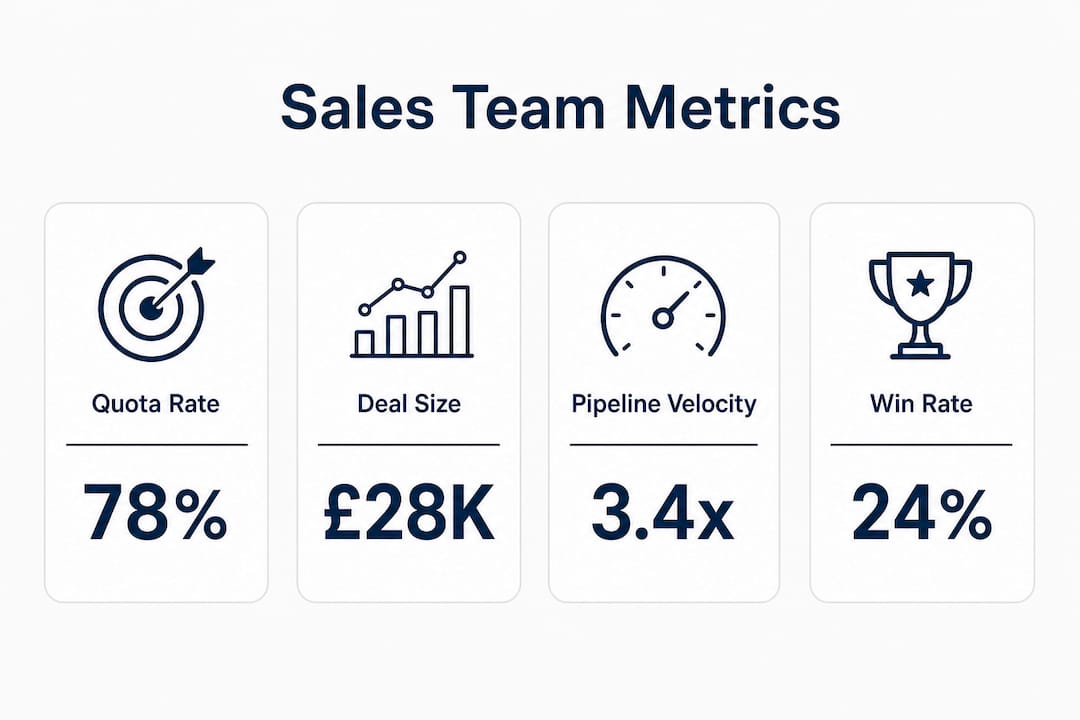
| Metric | What it measures | Why it matters |
|---|---|---|
| Quota attainment rate | % of reps hitting target | Reveals individual and team consistency |
| Sales cycle length | Average days from first contact to close | Shorter cycles often signal stronger value messaging |
| Win rate | % of qualified opportunities closed | Indicates quality of pipeline and sales skill |
| Customer retention | Renewal and upsell rates | Reflects genuine value delivered post-sale |
One of the biggest myths I encounter in the UK market is that volume solves everything. More calls, more emails, more outbound activity. In reality, quantifying customer outcomes and aligning your messaging to measurable ROI is what separates high performers from the rest. Trusted advisor status, where your clients genuinely see your team as a strategic partner rather than a vendor, is the gold standard. It is not achieved through volume. It is earned through consistent, evidence-based value delivery.
Tracking the right sales performance metrics is therefore not optional. It is the foundation on which everything else is built.
Essential traits and prerequisites for building a high-performing sales team
Armed with a clear definition of high performance, the next priority is ensuring your organisation is set up to cultivate those outcomes.

Getting the right people in the right roles is where most businesses either win or lose before the first sales conversation even happens. Role fit is about more than experience on a CV. You are looking for a balance of commercial skills, relevant sector knowledge, and genuine cultural alignment with how your business operates. Someone who thrived in a high-volume transactional environment may struggle in a complex, consultative B2B sale, even if their numbers looked impressive on paper.
Here is a practical sequence I recommend for building your foundation:
- Audit your current team. Use win/loss analysis data to identify where deals are being lost and which reps are consistently closing at higher margins. This tells you far more than a performance review.
- Define your ideal sales profile. Based on your audit, build a clear picture of the skills, behaviours, and attitudes that correlate with success in your specific market.
- Recruit to that profile. Resist the temptation to hire based on charisma alone. Structured interviews and role-play scenarios reveal far more about a candidate’s consultative capability.
- Invest in baseline training immediately. Every new hire, regardless of experience, should go through your value-selling and consultative approach training before they speak to a single prospect.
- Create a continuous learning environment. High-performing teams do not stop learning after onboarding. Weekly coaching, peer-to-peer deal reviews, and access to ongoing sales training services keep skills sharp and mindsets growth-oriented.
Cross-functional alignment between marketing, sales, and sales enablement is essential for consistent business-value messaging. When your sales team is saying one thing and your marketing collateral is saying something else, buyers notice. That inconsistency erodes trust before the relationship has even begun.
A structured sales team management workflow helps you coordinate these functions without creating bureaucracy. The goal is alignment, not administration.
Pro Tip: Run a quarterly win/loss analysis and share the findings across sales, marketing, and product teams. The patterns you uncover will reveal training gaps, messaging weaknesses, and product positioning issues that no individual team could spot on their own. Pair this with customer service training tips to ensure your post-sale experience reinforces the value your team promises during the sales process.
Step-by-step guide: Advanced strategies for high-performing sales teams
Now that your sales foundation is robust, let us look at the practical, next-level strategies that translate preparation into sustained, measurable success.
The most advanced sales organisations do not just train their teams and hope for the best. They build structured systems that embed high performance into daily habits and cross-functional workflows. Here is how to do it.
-
Align all messaging to measurable customer value. Every pitch deck, proposal, and discovery call should be anchored to specific, quantifiable outcomes for the client. Quantifying customer outcomes and aligning messaging to measurable ROI is the mechanism that elevates your team from product-pushers to trusted advisors.
-
Implement an advanced coaching framework. Move beyond monthly one-to-ones. The most effective coaching is frequent, deal-specific, and forward-looking. Review live opportunities, not just closed deals. Ask your reps what the client’s top three business priorities are, and if they cannot answer clearly, that is your coaching moment.
-
Embed cross-functional feedback loops. Create a formal process where sales feeds intelligence back to marketing (what objections are coming up, what content is resonating) and marketing feeds sales with updated messaging and case studies. This loop should run monthly at minimum.
-
Monitor and iterate on your performance indicators. Do not set KPIs and review them once a year. Build a rhythm of weekly pipeline reviews, monthly metric analysis, and quarterly strategic resets. The data will tell you where to focus coaching and where to adjust strategy.
-
Apply consultative selling methods at every stage of the cycle. This means asking better questions, listening more than talking, and positioning your solution in the context of the client’s specific challenges rather than your product’s generic benefits.
| Standard approach | Advanced high-performance approach |
|---|---|
| Product-led pitching | Value and outcome-led conversations |
| Annual training events | Continuous, deal-specific coaching |
| Siloed sales and marketing | Integrated feedback loops and shared messaging |
| Volume-focused KPIs | Balanced metrics including win rate and retention |
| Reactive pipeline management | Proactive opportunity qualification and velocity tracking |
Value selling strategies are not a nice-to-have at this level. They are the operating system your team runs on.
Pro Tip: Once a quarter, pull out your three most significant boardroom-level deals, whether won or lost, and run a structured debrief. What made the difference? Where did trusted advisor status hold, and where did it slip? The lessons from these reviews are worth more than any generic training module.
Common pitfalls and how to verify your team’s performance
Execution often produces hidden challenges. The final piece is identifying stumbling blocks and developing an objective approach to measuring ongoing team results.
Even teams with strong foundations and good intentions fall into predictable traps. Knowing what these are in advance gives you a significant advantage.
The most common pitfalls I see in mid-sized UK businesses include:
- Lack of ongoing coaching. Training is treated as an event rather than a habit. Once the initial programme ends, reps revert to old behaviours within weeks.
- Siloed teams. Sales operates in isolation from marketing, customer success, and product. The result is inconsistent messaging and missed opportunities to reinforce value throughout the client lifecycle.
- Chasing the wrong metrics. Focusing purely on activity numbers (calls made, emails sent) while ignoring outcome metrics (win rate, deal quality, retention) creates the illusion of productivity without the results.
- Assuming good performance will continue without intervention. High performers need challenge and development just as much as struggling reps. Neglecting your top talent is one of the fastest ways to lose them.
High-performing teams act as trusted advisors by consistently quantifying and delivering customer value. That consistency does not happen by accident. It requires regular, structured verification.
“Consistent high performance relies on regular, candid evaluations, not assumptions.”
To verify your team’s performance objectively, build these practices into your rhythm:
Establish a formal win/loss review cycle, ideally monthly. This should involve both the sales rep and, where possible, direct feedback from the client or prospect. The advantages of consultative selling become clearest when you compare win rates before and after implementing a structured consultative approach.
Use performance dashboards that display real-time data on pipeline velocity, quota attainment, and average deal size. Pipeline velocity (how quickly opportunities move through your funnel) is particularly revealing. A slowing velocity often signals messaging problems or qualification weaknesses long before the revenue impact shows up.
Review your sales performance metrics at both the individual and team level. Aggregate numbers can mask significant variation between reps, and that variation is where your most valuable coaching opportunities live.
Why most sales teams never reach high performance (and what we get wrong)
Here is the uncomfortable truth I have observed working with sales teams across the UK: most organisations invest in process and technology before they invest in culture and alignment. They buy a new CRM, roll out a new sales methodology, and then wonder why performance has not shifted six months later.
The real barrier to high performance is rarely a lack of tools or frameworks. It is a lack of genuine cross-functional trust and shared accountability. When sales blames marketing for poor-quality leads, and marketing blames sales for not following up properly, no amount of process improvement will fix the underlying dynamic.
I also see a persistent tendency to hire “old school” salespeople, those who rely on charm, persistence, and relationship-building alone, over adaptive, learning-focused individuals who are willing to change how they sell based on evidence. The market has shifted. Buyers are more informed, more sceptical, and more demanding of measurable value than they were a decade ago. A team built on personality rather than consultative skill will struggle to keep pace.
The missed opportunity that costs businesses the most is failing to embed measurable value into every single client conversation. Not just in the pitch, but in follow-up emails, quarterly business reviews, renewal conversations, and upsell discussions. Every touchpoint is a chance to reinforce why your solution matters in commercial terms. Most teams let those moments pass without capitalising on them.
If you are serious about changing this, start with culture and buy-in before you layer on any new technology or process. Get your leadership team aligned on what high performance actually looks like, agree on the metrics that matter, and create an environment where honest feedback is welcomed rather than avoided. Then bring in the frameworks. Our sales consultancy services are built around exactly this sequence, because we have seen too many businesses do it the other way round and stall.
Take your sales team to the next level
If you have read this far, you already know that building a high-performing sales team is not a one-off project. It is an ongoing commitment to the right foundations, the right strategies, and the right support structures. The businesses that achieve 50% or more sales growth year on year are not doing anything magical. They are applying proven frameworks consistently, with expert guidance and honest accountability.
At Ahead of Sales, we combine bespoke 1:1 coaching with structured sales training services and consultancy to help mid-sized UK businesses hit target every quarter. Whether you are looking for a complete team transformation or a targeted sales acceleration packages to fast-track results, we have a solution designed for your stage of growth. If you want to understand why investing in your team is the highest-return decision you can make right now, our sales training matters guide is a great place to start.
Frequently asked questions
What is the most critical factor in building high-performing sales teams?
Cross-functional alignment between marketing, sales, and sales enablement is essential, as it creates the consistent business-value messaging that separates high-performing teams from the rest. Without this alignment, even talented reps will struggle to deliver a coherent, credible proposition to buyers.
How can I measure if my sales team is truly high performing?
Track measurable ROI, customer outcomes, and pipeline velocity alongside traditional metrics, because quantifying customer outcomes and aligning enablement to measurable ROI is the industry benchmark for genuine high performance. A team consistently delivering on these indicators is operating at the level that matters.
What are common mistakes to avoid when building sales teams?
Avoid siloed structures, volume-only KPIs, and irregular coaching, because trusted advisor status is built through consistent value delivery, not activity alone. Neglecting ongoing development is the single fastest way to erode the performance you have worked hard to build.
Should value-based selling be part of my training?
Absolutely. Training your team to quantify and communicate business value is central to high performance, and IDC frames high-performing teams as value-based trusted advisors precisely because this approach consistently outperforms product-led selling. It should be embedded from day one, not bolted on later.
What support options exist for UK sales leaders?
There are specialist training and consultancy services tailored specifically for the UK market, covering everything from bespoke 1:1 coaching to full team transformation programmes, designed to accelerate results and ensure your team hits target every quarter.