
Strong sales teams do not happen by accident. In fact, companies that invest in structured sales training see up to a 20 percent increase in revenue, highlighting the direct link between skill development and business growth. With shifting markets and higher customer expectations, understanding what effective sales training truly means is more valuable than ever. This guide unpacks the core principles, methods, and measurable impact of sales training so you can empower your team for lasting success.
Table of Contents
- Defining Sales Training And Core Principles
- Types Of Sales Training Solutions Explained
- The Sales Training Process Step-By-Step
- Customisation: Bespoke Vs. Standard Training Models
- Measuring ROI And Sustaining Performance Gains
Key Takeaways
| Point | Details |
|---|---|
| Sales Training Alignment | Sales training should align with organizational objectives and adapt to market changes to enhance performance effectively. |
| Diverse Training Approaches | Companies should utilize a mix of training methodologies, including digital modules, classroom sessions, and experiential learning for comprehensive development. |
| Continuous Improvement Process | Sales training must be an ongoing process that involves assessment, design, implementation, and revision to sustain skill development and competitive advantage. |
| Customized Training Models | Tailoring training programs to meet specific organizational needs leads to more effective outcomes than adopting generic training formats. |
Defining Sales Training And Core Principles
Sales training represents a strategic process designed to enhance the skills, knowledge, and performance of sales professionals within an organisation. According to research from the indianjournalofmanagement, effective sales training must align closely with organisational goals and continuously adapt to evolving market demands.
Sales training encompasses a comprehensive approach to developing sales team capabilities through structured learning experiences. These experiences typically focus on several core areas:
- Developing communication and interpersonal skills
- Understanding product knowledge deeply
- Learning negotiation techniques
- Mastering customer relationship management
- Building strategic selling approaches
The primary objective of sales training extends beyond mere skill acquisition. As highlighted by the Journal of Personal Selling & Sales Management, effective training programs aim to motivate sales professionals, improve their performance evaluation processes, and create sustainable competitive advantages for the organisation.
Successful sales training integrates theoretical knowledge with practical application, ensuring that sales teams can translate learning into tangible business results. By providing targeted interventions that address specific skill gaps and organisational needs, companies can transform their sales approach from transactional to strategic, ultimately driving revenue growth and customer satisfaction.
Types Of Sales Training Solutions Explained
Sales training solutions come in various forms, designed to address different learning needs and organisational objectives. Training.com highlights 12 distinct training methods that organisations can leverage to enhance their sales team’s performance and capabilities.
Sales Training Methodologies can be categorised into several key approaches:
- Classroom-Based Training
- Traditional instructor-led sessions
- Direct knowledge transfer
- Interactive learning environments
- Digital and Online Training
- Web-based modules
- Self-paced learning platforms
- Video tutorials and webinars
- Experiential Learning Methods
- Role-playing scenarios
- Simulated sales interactions
- Real-world case study analyses
According to research from Vaia, different sales methodologies like SPIN Selling, Challenger Sale, and Solution Selling provide structured frameworks for sales professionals to navigate complex selling environments. These methodologies offer tailored strategies for understanding customer needs, presenting solutions, and closing deals effectively.
Companies can enhance their sales training methods by combining multiple approaches. This might involve blending traditional classroom training with digital resources, mentorship programs, and ongoing performance coaching. The goal is to create a comprehensive learning ecosystem that continuously develops sales skills, adapts to market changes, and drives sustainable business growth.

The Sales Training Process Step-By-Step
Showell highlights the complexity of developing a comprehensive sales training approach that transforms raw talent into high-performing sales professionals. The process requires strategic planning, targeted interventions, and continuous evaluation.
Sales Training Process Stages:
- Assessment and Diagnosis
- Evaluate current sales team performance
- Identify skill gaps and knowledge deficiencies
- Analyse individual and team strengths
- Training Design and Development
- Create customised learning modules
- Develop training materials
- Select appropriate training methodologies
- Implementation
- Deliver structured training programs
- Provide multiple learning formats
- Ensure engaging and interactive sessions
- Performance Monitoring
- Track key performance indicators
- Measure training effectiveness
- Collect feedback from participants
- Continuous Improvement
- Refine training approaches
- Update content based on market changes
- Support ongoing skill development
Successful sales training is not a one-time event but a continuous journey of professional development. By following the role of ongoing sales training, organisations can create adaptive learning environments that consistently enhance their sales team’s capabilities, ensuring they remain competitive and responsive to evolving market dynamics.
The key is to view sales training as an investment in human potential. Each stage of the process builds upon the previous one, creating a holistic approach that transforms individual sales representatives into strategic, confident professionals who can drive meaningful business growth.
Customisation: Bespoke Vs. Standard Training Models
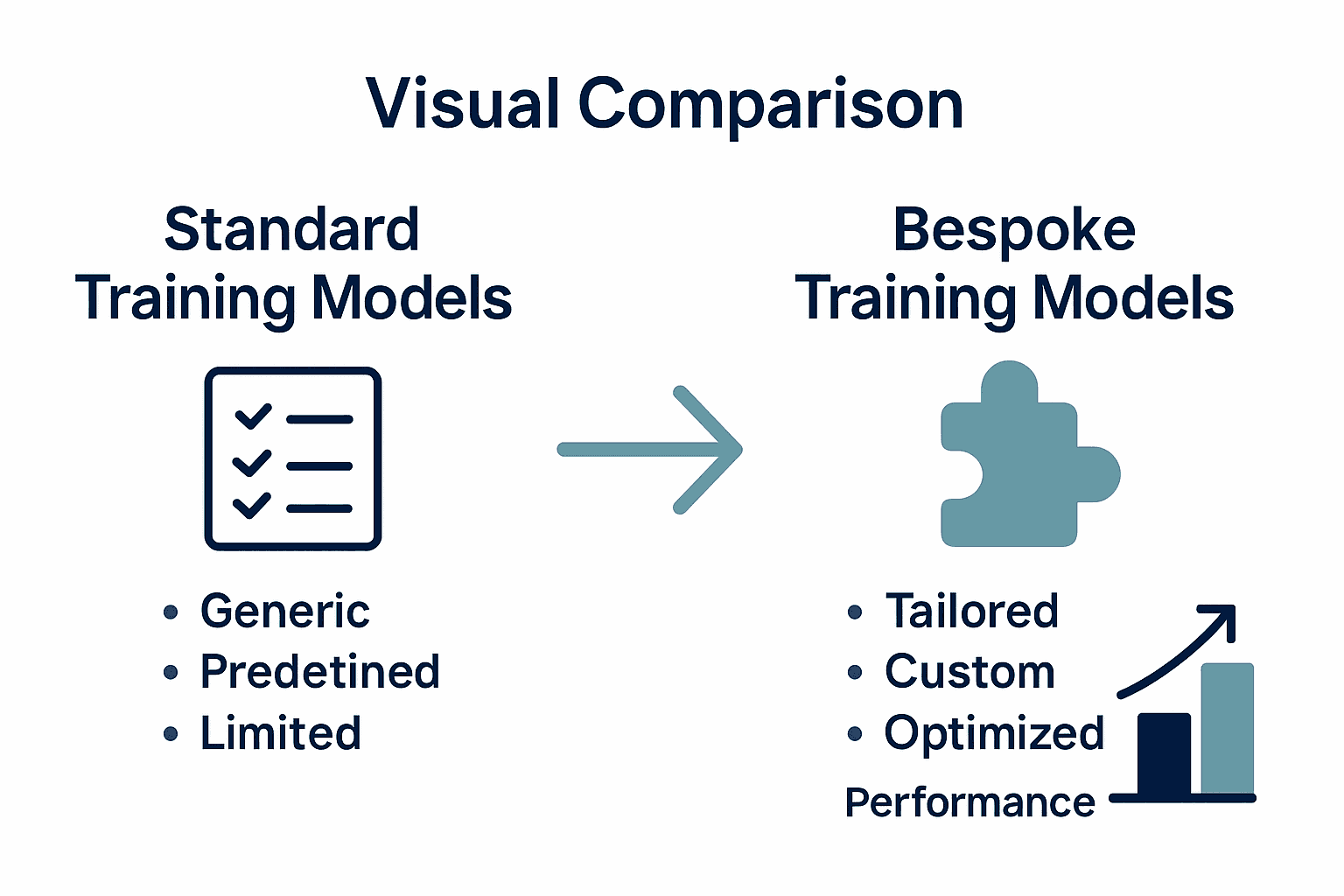
Research from Springer reveals the critical importance of tailoring sales training approaches to specific organisational contexts. The distinction between bespoke and standard training models represents a fundamental strategic decision that can significantly impact sales team performance and organisational growth.
Training Model Characteristics:
Standard Training Models
- Pre-designed curriculum
- Generic learning modules
- One-size-fits-all approach
- Lower cost
- Quick implementation
Bespoke Training Models
- Customised to organisational needs
- Targeted skill development
- Personalised learning paths
- Higher initial investment
- Precise skill alignment
Innovative approaches are emerging in training customisation. According to ArXiv research, virtual reality technologies are now enabling unprecedented levels of training personalisation, allowing organisations to create immersive, adaptive learning experiences that can be precisely tailored to individual and team requirements.
For businesses looking to optimize their sales team training platforms, understanding the nuanced differences between standard and bespoke models is crucial. While standard models offer efficiency and broad coverage, bespoke approaches provide depth, relevance, and a more direct path to addressing specific performance challenges. The ultimate goal is creating a training strategy that transforms potential into exceptional sales performance.
Measuring ROI And Sustaining Performance Gains
Measuring the return on investment (ROI) of sales training is a complex yet critical process for organisations seeking to validate and maximise their training initiatives. ArXiv research highlights innovative approaches to performance measurement, demonstrating how advanced analytical models can transform traditional ROI assessment strategies.
Key Performance Indicators (KPIs) for Sales Training ROI:
- Financial Metrics
- Revenue growth
- Sales conversion rates
- Average deal size
- Customer acquisition cost
- Profit margin improvements
- Behavioural Metrics
- Knowledge retention
- Skill application rates
- Behaviour change consistency
- Individual performance improvements
- Team collaboration effectiveness
According to network-based transfer learning research, organisations can leverage sophisticated forecasting techniques to predict and sustain sales performance gains. This approach allows businesses to move beyond traditional measurement methods, creating more dynamic and predictive performance tracking systems.
Business leaders can dive deeper into sales team performance strategies by implementing a holistic measurement framework. Successful ROI assessment goes beyond simple numerical tracking, requiring a nuanced understanding of how training translates into tangible business outcomes, individual growth, and long-term organisational capability.
Unlock Your Sales Team’s True Potential with Bespoke Training Solutions
The journey from identifying skill gaps to achieving sustained sales growth is complex yet rewarding. This guide perfectly showcases how a structured sales training process involving assessment, customised learning, and continuous improvement is essential for transforming sales performance. If you are struggling with inconsistent results, lack of motivation within your team, or simply want to hit your sales targets every quarter, it is time to embrace a training approach that aligns with your unique business needs.
Our revolutionary sales training company combines bespoke 1:1 coaching, hands-on consultancy, and proven traditional training methods to deliver measurable growth. With packages designed for businesses with 50 to 1000 staff, we guarantee at least 50% sales growth annually while ensuring your sales team consistently reaches their targets. Discover how our sales acceleration programmes can propel solo-service businesses forward starting from £2995.
Don’t let generic training hold your team back. Experience the power of tailored strategies that build communication skills, product knowledge, and negotiation prowess exactly as described in the step-by-step guide. Ready to elevate your sales approach and secure reliable growth? Explore more on our website and get started today with Ahead of Sales. Learn how our customised programmes can transform your sales performance by visiting https://aheadofsales.co.uk now.
Frequently Asked Questions
What are the core principles of effective sales training?
Effective sales training focuses on enhancing communication skills, deep product knowledge, negotiation techniques, customer relationship management, and strategic selling approaches. It aims to motivate sales professionals and provide them with the tools needed for successful performance.
What types of sales training solutions are available?
Sales training solutions can include classroom-based training, digital and online training, and experiential learning methods like role-playing and simulations. Each approach addresses different learning needs and can be combined for a comprehensive training experience.
What is the step-by-step process for developing a sales training program?
The sales training process involves five key stages: assessment and diagnosis (evaluating current performance and skill gaps), training design and development (creating customized modules), implementation (delivering training programs), performance monitoring (tracking effectiveness), and continuous improvement (refining the training approach over time).
How can organizations measure the ROI of their sales training initiatives?
Organizations can measure the ROI of sales training by evaluating financial metrics such as revenue growth, sales conversion rates, and profit margin improvements, along with behavioral metrics like knowledge retention and individual performance improvements. This comprehensive assessment helps organizations understand the effectiveness of their training efforts.