
Many UK sales executives believe they have client acquisition figured out, yet everyday pain points say otherwise. Misunderstandings about what truly defines client acquisition often lead to confusion between marketing activities and conversion-focused strategy, putting both revenue and growth at risk. This guide clears up the most common pitfalls, helping you pinpoint where prospects slip through the cracks and how advanced training can drive measurable results for your team.
Table of Contents
- Client Acquisition Defined And Misunderstood
- Stages Of Client Acquisition In Business
- Major Strategies And Approaches For Success
- Challenges, Risks, And Common Pitfalls
- Calculating Costs And Measuring Effectiveness
Key Takeaways
| Point | Details |
|---|---|
| Client Acquisition is a Process | Focus on the distinct stages: Identification, Engagement, Communication, and Conversion rather than treating it as a single event. |
| Cross-Functional Responsibility | Ensure alignment between sales and marketing teams to effectively manage client acquisition processes and reduce miscommunication. |
| Measure Actual Costs | Calculate true Customer Acquisition Cost (CAC) and compare it to Customer Lifetime Value (CLV) for informed budgeting and investment decisions. |
| Continuous Improvement | Regularly review acquisition metrics and invest in training to address skills gaps and improve conversion rates across all stages. |
Client acquisition defined and misunderstood
Most business leaders say they understand client acquisition, but their actual approach suggests otherwise. The gap between what it is and what people think it is creates serious problems for sales teams and revenue targets.
Client acquisition is the process of attracting and gaining new customers for your business. Simple definition, but the execution involves distinct phases that many organisations skip or conflate together.
Here’s where the confusion typically starts.
The Common Misunderstandings
Most UK sales leaders confuse client acquisition with marketing activities. They assume that running campaigns, creating content, or building brand awareness equals client acquisition. That’s only part of the equation.
Client acquisition specifically focuses on converting prospects into paying clients. It’s narrower than marketing but broader than closing a single deal.
Another widespread misunderstanding involves timing. Many teams treat acquisition as a one-off event—getting the signature on the contract. In reality, it’s a process spanning multiple stages:
- Identification: Finding prospects who match your ideal customer profile
- Engagement: Building awareness and capturing their attention
- Communication: Demonstrating clear value aligned with their specific needs
- Conversion: Moving them from prospect status to paying client
The confusion deepens when teams blur the distinction between different buyer types. Understanding the differences between contacts, leads and prospects fundamentally changes how you approach acquisition strategy.
To clarify the distinctions, here is a comparison of client acquisition, marketing, and sales:
| Aspect | Client Acquisition | Marketing | Sales |
|---|---|---|---|
| Core Purpose | Grow paying client base | Create market awareness | Close deals and maintain clients |
| Main Activities | Convert prospects, track lifecycle | Campaigns, content, positioning | Negotiation, objection handling |
| Success Metric | Conversion rate, cost per client | Reach, impressions, leads | Win rate, retention, expansion |
| Typical Ownership | Shared: sales & marketing | Marketing department | Sales department |
Why This Distinction Matters for Your Business
Your sales growth depends on treating acquisition as a deliberate, measurable process rather than a vague collection of activities. When you clarify what acquisition actually involves, you can allocate resources properly and track real progress.
Client acquisition isn’t something your marketing team does alone—it’s a cross-functional responsibility requiring sales, marketing, and leadership alignment.
Companies with 50–1,000 employees often struggle because they lack clarity on ownership. Is marketing responsible for generating prospects? Does sales drive the entire acquisition process? The answer requires both working in sync, each playing a distinct role.
Misunderstanding the scope leads to three costly problems.
First, you measure the wrong metrics. Teams track website visitors or email opens instead of actual conversion rates and cost per acquired client.

Second, you budget incorrectly. Without understanding what acquisition actually costs across its full process, you underfund critical stages or overspend on early awareness activities that don’t convert.
Third, you set unrealistic expectations. Sales leaders promise growth without the proper infrastructure, training, or systems to support sustained acquisition.
Pro tip: Map your actual acquisition process from initial contact through contract signature, identify where prospects get stuck or drop out, then invest in training and tools to strengthen those specific bottleneck stages.
Stages of client acquisition in business
Client acquisition doesn’t happen in one step. It unfolds across distinct phases, each with its own purpose and tactics. Understanding these stages transforms how you allocate effort and measure progress.
The client acquisition funnel moves prospects from complete strangers to paying customers. Each stage requires different strategies and messaging to keep momentum going.
Here’s how the journey actually works.
Stage 1: Awareness
This is where everything starts. Potential clients don’t know you exist yet, so your job is to get their attention.
At this stage, you’re building visibility through content, referrals, LinkedIn activity, industry events, or targeted advertising. UK sales teams often rush past this—they want immediate leads. But skipping awareness creates a leaky funnel downstream.
Awareness activities include:
- Creating content that addresses your prospect’s problems
- Speaking at industry conferences or webinars
- Building relationships through warm networking
- Running targeted campaigns to reach your ideal customer profile
Stage 2: Interest and Consideration
Once prospects notice you, they need a reason to care. This stage is about demonstrating that your solution matches their specific situation.
You’re now moving beyond surface-level messaging. Prospects compare you against alternatives. They evaluate fit, price, and capability. Your sales team must engage meaningfully here, answering questions and building confidence.
Without strong consideration support, prospects drift toward competitors who make a clearer case for value.
Many companies fail at this stage because they treat all prospects identically. Understanding your ideal customer profile helps you prioritise the right opportunities and customise your approach.
Stage 3: Conversion
This is closing. The prospect commits to becoming your client by signing a contract or purchasing your service.
Conversion requires clear value demonstration, removal of objections, and proper sales technique. It’s where technical capability meets human persuasion.
Many UK sales teams experience conversion problems not because they’re poor closers, but because earlier stages were weak. A well-nurtured prospect at this stage moves forward naturally.
Stage 4: Retention and Growth
Acquisition doesn’t end at contract signature. A new client who churns within months kills your growth momentum.
Retention focuses on:
- Delivering promised value consistently
- Building genuine client relationships
- Creating expansion opportunities for additional services
- Gathering referrals from satisfied clients
Understanding your sales cycle helps you anticipate where clients typically drop off and strengthen those critical transition points.
Pro tip: Map each stage’s key metrics—awareness reach, interest engagement rate, conversion percentage, and client lifetime value—then identify which stage has the biggest drop-off. That’s your highest-leverage investment point.
Major strategies and approaches for success
One strategy doesn’t win client acquisition. You need a coordinated approach that combines multiple channels and aligns your entire organisation around a common goal.
Companies that hit their growth targets don’t rely on luck. They use proven methods, measure results, and adjust constantly.
Strategy 1: Multi-Channel Prospecting
Successful client acquisition requires combining multiple channels such as social media, email marketing, and content marketing to build visibility and attract the right leads.
Don’t put all your effort into one channel. If your entire pipeline depends on cold calling and it stops working, your acquisition stalls.
Effective channels for UK B2B companies include:
- LinkedIn outreach and content strategy
- Targeted email campaigns to warm audiences
- Industry events and speaking opportunities
- Referral programmes from existing clients
- Content marketing that positions you as a thought leader
Each channel serves a purpose. Some build awareness; others nurture consideration. Your job is connecting them into a system.
Strategy 2: Market Segmentation and Targeting
Not every prospect is worth equal effort. Effective client prospecting involves market segmentation to focus on high-potential leads, ensuring your sales team pursues the right opportunities.
Companies with 50–1,000 employees often waste time chasing low-fit prospects. They’re attracted by quick wins instead of sustainable growth.
Segmentation means dividing your market into groups based on:
- Company size and industry
- Budget capacity and decision-making structure
- Current business challenges matching your solution
- Growth readiness and buying timeline
Proper segmentation reduces wasted effort and increases conversion rates by ensuring your team pursues qualified, high-fit opportunities.
Strategy 3: Consultative Selling
Your sales team shouldn’t pitch immediately. Consultative selling means asking questions first, understanding the prospect’s situation, and then proposing solutions aligned with their actual needs.
This approach builds trust and positions you as a partner, not a vendor pushing products.
Strategy 4: Sales Process Alignment with CRM
You can’t scale what you don’t track. A comprehensive sales strategy combined with proper CRM implementation enables your team to personalise engagement, track progress, and identify bottlenecks.
CRM systems capture data on prospect interactions, allowing you to:
- See where each prospect stands in your acquisition process
- Identify which activities generate conversions
- Personalise follow-up based on prospect behaviour
- Measure performance against targets
Without this visibility, you’re flying blind.
Strategy 5: Continuous Feedback and Training
Client acquisition improves through repetition and learning. Continuous feedback and training refine your sales team’s approach, directly improving conversion rates over time.
Schedule monthly reviews of acquisition metrics. What’s working? Where are prospects dropping off? Train your team on stronger objection handling, discovery questions, and closing techniques.
Pro tip: Select your top three channels by conversion rate, then calculate the cost to acquire a client through each one. Allocate 60% of budget to your highest-performing channel, 30% to testing new channels, and 10% to maintaining relationships in weaker channels.
Challenges, risks, and common pitfalls
Client acquisition looks straightforward until you try scaling it. That’s when hidden problems emerge and derail your growth plans.
Understanding these pitfalls before they happen saves time, money, and missed targets.
Pitfall 1: Misalignment Between Marketing and Sales
Marketing generates leads. Sales converts them. When these teams don’t communicate, your entire acquisition process breaks down.
Marketing might send high-volume, low-quality leads. Sales complains they’re worthless. Marketing feels unsupported. Meanwhile, actual prospects slip through the cracks.
Misalignment between marketing and sales teams creates inefficiency, wasted budget, and missed revenue targets.
Fix this by:
- Defining what constitutes a “sales-ready” lead together
- Having monthly reviews of lead quality and conversion rates
- Creating shared KPIs that both teams influence
- Establishing regular communication between department heads
Pitfall 2: Relying on a Single Channel
If one channel disappears or saturates, your entire pipeline collapses. This happens constantly to companies dependent on organic social media or a single advertising platform.
Relying on a single channel creates vulnerability and hinders sustainable growth when that channel changes or becomes ineffective.
Build redundancy. Test multiple channels simultaneously. Measure which ones actually convert, then diversify your investment across proven channels.
Pitfall 3: Neglecting Lead Nurturing
You generated a lead. Now what? Many teams stop here, expecting immediate conversion.
Most prospects aren’t ready to buy when you first contact them. They’re in early research mode. If you don’t nurture them with relevant content, education, and relationship-building, they’ll go to a competitor who does.
Nurturing means:
- Sending targeted content matching their stage
- Following up consistently without being pushy
- Building genuine relationships over weeks or months
- Addressing objections before they become deal-killers
Pitfall 4: Underestimating Cost Per Acquisition
You can’t manage what you don’t measure. Many companies waste budget because they don’t calculate how much it actually costs to acquire each client.
Calculate this properly: divide total acquisition spending by the number of new clients acquired. Include salaries, software, advertising, and events. Once you know your true cost, you can decide which channels are worth pursuing.
Companies that ignore true cost per acquisition often overspend on ineffective channels whilst underfunding proven ones.
Pitfall 5: Poor Conversion Due to Skills Gaps
Your team might be nice people, but if they can’t ask discovery questions, handle objections, or present value clearly, prospects won’t convert.
This happens because most sales teams receive minimal formal training. They pick up techniques through trial and error, meaning your conversion stays flat regardless of how many leads you generate.
Invest in training. Better sales skills directly translate to higher conversion rates and lower cost per acquisition.
Pro tip: Audit your last 20 lost deals. Identify the top three reasons prospects didn’t convert, then design targeted training or process changes to address those specific issues.
Below is a summary of common client acquisition pitfalls and their long-term risks:
| Pitfall | Typical Sign | Long-Term Business Risk |
|---|---|---|
| Sales and marketing misalignment | Low lead quality | Stalled growth, wasted spend |
| Channel over-reliance | Pipeline fluctuations | Sudden loss of new clients |
| Neglected lead nurturing | Low conversion | High prospect drop-out |
| Underestimating acquisition cost | Unclear ROI | Unprofitable growth |
| Skills and training gaps | Flat conversion rate | Missed revenue, high churn |
Calculating costs and measuring effectiveness
You can’t improve what you don’t measure. Most companies spend heavily on client acquisition yet have no idea whether it’s actually profitable.
The difference between growth and waste comes down to numbers. Hard metrics tell you what’s working.
Understanding Customer Acquisition Cost (CAC)
Customer acquisition cost is the total expense required to attract and convert a single new client. This includes salaries, software, advertising, events, and training—everything spent to acquire that customer.
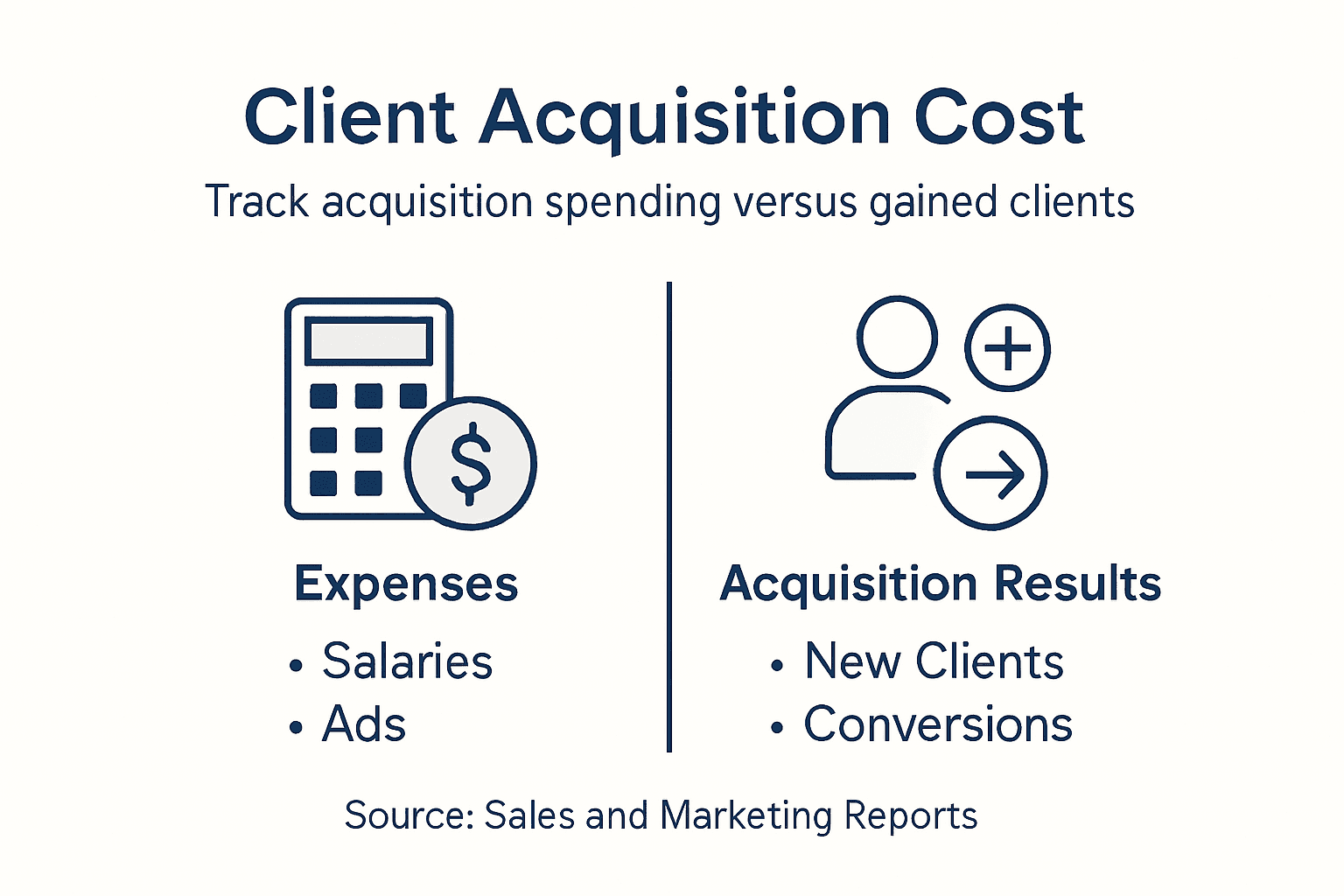
Calculating CAC is simple: divide your total marketing and sales expenses by the number of new customers acquired in a specific period.
Example: If you spend £50,000 on acquisition activities and gain 10 new clients, your CAC is £5,000 per client.
But here’s the crucial part. Customer acquisition cost (CAC) is crucial to measure because it reveals whether your growth is sustainable or burning cash.
The CAC-to-CLV Ratio
CAC alone tells an incomplete story. You must compare it to customer lifetime value (CLV)—the total profit a client generates over their entire relationship with you.
A healthy ratio is 3:1 or better. This means the lifetime value of your client should be at least three times what you spent to acquire them.
Calculation:
- CAC: £5,000
- CLV: £20,000
- Ratio: 1:4 (excellent)
If your CAC approaches or exceeds your CLV, you’re acquiring unprofitable clients. Something must change.
Measuring Effectiveness at Each Stage
Measuring effectiveness involves analysing conversion metrics at each funnel stage and ROI, enabling optimisation of your acquisition campaigns.
Track these metrics:
- Awareness stage: Reach and impressions
- Interest stage: Click-through rates and engagement
- Consideration stage: Lead quality and response rates
- Conversion stage: Win rate and sales cycle length
- Retention stage: Churn rate and expansion revenue
Each metric reveals where prospects drop off. If your awareness is strong but conversion weak, your problem isn’t lead generation—it’s sales skill or messaging.
Calculating Return on Investment (ROI)
ROI measures the profit generated relative to what you spent. It’s the ultimate effectiveness metric.
Calculation: (Revenue from new clients – Total acquisition cost) ÷ Total acquisition cost × 100 = ROI %
Example:
- Revenue from 10 new clients: £120,000
- Total acquisition cost: £50,000
- ROI: (£120,000 – £50,000) ÷ £50,000 × 100 = 140%
Strong ROI means your acquisition strategy is sustainable and profitable. Weak ROI signals you need to optimise channels, improve conversion, or adjust your pricing strategy.
Identifying Your Best-Performing Channels
Not all acquisition channels deliver equal returns. Evaluating sales performance at the channel level reveals which deserve increased investment.
For each channel, calculate:
- Cost per lead generated
- Conversion rate (lead to client)
- Average deal value from that channel
- CAC for that specific channel
Then rank channels by profitability. Your top two or three channels likely generate 70% of your revenue. Allocate more budget there.
Pro tip: Create a simple spreadsheet tracking CAC, CLV, win rate, and sales cycle length by month. Review it quarterly with your sales and marketing leaders to identify trends and redirect resources toward highest-performing activities.
Accelerate Your Client Acquisition and Drive Consistent Sales Growth
Struggling to align your sales and marketing teams or unsure how to pinpoint and nurture high-value prospects in every stage of the acquisition funnel This article highlights key challenges like misaligned ownership, neglected lead nurturing and unclear cost per acquisition that inhibit sustainable growth at companies between 50 and 1,000 employees. If your goal is to convert more prospects efficiently while boosting retention and maximising ROI our targeted sales training solutions can transform your approach.
Explore actionable insights and proven strategies in our Sales Playbook Archives – Ahead of Sales and discover how our bespoke 1:1 coaching combined with immersive traditional training helps your teams master consultative selling, multi-channel prospecting, and pipeline management. With packages designed to secure at least 50% sales growth annually and ensure your sales team hits targets every quarter, now is the time to invest in measurable client acquisition success. Visit Ahead of Sales today to start accelerating your sales growth journey.
Frequently Asked Questions
What is client acquisition?
Client acquisition is the process of attracting and gaining new customers for a business. It encompasses various stages, including identifying prospects, engaging with them, communicating value, and converting them into paying clients.
How does client acquisition differ from marketing and sales?
Client acquisition specifically focuses on converting prospects into clients, acting as a bridge between marketing activities (like creating awareness) and sales (which involves closing deals). It requires a strategic approach that includes multiple activities beyond just marketing campaigns.
What are the key stages of the client acquisition process?
The key stages of the client acquisition process include: 1) Awareness, where potential clients discover your brand; 2) Interest and Consideration, where they assess your offerings; 3) Conversion, where they decide to become clients; and 4) Retention, where the goal is to maintain and grow the relationship with existing clients.
Why is measuring Customer Acquisition Cost (CAC) important?
Measuring Customer Acquisition Cost (CAC) is crucial as it reflects the total expenses required to acquire a new client. Understanding CAC helps businesses evaluate the sustainability of their growth efforts and ensure they are not overspending on ineffective acquisition strategies.