
If your late-stage deals are stalling on indecision, The JOLT Effect is your fastest fix; if you’re new to consultative selling, SPIN Selling still teaches the questioning discipline everything else builds on. Beyond those two, the right book depends entirely on where your pipeline is actually leaking, not on which title is trending. Below, I’ve organised the 2026 shortlist by role and problem so you can skip the ranking debate and go straight to what fixes your specific gap.
TL;DR:
- Focusing on diagnosing your pipeline bottleneck before choosing a sales book ensures you address the specific issue, whether it’s prospecting, qualification, or indecision.
- Pairing frameworks like the JOLT Effect with coaching and team application maximizes behavioral change and deal closure rates over simply reading the material.
- Implementing a focused, role-specific reading stack and applying one framework for 90 days leads to measurable improvements in key sales metrics rather than superficial knowledge.
- Books like SPIN Selling and Gap Selling are most effective for building foundational questioning and diagnostic skills, crucial for early-stage or stalled deals.
- Converting individual learning into team habits requires structured sprints, consistent vocabulary reinforcement, and targeted impact tracking in deal reviews.
Table of Contents
- Best sales books 2026: the curated shortlist
- Three-book stacks by role: what to read in what order
- Which book fixes your actual bottleneck?
- Quick-reference table: core idea, best for, first action
- How to choose your next read and turn it into behaviour
- Turning a book into a team habit, not just a personal one
- Ahead of Sales’ perspective on turning books into results
- Sources
Best sales books 2026: the curated shortlist
Picking a book by popularity alone wastes a month of reading time. The operator-first approach favoured by practitioner reviewers is to diagnose the funnel stage that’s actually broken, then choose the title that addresses it directly. Here’s the shortlist, organised for exactly that.
SPIN Selling by Neil Rackham
The original large-scale study behind consultative selling, SPIN broke down what separates high-performing reps from average ones: they ask more Situation, Problem, Implication, and Need-payoff questions and pitch less. It’s still the clearest explanation of why discovery questions outperform feature dumps.
- Best for: New reps and anyone whose calls turn into product demos too early.
- First action (week 1): Record three discovery calls and count how many questions fall into each SPIN category. Most reps discover they’ve skipped Implication questions entirely.
Fanatical Prospecting by Jeb Blount
Blount’s central argument is blunt: your pipeline problems are almost always prospecting problems, not closing problems. The book pushes multichannel outreach (calls, email, social, referrals) with a daily discipline framework rather than sporadic bursts of effort.
- Best for: Reps and teams with thin top-of-funnel volume.
- First action: Block a 90-minute “power hour” daily for outbound activity, tracked by dials and conversations rather than hours logged.
Gap Selling by Keenan
Keenan’s premise is that most sales training focuses on the wrong gap. It’s not about pitching your product’s features; it’s about quantifying the distance between a buyer’s current state and their desired future state, and letting the size of that gap create urgency naturally.
- Best for: AEs stuck writing proposals that buyers politely ignore.
- First action: Rewrite your next discovery call script to spend 70% of the time diagnosing current-state pain before mentioning your solution once.
The Challenger Sale by Matthew Dixon and Brent Adamson
This book’s research found that the highest-performing reps aren’t relationship builders; they’re “challengers” who teach customers something new about their own business and push back constructively. It reframed an entire generation of enterprise sales training around commercial teaching.
- Best for: AEs and managers selling into complex, multi-stakeholder B2B accounts.
- First action: Draft one “commercial insight” for your top prospect account, a fact about their market they likely don’t know, and lead your next call with it.
The JOLT Effect by Matt Dixon and Ted McKenna
Analysis of 2.5 million recorded sales conversations found that customer indecision, not competitor losses, is the leading cause of deals dying at the finish line. JOLT stands for Judge the indecision, Offer your recommendation, Limit the exploration, and Take risk off the table, a framework built specifically to counter fear-driven stalling rather than manufacture false urgency.
- Best for: Anyone losing deals to “we’ll revisit next quarter.”
- First action: On your next stalled deal, name the indecision directly to the buyer and offer a single recommended path rather than three options.
Never Split the Difference by Chris Voss
Voss, a former FBI hostage negotiator, applies tactical empathy and calibrated questions to commercial negotiation. It’s less about splitting price differences and more about understanding what the other side is actually afraid of losing.
- Best for: Anyone negotiating final terms, procurement pushback, or multi-stakeholder consensus.
- First action: Replace your next “why” question in a negotiation with a calibrated “how” or “what” question, and note how the tone of the response shifts.
The Sales Acceleration Formula by Mark Roberge
Roberge, HubSpot’s former CRO, documents a data-driven approach to building a scalable sales machine: hiring formulas, training cadences, and a management framework based on measurable inputs rather than gut feel.
- Best for: Revenue leaders scaling a team past the founder-led sales stage.
- First action: Build a simple scorecard for your next three hires based on the traits that correlated with your current top performers, not generic competency lists.
Coaching Salespeople into Sales Champions by Keith Rosen
Rosen’s core claim is that most sales managers coach by telling, not asking, and it stalls rep development. The book gives a structured coaching framework built on questions that force reps to solve their own problems, building long-term capability instead of short-term dependency.
- Best for: First-time and experienced sales managers who feel like they’re doing reps’ jobs for them.
- First action: In your next 1:1, ban yourself from giving advice for the first ten minutes; ask questions only.
Predictable Revenue by Aaron Ross and Marylou Tyler
The book that popularised the idea of separating prospecting from closing into distinct roles (SDRs and AEs), built around the “cold calling 2.0” outbound engine Ross built at Salesforce.
- Best for: Revenue leaders and CROs designing or restructuring a go-to-market team.
- First action: Audit whether your best closers are still spending hours on cold outbound; if so, that’s your first structural fix.
Influence by Robert Cialdini
The foundational psychology text behind reciprocity, social proof, scarcity, authority, consistency, and liking, six principles that show up in every negotiation and closing conversation whether reps realise it or not.
- Best for: Anyone who wants to understand why buyers say yes, independent of any specific sales methodology.
- First action: Identify which of the six principles you currently use least, and build it deliberately into your next three pitches.
Selling Power’s 2026 recommended list also flags titles on leadership, hiring, and value selling as essential reading for leaders keeping pace with hybrid selling and AI-assisted prospecting, worth a look once you’ve worked through the core operational gaps above. Amazon’s Sales & Selling bestseller rankings consistently confirm that JOLT, Fanatical Prospecting, and The Challenger Sale remain the most actively purchased titles in the category, a reasonable proxy for which books are staying relevant to working sales teams rather than fading into business-book nostalgia.
Three-book stacks by role: what to read in what order
Reading twelve books in a year rarely changes behaviour. Reading three, in the right sequence, and actually applying each one, does. Role-specific reading stacks reduce overwhelm far more effectively than a long alphabetical list, because each book builds on the skill gap the previous one just closed.
-
New rep stack: SPIN Selling → Fanatical Prospecting → Influence. Start with SPIN to fix your questioning discipline, then Fanatical Prospecting to build volume and pipeline habits, then Influence to sharpen the psychology underneath every conversation. Days 1 to 30: rebuild your discovery script. Days 31 to 60: build a daily outbound cadence. Days 61 to 90: audit your close-rate conversations against Cialdini’s six principles.
-
Account executive (AE) stack: Gap Selling → The Challenger Sale → The JOLT Effect. Gap Selling fixes diagnosis, Challenger fixes positioning against competitors and status quo, and JOLT fixes the indecision that kills deals in the final stretch. Days 1 to 30: rewrite your discovery framework around current state versus future state. Days 31 to 60: build one commercial insight per active opportunity. Days 61 to 90: apply the JOLT framework to every deal stuck past its expected close date.
-
Sales manager stack: Coaching Salespeople into Sales Champions → The Challenger Sale → Never Split the Difference. Rosen’s coaching framework comes first because a manager’s core job is developing reps, not just reviewing pipeline. Days 1 to 30: run every 1:1 as a coaching conversation, not a status update. Days 31 to 60: teach the team one commercial insight framework per vertical. Days 61 to 90: run negotiation role-plays using calibrated questioning on your three toughest live deals.
-
Revenue leader / CRO stack: The Sales Acceleration Formula → Predictable Revenue → Influence. Roberge’s hiring and management data gives structural rigour, Ross and Tyler’s outbound engine model fixes how prospecting and closing roles are split, and Influence keeps the underlying psychology sharp across the whole organisation. Days 1 to 30: audit your hiring scorecard against actual top-performer traits. Days 31 to 60: separate prospecting and closing responsibilities if they’re currently blended. Days 61 to 90: build a single dashboard tracking the leading indicator your new structure is meant to improve.
When a manager reads a stack alone, it changes one person’s habits. When it’s rolled out to the whole team, with shared vocabulary and shared call-review criteria, it changes the unit’s number. That’s the point where a stack stops being a personal reading list and becomes a training curriculum, and it’s usually the moment worth bringing in outside coaching to keep the standard consistent across every rep.
Which book fixes your actual bottleneck?
Before picking a book, answer three questions honestly:
- Is your pipeline volume too thin, or is volume fine but conversion is poor?
- Are deals dying at discovery (no qualified opportunity), at proposal (going quiet), or at close (indecision, procurement stall)?
- Is the problem individual skill, or is it systemic across the whole team’s structure?
Several 2026 lists argue explicitly for choosing a book by diagnosed bottleneck rather than reputation, and the pairing logic below reflects that.
Prospecting bottleneck (thin pipeline):
- Fanatical Prospecting for daily outbound discipline.
- Predictable Revenue if the structural issue is that closers are doing their own prospecting.
- Next step: build a weekly outbound scorecard and review it in every team meeting, not just 1:1s.
Qualification bottleneck (opportunities that shouldn’t have been opportunities):
- Gap Selling to rebuild diagnostic discovery.
- SPIN Selling if the root cause is shallow questioning technique specifically.
- Next step: add a mandatory “quantified gap” field to your CRM before any deal moves past discovery stage.
Indecision / no-decision bottleneck (deals stall at the finish line):
- The JOLT Effect is the direct fix, built specifically around this failure mode.
- Never Split the Difference pairs well here because tactical empathy helps surface the fear driving the indecision in the first place.
- Next step: on every deal past its expected close date, apply the JOLT framework in your very next call.
Negotiation bottleneck (price and terms disputes):
- Never Split the Difference for calibrated questioning and tactical empathy.
- Influence to understand the psychological levers procurement teams use against you.
- Next step: script three calibrated questions before your next contract negotiation and use them verbatim.
Forecasting and management bottleneck (inconsistent numbers, weak coaching):
- The Sales Acceleration Formula for data-driven pipeline management.
- Coaching Salespeople into Sales Champions if the underlying issue is manager behaviour, not process.
- Next step: pick one leading indicator (proposal-to-close rate is a strong default) and track it weekly for 90 days.
A pairing worth naming specifically: methodology frameworks like MEDDICC work best alongside behavioural closing books like JOLT, because MEDDICC gives you the qualification structure while JOLT gives you the language for the moment a qualified deal still stalls. One without the other leaves a gap either at the start or the end of the deal cycle.
Quick-reference table: core idea, best for, first action
| Book | Core idea | Best for | First action (week 1) |
|---|---|---|---|
| SPIN Selling | Ask more, pitch less; question categories drive outcomes | New reps, discovery skills | Audit three calls against SPIN question categories |
| Fanatical Prospecting | Consistent multichannel outbound beats sporadic bursts | Thin pipeline, new reps | Block a daily 90-minute prospecting hour |
| Gap Selling | Quantify the gap between current and future state | AEs stuck in proposal stage | Spend 70% of discovery diagnosing, not pitching |
| The Challenger Sale | Teach, tailor, take control instead of just relating | AEs and managers in complex B2B | Draft one commercial insight per key account |
| The JOLT Effect | Indecision, not competitors, kills late-stage deals | Deals stalled at close | Name the indecision directly on your next call |
| Never Split the Difference | Tactical empathy and calibrated questions | Negotiation and procurement stalls | Replace one “why” with a calibrated “how” |
| The Sales Acceleration Formula | Data-driven hiring and management builds scale | Revenue leaders scaling teams | Score your last three hires against top-performer traits |
| Coaching Salespeople into Sales Champions | Coach by asking, not telling | Sales managers | Run one 1:1 with no advice for the first ten minutes |
| Predictable Revenue | Separate prospecting from closing roles | CROs designing GTM structure | Audit whether closers still cold call |
| Influence | Six psychological principles behind every yes | Anyone closing or negotiating | Identify your weakest principle and use it deliberately |
Keep this table close to your CRM tab. When a deal stalls, the “first action” column doubles as an immediate diagnostic prompt rather than a reading recommendation you’ll get to eventually.
How to choose your next read and turn it into behaviour
Reading widely feels productive; reading narrowly and applying relentlessly actually moves numbers. Practitioner-focused adoption models consistently favour depth over breadth: four books applied properly outperform twelve skimmed and forgotten.
- Run the checklist first. Identify your bottleneck (prospecting, qualification, indecision, negotiation, or management), your role, your realistic weekly bandwidth for practice, and one metric you’ll track to know if it worked.
- Choose one framework, not three. Pick a single book’s core model and commit to it for 90 days before layering on anything else.
- Micro-practice weekly. Apply the framework to two or three live deals a week rather than trying to overhaul every call at once.
- Schedule manager check-ins. A fortnightly review against the framework, not a general pipeline update, keeps the habit from fading by week three.
- Track one KPI throughout. Proposal-to-close rate, discovery-to-qualified ratio, or outbound-to-meeting conversion, whichever maps to your original bottleneck.
Pro Tip: If you finish a book and can’t name the one call you’re going to change this week because of it, you haven’t finished reading it yet. Go back to chapter one and read for the action, not the summary.
Red flags that mean it’s time to stop reading and start applying: you’ve bought your third book this quarter without finishing the first, your notes are longer than your practice log, or your team can quote the framework but nobody’s changed a single call script.
Turning a book into a team habit, not just a personal one
A two-week sprint format works better than an open-ended “read this by Friday” ask. Week one: everyone reads the same three chapters and comes to a 30-minute session with one example from their own pipeline. Week two: apply the framework to two live deals each, then debrief what broke.
- Run a chapter-by-chapter micro-practice: one framework element per week, not the whole book at once.
- Use manager coaching prompts drawn directly from the book’s language (“What’s the gap here?” for Gap Selling, “What’s driving the indecision?” for JOLT) so 1:1s reinforce the same vocabulary the reading built.
- Build a call-review template with three fields: which framework element was attempted, what happened, what you’d change next time.
- Measure impact in deal reviews specifically, not just in general team sentiment: track the one KPI tied to your original bottleneck.
A structured pilot approach works well here too: pick one framework, apply it to three live deals over four weeks, and measure a single leading indicator such as proposal-to-close conversion or the number of “champion artefacts” (business cases, internal emails, ROI models) your buyer produces on your behalf. If that number moves, you’ve proven the framework works for your specific pipeline, not just in theory. If it doesn’t, you’ve learned that fast, rather than after a whole quarter.
For teams building consultative discovery skills specifically, pairing a book like Gap Selling with structured consultative selling technique training tends to close the gap between reading and reliable execution faster than reading alone.

Ahead of Sales’ perspective on turning books into results
Books give you the vocabulary and the framework. They rarely give you the accountability structure that makes a rep actually change what they say on call fourteen when nobody’s watching. That’s the honest gap most reading lists skip over, and it’s the reason a strong shortlist and a strong coaching programme solve different halves of the same problem.
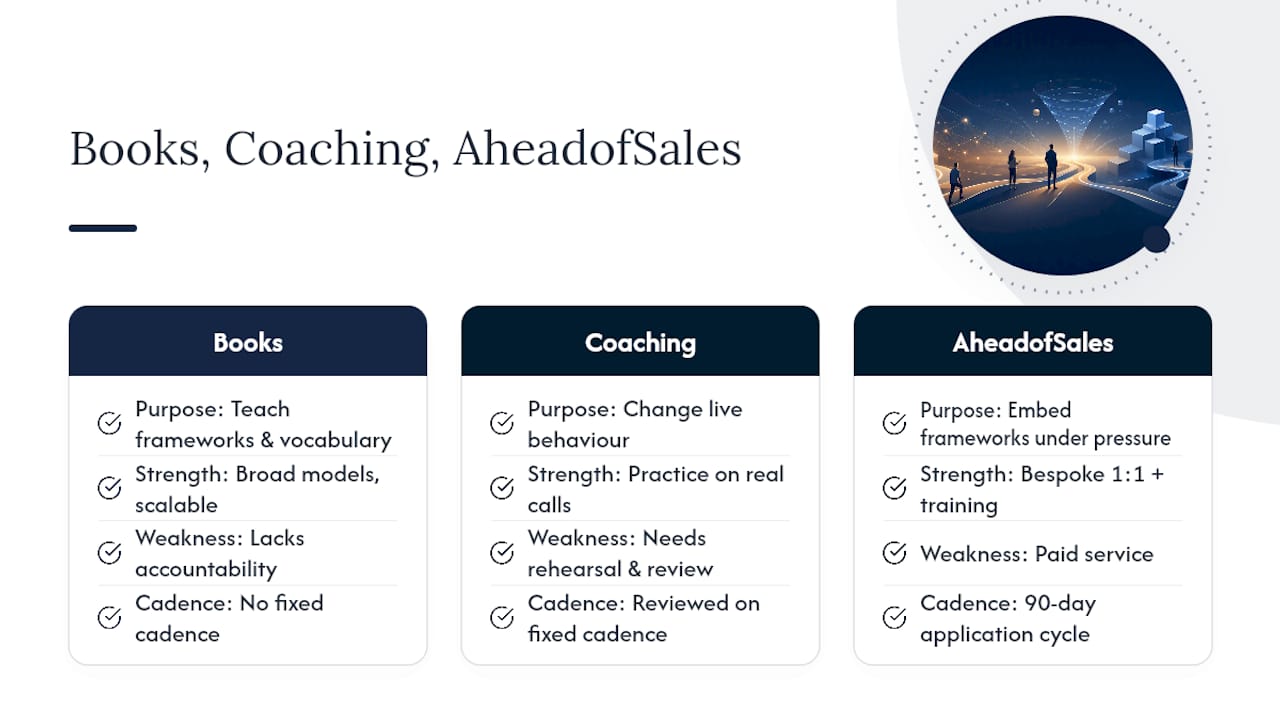
At Aheadofsales, we combine bespoke 1:1 coaching with structured training and consultancy specifically because reading a framework and embedding it under live call pressure are two different skills. Team-wide training and consultancy packages start from £4,500 to £8,500 for businesses roughly 50 to 1,000 staff, and solo service businesses can access sales acceleration packages from £2,995 to £5,995, both structured around exactly the kind of 90-day application cycle this article recommends for any of the books above.
We’ve watched sales managers hand out Coaching Salespeople into Sales Champions to their whole team and see almost no behaviour change, not because the book is wrong, but because nobody rehearsed the coaching questions under pressure before trying them live. The coaching examples we’ve documented tend to share one trait: a specific framework, applied to specific deals, reviewed on a fixed cadence. That’s the part a book, however good, can’t do on its own.
— Jerry
Sources
The shortlist and role-based stacks above draw on a mix of research-backed frameworks, editorial curation, and live market data:
- What is the best sales book of 2026? — Pulse RevOps
- Highly Recommended Sales Books 2026 — Selling Power
- Amazon Best Sellers: Best Sales & Selling
- The Best B2B Sales Books for 2026 | destackd
- The Best Sales Books in 2026: Reviewed by Two People Who’ve Actually Used Them — The B2B Playbook
If you’re weighing whether to invest in reading alone or pair it with structured coaching, Aheadofsales’ training services outline how the frameworks above translate into a measurable 90-day programme for teams and individual operators alike.