
TL;DR:
- Legal bottlenecks significantly slow UK sales pipelines, but they can be reduced with the right processes, tools, and mindset. Implementing centralized legal intake systems, unified CRMs, and automation accelerates deal flow while maintaining quality, enabling faster, more efficient sales cycles. Sustained success relies on process audits, stakeholder engagement, ongoing reviews, and fostering collaboration between sales and legal teams.
Every sales leader I speak to in the UK has felt it: a promising deal stalling at the contract review stage, a client growing cold while your legal team works through approvals, revenue sitting frustratingly out of reach because of process friction rather than genuine commercial disagreement. Legal bottlenecks are one of the most consistent drains on pipeline velocity for businesses with 50 to 1,000 staff, and yet most organisations treat them as unavoidable. They are not. With the right process, tools, and mindset, you can dramatically compress your sales cycle without cutting corners or sacrificing the quality of your deals.
Table of Contents
- What is the legal sales acceleration process?
- Key tools and requirements for accelerating legal sales
- Step-by-step guide to designing and executing your legal sales acceleration process
- Troubleshooting, common pitfalls, and sustaining improvements
- A fresh perspective: Why legal sales acceleration is not just about speed
- Let Ahead of Sales help you accelerate your legal sales process
- Frequently asked questions
Key Takeaways
| Point | Details |
|---|---|
| Centralise legal intake | A single-entry workflow lets sales and legal teams triage requests rapidly and avoid costly bottlenecks. |
| Leverage workflow automation | Automated CRM, lead scoring, and follow-up deliver 4–8 hours saved per week for UK SMEs. |
| Qualify and parallelise deals | Strict qualification and multi-threading prevent pipeline gridlock from slow-moving stakeholders. |
| Use benchmarks as guidance | Time-savings benchmarks should be validated against your actual lead volume and process maturity. |
| Acceleration boosts quality | Done right, acceleration removes friction and increases consistent deal quality, not just speed. |
What is the legal sales acceleration process?
Having set the context, let’s define what the legal sales acceleration process actually involves and why it matters so much for UK businesses right now.
At its core, sales acceleration is a set of strategies designed to move leads through the pipeline more efficiently, keeping every fundamental sales step intact but making each one faster. Think of it as improving the engine without changing the destination. The most effective implementations unify all commercial activity inside a single CRM, then layer in tools for prospecting, lead management, engagement, and analytics so that nothing slips through the gaps.
For businesses with in-house legal teams or regular legal touchpoints, the picture is slightly more involved. The legal function acceleration approach centres on operationalising legal intake and routing through centralised “one-door” systems. That means a single, structured entry point for all legal queries, with clear triage, transparency, and defined escalation paths. Crucially, it also encourages earlier involvement of legal counsel in go-to-market activity, catching issues before they become costly revisions that stall deals at the final hurdle.
Here is a quick comparison of how a traditional legal sales process stacks up against an accelerated one:
| Factor | Traditional process | Accelerated process |
|---|---|---|
| Legal involvement | Late stage, reactive | Early, integrated |
| Intake method | Ad hoc emails and calls | Centralised “one-door” system |
| CRM use | Partial or inconsistent | Unified, real-time updates |
| Turnaround time | Weeks for standard contracts | Days with templates and automation |
| Stakeholder visibility | Low | High, with clear escalation paths |
The goal is not to rush your legal team. It is to remove the avoidable waiting, the back-and-forth, and the unclear ownership that slow everything down. If you want to increase legal sales consistently, this structural shift is where it starts.
The three essentials you need before anything else:
- A unified CRM that all commercial and legal stakeholders can access and update in real time
- A set of legal playbooks (standard templates, pre-approved clauses, escalation rules) to reduce every-deal-from-scratch delays
- A centralised intake process so legal queries never get lost in individual inboxes
With these foundations in place, the rest of the process becomes significantly more manageable.
Key tools and requirements for accelerating legal sales
Now that the process is defined, let’s look at the tools and requirements you need to accelerate legal sales in practice.
Technology is the enabler, not the solution. I want to be clear about that upfront, because I have seen businesses invest heavily in software and still struggle because the underlying process was not sorted first. That said, the right tools make a profound difference. UK SME automation benchmarks show that lead management, CRM enrichment, lead scoring, and follow-up automation are among the workflows delivering the most tangible time recovery. Specifically, firms with 40 or more monthly leads are seeing 4 to 8 hours per week saved on lead follow-up and CRM management alone. That is a full working day returned to your team every single week.
Here is an overview of the core tools and what each one contributes:
| Tool category | Function | Impact |
|---|---|---|
| CRM platform | Centralised deal and contact management | Reduces duplication, improves handoffs |
| Lead scoring software | Prioritises high-value prospects | Stops wasted time on low-intent leads |
| Follow-up automation | Triggered emails and tasks post-interaction | Prevents leads going cold between stages |
| Workflow orchestration | Routes tasks and approvals automatically | Removes manual bottlenecks |
| Document management | Shared contract drafts and e-signatures | Speeds up the legal review stage |
| AI-assisted tools | Drafting support, clause identification | Reduces time on repetitive legal tasks |
Beyond the technology itself, digital enablement for UK law firms involves embedding these tools into real workflows through governance, change management, and structured training. Secure cloud-first infrastructure and firm-wide AI deployment are now standard expectations for businesses serious about accelerating their legal sales. This is not theoretical. It is what competitive UK businesses are actually doing in 2026.
Pro Tip: Do not attempt to automate a broken process. Before you invest in any tool, map your current legal sales cycle from first contact to signed contract. Identify where deals actually stall, and fix those specific steps first. Automation should amplify a good process, not disguise a bad one.
You can explore some of the most effective legal sales techniques in more detail, and if you are considering a structured programme for your team, our work on sales training for legal firms covers precisely this ground.
Step-by-step guide to designing and executing your legal sales acceleration process
Once tools and requirements are clear, it is time to design and execute your acceleration process, step by step.
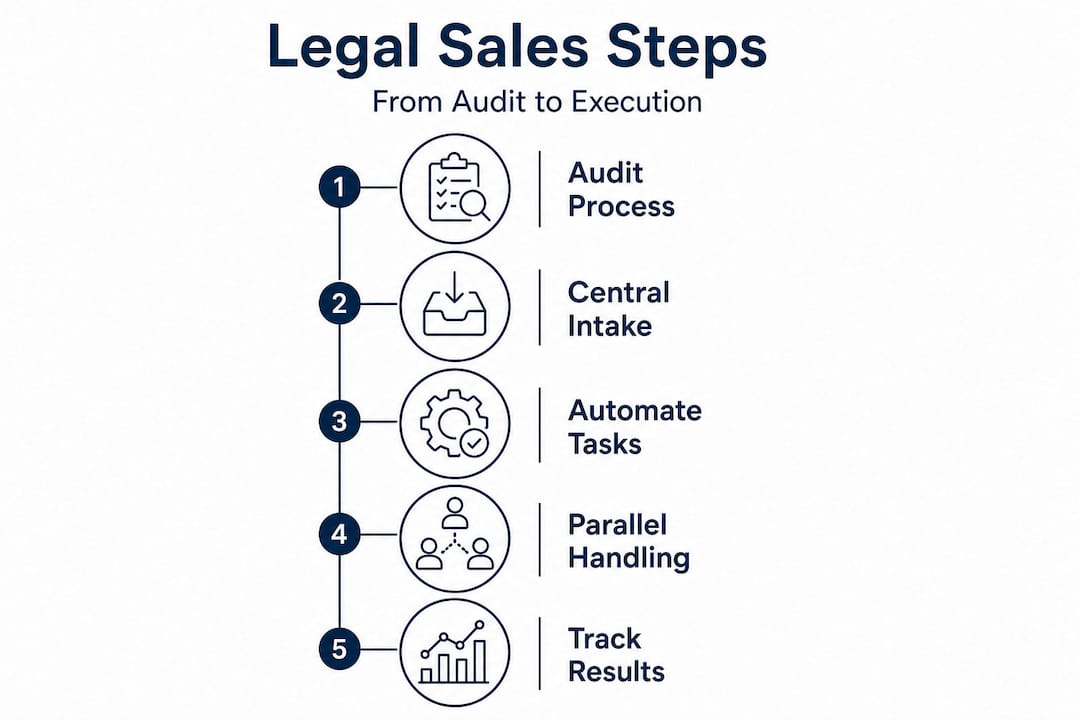
Step 1: Audit your existing process and map legal bottlenecks
Start by walking through a recent deal from start to finish. Where did it stall? Was it waiting for legal sign-off? Was it unclear who owned the next action? Was a contract template not available so something had to be drafted from scratch? Document every bottleneck. Be specific. “Legal was slow” is not actionable. “We waited 11 days for a contract draft because there was no standard template for this service type” is something you can fix.

Step 2: Create centralised legal intake and escalation pathways
This is the structural change that unlocks everything else. Establish a single, visible intake process for all legal queries that arise during a sale. That might be a dedicated channel in your project management tool, a form that routes to the right person, or a section of your CRM. The point is that no legal query should be able to disappear into an email thread. Define who handles what, what the expected turnaround is, and what triggers an escalation. Clarity here saves days per deal.
Step 3: Automate CRM updates, lead scoring, and follow-ups
Once your intake process is in place, turn your attention to the commercial side of the pipeline. Set up your CRM to update automatically when key actions occur: a contract is sent, a meeting is booked, a document is opened. Layer in lead scoring so your team knows exactly which deals deserve the most attention. Automate your follow-up sequences so that no prospect falls silent without a timely, relevant touchpoint. As part of your broader sales team workflow, this step alone can recover significant time and prevent deals going cold unnecessarily.
Step 4: Enable parallel stakeholder handling and document sharing
In complex B2B deals, pipeline acceleration means removing delays and friction without pressuring buyers. One of the most powerful ways to do this is parallelisation: engaging multiple stakeholders simultaneously rather than sequentially. Share documents in real time using cloud-based platforms so your legal team, your client, and your commercial lead can all review and comment without waiting for email attachments. Pre-approved clause libraries let legal teams respond faster. E-signature tools remove the final physical bottleneck.
Step 5: Schedule regular reviews and verify turnaround improvements
Acceleration is not a one-off project. UK sales progression workflows require ongoing coordination, tracking of key dates, and regular client-facing updates to maintain momentum. Build a monthly review into your process. Are deals moving faster than they were three months ago? Are there new bottlenecks forming? Use your CRM data to measure average days per stage, not just overall win rate. This is where sustained improvement comes from, and it is where working with a sales consultancy can give you an objective view when internal teams are too close to the process.
“Acceleration is not about pressuring buyers. It is about removing the operational waiting and back-and-forth that slows deals without adding value to anyone.”
If you want to go deeper on the commercial side of this, our guide on how to accelerate revenue growth offers additional frameworks that complement the legal-specific steps above.
Troubleshooting, common pitfalls, and sustaining improvements
With execution underway, understanding common challenges and how to avoid them is essential for lasting results.
The most common failure I see is organisations treating legal sales acceleration as a technology project rather than a process project. They buy a CRM, implement automation, and then wonder why deals are still slow. The reason is usually one of three things:
- Legal is still not involved until the final stages, so early-stage friction remains unchanged
- The centralised intake system exists on paper but is not actually used because no one was properly trained or incentivised to follow it
- Benchmarks from external sources were applied without being validated against the firm’s own data
On that last point, UK automation benchmarks based on anonymised deployment observations should be treated as directional guidance rather than guaranteed outcomes. Your actual time recovery will depend on your inbound lead volume, your CRM maturity, and your legal intake workload. Measure your own baseline first, then compare progress against that.
For multi-stakeholder deals, which are the norm in B2B environments, acceleration failures most commonly stem from waiting for information, approvals, or meetings to be scheduled. The fix is multi-threading: engaging multiple stakeholders in parallel rather than waiting for one person to pass the baton to the next. Strict qualification criteria at pipeline entry also matter. If deals with no real chance of progressing are consuming capacity, your pipeline will always feel congested regardless of how fast the good deals move.
“Legal playbooks and templates only speed deals when paired with visibility and escalation paths. Without those, frontline sales teams experience uncertainty and delays even when standard documents are available.”
This insight from the LexisNexis in-house team captures something I have seen repeatedly. Documents alone are not enough. People need to know where to find them, when to use them, and what to do if a situation falls outside the standard playbook. That combination of tools, visibility, and escalation paths is what actually sustains improvement over time.
Pro Tip: Assign a named owner for your acceleration process, someone accountable for tracking deal velocity, running monthly reviews, and flagging bottlenecks early. Without a named owner, even the best-designed process gradually reverts to old habits.
The broader sales acceleration strategies that complement your legal process improvements are worth exploring as you look to embed these gains across your entire commercial operation.
A fresh perspective: Why legal sales acceleration is not just about speed
In the context of troubleshooting and sustaining improvements, let me step back and challenge the assumption that acceleration is simply about moving faster.
The businesses that get the most from legal sales acceleration are not the ones obsessed with speed. They are the ones focused on quality of flow. There is a meaningful difference. Speed for its own sake creates errors, erodes trust, and occasionally loses deals that were winnable. Quality of flow means every step happens at the right time, with the right people involved, and without unnecessary waiting.
When legal is involved early and intake is centralised, something interesting happens: deals actually get better qualified before they consume significant legal resource. Issues that would have caused expensive late-stage renegotiations get caught at the beginning. That is not just faster. It is smarter.
There is also a pipeline capacity argument that is often overlooked. When your team is not buried in chasing approvals, resending documents, and managing ad hoc legal queries, they have bandwidth for more deals. A well-designed acceleration process does not just close existing deals faster. It frees capacity to pursue more opportunities in parallel. For businesses aiming at 50% year-on-year growth, that is where the compound effect really kicks in.
I would also argue that the cultural shift is underestimated. When sales and legal teams operate through shared systems with clear escalation paths, the adversarial dynamic that often exists between them begins to dissolve. Legal stops being the department that slows things down. It becomes a genuine commercial partner. That shift in relationship quality is worth more than any single tool you could deploy. Explore more on this through business growth techniques that address both the commercial and operational dimensions together.
Let Ahead of Sales help you accelerate your legal sales process
With the right strategy, tools, and mindset, you are ready to advance. But the difference between knowing the process and executing it consistently across a team of 50 to 1,000 people is significant, and that is exactly where expert support adds the most value.
At Ahead of Sales, our sales acceleration packages are designed to help UK businesses implement precisely these kinds of process improvements, tailored to your sector, your team size, and your commercial goals. Whether you need structured sales training services to build your team’s capability, or a deeper engagement through our sales consultancy services to redesign your pipeline from the ground up, we work with growth-minded businesses to deliver at least 50% sales growth every year. The next step is a conversation.
Frequently asked questions
What is legal sales acceleration in plain terms?
It means streamlining your sales process, especially legal and compliance steps, by using technology and workflow improvements to move deals through faster without cutting corners. Sales acceleration keeps every fundamental step intact but removes the avoidable waiting and back-and-forth between stages.
How much time can UK businesses typically save with legal sales automation?
UK SME benchmarks suggest 4 to 8 hours per week are recovered on lead follow-up and CRM management, particularly for firms handling 40 or more monthly leads, though firms should validate this against their own data before setting expectations.
Do sales acceleration methods compromise deal quality?
No. When properly designed, pipeline acceleration keeps deal quality and win rates intact by removing operational delays rather than pressuring buyers, and early legal involvement typically improves deal quality rather than diminishing it.
What is a ‘one-door’ legal intake and why does it matter?
A “one-door” intake is a centralised entry point for all legal queries, and legal function acceleration depends on it because it improves triage speed, creates visibility across the team, and ensures every query reaches the right person with a clear escalation path.