
A fractional sales director gives you senior sales leadership for a set number of days each week, with no end date fixed by a vacancy. An interim sales director steps into a gap for a finite period, usually full time, then leaves. If your sales function needs direction, a plan and a leader who builds it over several quarters, fractional is the better fit. We offer exactly that through our fractional sales director service.
The two titles get used interchangeably, and that causes expensive mistakes. Owners hire an interim when they needed a builder, or hire a fractional leader when they needed someone to hold a seat for six months. This guide sets out the difference in plain terms, what it means for cost and IR35, and how to decide.
TL;DR
- Fractional means part-time, ongoing sales leadership (typically one to three days a week) with no fixed exit date. It suits businesses that need strategy, pipeline discipline and a coached team, but not a full-time salary.
- Interim means a finite assignment, usually covering an executive gap, a turnaround or a transformation, and often full time.
- Neither label decides tax or employment status. Your working arrangement does, so IR35 needs checking on the contract, not the job title.
- The cheapest option is the one that matches the problem. A vacancy needs cover; a growth plan needs a leader who stays long enough to see it through.
Table of Contents
- The core difference in one minute
- When interim is the right shape
- When fractional is the right shape
- What each one actually does day to day
- What it costs
- IR35: the label does not decide it
- How to decide: five questions
- Worked example
- How we work with fractional engagements
- Our perspective
- FAQ
- Sources
The core difference in one minute
The Institute of Interim Management (the UK’s professional body for interims) defines interim management as independent, senior-level work over a finite time span. Its guide adds that the interim is accountable for delivering results, not just advising, and that an assignment may involve managing teams or filling an executive gap.
That is the heart of it. Interim is defined by the time box and the gap. Fractional is defined by the share of time and the ongoing mandate.
Here is how that looks side by side.
| Fractional sales director | Interim sales director | |
|---|---|---|
| Time commitment | A fixed number of days per week or month, often one to three | Usually full time for the assignment |
| Duration | Ongoing, reviewed quarterly or as the business grows | Finite, ended by the assignment’s goal or a replacement hire |
| Typical trigger | You need senior sales direction but not a full-time salary | A director has left, or a turnaround or transformation is under way |
| Main output | Strategy, process, pipeline discipline, coaching, forecasting | Continuity, stabilisation, delivery against a defined brief |
| Fit for smaller firms | Very strong: senior input scaled to your size | Often more than a smaller firm needs day to day |
When interim is the right shape
The IIM guide notes that interim assignments commonly address change, transformation, turnaround, business improvement, crisis management and strategy development, as well as executive gaps and shortages.
So interim makes sense when there is a hole in the org chart that must be filled this month. Your sales director resigns with a 3-month notice period that has gone badly, a merger needs two sales teams combined, or a board wants a full-time safe pair of hands while the permanent search runs.
In those cases the job is to hold the line, and the person is expected to be gone by the end. If that is your situation, you will be paying for full-time presence.
When fractional is the right shape
Most of the owners who come to us are not facing a vacancy. They are facing a ceiling. Revenue has grown on the founder’s own selling, the team is inconsistent, forecasting is guesswork and nobody senior owns the pipeline. They do not need a caretaker. They need a sales leader who sets the plan, runs the cadence and coaches the team, for a fraction of a full-time cost.
Typical signs:
- You are the best salesperson in the business and the bottleneck.
- Your reps hit target some quarters and miss others, and you cannot say why.
- You have a sales manager who sells well but has never built a process.
- You are a SaaS company post Series B, with investors expecting a repeatable engine rather than founder-led deals.
- You are a solo consultant or coach at around £10k a month who wants a structured route to the next level.
Our own page on when UK founders hire a fractional sales director goes deeper on the one-to-three-days-a-week model, and the 30, 90 and 180 day plan shows how the first six months are usually structured.
What each one actually does day to day
A fractional sales director typically owns the things a full-time director would own, in condensed hours. That means setting targets and territories, defining the sales process, reviewing the pipeline, coaching managers and reps, and reporting to the board or owner. Our overview of a fractional sales director’s responsibilities lists them in full.
An interim covers the same ground when needed, but the brief is shaped by the reason they were called in. Often that means stabilising the numbers, keeping the team intact and handing over cleanly.
One point worth keeping straight is where the role sits on the ladder. A sales leadership career map describes the levels roughly as follows: team leads coach while still selling, sales managers own the team’s numbers, heads of sales own the function and its plan, VPs own several teams, and a chief revenue officer owns the revenue functions. It also notes that fractional or interim leaders work to a defined mandate and handover. Titles vary a lot between companies, so judge the mandate, not the label. If you are unsure whether you need a director or a VP, our guide to Sales Director vs VP of Sales helps.
Which level do you need?
A useful rule of thumb for fractional leadership:
- Hands-on head of sales level. You have a small team or a founder selling, and you need someone to build the process, hire and coach.
- Sales director level. You have multiple reps or managers, a pipeline that needs forecasting discipline and a board that wants numbers you can trust.
- VP or CRO level. You are running several teams or channels, with revenue targets across product, partnerships and customer success.
Match the level to the complexity of the revenue problem, not to the size of your ego or your investor deck.
What it costs
Two things move the price of senior sales leadership: how many days you buy, and how senior the person is. Beyond that, fees depend on the sector, the complexity of the brief and whether the work includes coaching your team as well as running the function.
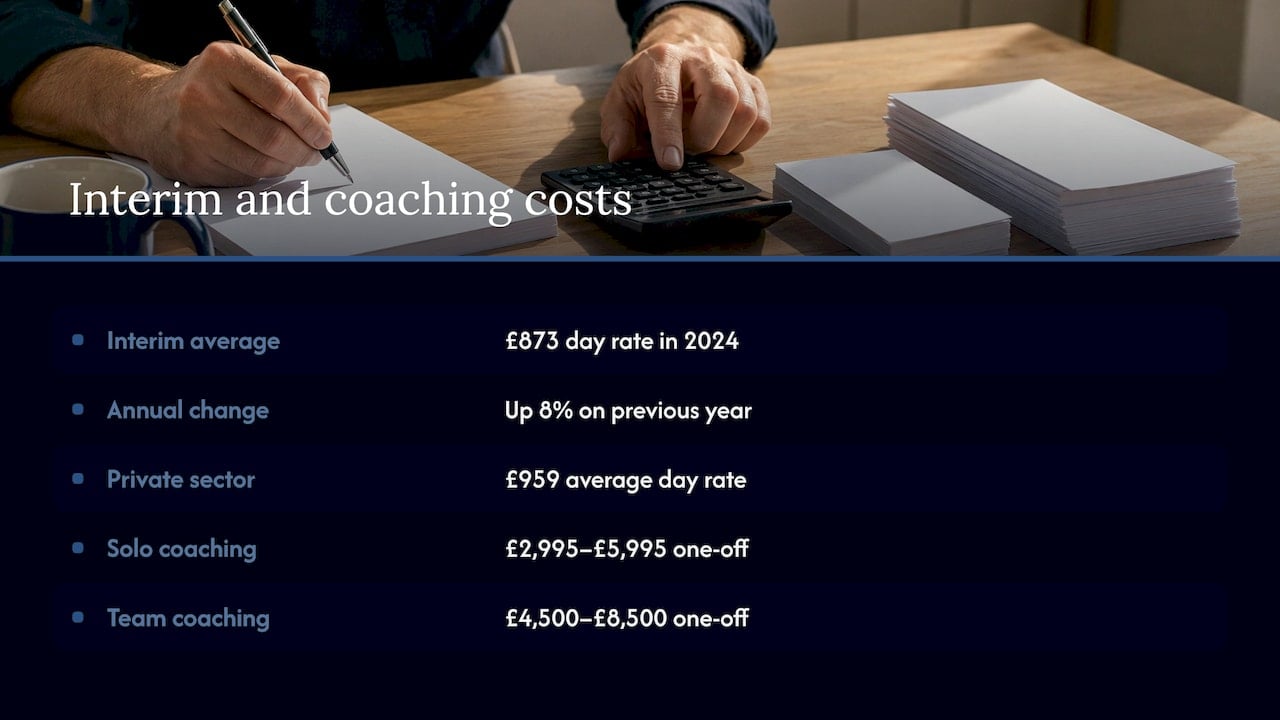
For interims there is a published benchmark. The IIM’s 2024 survey reported an overall average day rate of £873, up 8% on the year before, with private sector assignments averaging £959. That is a figure for interim managers across all functions, not sales directors specifically, and it applies to 2024. Check the latest survey for a newer reading.
The important point is structural. An interim is usually paid a day rate for most days of the week. A fractional director is bought for a small number of days, so your monthly outlay is a fraction of that. The question to ask is not “what is the day rate?” but “what does the total engagement cost against the revenue it should generate, and for how long?”
Solo consultants and coaches have a different calculation, because a full engagement for a team is not what they need. Our sales coaching programme for solo service businesses is built for that case, and the sales training cost page sets out our published ranges: £2,995 to £5,995 one-off for solo service businesses and consultants, and £4,500 to £8,500 one-off for team-based bespoke coaching and consultancy engagements.
IR35: the label does not decide it
IR35 (the off-payroll working rules) is HMRC’s test for whether someone working through their own company would be an employee if engaged directly. It is the question owners most often ask about both interim and fractional leaders, and the answer is the same for both: it depends on how the work is done.
GOV.UK’s employment status guidance makes the point that titles such as “interim” or “contractor” do not determine status. It depends on the working relationship, and an interim may be self-employed, a worker or an employee. The same guidance says that for Great Britain the factors include personal service and control, and, for worker status, whether the individual is in business on their own account for a client.
In practice, three questions matter for you as the hiring business:
- Control. Do you direct how, when and where the person works, or do they own the outcome and decide the method?
- Personal service. Must this exact individual do the work, or could they send a substitute?
- In business on their own account. Do they serve other clients, carry their own insurance and market themselves?
A genuine fractional director working a few days for several clients tends to look different from an interim embedded full time in one company’s structure, but that is a general observation, not a ruling. Whether the rules apply to your contract also depends on the size of your business and how the engagement is set up. Take advice from your accountant or an employment lawyer on the specific contract before you sign.
How to decide: five questions
- Is there a vacancy, or is there a plan to build? A vacancy points to interim. A plan to build points to fractional.
- How long will you need senior leadership? Under six months and full time, interim. Six months or more, at one to three days a week, fractional.
- Do you need the leader to coach? If your reps need to change how they sell, a leader who works alongside the team week after week usually gets further than one who stabilises and leaves.
- What is your revenue size? For a business at £2 million plus, or a SaaS firm at Series B, a full-time director may be coming, but fractional gets the process in place first so that hire inherits something that works.
- What is the cost of waiting? Each quarter without a process or a forecast has a price. Scale the commitment to the problem, then review it.
Worked example
Take a 60-person UK services company with a founder who still closes the biggest deals. The head of sales left in the spring. Two options are on the table.
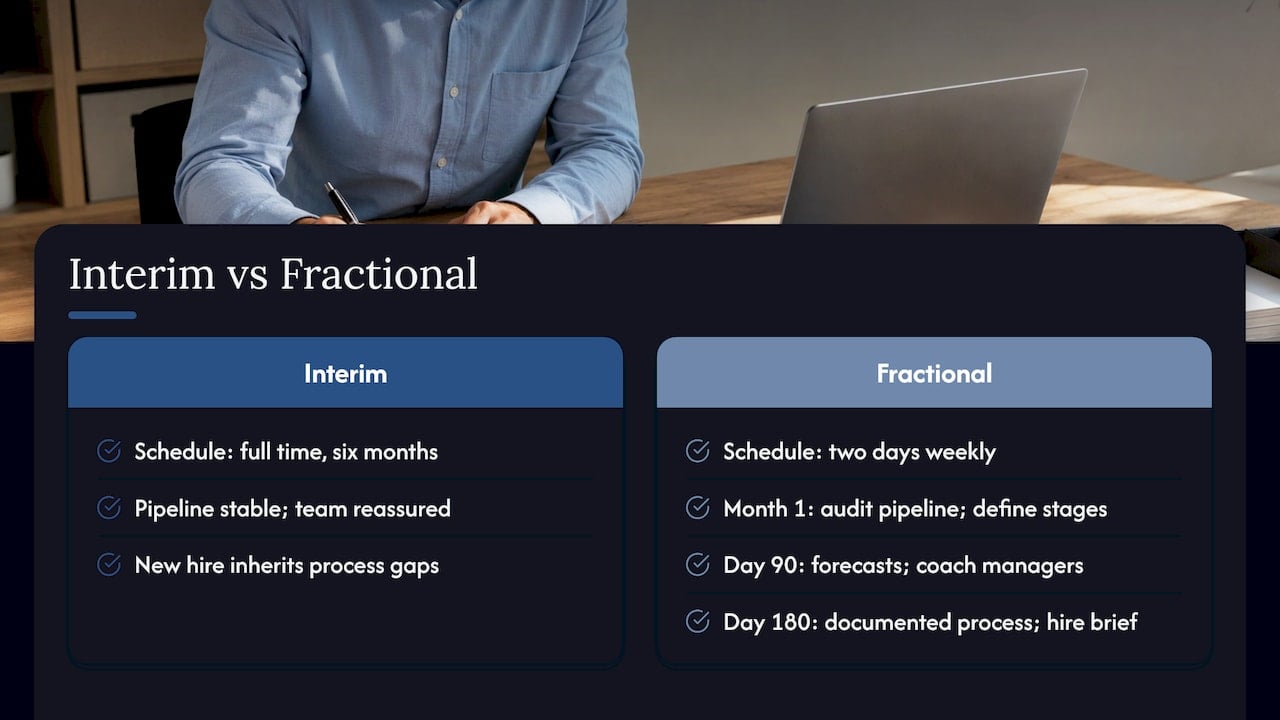
The interim route fills the chair full time for six months while recruitment runs. The pipeline is stable, the team is reassured, and the permanent hire arrives to find the same process gaps the leaver left.
The fractional route puts a sales director in two days a week. In the first month, the pipeline is audited and the stages defined. By day 90, forecasting is consistent and managers are being coached on call reviews. By day 180, there is a documented process and a clear brief for any later full-time hire. The business paid for senior judgement where it counted, and kept building rather than holding still.
That is the pattern we recommend for growth-minded businesses.
How we work with fractional engagements
Our Fractional Sales Director service is aimed at B2B companies and solo service businesses that want senior sales leadership without a full-time hire. We combine it with 1:1 coaching and consultancy, so the leader is not only setting the plan but developing the people who run it. Our stated aim is to help businesses reach at least 50% sales growth a year and see their teams hit target every quarter.
If you want to see how a plan, coaching and consultancy fit together, our sales consultancy services page explains the consultancy side, and the Sage Collective is available at £990 per month.
When you are ready to talk through which shape suits you, start from our Fractional Sales Director page.

Our perspective
In my experience, owners rarely lose revenue because they picked the wrong title. They lose it because they bought the wrong shape of help. A gap needs filling, a plan needs building, and those are different jobs.
We built our fractional work around the second job. A sales director who is in the business a few days a week, running the cadence, reviewing real deals and coaching the people who sell them, changes habits in a way a short, full-time assignment struggles to. Pairing that leadership with bespoke 1:1 coaching and consultancy is the point: the plan and the people develop together.
If you are at £10k a month as a solo consultant, or leading a team of fifty or more, the first step is the same. Be honest about what is actually stopping the next stage of growth, then buy exactly that.
Jerry
FAQ
Is a fractional sales director the same as an interim?
No. A fractional director works part time on an ongoing basis, usually a set number of days a week, and the engagement is reviewed as the business grows. An interim takes on a finite assignment, often full time, to fill a gap or deliver a change, as the IIM guide describes.
Is a fractional sales director inside IR35?
There is no automatic answer. GOV.UK says the working relationship decides status, not the job title. Control, personal service and whether the person is in business on their own account all count, so have your accountant or an employment lawyer review the contract.
How many days a week does a fractional sales director work?
One to three days a week is the usual range for small and mid-sized businesses. The right number depends on the size of your team, how much coaching is needed and whether you are building a process or running one that already exists.
Can a fractional director later become a full-time hire?
The more common outcome is that the fractional director builds the process, structure and hiring brief so that a full-time sales director can step in and keep going. How you handle that is agreed up front in the engagement.
Sources
- Institute of Interim Management: Guide to Interim Management (2024)
- Institute of Interim Management: Interim Management Survey 2024
- GOV.UK: Employment status and employment rights guidance
- Sales leadership career ladder map