
In most cases, yes. If you run a UK business and the training sharpens the selling you already do, its cost is normally a deductible business expense. The test is purpose: the money must be spent wholly and exclusively for the business. The treatment differs a little depending on whether you are a limited company, a sole trader or an employer paying for a team, and there are a few traps around new trades, food and away days. This guide walks through each one so you can plan the spend with your accountant, not guess at it.
We coach and train sales teams and solo business owners, so we get asked this one constantly, usually just before someone signs for a programme.
TL;DR
- Sales training that develops skills for the business you already run is normally an allowable expense, because it passes the “wholly and exclusively” test.
- Training that moves you into a new trade or gives you a new qualification is treated differently and is generally not deductible.
- Limited companies deduct the cost before Corporation Tax. Sole traders deduct it before Income Tax. Work-related training for employees, directors included, usually creates no taxable benefit for them.
- VAT-registered businesses that make fully taxable sales can normally reclaim the VAT on a genuine training invoice.
- Keep the invoice, the programme outline and a note of why it serves the business. Your accountant makes the final call.
Table of Contents
- The test HMRC applies: wholly and exclusively
- Limited company, sole trader or partner: how the deduction works
- Existing business or new trade: where the line sits
- Training your team, and yourself as a director
- Food, hotels and away days
- VAT on sales training
- Records and how to claim
- A worked example
- What our programmes look like for this purpose
- Our view on tax and the return on training
- FAQ
- Sources
The test HMRC applies: wholly and exclusively
Every business expense in the UK rests on one idea. HMRC’s Business Income Manual says spending on staff training and development is normally allowable for an employer, provided it is incurred wholly and exclusively for the purposes of the business. The same manual makes a useful point: the test looks at the purpose of the spending, not the result. So HMRC cannot second-guess your business decisions, and a cost is not disallowed just because someone enjoyed it or picked up a personal benefit along the way.
For a sales programme the purpose is easy to state. You are training to win more customers, close better, handle objections or lead a sales team more effectively. That is a trading purpose, and it sits comfortably within the test.
What can go wrong is when the purpose is mixed. A course that is half about your business and half about a hobby, or a package with a large leisure element, invites a closer look. Keep the stated purpose of the training clear and documented.
Limited company, sole trader or partner: how the deduction works
The route to relief depends on how you trade.
Sole traders and partners. GOV.UK lists training courses related to your business, such as refresher courses, among allowable expenses you deduct to work out your taxable profit before paying Income Tax.
Limited company owners. You are not self-employed in the tax sense, but the company deducts its business costs before Corporation Tax. GOV.UK’s guidance on company expenses you can deduct says a revenue expense can be fully deducted from profit if it is not specifically disallowed (client entertaining is the example) and has only a business purpose.
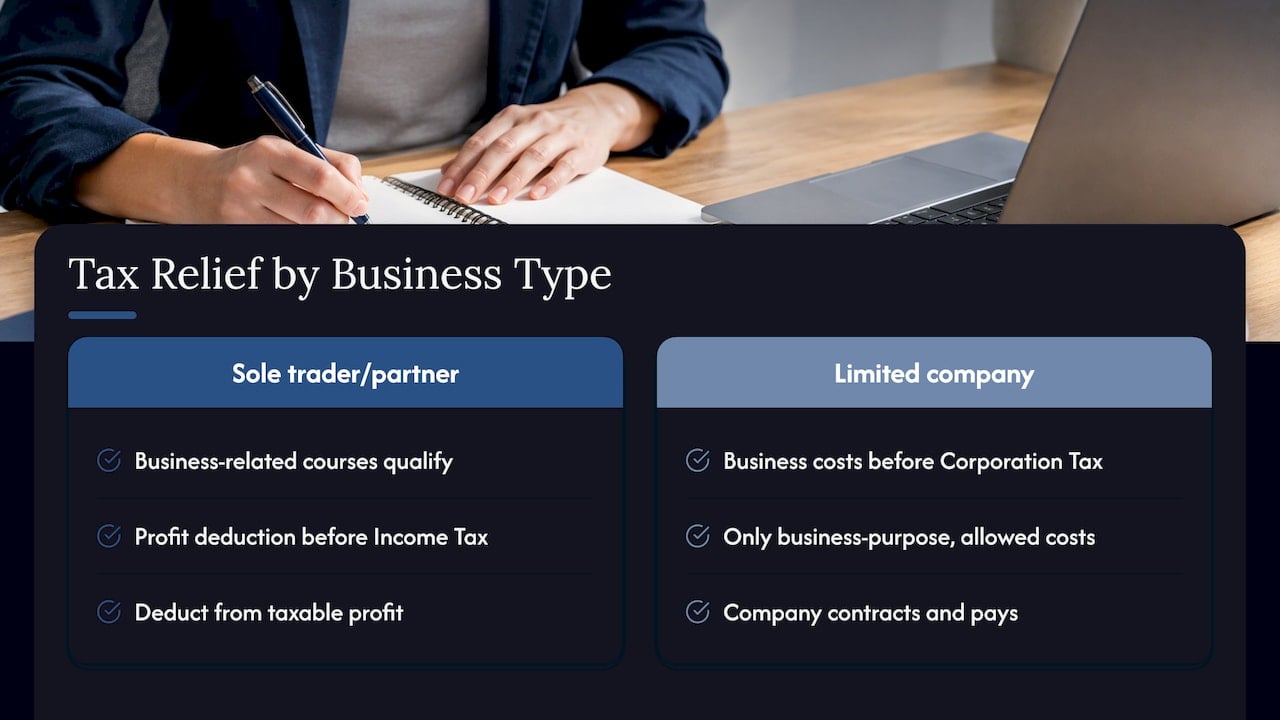
The practical difference for a director is how the company pays. Where the company contracts for the training and pays the invoice, the cost sits in the company accounts. One accountancy guide explains that a company can pay for qualifying work-related training without an income tax or National Insurance charge arising for the director. If you pay personally and then try to claim it back, you can create avoidable problems, so have the company pay directly.
A note for very small sole traders
If your self-employed income is small, the trading allowance may apply instead of claiming individual expenses. The £1,000 trading allowance rules are worth reading first, because you generally choose between the allowance and deducting actual costs. For most solo coaches and consultants investing in a proper sales programme, actual costs will be the larger figure, but check it with your accountant.
Existing business or new trade: where the line sits
This is the part that catches people, and it matters for solo consultants and coaches in particular.
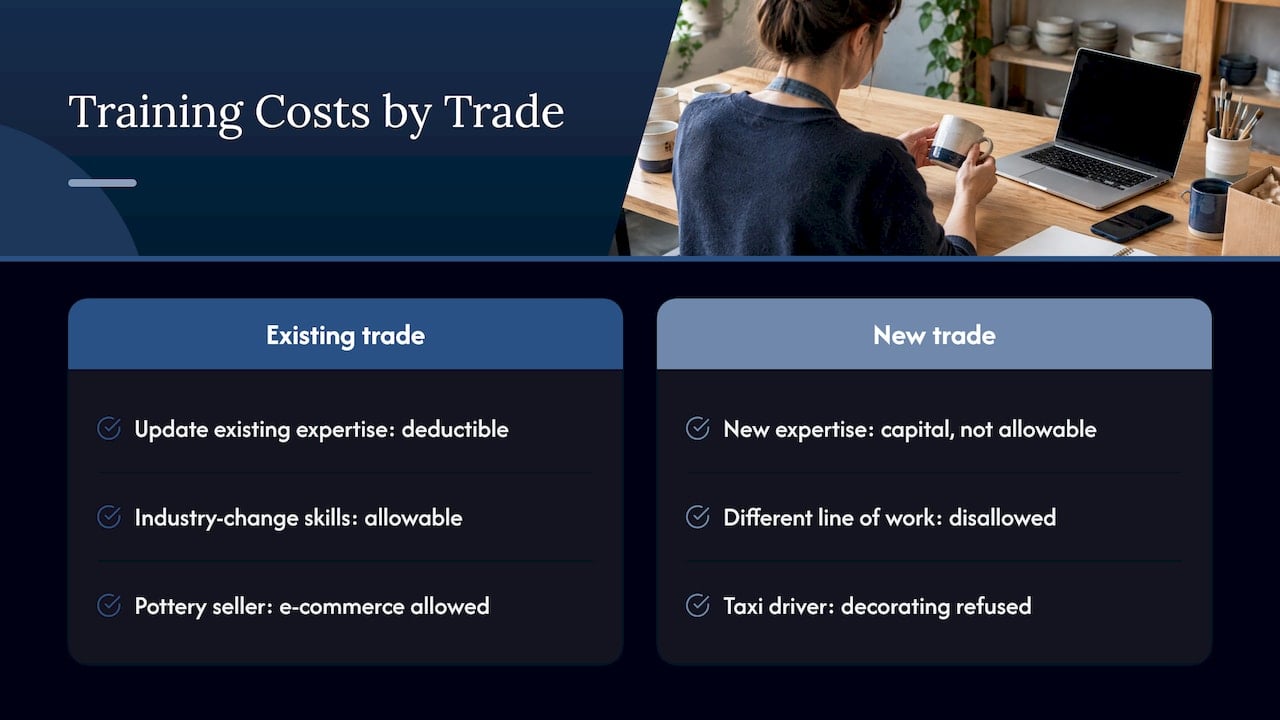
HMRC’s Business Income Manual says that for a self-employed owner, course costs are deductible only if incurred wholly and exclusively for the trade carried on at the time the training is undertaken. Training that updates or deepens expertise in your existing business area is normally revenue expenditure and allowable, including new skills needed to keep pace with industry changes.
The Low Incomes Tax Reform Group puts the contrast plainly: training that gives new expertise or a recognised qualification is a capital cost and not allowable, while attending simply to update what you already know is deductible.
HMRC’s own examples, in its guidance on training costs (6 March 2024), show the pattern. A pottery seller taking e-commerce and website courses to sell online is likely to be allowed. Not allowed: an unemployed person’s driving-instructor course to start a new business, a sportswear shop owner’s sports science degree, a makeup artist’s tattooing courses and a taxi driver’s decorating course. In each refused case, the course opens a different line of work.
What this means for sales training
Put a consultant, coach, HR specialist or service business owner who already sells services into that picture. Training in discovery calls, pricing conversations, objection handling or building a sales process improves the trade they already carry on. That is the same shape as the pottery seller’s online selling course.
Two situations deserve a pause:
- Starting up. If you are still preparing to launch, costs before the trade begins are judged differently from costs in a running business. Speak to your accountant about timing.
- A pivot. If the programme is designed to take you into a different profession, such as a consultant moving to become a recruiter, it looks more like a change of trade.
For an established business adding more revenue from the same services, you are firmly on the allowable side.
Training your team, and yourself as a director
When the business pays for staff to be trained, the position is generous. HMRC’s manual says staff training remains deductible even where it develops skills not directly related to the current job, for example training that only becomes relevant if the person is promoted. That suits sales teams well, where a strong rep is often being groomed for team leadership.
The point to watch is connected people. Where the trainee is a director or an employee with a significant stake in the company, or a relative of one, the cost can be disallowed if it provides a personal benefit. The manual suggests asking whether the company would have incurred the same cost for an unconnected employee doing the same job. For sales training the answer is usually yes: you would send any head of sales or sales director on a programme that improves how they sell and lead.
On the employee side, work-related training is defined as a course or activity designed to impart or improve knowledge, skills or personal qualities likely to prove useful in the duties of the job. Tax advisers at BDO note such training is generally not a taxable benefit and is not business entertaining, so the gross cost gets a business deduction.
One rule runs the other way. A guide for limited companies points out that training costs paid for personally by an employee are not allowable to the company, so the business should be the one commissioning and paying.
Food, hotels and away days
The training fee is rarely the problem. The extras around it can be.
HMRC’s guidance says food and accommodation for employees attending training for the purposes of the trade is not disallowed. It treats training given free to non-employees, such as self-employed sales agents on commission, differently: the training itself (speakers, room hire) is allowable, while any food or overnight accommodation counts as disallowable entertainment. A tax adviser’s note says the same, and adds that meals included in a paid training package escape disallowance where the lump sum secures a commitment to provide training.
There is also a warning about events labelled as training. BDO’s tax team notes that management away days, motivational events and team-building can contain taxable benefits if the recreational elements are not merely incidental to the training. The cure is simple: a clear agenda, working sessions that fill the day, and a programme whose content is plainly about selling.
VAT on sales training
VAT is a separate question from the deduction, and it is where many owners leave money behind.
HMRC’s VAT Notice 701/30 describes vocational training as courses, conferences, workshops or seminars that prepare people for future employment or improve performance in current work. Some supplies by eligible bodies, such as universities and further education colleges, are exempt, and from 1 January 2025 private schools’ education and vocational training became standard rated. Commercial sales training from a business is normally charged with VAT where the provider is VAT-registered.
For you as the buyer, an accountancy firm explains that a fully taxable VAT-registered business can reclaim VAT on a genuine staff-training invoice in full as input tax on its next return, provided the course prepares staff for their current or future role and is not a personal benefit. If you are not VAT-registered, or you make VAT-exempt supplies, the picture changes, so confirm with your accountant before assuming a full reclaim.
Records and how to claim
HMRC expects you to keep records of sales, takings, purchases and expenses. Its self-assessment help sheet HS222 (updated 7 April 2026) sets that out, and notes that under the cash basis, capital expenditure on education or training is not deductible as a capital item. That is another reason to be clear that the training is for your existing trade.
On the return itself, the LITRG explains that where turnover is under £90,000 for 2025/26 and other conditions do not apply, you can enter the total of allowable expenses as one figure, but you must keep the details in case HMRC asks. Above the threshold, expenses are shown by category.
A short file for each training engagement is enough:
- The invoice, in the business name.
- The programme outline or proposal showing it is about selling.
- A line on why it serves the business now (for example, “improve close rate on inbound enquiries”).
- Proof of payment from the business account.
- For teams, the list of attendees and their roles.
A worked example
Take a limited company consultancy with a founder and three people on the sales side. The company commissions a team-based programme and pays the invoice from the business account. The training covers pipeline, discovery conversations and objection handling.
The cost is a revenue expense, deducted from profits before Corporation Tax. Because the founder is a director, the question is whether the company would pay the same for an unconnected head of sales. It would. No personal benefit arises. If the company is VAT-registered and sells taxable services, the VAT on the invoice is normally recoverable on the next return. The saving is the cost multiplied by the company’s tax rate for that year, plus the VAT recovered, which is why the net cost to the business is lower than the headline fee.
Now take a sole trader coach, three years in, who books a sales programme to fill her diary with better-fit clients. She still coaches the same people on the same subjects. This is the pottery-seller shape: an improvement to the existing trade, so the fee goes into allowable expenses.
What our programmes look like for this purpose
If you are weighing up a programme, the tax treatment is one input and the commercial return is the other. Our team-based bespoke coaching and consultancy engagements run at £4,500 to £8,500 one-off, and our sales acceleration track for solo service businesses and consultants is £2,995 to £5,995 one-off. The Sage Collective is £990 per month. You can see how the packages are built on our sales training cost page, and solo owners can look at the sales coaching programme.

Both tracks combine one-to-one coaching with consultancy and training, and each is aimed at selling services you already deliver, which is the profile that fits the allowable side of HMRC’s line. If you want to talk it through, start from our sales training page and bring your accountant’s questions with you. For help on funding routes, we also cover sales training grants in the UK.
Our view on tax and the return on training
We would rather you decide on training for the return, then let the tax treatment make it cheaper. Our packages are built around the idea that a sales team should hit target every quarter and that a business should grow sales by at least 50% a year. Those are our own aims, and the programmes are designed to work towards them.
Because we combine bespoke one-to-one coaching with traditional training and consultancy, the work is about your pipeline, your conversations and your people. It is the business you already run, and that is why it sits so naturally with the wholly and exclusively test.
If you are a solo consultant or coach, our track is built for you to sell the services you already deliver, with more confidence and better prices. If you run a team, we coach the people and fix the process together. Where a fractional sales director suits better, we provide that too.
Whichever you choose, keep the paperwork tidy and give your accountant the outline early.
Jerry
FAQ
Can I claim sales training as a sole trader?
Yes, if it relates to the business you carry on now. GOV.UK lists training courses related to your business, such as refresher courses, among allowable expenses for sole traders. You deduct the cost when working out taxable profit. Keep the invoice and a note of the purpose.
Can a limited company pay for a director’s sales training?
Yes. The company can deduct the cost as a business expense where it has a business purpose only, and work-related training paid by the company does not normally create a taxable benefit for the director. Have the company contract and pay directly. Ask whether it would pay the same for an unconnected employee in that role.
Can I reclaim VAT on sales training?
A VAT-registered business making fully taxable supplies can normally reclaim VAT on a genuine training invoice through its next VAT return. The course must prepare staff or you for current or future work, not give a personal benefit. If you make exempt supplies, ask your accountant how much is recoverable.
Is training for a different career deductible?
Generally not. HMRC treats training that gives you new skills for a new trade, or a recognised qualification, as a capital cost. Training that updates skills in the business you already run is the allowable kind.
Are the meals and hotel on a training course deductible?
For employees on training for the business, food and accommodation are not disallowed. For non-employees such as self-employed sales agents, the training is allowable but food and overnight accommodation are disallowed entertainment. This is general information, so confirm your own case with an accountant.
Sources
- HMRC Business Income Manual BIM47080: staff training
- HMRC Business Income Manual BIM42526: own training
- HMRC Business Income Manual BIM45047: entertainment and training
- GOV.UK: expenses if you’re self-employed
- GOV.UK: company expenses you can deduct before paying Corporation Tax
- GOV.UK: check if the cost of training could be an allowable business expense
- GOV.UK: VAT Notice 701/30 on education and vocational training
- GOV.UK: HS222 how to calculate your taxable profits (2026)
- Low Incomes Tax Reform Group: business expenses allowable for tax
- Smart Formations: UK director expenses guide
- DNS Associates: limited company guide 2026
- BDO: seasonal staff benefits
- Tax Network: business entertaining and tax
- Alto Accounting: VAT on training courses
- Fixxa: trading allowance UK