
Your first sales leader should arrive when selling already works but depends on you. The hire fixes a gap in leadership: process, coaching and forecasting. It does not fix a missing product-market fit. For many UK owners and SaaS founders, the lowest-risk first step is a fractional sales director who leads the function one to three days a week while the motion is proven and the team takes shape. That is what we do at Aheadofsales, and the reasoning below shows why it suits most businesses at this stage.
TL;DR
- Hire a leader when you can explain why deals close, but you are still the one closing, coaching and forecasting.
- A permanent Head of Sales in the UK is a six-figure commitment before commission, and director notice periods are long.
- A fractional sales director builds the process, the plan and the first hires at a fraction of that commitment, then hands over to a permanent leader if you need one.
- Write the role down in terms of outcomes, targets and ramp period before anyone starts. The UK tribunal time limit for most claims doubled to six months from 1 October 2026.
- Agree a 30, 90 and 180 day plan before day one.
Table of Contents
- How to know you are ready
- What a first sales leader should own
- Your options, side by side
- What a permanent hire costs in the UK
- Choosing the person
- Getting the contract and paper trail right
- The first 90 days
- Where we come in
- Our view
- FAQ
- Sources
How to know you are ready
The common mistake is hiring on revenue alone. A founder reaches a number, feels the pressure, and recruits a senior person to “sort sales out”. Then the leader finds no written process, no consistent buyer and a pricing model that changes by deal.
There are a few signals worth checking honestly.
You can explain your wins. If you can describe your buyer in a few sentences and say why the last ten similar deals closed, a leader has something to repeat. If every win has a different story, you still need to find the pattern, and that is founder work.
Your time is the bottleneck. UK recruitment specialists put the typical trigger for a first VP of Sales in SaaS at around £1m ARR, with two or three salespeople struggling to coordinate, or a founder spending more than half their time selling. For a service business at, say, £10k a month or a company above £2m turnover, the same logic applies: if you personally close, hire, coach and forecast, that is a function with no owner.
Someone other than you can run a discovery call. If nobody else has ever sold the product, you cannot yet judge a leader’s results, and they cannot judge the process.
You can name the job. Is the gap a builder (no plan, no structure, no hiring sequence) or a coach (a working motion that needs cadence and review)? The first needs a Head of Sales or a fractional director. The second often needs only a sales manager.
If you are a solo consultant or coach, you probably do not need a leader at all. You need a sales method you can run yourself, and our sales coaching programme is built for that.
What a first sales leader should own
A salesperson owns pipeline: prospecting, calls, follow-up, closing. A leader owns the system the salespeople work in. In practice that means:
- the written sales process, with stage definitions and what must be true to move a deal on
- the forecast, so you can trust the number you give a board or a bank
- coaching and deal reviews
- the hiring plan and ramping of the next sellers
- the agreed definition of a qualified lead with marketing
The leader should not be asked to invent your ideal customer from nothing, build your CRM from scratch, or generate all the pipeline alone. Those are founder and operations jobs, and a leader handed them becomes an expensive salesperson.
Title matters too. A first leader is usually a player-coach who still carries some of the number. Calling them VP too early makes the next senior hire awkward. If you are weighing the titles, our guide to Sales Director vs VP of Sales sets out which fits which stage.
Your options, side by side
| Option | Fits when | Typical commitment |
|---|---|---|
| First salesperson (AE) | The constraint is closing capacity | Salary plus commission |
| Sales manager | The motion works but needs coaching and cadence | Salary, smaller team |
| Permanent Head of Sales or VP | The motion repeats, there is a team to lead and budget to grow it | Six-figure package, notice period |
| Fractional sales director | The process needs building before anyone leads it full time | Part-time, fixed mandate |
The fractional route deserves a closer look because it is the one most owners overlook. A fractional sales director is a senior leader who works with you for one to three days a week, owns the sales function’s plan and hands you the result. Our Fractional Sales Director service is built around this, and the responsibilities of a fractional sales director are the same ones listed above: process, forecast, coaching and hiring.
The reasoning is simple. The riskiest period of a first leader’s tenure is the first six months, when the process is being defined and nobody yet knows whether the person fits. With a fractional leader you get the definition work done by someone who has done it before, and you make the permanent hire later, with a written process and a proven plan for that person to inherit. If you are deciding between the two, when UK founders hire a fractional sales director walks through the thresholds.
What a permanent hire costs in the UK
Pay figures move with the market and each guide reflects its own survey period, so treat these as 2026 guides, not fixed prices.
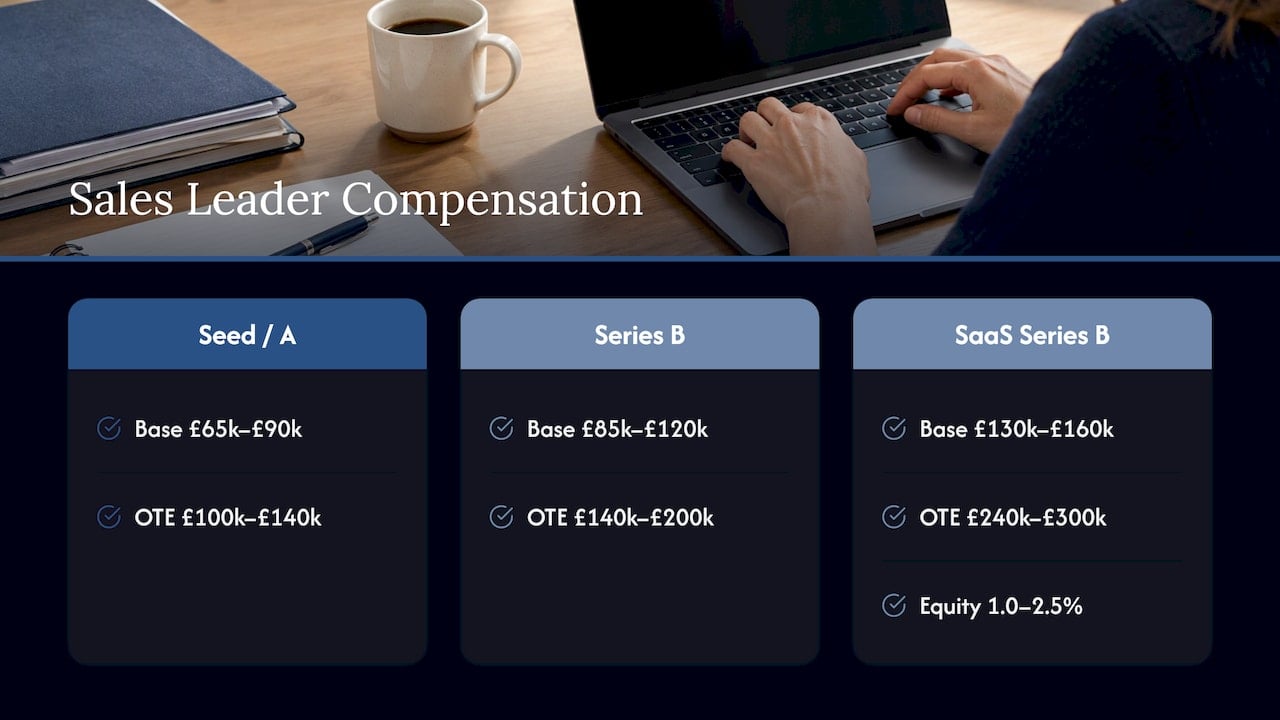
One UK salary guide, updated in November 2026, puts Sales Director and Head of Sales base pay at £110,000 to £150,000, with on-target earnings (OTE, base plus commission at target) of £180,000 to £260,000. A UK recruitment guide published in 2026 splits it by stage: at seed or Series A with a team of two to five, £65,000 to £90,000 base and £100,000 to £140,000 OTE; at Series B with a team of five to fifteen, £85,000 to £120,000 base and £140,000 to £200,000 OTE. The same guide says London roles command 15 to 20 per cent more than comparable regional ones.
For SaaS, a UK comp table for 2026 shows a Series B base of £130,000 to £160,000, OTE of £240,000 to £300,000 and equity of 1.0 to 2.5 per cent.
Add recruitment fees, a notice period (director-level notice is commonly several months), and the months before the leader’s own results arrive. That is the cost you are weighing a fractional engagement against. Our team-based engagements are listed at £4,500 to £8,500 one-off, and the solo service business track at £2,995 to £5,995 one-off, on our pricing page.
Choosing the person
If you do hire permanently, two questions matter most.
Builder or scaler? Leaders who inherited a working machine can run it, but often cannot construct one. If you need the plan, process and team built, weight evidence of building: a team they hired from nothing, a process they wrote, a target they hit while the process was still forming.
What would they do in month one? Ask a candidate what they would do after a missed quarter. Strong answers involve joining customer calls and reviewing live opportunities. Weak ones add reporting layers before they have spoken to a buyer.
A sensible assessment runs in stages: a founder screen, a deep dive on track record, a 90-day plan the candidate presents to your stakeholders, and references. Take references from your own network as well as the ones supplied. Ask for the year things went badly, not only the good ones.
The candidate’s plan will lean on data, so check what your own is like. Forecasting from a messy pipeline is guesswork for any leader, and a CRM selection checklist helps you judge whether your system can hold deal stages and follow-up in one place before you interview.
Getting the contract and paper trail right
A sales hire involves targets, commission and ramp periods, which are exactly the things that go wrong in disputes. Three UK points are worth knowing.
Written particulars. An employee must receive a written statement of employment particulars on or before their start date, covering pay, notice, duties, hours and more. Failure can lead to an award of two to four weeks’ salary.
Tribunal time limits. From 1 October 2026 the limit for most employment tribunal claims doubled from three months to six months, and further changes follow from 30 October 2026. Before a sales hire starts, write down the target and how it is measured, commission terms, accounts or territory, reporting line, ramp period and review dates. Keep dated notes of the support you give anyone who is struggling.
Probation and dismissal. Probation in the UK is a contractual device, not a statutory one, and employment rights apply from day one. From 1 January 2027 the unfair-dismissal qualifying period falls from 24 months to six under the Employment Rights Act 2025. A six-figure hire you cannot easily part with makes a proven process and a clear brief more valuable. Take advice from an employment solicitor on the contract itself.
The first 90 days
Whoever you hire, agree the plan before day one. One UK and US guide for Series A and B companies suggests this frame:
- Days 1 to 30, listen and sell. Meet customers and lost prospects, join calls, co-lead the most important deals.
- Days 31 to 60, define. Document stages and exit criteria, set the forecast cadence and draft the hiring plan.
- Days 61 to 90, hire and commit. Open the first account executive roles, present a quarterly plan to you and the board, and agree month-six measures. The full first 90 days framework is worth reading before you brief anyone.
Then step back. A founder who joins every call turns the new leader into an expensive SDR (sales development rep, the person who books first meetings). Join when they ask.
Our fractional sales leadership engagements use a 30, 90 and 180 day plan for the same reason: a leader with a visible plan can be measured, and you can see by day 180 whether the next step is a permanent hire.
Where we come in
If your sales are founder-led and you want them to become a system, our Fractional Sales Director service puts a senior leader on the function one to three days a week. Pair it with team coaching and our sales consultancy and your sellers are coached while the process is built. Packages for teams start at £4,500, and the Sage Collective is £990 per month for owners who want ongoing coaching.
See the Fractional Sales Director page or our sales consultancy to see which fits your stage.
Our view
I have sat on both sides of this decision, and the pattern is rarely different. A founder hires a senior leader to “fix sales”, and six months later neither side is happy, because the job was never defined.
Our view is that the first sales leader is a process job before it is a people job. We combine one-to-one coaching with consultancy because a plan on paper does nothing until the people who must run it can sell to it, and a coached team does nothing without a plan to follow.
That is why we put fractional leadership first for most owners at this stage. You get a senior person on your numbers within days, a written process, a forecast you can trust and a hiring plan. If you then want a permanent leader, you hire one into a function that works. We aim for at least 50% annual sales growth for the businesses we work with, and for the team to hit target every quarter.
Hire slowly and define quickly.
Jerry
FAQ
When should a SaaS startup hire its first sales leader?
Typically when the company is approaching or just past £1m ARR, a few salespeople need coordinating, or the founder spends over half their time selling. The more reliable test is repeatability: you can explain why deals close and the process can be written down.
Should my first sales hire be a leader or a salesperson?
Hire a salesperson if the constraint is closing capacity and the process already works. Hire a leader if the function needs building, or the founder is the only person who sells, hires and coaches. If you have one seller and no proven motion, bring in fractional leadership first.
What does a Head of Sales cost in the UK?
UK guides for 2026 put base pay at roughly £110,000 to £150,000 for a Sales Director or Head of Sales, with OTE up to £260,000, and lower at seed stage. Recruitment fees and notice periods come on top, and London pays more than the regions.
Can a fractional sales director replace a full-time hire?
For many businesses at this stage, yes. A fractional director owns the plan, process, forecast and coaching one to three days a week. If the business later needs a full-time leader, that person inherits a working process.
Sources
- Hiring Your First VP Sales, What SaaS Founders Get Wrong
- Sales Leadership salary UK and US 2026
- Head of Sales Recruitment UK
- How to hire a VP Sales at Series A or B
- The Sales Hire Now Comes With a Longer Paper Trail
- K&L Gates UK Employer Guide
- UK Probation Period 2026