
MEDDICC and MEDDPICC are the same qualification method at different levels of detail. MEDDIC is the original six checks. MEDDICC adds Competition as a seventh. MEDDPICC adds Paper process as an eighth. The right version for you depends on how many people sign off your deals and how long they take to close, not on which acronym sounds most advanced.
I have seen owners and sales leaders lose weeks on this question. They pick the longest acronym, bolt it onto a CRM, and then discover the team never fills in half of it. This guide explains what each version covers, how all of them compare with BANT, how to choose, and how to run one on a real deal.
TL;DR
- MEDDIC has six checks, MEDDICC adds Competition, and MEDDPICC adds Paper process on top. The core idea is identical.
- MEDDIC’s creator has said the extra letters only put emphasis on elements that were already inside the original.
- BANT is a fast first-call filter. The MEDDIC family is for deals with several stakeholders, a real buying process and a long cycle.
- A common guide is that MEDDPICC suits average deals above $50,000 and cycles longer than six months, while simpler sales can run on MEDDIC.
- Whichever you choose, the value comes from scoring each deal honestly and working on the weakest area next.
Table of Contents
- What each acronym stands for
- Is there a real difference between MEDDICC and MEDDPICC?
- MEDDIC vs BANT: which fits which deal
- How to choose between MEDDIC, MEDDICC, MEDDPICC and BANT
- Is MEDDIC outdated?
- How to apply MEDDPICC to a live deal
- Common mistakes when adopting these frameworks
- Where Ahead of Sales fits
- Our view: pick the version you will use
- FAQ
- Sources
What each acronym stands for
MEDDIC is a deal qualification framework: a checklist that tells you whether a prospect is genuinely likely to buy, and what you still do not know. Each letter is a question you must be able to answer about the deal.
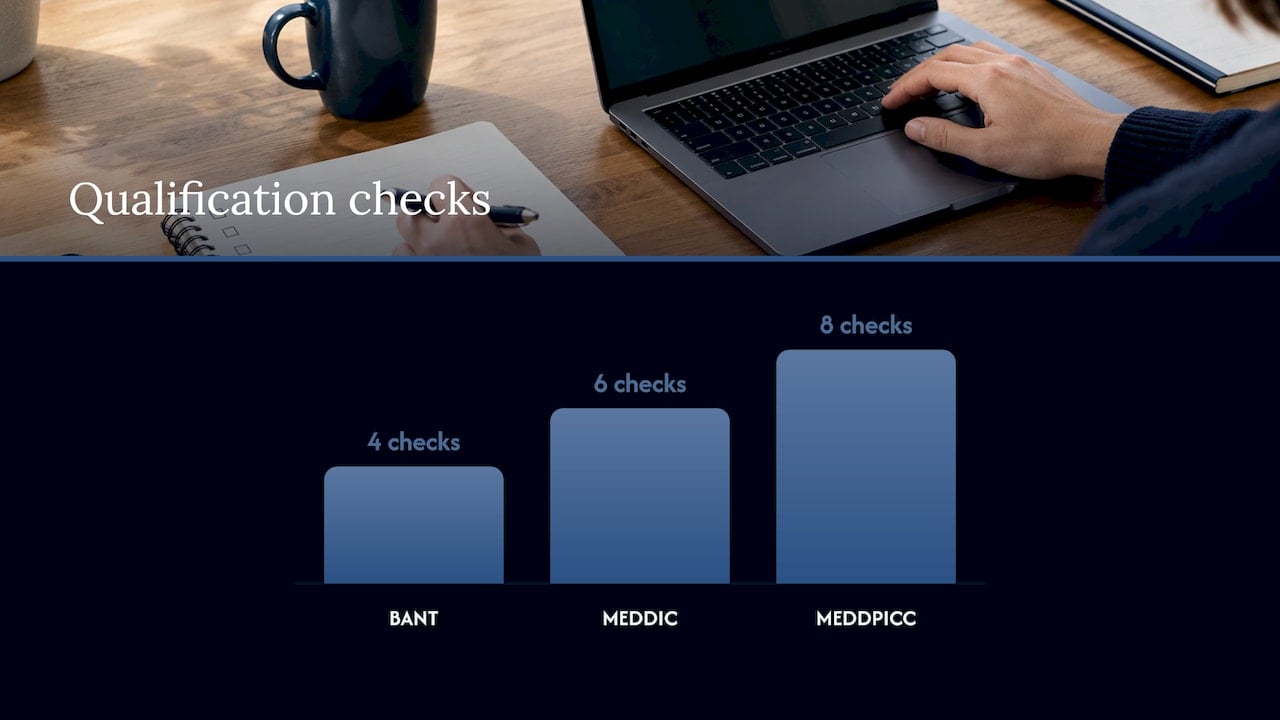
MEDDIC stands for Metrics, Economic Buyer, Decision Criteria, Decision Process, Identify Pain and Champion. MEDDPICC adds Paper Process and Competition, which makes eight letters. Another guide describes the three versions as differing only in how many checks they include: MEDDIC has six, MEDDICC adds Competition, and MEDDPICC adds Paper process (the master service agreement, procurement, legal, security review and onboarding steps).
Here is the plain-English version:
| Letter | What you need to know | Question to ask yourself |
|---|---|---|
| Metrics | The measurable value the buyer expects | Can the buyer put a number on the benefit? |
| Economic buyer | The person who can release the budget | Have I spoken to them directly? |
| Decision criteria | How the buyer will judge options | Do I know what they will score us on? |
| Decision process | The steps and people between now and a yes | Do I know the sequence and the dates? |
| Paper process (MEDDPICC) | Contract, procurement, legal and security steps | Do I know how long signature really takes? |
| Identify pain | The problem and its consequences | Is the pain costly enough to act on? |
| Champion | An internal advocate with influence | Will they sell for us when we are not in the room? |
| Competition (MEDDICC and MEDDPICC) | Rivals and the status quo | Who else is the buyer considering, including doing nothing? |
Where MEDDPIC fits
Searchers type MEDDIC, MEDDICC, MEDDPIC and MEDDPICC almost interchangeably, and one guide notes that MEDDPICC is often misspelled as medpicc or medpick. In practice, MEDDPIC usually appears as a shorthand for the version that includes Paper process. If a colleague uses it, ask which letters they mean and write them down. A shared definition matters more than the spelling.
Is there a real difference between MEDDICC and MEDDPICC?
The difference is emphasis, not a different method. Dick Dunkel, MEDDIC’s creator, has said MEDDPICC is exactly the same as MEDDIC. In the original 1996 version, Paper Process sat inside Decision Process and Competition was assumed throughout. The extra letters simply give those elements their own line.
That is also how Zapier explains the change: the framework grew to help teams cope with growing enterprise complexity, so sellers are not blindsided by legal and procurement roadblocks while they keep an eye on competitors.
Why does that matter to you? Because the deals most UK service businesses and SaaS firms lose late are rarely lost on pain or price. They stall in procurement, a security questionnaire, a legal redline, or a director who quietly prefers the incumbent supplier. If your pipeline has had a few of those, the two extra letters earn their place. If your deals are signed by one person with a short email, they are overhead.
Dunkel also offers a useful way to remember all eight. He groups them into three themes:
- The value you deliver: Metrics and Identify pain.
- The process you navigate with the customer: Decision criteria, Decision process and Paper process.
- The stakeholders who decide the deal: Economic buyer, Champion and Competition.
He adds that what matters is each company deciding “this is our version”. That is the right instinct. A framework used the same way by every rep beats a perfect one used by nobody.
MEDDIC vs BANT: which fits which deal
BANT stands for Budget, Authority, Need and Timing. Salesforce notes it has been used by sales organisations since the 1950s and works as a quick early-stage check, while MEDDIC is far more complex, covering the human and technical nuances of the modern buyer’s journey.
In the same comparison, each BANT criterion is a simple yes or no question: does the prospect have budget available, does your contact have decision-making power, have they articulated a specific need, and are they ready to buy with a purchasing or implementation timeline.
The practical difference:
| BANT | MEDDIC | MEDDPICC | |
|---|---|---|---|
| Checks | 4 | 6 | 8 |
| Best moment to use | First call, lead qualification | Mid-funnel, opportunity management | Mid to late funnel, forecasting complex deals |
| Typical deal | Simple, one decision maker | Several stakeholders, measurable value | Enterprise, procurement and legal involved |
| Main risk | Misses hidden stakeholders and weak pain | Misses late contract and procurement delays | Becomes admin if the deal does not need it |
| Asks about the buyer’s internal politics | Barely | Yes (Champion, Decision process) | Yes, plus Paper process and Competition |
BANT tells you whether someone is worth a second meeting. It does not tell you why the deal might die in month four. MEDDIC and its variants do. Many sensible teams use both: BANT to screen inbound leads, then the MEDDIC family once an opportunity is open.
If you want the longer version of that comparison, we cover it in BANT vs MEDDIC.
How to choose between MEDDIC, MEDDICC, MEDDPICC and BANT
Use three questions. Answer them from your last ten closed deals, not from how you hope to sell next year.
1. How big and how slow are your deals?
HubSpot’s guidance says MEDDPICC is particularly effective for enterprise sales with long cycles, high contract values and multiple stakeholders. Its tip is that SaaS companies with average deal sizes above $50,000 and sales cycles longer than six months are a good fit, while MEDDIC may suffice for simpler, shorter sales processes.
Translated for a UK service business: if a typical engagement is a few thousand pounds and closes in a fortnight, full MEDDPICC will feel like paperwork. If you sell a six-figure contract to a firm with a procurement team, a legal review and a security questionnaire, leaving out Paper process is asking for a surprise at the end.
2. How many people sign off a purchase?
One decision maker means BANT or a light MEDDIC is enough. Three or more people, with a finance director or board member involved, means you need Economic buyer, Champion and Decision process written down for every deal. This is the single clearest sign you have outgrown BANT.
3. Can your team and your CRM carry it?
Salesforce’s Samuel Holzman advises matching the methodology to your team’s reality: experienced sellers adapt quickly to MEDDIC, while less experienced teams may be better served by BANT, and if your CRM cannot track a wide range of data points, a streamlined approach is safer. That is sound advice. A framework nobody updates is worse than a simple one that stays current.
A quick rule of thumb:
- Solo consultant or small service business, short cycles: BANT, with a few MEDDIC questions (Economic buyer, Champion, Metrics) added to discovery calls.
- £2m+ business with a small sales team and mixed deal sizes: MEDDIC, with a Paper process checklist for your biggest deals.
- Series B+ SaaS or any team selling into enterprise and public sector: MEDDPICC from first qualified opportunity.
Is MEDDIC outdated?
No. One 2026 guide reports that MEDDIC is still actively used by enterprise SaaS teams, with most large organisations now using the MEDDPICC extension. The mechanics are unchanged: score the deal across the dimensions, drop weak deals early, and work on the lowest-scoring dimension next. The same guide notes that conversation-intelligence tools can now score the dimensions from call recordings, which reduces data entry.
The age of the framework is a strength. It came out of one painful problem: too many deals in the pipeline that never closed. Qualification discipline does not date.
How to apply MEDDPICC to a live deal
This is the part most guides skip. A framework only helps if it changes what you do on Monday morning. Here is a routine you can run in 30 minutes per deal.
Step 1: Score each letter honestly
Give every letter a score from 0 to 2:
- 0: you do not know, or you are guessing.
- 1: you have heard it from your contact, but not confirmed it.
- 2: you have verified it with evidence, ideally from the person concerned.
The discipline is in the scoring. “The budget is fine” from an enthusiastic contact is a 1, not a 2. Hearing it from the Economic buyer is a 2.
Step 2: Find the lowest score and set one action
Do not try to fix everything. Pick the weakest letter and write the single next action that would move it up a point. If Economic buyer is a 0, the action is a request for an introduction, framed around the value in Metrics.
Step 3: Test your Champion
A friendly contact is not a Champion. A Champion has influence and a personal reason to want you to win, and will share information you cannot get yourself. Ask them to help you prepare for the meeting with the Economic buyer. If they hesitate, you have a fan, not a Champion.
Step 4: Map the paper trail early
This is the MEDDPICC letter that saves quarters. Ask in the first or second meeting: after you decide, what happens next? Who reviews the contract, does procurement or security need to approve, and how long did the last supplier take? Put those steps and rough dates in the deal record.
Step 5: Name the competition, including doing nothing
For most UK service businesses, the biggest rival is not another supplier. It is the buyer deciding to wait or to handle it in-house. Write that down as a competitor and ask what would make the status quo more expensive than acting.
Worked example
Imagine a UK B2B software firm quoting £90,000 a year to a logistics company. After discovery the scores look like this:
| Letter | Score | Evidence |
|---|---|---|
| Metrics | 2 | Customer expects to cut manual rework by a stated amount |
| Economic buyer | 0 | Never met the finance director |
| Decision criteria | 1 | Operations lead mentioned integration and price |
| Decision process | 1 | Told “it goes to a committee”, no date |
| Paper process | 0 | Unknown whether security review is required |
| Identify pain | 2 | Missed delivery windows are costing them contracts |
| Champion | 1 | Operations lead is keen, influence untested |
| Competition | 1 | Incumbent supplier plus an in-house option |
That deal is not a “70% forecast” because the demo went well. Two zeros sit on exactly the items that cause late stalls. The next actions are an introduction to the finance director and a question about security and legal review. This is how the framework earns its keep: it replaces optimism with a list of specific unknowns.
Using it in deal reviews
Run a weekly 20-minute review of your top deals using the scores. Sort by lowest total, not largest value. Anyone can describe a big deal with energy. Only a scorecard shows which ones you are guessing about. If you want to connect this to your wider funnel, our guides on B2B sales pipeline stages and sales pipeline optimisation show where each check sits.
Common mistakes when adopting these frameworks
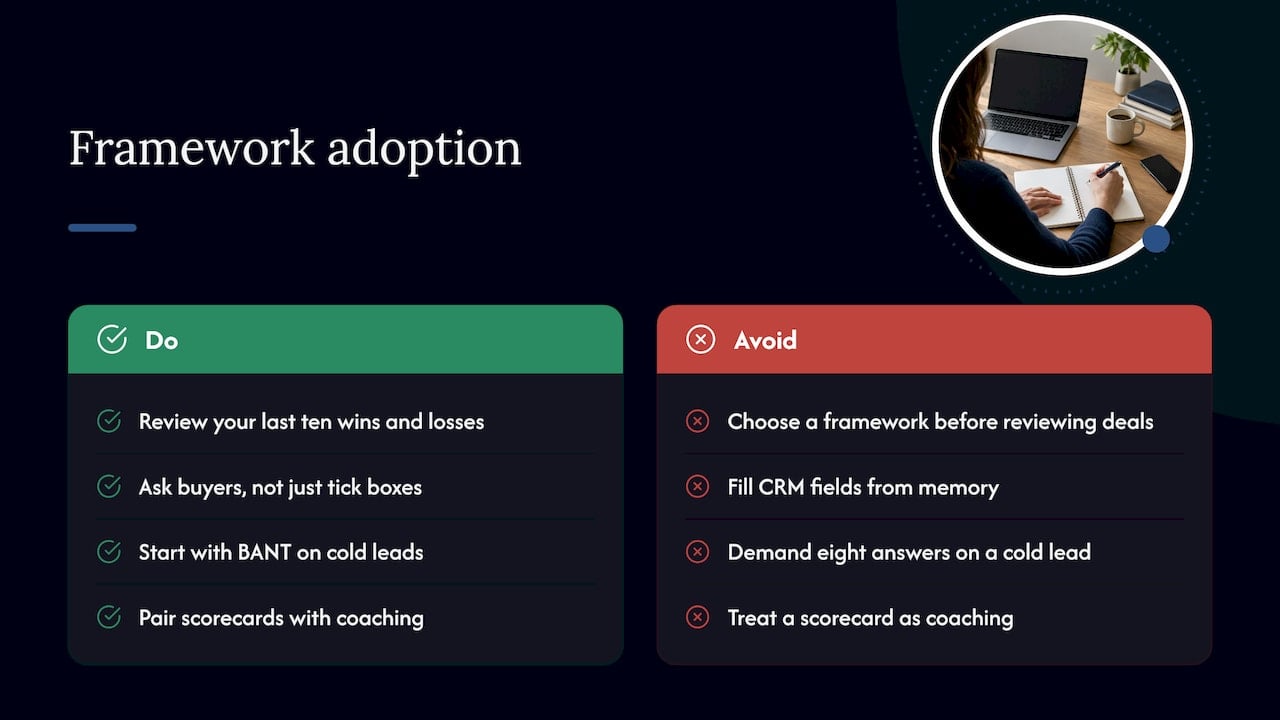
Choosing the framework before knowing your deals. Look at your last ten wins and losses first. If losses cluster around hidden decision makers, you need Economic buyer and Decision process. If they cluster around contracts, you need Paper process.
Treating it as a CRM field exercise. The letters are questions to ask buyers, not boxes to tick after the call. A rep who fills the fields from memory has recorded their opinion.
Using it too early. A first conversation with a cold lead does not need eight answers. Use BANT-style questions first, then MEDDIC once there is a real opportunity.
Skipping coaching. A scorecard shows the gap. It does not teach a rep how to ask a finance director for a meeting. That takes practice with feedback, which is why qualification frameworks work best when paired with coaching on discovery and objection handling. Our piece on consultative selling techniques covers the conversation side.
Where Ahead of Sales fits
The framework is the easy part. Getting a whole team, or yourself as a founder, to use it consistently on live deals is where it either becomes a habit or a forgotten spreadsheet.
We combine bespoke 1:1 coaching with training and consultancy. For teams, our bespoke coaching and consultancy engagements run from £4,500 to £8,500 one-off. For solo service businesses and consultants, our sales acceleration track runs from £2,995 to £5,995 one-off. Details of both are on our sales training cost page.
If you are an owner who sells personally, our sales coaching programme is built for that situation. If you lead a team and need someone to set up qualification, pipeline reviews and coaching rhythm, our fractional sales director service covers it. For sales consultancy more generally, see our sales consultancy services.
Our view: pick the version you will use
We get asked this question by founders and sales leaders who assume that a longer acronym means a more mature sales operation. It does not.
Our view is simple. Qualification is a habit, and habits survive when they are matched to the deals you actually sell. A solo consultant closing £3,000 engagements needs a handful of sharp questions about who decides and why now. A Series B team chasing six-figure contracts needs the whole of MEDDPICC, including the paper trail.
What turns a framework into revenue is the coaching around it: rehearsing how to ask for the Economic buyer, how to test a Champion, how to raise procurement early without sounding pushy. That is why we pair 1:1 coaching with team training and consultancy, so the method is used on live deals and not left in a slide deck.
If you tell us how your deals really close today, we can show you which letters you need, and which you can leave alone.
Jerry
FAQ
What does MEDDICC stand for in sales?
MEDDICC stands for Metrics, Economic buyer, Decision criteria, Decision process, Identify pain, Champion and Competition. It is MEDDIC with Competition added as its own check. MEDDPICC goes one step further and adds Paper process.
Why is MEDDIC better than BANT?
It is better for complex deals, not for every deal. BANT checks budget, authority, need and timing, which is enough for a quick first screen. MEDDIC also asks about measurable value, the buying process and an internal champion, which is what you need when several people decide.
Who started MEDDPICC?
MEDDIC was created by Dick Dunkel and colleagues, including Jack Napoli, at PTC in the 1990s. The original version dates to 1996, according to its creator’s own account. MEDDICC and MEDDPICC are later extensions of that framework.
Is MEDDIC outdated?
No. Enterprise SaaS teams still use it, mostly in its MEDDPICC form. The way of scoring deals and working on the weakest area first has not changed, and tools now help capture the data from calls.
Can a small UK business use MEDDPICC?
Yes, but use it selectively. A solo consultant or small service firm can take the questions that matter most (Economic buyer, Champion, Metrics) and leave the full eight-letter scorecard for larger deals with procurement and legal involvement.
Sources
- Supernormal: MEDDIC, MEDDICC and MEDDPICC explained
- Lead Forensics: What is MEDDPICC, explained by MEDDIC’s creator
- Zapier: What is the MEDDPICC sales methodology?
- Salesforce: BANT vs. MEDDIC comparison
- HubSpot: Inside the MEDDPICC methodology
- Nimitai: MEDDIC sales methodology guide