
VILT sales training is virtual instructor-led training: a live facilitator teaching your salespeople in real time over video, with practice and feedback built in. It works best when the live sessions are short, built around practice, and followed by 1:1 coaching on real deals. That last step decides whether your team changes how it sells or just sits through a good webinar. If you run a company, lead a sales team or sell your own services, this guide covers how a session runs, how to blend it with self-study, and how to tell whether it worked.
I have run live online and in-person sales training for years. The format matters less than people think. What matters is what happens between sessions.
TL;DR
- VILT is synchronous: a facilitator and learners interact in real time, so it suits role-play, objection handling and feedback rather than passive content.
- Short, interactive sessions beat long lectures. Plan interaction every few minutes and keep sessions to a couple of hours at most.
- A flipped or blended design puts information before the session and uses live time for practice, with reinforcement afterwards.
- Training alone rarely moves revenue. Pair it with 1:1 coaching on live opportunities and measure behaviour and pipeline, not attendance.
- For UK teams and solo service businesses, we combine bespoke 1:1 coaching with training and consultancy, so the learning lands in the deals you are working now.
Table of Contents
- What VILT sales training actually is
- VILT, self-paced and face-to-face: what each is good for
- What a good live online session looks like
- Preparing the room: facilitation and learner prep
- The flipped classroom for sales teams
- Blended learning: putting the pieces together
- Why coaching is what makes VILT pay off
- How to measure whether it worked
- What this looks like with us
- FAQ
- Sources
What VILT sales training actually is
The CIPD, the UK’s professional body for HR and people development, describes a virtual classroom as synchronous learning: the facilitator and learners interact in real time, using presentations, activities, discussion and small-group breakouts. “Synchronous” just means everyone is there at the same time. That is what separates VILT from a recorded course.
The same CIPD review notes that use of webinars and virtual classrooms rose from 36% in February 2020 to 51% a year later. Live online learning is now a normal part of how UK organisations train people, not a stopgap.
The other terms you will meet are mostly the same thing in different words. “Live online sales training” and “virtual instructor-led sales training” describe the format. “Blended” and “flipped” describe how you wrap it, which we come to below.
VILT, self-paced and face-to-face: what each is good for
Gartner’s guide to virtual sales training separates three models: asynchronous self-paced training, synchronous instructor-led training (webinars and VILT), and blended programmes that combine both. Gartner says self-paced learning suits passing on information or reaching people with very different experience levels. Live group learning suits collaboration, expert coaching and practice with feedback.
The Association for Talent Development (ATD) makes a similar split. It says in-person sessions give peer learning, skills practice and real-time feedback, while e-learning gives flexible, self-paced, measurable content that works well as pre-work or reinforcement.
Put plainly, use each for what it does well:
| Format | Best used for | Typical role in a programme |
|---|---|---|
| Self-paced online | Product knowledge, process, frameworks | Pre-work and reinforcement |
| VILT (live online) | Role-play, objection handling, discussion, feedback | The practice core |
| In-person | Team culture, intensive practice, senior leadership offsites | Kick-off or capstone |
| 1:1 coaching | Applying skills to live deals and individual habits | The bridge to revenue |
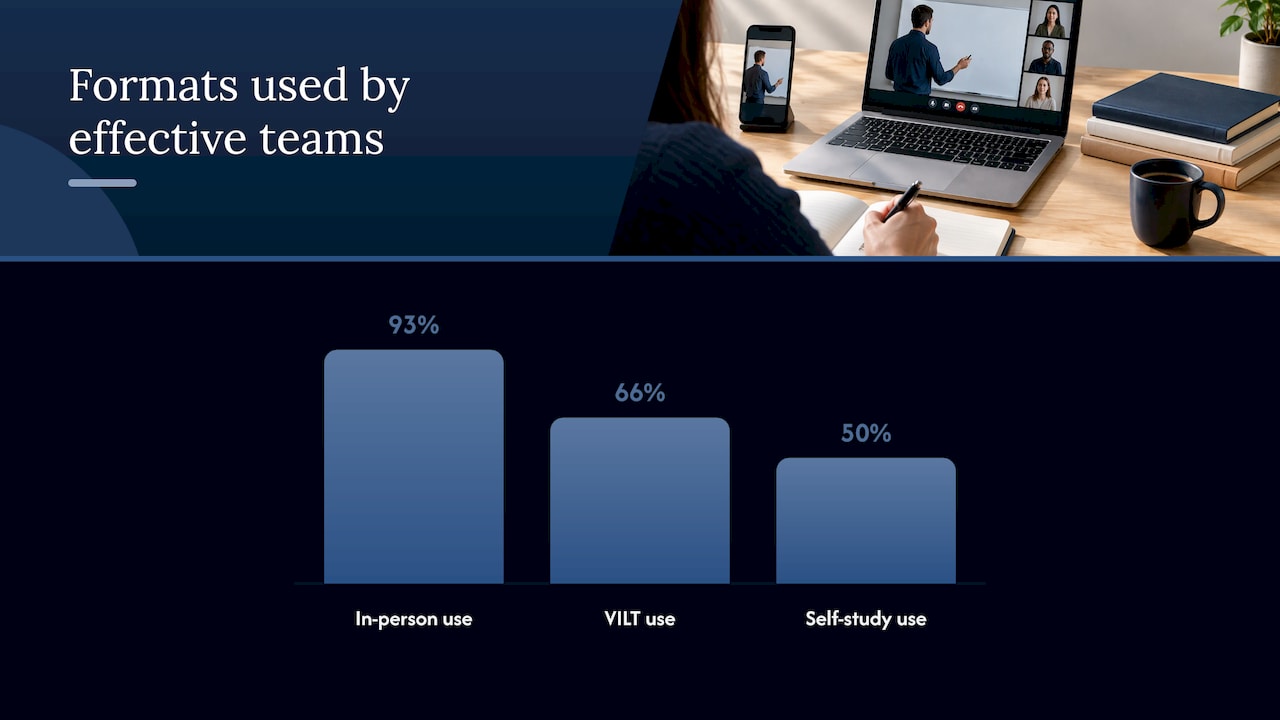
The ATD’s research on sales training providers shows combining is the norm. Highly effective sales-training organisations use in-person training (93%), VILT (66%) and self-study (50%), so they are using more than one at once.
If you are deciding between training and sales enablement (the tools, content and processes that support sellers), our piece on sales enablement versus sales training sets out which problem each one solves.
What a good live online session looks like
The Google results for this topic agree on one thing: long days on screen do not work. Most providers split content into shorter blocks, either a series of 2 to 3 hour sessions or half-day workshops. I would plan around that range.
Two UK-relevant guides give practical numbers:
- Kineo’s webinar guide recommends a maximum of 90 minutes, interaction every three to five minutes, and at least five polls or questions in a 50-minute session. Interaction also tells the facilitator where the knowledge gaps are.
- The Sales Enablement Collective’s Tell, Show, Do, Apply framework advises against lecturing for more than ten minutes without engaging the learners, for example by asking them to share a challenge or question.
For sales, the most valuable live activity is role-play. The same framework recommends groups of three: one person sells, one plays the customer and one observes and coaches, rotating roles. In a video call that is simple to run in breakout rooms, and it gives every person far more speaking time than a whole-group exercise.
A sample 90-minute session
Here is a structure I would trust for a team on a discovery-call skills session:
- 0 to 10 minutes: one real question from the pre-work, answered by the facilitator, with a quick poll on where the team feels weakest.
- 10 to 25 minutes: one skill taught with a worked example, such as how to open a discovery call without pitching.
- 25 to 60 minutes: breakout role-plays in threes, using real prospects from the team’s own pipeline, rotating roles twice.
- 60 to 80 minutes: the group reconvenes, two pairs replay their calls, and the facilitator gives specific feedback.
- 80 to 90 minutes: each person commits to one behaviour to use on a live call this week.
That final commitment is the hinge. It links the session to real work, which is where coaching takes over.
Preparing the room: facilitation and learner prep
The CIPD’s evidence review gives advice that applies directly to sales. Reduce cognitive load, so learners are not juggling slides, chat and a new skill at once. Scaffold the content, so people master one area before moving on. Give worked examples. Treat learning as social, through discussion and peer tutoring. And make the goals clear from the start.
In practice that means:
- One skill per session. “Handling price objections” is a session. “Better selling” is not.
- A named goal in the invitation. Tell people what they will be able to do afterwards.
- Cameras and a quiet space. Reps who are half in their inbox do not practise.
- Real material. Use real prospects and real proposals. If your team sells with shared deal pages or a digital sales room, have them rehearse presenting from that material rather than from a generic script.
For tools, you need very little: a video platform with breakout rooms, polling and chat, and a shared document for notes. Fancy tooling is rarely the bottleneck. Facilitation is.
The flipped classroom for sales teams
A flipped classroom moves the instruction out of the live session. As the ATD describes it, learners complete online learning, join discussions or research the topic beforehand, and the facilitator then uses the live time to guide application and practice.
For a sales team, a flipped week might look like this:
- Before: a 20-minute recorded explanation of a qualification framework, plus a task: qualify one live opportunity on paper and bring it along.
- Live: the team works through those real opportunities in groups, the facilitator challenges the thinking, and people practise the questions out loud.
- After: each person uses the framework on two real calls, then reviews them with a coach or manager.
The flip only works if the pre-work is short and has a task attached. If reps arrive without having done it, the live session turns back into a lecture. Make the pre-work part of the working week, not an extra, and have the sales leader mention it in the team meeting.
Blended learning: putting the pieces together
Blended simply means more than one format in one programme. One peer-reviewed study of a South Korean car company, published in Frontiers in Psychology, compared three groups. A hybrid programme combined eight online hours with eight offline hours, while a pure-digital programme used three days of self-learning and a traditional programme used three classroom days. The useful takeaway for you is that the design was deliberate: each format had a defined job and a defined number of hours.
The ATD’s 2025 analysis of blending modalities says virtual self-study supports retention and just-in-time learning when content is reinforced over time, while live virtual sessions build interactive skills for dispersed teams. That is a good description of a UK sales team spread across home offices, client sites and two or three cities.
A sensible blend for a team of 10 to 50 salespeople:
- A short diagnostic: listen to a sample of calls to find the two or three skills that cost you the most deals.
- Self-paced pre-work for the shared language and frameworks.
- Live online sessions, spaced weekly or fortnightly, one skill each.
- A day in person, once or twice a year, for the hardest practice and team cohesion.
- 1:1 coaching between sessions to apply each skill to live deals.
We go deeper on the manager’s side of this in making blended sales training stick.
Why coaching is what makes VILT pay off
A live session builds awareness and a bit of practice. Nobody becomes a better closer in 90 minutes. The change happens when someone helps a rep apply the skill to a prospect they are actually talking to this week, then reviews how it went. That is a 1:1 job. Group sessions cannot cover the particular deal, the particular objection, or the particular habit that one person falls back on under pressure.
It also matters most for the people who do not have a manager doing it. If you are a founder or a solo consultant, nobody is reviewing your calls. Our sales coaching for consultants work is built around exactly that gap. For teams, 1:1 coaching alongside training is the part that carries a skill from a workshop into the pipeline.
How to measure whether it worked
Attendance and satisfaction scores are easy to collect, so most companies stop there. They tell you the session was pleasant. To know whether it worked, track three layers:
- Learning: can reps do the thing? Score a recorded role-play against a simple rubric before and after.
- Behaviour: are they doing it on real calls? Count how many discovery calls now include the new questions, from call recordings or CRM notes.
- Results: are stage conversion rates, deal size or sales cycle length moving over a quarter or two?
Be careful with satisfaction scores alone. In the South Korean study, the traditional group rated the training 4.523 for recommendation, hybrid 4.339 and pure digital 4.093, and the authors found no statistically significant difference between hybrid and pure digital. Ratings of how people felt about a format are a different thing from whether they sell better, so set your measures before the programme starts and review them at 30, 60 and 90 days.
Our view: the format is the easy part
We get asked about VILT as if the delivery method were the big decision. In our experience it is not. The decision that moves revenue is whether the training is tied to your actual deals and whether someone is coaching each person on them afterwards.
That is why we combine bespoke 1:1 coaching with traditional training and consultancy, delivered in person or online. Training gives the team a shared way of selling. Coaching makes it personal. Consultancy fixes the process around it, so people are not trained to do something the pipeline does not support.
Our aim for the businesses we work with is at least 50% sales growth a year, with the team hitting target every quarter. We build everything around that goal, not around hours of content delivered.
Jerry
What this looks like with us
We work with UK businesses of roughly 50 to 1,000 staff, and with solo service businesses and consultants. Our team-based bespoke coaching and consultancy engagements are priced at £4,500 to £8,500 one-off. Our sales acceleration track for solo service businesses and consultants runs from £2,995 to £5,995 one-off. Our Sage Collective is £990 per month. You can see how the options fit together on our sales training cost page, or look at our sales training cohorts if you want a group format.
If you want to talk through your team’s situation, start from our home page and tell us where deals are stalling. If you are a solo operator, our sales coaching programme is the place to begin.
FAQ
What does VILT stand for in sales training?
VILT stands for virtual instructor-led training. A live facilitator teaches a group over video, and learners take part in real time through discussion, polls, role-play and breakout rooms. It differs from a recorded course because the instructor can see the group, answer questions and give feedback on the spot.
How long should a live online sales training session be?
Plan for 90 minutes at most, and a couple of hours as an upper limit for a skills session with breaks. Kineo’s UK guide recommends keeping webinars to 90 minutes with interaction every three to five minutes. Many providers split longer content into a weekly or fortnightly series so that people can still serve customers on training days.
What is the difference between blended and flipped sales training?
Blended training combines formats, such as self-paced modules, live online sessions and coaching. Flipped training is one way of blending: learners take in the content before the session, and the live time is spent practising and applying it. Most good programmes use both ideas together.
Is VILT suitable for a solo consultant or small team?
Yes, but a group webinar is rarely the right fit for a one-person business. A solo consultant gains most from 1:1 coaching on real proposals and calls, with short frameworks to apply between sessions. Teams of ten or more get more from a shared live programme plus individual coaching.
Sources
- Effective virtual classrooms: an evidence review (CIPD)
- Virtual Sales Training in the Digital Era (Gartner)
- 7 Sales Training Delivery Methods and Modalities (ATD)
- Beyond Virtual vs. In-Person: blending sales training modalities (ATD)
- The ultimate guide to effective and engaging webinars (Kineo)
- Creating effective sales training with the Tell, Show, Do, Apply framework
- Innovating workplace learning: training (Frontiers in Psychology, 2022)
- Digital sales room use cases (Foyai)